Poor man’s roast chicken

This recipe was one of those happy mistakes. Except I don’t, now, remember what I was trying to do that I erred at.

The reason it’s called poor man’s roast chicken originally came about because this isn’t a whole chicken dish, but one made of pieces and I thought that looked like a poor man’s version of a roast chicken dinner. But given that, these days you can often buy fairly cheap whole chickens, even in posh stores like Waitrose, and chicken pieces aren’t as cheap anymore, I’m not sure that still holds true.

However, it also conveniently covers up a slight, controlled fear I have of cooking whole roast chickens. Even though they were one of the first things I learned how to cook, as a child. When my mum was at work, I’d quite often start the dinner off and it was usually either roast chicken or bolognese. I’m also a bit scared of roast chicken because I never really know when it’s done (my mum was always home for that bit). If you overcook it it’s awful and like eating the contents of your shredder, undercook it and everyone dies. Plus I really HATE carving up a cooked chicken or jointing up a raw one.

So I always buy chicken pieces if I can, even though my partner always, always says “but you can buy a whole chicken, it’s better value and I’ll joint it for you”. This is a nice gesture, isn’t it? Utterly lovely. But it makes me feel wretched because I feel at once dependent and useless. Which is a hideously bad combination for me, like smocks and dirndl skirts. So when he is away, I rebel and BUY CHICKEN PIECES.

Thighs are best for this recipe because they are the tastiest meat I think. They are also not mentally expensive. But whatever you use, you do need chicken pieces with bones in. Leave those breasts for something else.

This is what you do. There are no exact measurements, sorry. Today I used six thighs and this is what I did.

Get a roasting tray with sides. The idea is to have just enough room for the meat, so not too big, otherwise you need to use a bucket load of stock. Now, put the meat in and then some lengths of carrot and celery. Over the top, pour about half a litre of stock made using a stock cube. Stock cubes scare me (there does seem a high level of fear in this post doesn’t there?), so I always, always buy organic ones, even though we’ll probably discover, in time, that they contain MDF dust. You want enough stock so that it comes about half way up the chicken pieces, no more. The idea, you see, is to keep the chicken moist. As it cooks, the stock renders down, and the whole thing goes really wonderfully concentrated.

Put it in the oven, uncovered at 200C on FAN. You want the stock to evaporate. The other beauty of this dish is that you really don’t have to be madly accurate about timings and I never am. I probably cook it for about 60 minutes, maybe even longer (don’t tell Heston). You will need to turn the chicken pieces regularly, so set a timer, and each time you do, baste the chicken. Ideally, you cook this until the stock has rendered down to a slick at the bottom of the tray – see pic above – but you may need to use your common sense here. If the chicken is starting to desiccate, you know, stop before this. But this is why you don’t want to put too much stock in.

Now, if you’re serving this up as roast chicken, serve up a piece per person or whatever. If you’re going to use the chicken for sandwiches or wraps, then take the meat off the bone, and throw the discarded bones, skin etc in a pan with whatever’s left in the roasting tin: carrot, celery, the almost not there anymore stock juice. Add about 500ml of water and simmer for about two hours. To give it even more oomph, I put in half a stock cube.

Even if you serve it up as roast chicken, when people have finished eating put all the detritus in a pan to make stock as above. And the stock you get from this is glorious stuff. However, if you serve this up as a roast chicken dish, back up a bit. When you take the chicken out of the roasting tin and you leave behind the cooking juices/carrot/celery, put the roasting tin on the hob, add a bit of water to loosen if up only if you need it, but then swirl everything around, mashing the carrot and celery up as you go. When it’s all bubbly, take off the heat and put through a sieve and serve this as gravy. It’s delicious (put through a fat separator jug if you want, so you take off the fat).

Chicken done like this is so easy and really, really tasty. It probably has posh, kennel name. I don’t know what it is.
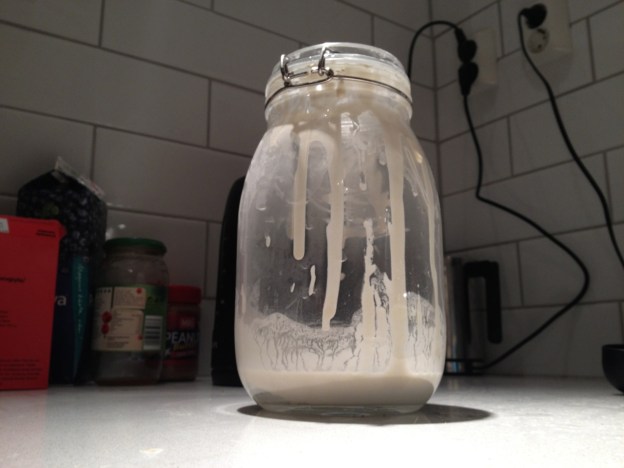
The spawning of the sourdough

Photo ©Ben McPherson


I have now shared my sourdough amongst at least four people. Possibly more but I forget. The latest recipients were my friend Ben McPherson and his wife Charlotte, who live in Norway and are keen to get started on sourdough making.

This is the furthest my sourdough starter has ever travelled and I told Ben that part of the deal, now that we were sharing wild yeast spores, was that he had to keep me in touch with how his starter was doing.

You can probably tell that Ben is a writer, producer and director by this photo of his starter, which he has put in an ENORMOUS jar and obviously crouched down to take this photograph from as dramatic an angle as possible. I said that it – the starter – looked like it needed its own TV show.

Anyway, I sent it heat sealed in a very strong plastic bag and that bag was in a plastic security sealed envelope. And yet the starter burst out of the heat sealed bag (which is made to withstand sous vide cooking) and only the plastic envelope stopped it escaping further. This just shows the power of the sourdough starter.

Ben has refreshed it and will hopefully start baking at the weekend. I hope to convince him to do a guest-post soon. Maybe with sub titles.

White chocolate cream

A mini doughnut, with all sorts of gloriousness, on it and in it

A couple of weeks ago I wrote about eclairs. Which I am, now, well into. Not so much eating them (although I’m getting there…) but making them. I have just gone mental for piping stuff. I think eclairs are going to be the new macaroons which were the new cupcakes which were the new doughnuts which were probably the new eclairs.

I am slightly obsessed with thinking of new fillings and toppings. Not that I’ve got that experimental yet. But give me time.

It was my youngest child’s birthday last week, and I made her these small celebration cakes (okay, okay, they’re cupcakes, but cupcakes are so over aren’t they? I daren’t mention them…). And some bourbon biscuits with her name stamped on them. And some mini chocolate eclairs with white chocolate cream in them.

Mini eclairs with white chocolate cream.

They were delicious. But they still looked like ‘normal’ eclairs, so with a dark chocolate topping and a white cream filling. Not that eclairs have to look like this, but I wanted them to.

The white chocolate cream was amazingly good and people couldn’t quite work out what was in it but it just tasted so good.

Have I mentioned how good it tasted? So good that today, whilst making the mini doughnuts you see above, glazed with chocolate and dipped in sprinkles, sliced and with white chocolate cream PIPED inside (for I wanted to use up this wonderful stuff), I almost, almost, just stuck the icing bag straight in my mag and squeezed in the style of, probably, Homer Simpson.

But I didn’t. Time, still, for that.

So here’s how you make white chocolate cream. An idea I got from here.

For the eclair recipe here, I’d recommend 300ml of double cream (or whipping, which I will try next time, but I used double) and 100-125g of white chocolate. I only ever use Green and Black’s white chocolate as it’s fantastic.

Break up the chocolate into individual pieces and put in a heat proof bowl.

Heat half the cream in a pan, until boiling. If you use another sort of white chocolate, you may want to add a teaspoon of vanilla extract into the cream. But the Green and Black’s already has vanilla in it, so I don’t. When it’s reached boiling point stir it around for a few seconds, then take off the heat. Pour it onto the chocolate. Give it a count of 15/20 seconds then whisk together.

Chill for an hour or until needed.

When you are ready to make the eclairs, add the other cream (the one without the chocolate in it) and add to the cream with the chocolate in it. Or vice versa, just introduce them! Now whisk until firm, you know, so it’s pipe-able.

Put in a piping bag with a nozzle and pipe into your eclairs. If the piping bag happens to get stuck in your mouth, squeeze, swallow and then hide the evidence.

How to deal with nosebleeds and how to get rid of blood stains

I know. Birruva shock for a Sunday morning, and not a post involving the beating together of diabetes and cardiac arrest inducing amounts of sugar and butter.

Sorry.

But I have a cold. A really bad one and the incessant blowing of my nose has made my nose bleed lots.

I’ve had nose bleeds since I was about seven. I remember my first one because it was traumatic. Let me tell you about it.

Crossroads had just started. Crossroads was a very bad soap opera based in a motel. Television could be brilliant or very poor back in those days. As the opening titles finished and Benny with his woolly hat came on, like a runaway from the children’s programme Rainbow, my  nose started bleeding. And bleeding. And bleeding.

My mum rang the GP who gave us the totally wrong advice to put  my head back and pinch my nose. All this did was make the blood run down my throat into my stomach. Half an hour later I still had a nose bleed but then also puked up a stomach full of blood. Which alarmed everyone. I could hear Crossroads finishing.

Still my nose bled. Eventually of course it stopped. But I learned something useful.

You don’t stop a nosebleed by putting your head back. This is how they always show it on TV. That’s about as helpful as showing women labouring on their back. I think it’s about camera angles.

If you have a nosebleed and you have no other health problems, like suffering from haemophilia then the way to stop it is to lean forward. Pinch the affected nostril hard. Not at the top of your nose, the fleshy part so you close that nostril. Wait for about three minutes, by which time your natural blood clotting soldiers will have come in and fought the battle.

What you may then find is a big clot coming out of your  nose. Don’t panic. This is normal. At least, it’s normal for me and those whose nose bleeds I’ve observed.

I’m so adept at dealing with nosebleeds now I mostly get on and do other things when I have them. Unless I get a simultaneous nose bleed in both nostrils, like I did when I was pregnant and when I have colds. That’s not so fun, but the same principles apply. I’m so confident now that when my nosebleed has stopped, I gently blow it to get the clot out and carry on with my day.

Eeuww. But look this might be useful one day.

Now then: blood stains. Obviously you can’t deal with huge ones this way, well not without spending all day spitting. But this morning I got a bit of blood on my sheets as I was trying to stem the nose bleed from both nostrils. Damn I thought, I’ve only just changed the bed. Then I remembered a trick I picked up from when I used to write the Dear Annie columns.

Your saliva, apparently, has enzymes to dissolve your own blood. Or something like that. So I spat – or to put it another way, transferred saliva – onto the stain and the blood disappeared like magic. Really it’s incredible (the fresher the stain the more effective the saliva is). It only works on your own blood though, so if you’ve killed someone, you can’t get rid of evidence this way.

Anyone fancy a sleepover?

Waitrose Bottom Butter, a really good cleanser: for your face

£2.89. Bargain.

I am a huge fan of oily cleansers. They seem counter intuitive but they work to dissolve dirt and make up and also don’t dry out the skin. My favourite such cleanser is Eve Lom‘s, but it starts at £40 for 50ml. The Eve Lom cleanser is thick and solidy but melts when in contact with your skin. It’s main ingredient is mineral oil and it also contains parabens. I can’t afford it anyway so I use Simple Cleansing Lotion, which probably also contains all sorts of things I’d rather not know about.

But now I’ve found a cleanser to rival Eve Lom’s. That delivers that same, solidy at room temperature, melts on the skin quality. That leaves skin feeling soft.

This is the balm close up, I hope you’re enjoying my photos.

It isn’t actually a cleanser at all and I didn’t actually discover it. It’s a balm for baby’s bottoms and my nine year old discovered its cleansing properties.

Waitrose Bottom Butter was in the news a few years ago as lots of people found it to be a great moisturiser for adult faces too. I don’t really like it too much as that, it’s too oily for me but my nine year old uses it as a moisturiser and in fact it was her who discovered it’s great cleansing qualities.

My eldest suffers from occasional eczema and dry skin. Like a lot of people with children with eczema, we’ve tried many things. When the seasons change from autumn to winter, her skin can get especially dry so I give her a little facial twice a day, along the lines of the great Dr Erno Laszlo’s principles (which uses hand-hot water splashing to get the blood to the skin).

One day she said she wanted to try this little cleansing regime on her own, so she did and she used the Bottom Butter as a cleanser.

This got me thinking, so I tried it. And it is indeed brilliant.

I wouldn’t use it on my eyes, but if you are a fan of cleansing with water and flannel (as many people are, and as opposed to wiping cleanser off with cotton wool, which I think is a useless way to cleanse), give this a go.

Just apply it as a cleanser, massage it in really well (which is also good for the skin as it gets the blood to it), then wipe off with a flannel dipped and wrung out in hand hot water (repeat this a few times). If you like the Laszlo method of splashing, too, you can do that. It’s brilliant in hard water areas, as it doesn’t dry your skin out. Then just carry on with your usual routine. I’d recommend using eye make up remover on your eyes.

(It’s also really helpful if you get dry skin in the shower or bath, apply a thin layer before you go in.)

All thanks to my eldest.

This bottom butter contains only only olive oil, hydrogenated olive oil, vanilla and chamomile oil. It smells lovely.

And it costs £2.89 for 125ml.

Jam tarts for a Monday

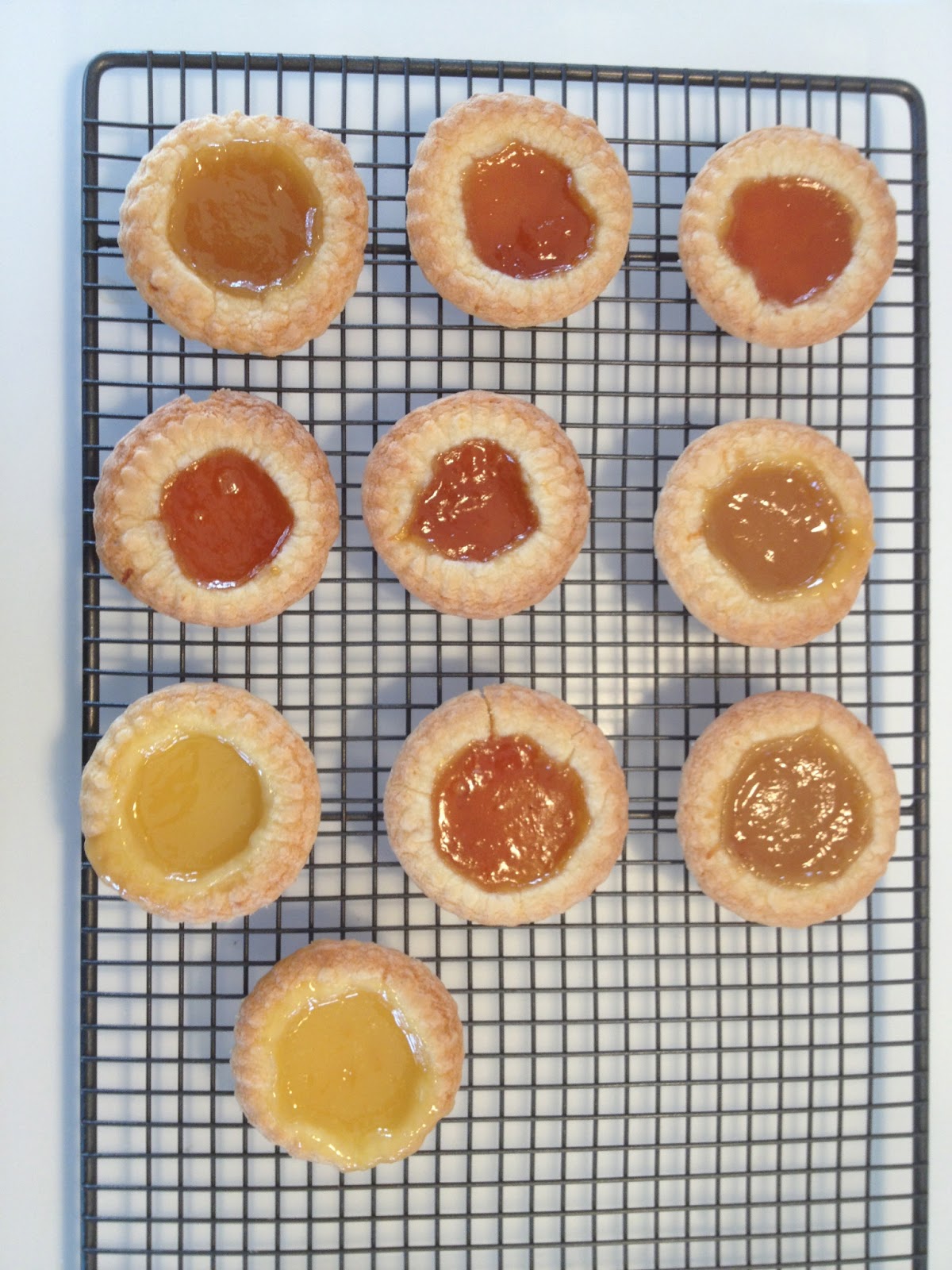
My jam tarts. The orange ones are apricot jam, the darker yellow ones are the Duchy Originals lemon curd, the bright yellow the Waitrose lemon curd.

As I look at the list of things I’ve written about on here recently, I see it’s a lot of food stuff.

And here’s more.

Jam tarts. I don’t often eat them, because the shop bought ones are like cheap jam spread on layers of newspaper. But they seem so easy to make. Except the last time I made them, they were a disaster. It’s too long ago now to remember what happened.

On Thursday I was looking through my recipe books, deliberating what to cook for Sunday lunch (I menu plan in a fierce way, this keeps spending under control and I can also make sure we have a good balance of food during the week in terms of ‘have we eaten enough fish?’ etc. You can hate me if you want, but I AM that organised).

I skimmed through Jamie Oliver’s Best of British and found a recipe for jam tarts that didn’t just say “shop bought pastry, jam”, so I tried them.

They were delicious, a bit superior in fact. The pastry is chewy. Jamie says to use all different coloured jams, and I’m sure that’s a great idea if you like a rainbow effect on the serving plate (he does indeed call them “Rainbow Jam Tarts“, p. 178 of Jamie’s Best of British). But I found that, in reality, some are more popular than others.

And let’s face it, no-one likes a green jam tart.

My children really liked the apricot jam ones. Me and their father shoved down the lemon curd ones as if we were trying to hide evidence.

A word about lemon curd. I used the Duchy Originals one and the Waitrose own make. No comparison. The former was vastly superior, a darker colour (more natural looking), a far nicer taste: rounded and subtle, the Waitrose one was too sharp, ringing that “I’ve got lemons in me” bell a little too shrilly. The curds also acted differently in cooking. The Waitrose one exploded out of the tarts, the Duchy one was all well behaved and stayed put.

This made 24 tarts for me:

Pastry

250g plain flour
250g icing sugar (try not to think about how much sugar that is)
125g unsalted butter
pinch of sea salt
1 large egg
The rind of a lemon or an orange, I used orange
A splash of milk

For the filling you will need a heaped tablespoon of your favourite jams or curds.

You need a jam tart tin, which is to say one of those shallow 12-hole tins. Not a deep one like you’d use for muffins or cupcakes. The sort you’d probably make mince pies in.

I greased mine very lightly.

Now, put the flour, sugar, salt and butter into a food processor and pulse until like breadcrumbs. Although in truth because there’s so little butter to dry ingredients, this will look more like what it is: lots of flour and sugar, rather than breadcrumbs. Crack in the egg, grate in the zest and pulse again, adding just enough milk to bring it all together. You’ll have a soft dough, flecked with zest.

Rest it in the fridge for at least 30 minutes, or until you’re ready to use it later.

Now preheat the oven to 180. Dust a surface with some flour, roll out the pastry to about 0.5cm thick (don’t make it too thin or they will collapse when cooked as they’ll be too thin to take the weight of the filling) and cut with a fluted cutter to a size bigger than the holes in the bun-tray. Place each circle in, gently push down.

Then add tablespoons of the jam/curd in: about one heaped tablespoon per tart. Don’t overfill but don’t be mean with it either. About half a cm below the top of the pastry shell should do it. Now, gently  spread the jam/curd around so it lies flat and fills the shell. Don’t just leave it in a blob as fell off the spoon as it won’t spread out whilst cooking, the pastry rises to fill the gaps and you’ll end up with something less than perfect looking.

This won’t do.

Put into the oven (you may need to cook in batches if you only have one tray, but that’s okay cos the pastry can sit in the fridge for a day or two). Cook for 12-15 minutes. You want the tarts golden round the edges.

Leave in their tray for a few minutes before prising out. Mine came out quite easily although the ones with the lemon curd were the hardest to take out. The ones with the Waitrose lemon curd in were the hardest of all and broke up quite easily (I am never again buying this lemon curd).

If it interests you, these are also really easy for children to make. I didn’t let mine near it as it was my self-soothing project.

How to make your own jaffa cakes

Inside. Luscious. The perspective makes these look giant, they are in fact the same size as regular jaffa cakes. And that’s a three year old holding one.

I bake, not only because I love cakes ‘n’ stuff and I prefer home made, but I bake when I need to feel safe. I find baking immensely therapeutic. The fact that I’m quite skilled at it is helpful because when I’m, say, grappling with a difficult deadline, as if it were a salt water crocodile (and we know how slippy they can be)  I have a need to achieve.  I have an almost pathological need to achieve. Something. Anything.

And when that something happens to result in baking a good biscuit, just baked into a chewy crispness, with hidden little bullets of chocolate. Or a fluffy, jolly cake, heavy with a mascarpone frosting stained red with raspberries, so large that you have to dislocate your jaw to get a slice in…well where’s the fucking harm in that.

When the news makes me feel like the world is too big, baking reminds me that the gentle stirring (or sometimes, vigorous whisking) of a few fine ingredients, can come together to make something good.

This is how I found myself making jaffa cakes.

Jaffa cakes. I don’t even really like jaffa cakes. But they seemed tricky enough to take my mind off all the bad news.

This recipe is from Jamie magazine. They weren’t tricky at all, but they did result in something so excellent and delicious and authentic (similar enough to shop bought ones to not alienate fans, different enough from to entice the not so keen) I had to keep eating them to make sure.

You need:

1 egg
50g caster sugar
65g self raising (I never sift flour but I guess you should)
butter for greasing
250g marmalade
100g 70% cocoa chocolate, chopped
Finely grated zest of half an orange
2 teaspoons of vegetable oil
 (the original recipe also asks for a tablespoon of water to use when melting the chocolate) but I didn’t use it and never use water in when melting chocolate).

You need a jam tart tin or shallow ‘bun’ tin with 12 holes. Grease this well, I also dusted it with flour (not from the 65g!)

Oven to 200C.

You do:

Okay so whisk the egg and sugar together, using an electric mixer if you have one (don’t sweat if you haven’t, you think sponge cakes were never made before the advent of the electric mixer?) if not by hand. Get those biceps and triceps working. Beat until the colour has lightened and the mixture has thickened. I’ll admit this is a a hell of a lot easier with an electric mixer.

Now stir in the flour by hand.

This is so easy isn’t it?

Now dollop about a tablespoon of the mixture into each hole, evenly. So if you get it wrong you’ll need to go round and nick a bit from the moulds that have too much.

Bake in the oven for 8-10 mins. Be careful: you want them lightly golden.

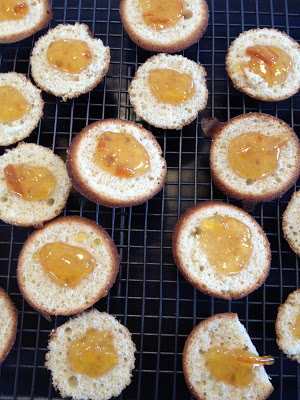
When done turn out and let cool. When cool slice in half horizontally. Are you seeing these jaffas taking shape?

Hopefully you’re the sort of person who reads recipes through before embarking on making something. And therefore you’ll know that whilst the cakes are cooling, put the marmalade in a pan, on the stove. I didn’t use the whole 250g but if you have any left over, once cool, you can put it back in the jar.

The sponge cakes fresh out of the oven.

So, heat the marmalade until it’s melted and stirrable and all one big thing and not little clumps of marmalade skulking round the pan, like nervous teenagers circling each other at a party, and then take off the heat and leave to cool. You can leave it for a good 20-30 mins, perhaps more and in fact it’s easier to use when it’s cooler. You could sieve out the peel in the marmalade but come on! Butch up and leave it in. I did and it was delicious.

Note the bit with a slice off? I ate it. Couldn’t wait.

Now. Take a teaspoon of the marmalade and dollop it in the centre of each sponge.

Melt the chocolate, with the orange zest and oil (oil not essential but gives a nice gloss), in a bowl over a pan of water. When melted, spoon over each marmalade covered sponge. What I did was put the cooling rack over a baking tray to catch any drips (ahem, I took it away for the photo below for better contrast), and then pick up each sponge and spoon the chocolate over, spreading it delicatedly with the back of the spoon – you don’t want to compromise the blobs of marmalade – then putting each back on the rack over the tray to catch any drips. And there were hardly any drips. I guess you could be more slap happy and just spoon the chocolate over each sponge whilst they’re sat on the rack and let the chocolate drip gaily.

Just one left to do.

But I think that’s more wasteful.

I ate at least six of these waiting for the chocolate to set. My youngest went potty for them. My eldest doesn’t like jaffa cakes and wasn’t convinced by these.

Make them and tell me what you think.

Chorizo, courgette gnocchi


Gnocchi – aka potato dumplings – are big in northern Italy. My paternal grandmother, from Parma, used to make them and I would help her by swooshing them along the prongs of a fork, which is how you get the pattern on them if you make them at home. She made it look so easy so of course I thought it was easy.

It isn’t. I don’t try to make them now as it’s so dependent on things like ambient temperature, how much water the potatoes take up. Well that’s how I’ve found it anyway. Hard and with unpredictable results. So gnocchi is not something I try to make.

I originally got this from the now defunct Easy Living and, as time has gone on, I’ve adapted it and made sure it has more veg. My children love this.


This dish is so easy but so delicious. I thoroughly recommend it. It serves four.

This is what you need:

Olive oil

120g chorizo – but I never weigh it and just use what I have/fancy

1 clove of garlic, crushed

3-4 courgettes, julienned (I use a peeler from Lakeland), easy as.

350-500g gnocchi

Basil leaves to serve (not essential)

grated Parmesan.

This is what you do:

Heat 1 tbsp of the oil in a large frying pan, everything in the ingredients list will end up in this pan so make sure it’s big enough. Add the chorizo and throw it around the pan for about 2 mins.

Have a pan of boiling, salted water on the go.

Now to the frying pan, add the garlic and courgettes and cook, stirring, for about 3 mins. Meanwhile cook the gnocchi according to the instructions (1-2 mins usually), drain when ready and then mix into the frying pan with the courgettes, chorizo etc. Mix and serve with sprinkled Parmesan and basil.

Eclairs

The best compliment I got was from a nine year old girl (not mine) who said “these are like real eclairs”

Here is a confession. I really am not that into eclairs. I know people who go cuckoo for them. Not me. I’m not overly a fan of choux (unless in a Paris Brest), nor whipped cream. Basically, eclairs aren’t piggy enough for me.

The first time I made choux pastry I was very young, about eleven and it was in HE. No-one told me it was difficult so I didn’t sweat over the choux pastry and I made the most amazing profiteroles. (Equally, no-one told me puff pastry was difficult and I used to make a great puff pastry.)

As I got older, and everyone went on about how hard choux pastry is, well that, coupled with my slight meh-ness towards them…meant I didn’t really try.

My children love eclairs so I decided to give them a go. They were easy. So easy I was expecting the sky to fall in.

I’d love to hear how you customise them.

The recipe for choux is pretty standard:

125ml water
50g butter
75g plain flour
3 medium eggs (at room temperature, this is important)
pinch of salt (I think this is key, choux is pretty tasteless, but the salt adds something).

The filling

I just used double cream, about 300ml, whipped up with a spoon of vanilla essence and a tablespoon of icing sugar. Or try delicious white chocolate cream, which is what I use as a default filling these days.

The topping

I used 150g 70% cocoa chocolate and a teaspoon of vegetable oil, melted in a bowl, over a pan of boiling water. Then manually just dipped the eclair tops in and set them down on a cooling rack. Hardly any drips..

Obviously with both filling and topping you can change it. Next time I’m going to try something a bit more adventurous.

You also need a piping bag and plain nozzle of about 1cm diameter. A baking tray and some baking parchment.

Oven to 180C.

Put the water and butter in a sauce pan and cook over a high heat. Stir until butter is melted and bring to the boil. When this happens, lower the heat and add in the flour. Beat with a wooden spoon until smooth and the mixture leaves the sides of the pan. For me this happened almost immediately.

Remove from the heat. Now. Some recipes say to let the mixture cool and then add the eggs. I can only tell you how I did it which was to add the eggs straight away to the mixture, once in the electric mixer bowl.

So. Put the butter/water dough in an electric mixer with the whisk attachment and add the eggs one at a time.

This is the important bit. After you’ve added the first egg, the mixture must be absolutely smooth before you add the next egg. At first the mixture seems to curdle, more so if your butter/water dough is hot and the eggs are very cold. It will look like scrambled eggs. You will want to cry.

Don’t. And don’t panic. Keep mixing. It will eventually blend together and go smooth. Honestly mine took a good five-ten minutes during which I started to panic and think “why the hell did I not LISTEN to everyone who told me choux pastry was so hard.” Keep the faith. Keep mixing. It will smooth out. Then, add the next egg and mix until smooth and then the next one. I added the salt with the third egg. No idea why just did.

The mixture is ready when you lift the whisk and it leaves ribbon marks – indentations in other words.

Put into the piping bag. I find it useful to a) use a clip to secure the top of the icing bag – just above the nozzle – so that the mixture can’t ooze out. By clip I mean like those Klip-it things you use to keep food in a plastic bag fresh. b) put the bag in a tall glass and fold the top of the bag over so you can spoon the mixture in. Obviously when you are ready to pipe, you take the Klip-it off.

This mixture pipes really beautifully, so pipe eclair shapes (or profiterole shapes) onto the tray, leave a good gap as they do grow.

Put in the oven. I cooked mine for 30 mins and they were perfect, dry and crispy. My patisserie expert said that’s how high quality eclairs should be – kinda dry and not soggy like shop bought ones. You can’t really overcook eclairs (well, actually you can but you know…). I cooked some profiteroles another time and gave them 35 minutes and they were fine.

Don’t be tempted to open the oven at all if possible and certainly not before about 25 minutes.

They should be puffed and golden. Mine were almost empty inside. There was no need to dry them out inside as some recipes suggest, by placing them back in an oven.

I just cut them lengthways when they were completely cool and did the topping first (put the topped eclairs in the fridge for five mins to make the topping set if you’re in a hurry), then I added the cream with another piping bag (I was piping bag mad by this stage).

They all got eaten that day. And when I served them the second time round, because I had some salted caramel left, I added a dollop of that in too. I am salted caramel crazy though.

The reason I’m writing about these is that they were so easy and the return to effort ratio so madly unbalanced in favour of the return part, that I did wonder why I had left it so long.

Update on 6th March 2013. I thought it might be useful to have some troubleshooting here.

There are a couple of key important bits in making eclairs. The bit in the saucepan, with the flour and the butter/water…make sure you really dry this mixture out. By that I mean, even when it starts to come off the sides, keep going for a minute longer. The more you dry it out now, the more eggs you will be able to add (more on this later). The more eggs you can add, the more the eclairs will rise.

What do you mean, the more eggs I can add? Don’t you say three eggs?

Yes, yes I do. But here’s the other thing. I make this all the time with three eggs but mine are medium (in fact I’ve altered the recipe above to say this). Eggs differ in size, although it’s usually the amount of white in an egg that differs between the different sizes. So if you were to crack open a medium and extra large egg, the real difference is in the white, not the yoke.

Anyway, when you’re at the adding the eggs stage, if you’re new to this, I’d whisk up the third egg before adding it and then add it a bit at a time. What you want is a mixture that’s thick. Don’t be afraid to give it a really good whisking, don’t stop just the moment you think it’s done. You want the mixture to be able to stand in stiff peaks. If it’s not thick enough at this stage, it won’t get any thicker at the piping them out stage. So when you stop whisking you need to be absolutely sure it’s thick enough, otherwise,  you pipe it the eclairs will spread.

If you add too much egg, then the mixture might get too sloppy which is why I recommend adding it in stages if you’re new to this.

Should I cool down the butter/water/flour mixture before putting it in the mixer?

Almost every recipe tells you to do this, to cool it down otherwise it will cook the eggs.

I don’t. I know, madness, but I’ve tried it both ways and for whatever reason I’ve found that if I add this to the mixer and add the eggs straight after the sauce pan stage, my eclairs rise more. Yes you do need to beat the first egg in for much longer and it will go through a scrambled egg phase. Try it whichever way you want and see how you go. I’m fairly brave with patisserie making so I like to fly by the seat of my pants. You may want to go more slowly. Both are fine approaches.

If you’d like more ideas about what to fill them with, other than cream: chocolate ganache filling recipe here; white chocolate cream filling here (this is YUM). And not long after I originally wrote this I stopped cutting the eclairs in half and instead using a piping nozzle to fill them.

Gingerbread porridge

I have just come off deadline for a hideously complicated piece about mackerel. The research on anything to do with fish quotas is almost enough to drive me to a drug habit (JOKING). So I’m indulging myself with something blissfully easy to write about, something comforting, that I hope you will find useful.

Porridge. We all know how healthy it is. Rich in fibre, lowers your cholesterol, makes you strong and gives you a glow etc.

However.

I am always STARVING five minutes after eating it and I have a bit of a guilt trip going over porridge in that I feel it should be made with steel cut pinhead oatmeal and stirred for one hundred hours and eaten with almost nothing, bar a grimace.

I do lighten up occasionally and use jumbo oats and semi skimmed milk and water and cook it on the hob with my spurtle (NEVER NEVER NEVER in the microwave) and then flood it with sliced fruit and maple syrup, but in my Catholic guilt-ridden heart, I know I am sinning.

Thus I hardly eat porridge which is stupid. Like not letting yourself buy cut up fruit because you should cut it up yourself and therefore never eating fruit (not relevant to me but you know what I mean).

This morning, as I was wafting round Waitrose and taking my commission for my mackerel piece and slightly panicking as I do before I start to write any piece (I can’t do it I CAN’T DO IT), I spied something. Dorset Cereals Gingerbread Porridge. In the packet are premeasured and sealed daily sachets (so wasteful!). It had stuff added to it to make it tasty (so indulgent!) and it recommended you do it in the microwave (shocking!).

I hadn’t had breakfast.
I’d had to dig the car out of the snow that morning.
I had been coerced into buying my child Smarties (I don’t buy Nestle products usually).
I had a hideously difficult piece to write on mackerel.
So I bought it.

I came home and made it – in the microwave – and ate it with a dollop of nut butter (to up the protein) and it was DELICIOUS. I am still going on it six hours later (bar the handful of nuts and an apple that I ate an hour ago but that was more out of deadline avoidance than hunger).

Am now going to eat this every day. Every day.