Category Archives: Sourdough

What to do when someone gives you some of their starter so you can start your own starter..

A present of a little of your established starter really can be the present that keeps on giving

My starter came from my friend Emily; about three years ago now. Her starter was already going on for 18 months old itself, if I recall correctly.

Since I got that fantastic, promising present, my own starter has gone on to spawn many other sourdough starters, not least that of John-Paul Flintoff.

Anyway. I’ve been meaning to, for ages, write up here about What To Do when someone gives you some starter, so here I go.

You could of course give someone a full jar of starter ready to go since, if you have some levain on the go, it wouldn’t take long at all for you to build it up to a whole other working jar size. But this isn’t madly practical unless you can actually hand it over in person. And, also people like to build it up themselves. So what I do when I’m sharing starter is send it on the dry side, so it’s less frisky and likely to tire itself out. I either send it in a small plastic lidded box or double bag it in those sealable sandwich bags.

Hopefully, before you are sent a starter of starter, you will have ready:

A large jar
Some white, strong bread flour.
Weigh the jar when it’s empty and make a note of it.

What you do when you get it is this:

Put the starter in your jar. Add 50g white strong bread flour, and 40g of out of the tap water. Mix it up well and put the jar aside. In the fridge or a cool place in your kitchen.

You don’t need to remove any starter, you do that when your starter is big and to keep refreshing it would mean you’d end up with unfathomable amounts of the stuff.

The next day, if you want to, take out a tablespoon of starter and discard it. There is no reason for this, it just kinda feels authentic. Add another 50g white strong bread flour and 40g of water.

What you want to do is build up so that you have about 300g of starter in your jar (because for most breads you use about 200g of starter). So you keep repeating this until your jar is about 3/4 full when it’s just refreshed.

Never fill it up to the top as if you do, as the starter grows (because it will go up and down during the day until it settles) the jar can explode. Don’t worry if you look at your starter during the day and it regularly goes up to near the top, that’s normal. What it mustn’t ever be is that full when it’s just been refreshed.

When you’ve got about 320-350g of starter going (this is why you weigh the jar empty) you’re ready to go. Every time you bake – presuming you use 200g of starter, refresh your jar with 120g of white bread flour and 100g of water. Or, if it’s looking a bit full already, 100g of flour and 80g of water.

And you’re ready for a life time of baking.

Unless you bake every day, keep your starter in the fridge. I bake bread about 2/3 times a week and never need to discard starter to refresh it, I just use it straight from the jar.

I hope this makes sense, do ask any Qs if you need to (on here please so others can benefit).

What to do with your starter when you go away

This piece in the Guardian today is getting quite a lot of attention on Twitter. I think some people have taken it a tad too seriously…(it’s about checking your sourdough start into a hotel).

But it does bring me onto something pertinent, which is that people who I’ve got into sourdough (I’m a sourdough pusher) and have shared my starter with, have gone into a panic about going away.

It’s really no big deal. If you go away on holiday:

Make sure your starter is in a big enough jar to cope with any expansion.
If you’re worried about your start erupting (I never do, but I know some people do) then refresh it about 24hrs before you go away, not just as you leave. So you can keep an eye on it.
Keep the starter drier than usual so it’s less frisky.
Put your starter in the fridge.

I have to say, I don’t do anything different as I know my jar is big enough and I know how my starter behaves, but just to be extra cautious.

It’ll be fine. When you come back, refresh it as normal once or twice before you bake.

That’s all. Happy hols!

Le Couronne, or the loaf with the hole

I got really excited when Patrick from Bakery Bits, tweeted to say he had a new banneton in stock in a couronne, or ring shape. It was in cane, which I’ve never used before (all my bannetons are wicker and lined in linen).

I’ve a healthy collection of bannetons that I’ve built up over the last year, but in baton and round shapes. I really fancied a couronne shaped one. (I’ve been obsessed with round bread with a hole in it since my purchase of a Tortana from Flour City.)

So I bought one, and also took the opportunity to replenish my Aroma Panettone, which immediately transports me back to my childhood (you seen that scene in Ratatouille where whathisface the restaurant critic, goes back in time to his mother’s kitchen? That’s what this does to me).

Anyway, I was EXCITED about it. Made a batch of my every day bread, put it into the fridge for a retarded proof and got up in the morning.

First thing: the dough stuck to the banneton (the middle bit is wood). Not a good start. I slashed and cooked it and the hole completely closed up so that I ended up with a round loaf with a tiny dimple.

Not good.

I emailed Patrick. He recommended rice flour to aid non-stick (I had used rye). That remedied the sticking situation, but I just couldn’t get the hole to keep. (Sadly no pictures of bread proved in this banneton as I just never had a camera handy.)

When you cook bread, you want it to rise, but you can’t choose where it rises, so any hole you make (like in bagels) has to be bigger than you want it to end up with. But I just couldn’t get the hole to stay.

I knew the fabulous (and far more experienced baker than I) Joanna from Zeb Bakes had also bought one, so I asked her what she thought. She was also struggling with it. We both thought the middle bit should be thicker.

Patrick was v.helpful and kept going back to the manufacturers who said it should work. But it didn’t. Patrick got another banneton in, this time in linen lined wicker. He sent it to me free of charge. This banneton just looked much better, the middle bit was thicker and the whole shape was more promising.

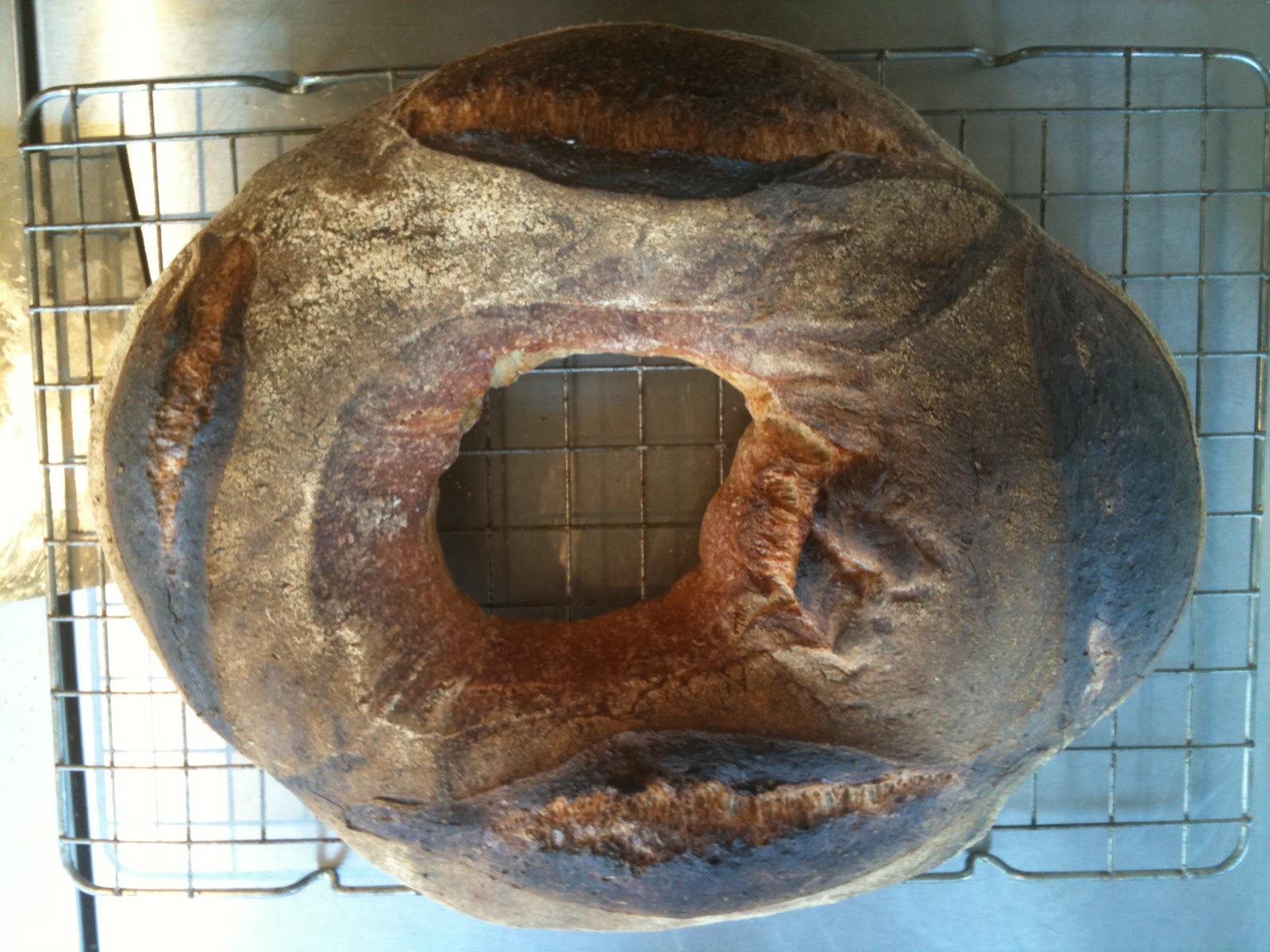
It worked much better, too. Here is the loaf I made that first time. I did however, enlarge the hole once it was on the baking tray, which isn’t for the nervous. I haven’t fully got the hang of slashing the dough however (any thoughts anyone?) as I find it quite hard to make slashes on such a small ring of dough, such as it is before it puffs up.

First loaf using linen-lined wicker couronne banneton. V.nice.
Second loaf in the couronne, this was a white dough

Second time I made a white loaf but was more gung-ho didn’t enlarge the hole on the tray. This is what happened:

Hmm.

The third time I tried sticking a muffin ring in the middle. This did indeed hold the middle open, but a) the middle didn’t crust up properly and b) the ring sort of got swallowed into the bread. It was fine, and a really great loaf. I’m going to carry on experimenting with a tin in the middle and maybe even – gasp – put ice cubes in there. Just till the bread has developed a crust and then remove the tin.

In the meantime, if you’re careful you can get a really nice ring shape, but you need to play around with the dough on the tray. I do love the couronne bread shape however as you get maximum crust, not great for children who are fussy about these things, but good for me, who does.

Any more experienced bakers out there with any tips, I’d welcome them. Grazie!

Number of the beast bread

I love this loaf

We do love white sourdough in our house, but there’s only so much white flour stuff you can (should) eat. I like the Mill loaf but that’s not sourdoughy enough for us. What I wanted was something very similar to the bread I get in Italy that’s not white, not wholemeal but suitably tangy and ‘paysan’ as we call it.


I think this loaf is it, although the more I make it the more I’ve realised that it really improves from a very long proving time, it doesn’t like being too cold and the dough should be fairly wet and sticky, so you need to be brave whilst kneading and use oil and not add any more flour. There can be a dramatic difference – better crumb, better flavour – between a loaf that’s been proved over ‘just’ 12 hours and one that’s had 24hrs plus. If the prove is too (relatively speaking) short, the bread becomes a bit too ‘wholesome’. It’s a difficult bread in that respect, to get right. 


This is what you do to make two loaves.


You take 


400g white leaven
666g cold water (number of the beast, hence the name)
500g white flour
500g wholemeal/other flour
3tsp salt (I’m experimenting with cutting this down).

 
You mix the leaven with the water, add the flours and salt and mix to a messy dough. 
 
Rest for 10 mins, then, a la Dan Lepard, knead lightly. 
 
Rest 10 minutes then knead lightly (I knead for twelve counts). 
 
Rest for 10 minutes then knead lightly. Rest for 30 minutes then knead lightly. 
 
Rest for 1 hour then knead lightly. 
 
Rest for 1 hour then knead lightly. 
 
Rest for 1 hour then knead lightly. 
 
Rest for two hours, then knead lightly and shape and place into two bannetons (I use a 1kilo round and a 600g baton). 
 
Rest in fridge overnight for a good twelve hours or more. I’ve rested it for up to 72 hours
 
Preheat oven to 220 with one baking tray on a high shelf, one underneath. When up to temperature turn loaf out of the banneton, slash with a bread knife and put in the oven. Whilst oven still open, turn ice cubes onto the bottom tray. Close oven and turn the temperature up to 250C and cook for 15 mins. Lower temperature to 220 for further 15 minutes.


A tale of two loaves

I’ve recently perfected my own little sourdough recipe. It’s nothing mind blowing, but it’s something I came up with all by myself. So I’m pleased. I’ll post about this another time since I can’t remember proportions and I’ve got it all written down at home in my little book.

The recipe – the one, let me make it clear, I made up myself – makes two loaves. I recently made a batch and put both loaves in the fridge to prove overnight. Except it was really late when I put it in and I got up early, so in fact the loaf that I cooked the next morning had only had about seven hours’ proving at 4 degrees. Really I should have proved it at room temperature for such a short period of time.

Anyway come the morning I put it in the oven and when I took it out a whole little baby loaf had burst out of the side. Unfortunately I wasn’t able to take a picture of it. Despite slashing the loaf it still burst out of the side at the bottom.

This used to happen to me a lot, but nothing as dramatic as this. I’d researched why it could happen and it seemed one of those things (an ‘OOTT’ to give it its official name) that can happen for a myriad of reasons but the two that kept coming up were underproving and bad shaping.

Now I’m rubbish at shaping a loaf. Or rather I’m not bad but often by the time it gets to the ’10 min rest’ before you shape it it’s late, so I have just shaped it crudely and cast it into a proving basket. And, despite what the professionals say, honestly I’ve not noticed a difference. I thought the bursting could also be due to a too sharp change in temperature too quickly (i.e. putting bread straight from fridge to oven). But that doesn’t seem to be consistent either. I definitely think underproving is a main cause, and I rarely underprove.

So the loaf, once I’d amputated the rogue bit off, was okay. But not great. For one the bit that I’d cut off was doughy – like you could scrunch up a bit and it would go to dough. This never happens to me with sourdough and it wasn’t cos it was undercooked (it wasn’t). The crumb was dense and not very exciting at all. I cooked the other loaf about two days later. It was completely different. Much larger air holes, waxy crumb, delicious. Same dough, different loaves.

Making sourdough whilst drunk

A few days ago I started making some white sourdough, in large part to take to a friend’s house and also because I fancied a change from our usual largely-wholemeal sourdough. It turned into a long process. I kept taking out the starter, meaning to get the dough going, but somehow never finding the five minutes I needed to do it.

On Thursday of last week (it’s Monday as I write now) I weighed out my starter, refreshed it in the bowl to make it up to the weight I wanted (400g of starter), refreshed the starter in the Kilner jar and put the latter back in the fridge. However, in between me doing this and the starter in the bowl becoming active, my partner had made a loaf of yeasted-bread (no doubt fed up at having no bread..) and used up some flour. Because I needed a lot of white flour – 1k of the stuff – there now wasn’t enough.  So the dough became a mishmash of white flour, wholemeal and whatever else I could bung in. It ended up being 500g of white, about 430g of wholemeal and 70g of barley flour.

I started it off. Knead, rest, knead, rest. Somewhere along the line, that magic, nebulous hour of evening came, the one that tells you it’s socially acceptable to have some wine and thus it was that I poured myself ‘un dito di vino’ (a finger of wine): it really doesn’t take very much to make me feel merry. I started chatting to my partner, had another dito di vino, la la la la. Suddenly I remembered the bread. It had sat there for hours (it was at the ’30 min rest’ stage, some 30 minutes that ended up being).

I kneaded it, slung it in a bowl and put it in the fridge, thinking “fuck”. Over the next few days I kept doing this – taking it out, kneading it and then putting it back in as I kept running out of time. Look, I’m a very social, busy person when I’m not being a hermit. To cut a really long story short, it wasn’t til last night that I put the dough into some bannetons and put it in the fridge for what I planned to be the final rise.

I had no idea what to expect, so we’d made some ‘normal’ bread for eldest daughter’s sandwiches this morning, just in case (I say ‘we’ it was of course entirely not of my doing).

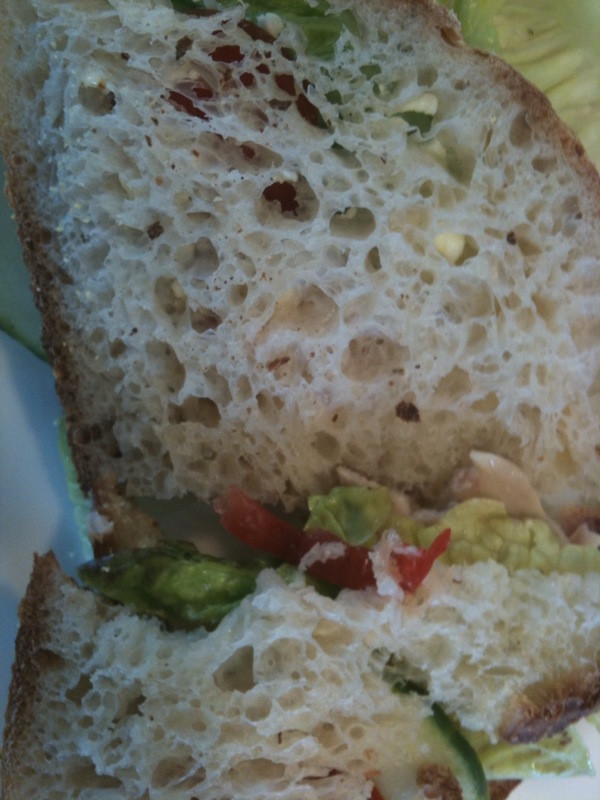
What I really didn’t expect was to get some bread that was – is – just delicious. It’s far more aerated than a normal loaf (which usually contains 60/40 white to wholemeal; this loaf as you see above was 50/50. This is because it had a higher hydration than my usual loaf (65% instead of 55%), whilst having less starter (40% instead of 50%). I have no idea what any of those numbers really mean, but for once, making a mistake whilst cooking has led me to a happy discovery. Not only has it got far bigger holes than my usual 60/40 loaf, because I made it over four days, it has a wonderful taste to it.

This is, perhaps, how people invent their own recipes. My knead/rest cycle went something like this, for those interested:

Knead, rest for ten minutes.
Knead, rest for four hours.
Knead, cover guiltily with a cloth and put in fridge for 14 hours.
Take out of fridge and ignore dough for an hour or so.
Knead, put back in fridge for a day, or so.
Take out of fridge, knead. Put back in fridge for another day.
Take out of fridge. Knead. Rest for one or two hours – who can remember. Shape, put in bannetons, cover, put in fridge for 18 hours.
Cook. Eat. Enjoy.

When I said sourdough was the most forgiving of breads, I wasn’t lying.

A very good sourdough me thinks.

Making sourdough: what equipment do you need?

As has been mentioned before, I like gadgets, I like buying new kit. But there are some things that are more important than others. Making sourdough bread should be about connecting you to an easier, but also harder, time. When things were simpler, but more effort went into them. I promise you that once you start making and eating sourdough on a regular basis, your life changes in little ways.

Yeh, yeh, whateva. But until that happens: shopping.

What to keep your sourdough starter in?

You need to be a bit careful about what you keep it in. A clean glass jar will do, but it has to have room for the starter to grow. If you refresh it to capacity, there’s a very real possibility that your starter could explode the jar as it ferments. I use a Kilner jar. You can use a large jam jar. You can keep your starter in plastic of course, but yuk.

My starter in its Kilner jar, aka the mothership

Okay what other bits do I need?

Disappointingly little, really. If you want a past-time that involves spending loads of money on kit, you need to take up fishing or golf. Things that I use and think are really useful are:

Large stainless steel bowls that I bought in Ikea once. Actually that’s a lie, I inherited them from my boyfriend when we moved in together. But you can buy stainless steel bowls anywhere. Don’t spend loads and bigger rather than smaller but not so big you could spin yourself round in them. But don’t sweat it if you don’t have the, any big old bowls would do.

A dough scraper: absolutely worth buying if you don’t have one. When the dough is really frisky, there are times it’s hard to handle and I knead it using just the dough scraper, moving the dough around as I go. Without wishing to start sounding like an ad for it, ours is from Ikea. It’s stainless steel and I also inherited it when my boyfriend/partner blah de blah moved in together. See “living with a boy” as Monica from Friends once put it, has it uses. I recommend using a stiff (rather than those super flexi ones) dough scraper, insofar as I’m experienced enough to recommend anything bready. They make it easier to handle the dough and easier to scrap up bits of dough that have dried on any surface you’ve been working on.

Bannetons or proving baskets – covered in full here. You can make sourdough without them, but they make life so much easier and sweeter.

You also need something to cook the bread on. You’ll have baking trays, so use them. I use my Mermaid baking trays which I also use for tons of other stuff: not cheap but I bake a lot and they last years. I love the older Mermaid trays, the anodised aluminum ones rather than the non stick ones. Non stick, I find a bit scary. Again, any old baking tray will do, what’s important is to preheat it.

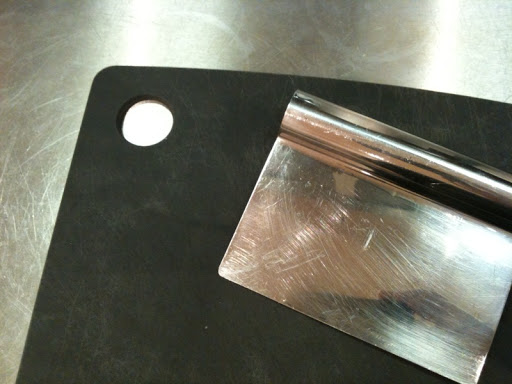
Top Gourmet chopping board with my scraper. 

Top Gourmet chopping boards – I really rate these. As chopping boards but also as surfaces to make your bread on. I have the big size one (40cm by 30cm) and I can move it around the kitchen as I work. You may not work like that and working on your regular kitchen work top may be fine for you, but remember that sourdough is hours in the making, which means it could be taking up that bit of work surface for half the day. I oil my board before each kneading and rest the bread on it (covered with an oiled bowl, so I lift the dough up, oil underneath where it was laying, then knead etc). So any chopping board will do in theory, but these are good: light and therefore easy to move around, hygenic (you can dishwasher them if you want to, bear this in mind when ordering the really big ones) and they store easily as they’re so thin. These are the future of chopping boards as far as I’m concerned. Plus they’re black so chic in my book.

What you really don’t need when you first start out:

You really don’t need a peel if you use bannetons, you just flip the bread out onto the tray (always preheat the tray).

You don’t need a bread stone. But when you get one, you’ll need a peel.

Special dough hand whisks: a fork will do just as well.

You don’t need a grignette or lame, just use a bread knife.

You don’t need a couche proving cloth until you start making baguettes.

Save all that stuff as incentives to go further into making sourdough and for present material.

Arkansas bread

I have a habit of not being able to say certain words correctly. Often I’ve said a word the same way for years, in the privacy of my head, but no-one knows I can’t pronounce it properly.  It’s rarely a problem unless I have to suddenly say that word out loud and can’t get away from it and then people start pointing and laughing. And because of this, I often get words mixed up.

It started with ‘calzolaio’ and ‘colazione’. When I was a little girl, and in Italy with my Daddie (I feel compelled to point out that my parents are still together, my mother was just back home in central London, this wasn’t a ‘summer with the estranged parent kinda thing), I remember seeing a sign saying ‘calzolaio’ (cobblers, shoe-menders). The next day I said to my father “I’ve found a place we can go to for breakfast (colazione).” You can guess the rest.

Like a lot of stupid people, I used to pronounce ‘Arkansas’ just as it looks ‘Ar-Kan-sas’, instead of Ar-kan-saw. In my head, I still do.  I’m not related to George Bush, I promise.

What has any of this to do with bread?

In the search for more sourdough recipes, I recently bought Andrew Whitley’s Bread Matters. Loads of people, far more experienced bakers than I, rave about this book. So I in no way mean to detract from that. The fact that I didn’t get on with it – I didn’t – is entirely due to my own failings.

It’s a big book with almost no photographs. I need pictures to help me with the words where food is concerned. Where almost anything is concerned. The way Whitley makes his sourdough is also different from the way Dan Lepard makes his. I can see how people would think sourdough is even more complicated than it is after reading Bread Matters. I just couldn’t get my head round it and I almost ended up crying.

Anyway, in it was, and I’m imagining still is, a recipe for Arkatena bread. Which I immediately, and persistently read as Ar-kan-sas bread,  hence the name of this post. I fancied the look of it because it contains gram (chickpea) flour, which I had in and wanted to find a use for. But I could see instantly that I’d never be able to follow the recipe for it, so before I threw myself down and started kicking my feet into the wooden floor, I decided to bloody well vary the recipe to suit myself.

This is what I did.

I used 300g white levain starter

to this I added

50g gram flour
50g wholemeal flour
300g white bread flour
7g sea salt, ground up in a pestle and mortar
300g cold water

I mixed the starter up with the water, then added the flours and salt and then kneaded it for 10-15 seconds at a time, resting it for 10 mins. Then kneading it for 10-15 seconds and resting it for another ten minutes, then kneading it for 10-15 seconds and resting it for another ten minutes then repeating but this time resting it for

30 mins
1 hour
1 hour
1 hour


Then I shaped it and put it in a banneton to prove overnight at 4 degrees. Then I cooked it at 220 for 20 mins or so.

It was probably the most ‘worthy’ loaf I’ve ever made, in other words it was quite dense. And it smelled very ‘yeasty’ despite me not adding any yeast. It would be very, very good with some soup or cheese and chutney. I’m not sure I’d like it for sandwiches.

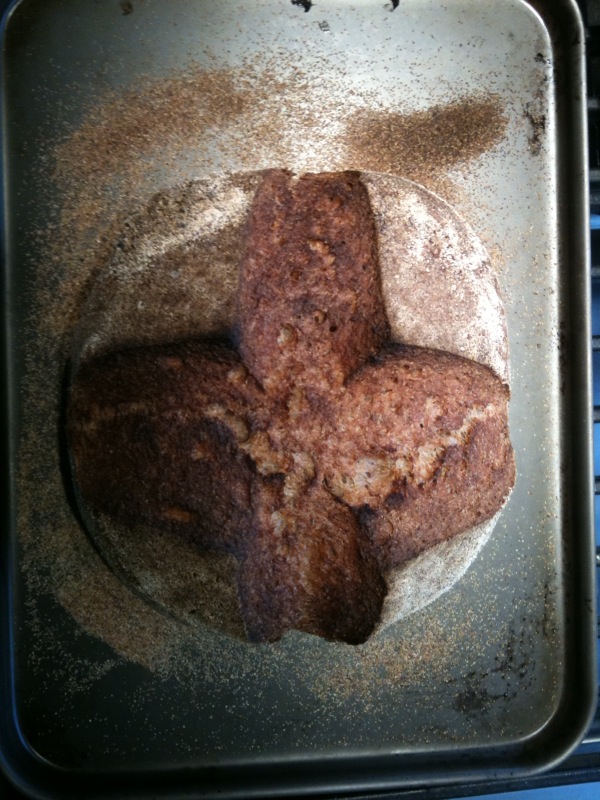
The Arkansas bread as I’ve named it, with a big cross slash to celebrate the forthcoming visit of the Pope.  Yeh right.
The crumb. Pretty impressive save, me thinks.


A step by step guide to sourdough

I thought it’d be useful to do an entry with a step by step guide to sourdough.

Not, I will add quickly, because I am any sort of expert. But because I know a few people who are interested in ‘getting into’ sourdough and have been asking me questions about it, so I thought they might find it useful. But also there’s nothing like someone who has just learned how to do something to explain it back to you. I know that I had a few questions when I first started (which was only a few months ago!) so this is really to help those that are even greener beginners than I.

Hopefully, you will have got yourself a copy of Dan Lepard’s The Handmade Loaf, which is the book that got me on this incredibly exciting (je jeste pas) journey into artisan bread-making. You will have your starter, which is explained in great detail in his book. And you will know the basics of what you’re doing. I include the basic recipe that I now use but really  this is to show you what to do regardless of which recipe you follow.

The basic recipe I follow

200g starter

340g water (just from the tap)

500g flour (I use 400g of white bread flour and 100g wholemeal bread flour/spelt)

a teaspoon of salt – I use Maldon

The equipment that I use and find useful:

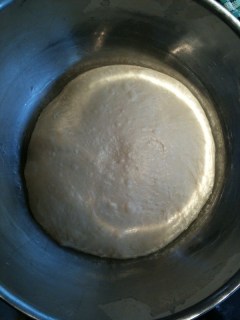
A large stainless steel bowl, actually two.
A clean, baby muslin
A little whisk that I picked up from somewhere (Bakery Bits does a similar one here)
A dough scraper
A fork

You’ll need (if you don’t follow basic above)

Flour – according to recipe
Cold water – according to recipe
Salt – I use Maldon sea salt ground in a mortar and pestle – according to recipe

All Dan’s recipes ask for X g of starter. It took me a while to work out that if I didn’t have the actual amount in my starter jar, it didn’t matter. I could pour in what I had (not all of it! you always keep some starter to make more out from it), and then top it up with water and flour. But if you do this – i.e. feed the starter in a bowl to make more of it – you’ll need to leave it for a few hours before it’s ready.

For example. Let’s say the recipe calls for 500g of starter. If you have that to spare in your jar, great. Spoon it in to a bowl. But what about if you don’t really have that to spare?

After a while you will get to know roughly how much starter you have in your starter jar in the fridge. For example, I pretty much know I always have 200g of starter to spare, but I’m pushing it to get to 250g and I would never have a spare 500g in the jar.

So I get my bowl, put it on the scales and, for white leaven I measure out 100% of flour to 80% water (for a rye starter it’s more like 100% floor to 90% water). So for example, I’d put in 150g of flour to 120g water, which weighs 350g on the scales. I then top that up with 150g of  actual starter from my jar.

It sounds complicated, and sometimes the calculations do cause me to stare into space and bite my lip and ssssh my children if they try to talk to me, but you do get your head round it.

The easier way I remember it is that the ratio equates to:

100g flour to 80g water or,
125g flour to 100g water or,
150g flour to 120g of water, and I use those three formula calculationy things to muddle me along.

If you’re using starter that’s all straight from the starter jar, you can go straight onto ‘first dough’.

If not then you you now mix up the starter with a fork or a whisk or a spoon until it’s all incorporated (it will be quite thick). Leave it for a few hours until it’s looser looking, more relaxed, with some bubbles. If you imagine that when you first mixed it up it was a bit uptight, top button done up, now it’s slipped into a pair of velvet slippers and a smoking jacket and is having an evening smoke.

Remember to refresh your starter in the jar. I use 125g flour/100g of water or 100g flour/80g of water depending on how much space is in the  jar.

First dough

I call this first dough, just cos. It’s when you add the other ingredients to the starter, which will be

Flour
Water
Salt

according to the recipe that you’re following. You add it all in and mix it around. The dough will look ‘scrapy’, with bits sticking out maybe.

Do not panic. Do not try to mix the dough until it’s smooth. You will be there all day and start to cry. Believe that great things can happen.
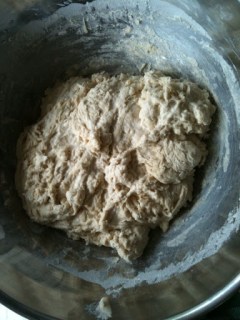
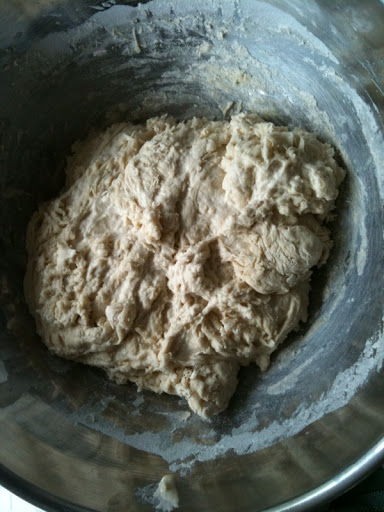
This is a white sourdough dough after the very first mix. Looks pretty unruly huh?

Let the dough rest for ten minutes; all of Dan’s sourdough recipes ask for rests of

10min
10min
10min
30min
1hr
1hr

then it can vary to another 1hr or 2hrs. You’ll need to see the recipe but once you’ve gone past the first 2/3  stages it’s pretty much all of a muchness with a tiny knead and then a rest of X amount of time.

So, first rest of ten minutes. I just let it rest in the bowl I mixed it up in. The bowl will have scraps of dough around it and every time EVERY TIME, my partner says “can’t you scrape them up into the dough”.

And the answer is: no. It doesn’t work like that. So you’ll have a ball of scruffy looking dough, kinda dry looking (DO NOT be tempted to add more water), in a bowl with bits all over it. See the picture above.

Cover it with a dishcloth and bite your nails nervously. Set the timer for ten minutes.

In the meantime, oil a surface. I use sunflower oil and recommend you do too. Dan recommends olive oil, too, but he’s probably richer than you or I. Sunflower oil is just fine. I use a big, big chopping board so that I can move my dough around the kitchen. Remember sourdough bread takes hours to make, so unless you are sure you can remain at the same work station unmolested, or don’t mind clearing up after yourself each time, use a board. I also find a dough scraper invaluable. I got mine from Ikea, it’s stainless steel, it’s great. I use it when I go back to the dough after each rest to pick the dough up with and move it around. I also oil the board before each knead. Oil works great and doesn’t alter the integrity of the dough. If you add flour or water, I found, you can get into a big sticky mess. Use oil, be brave.

After ten minutes, turn the dough out onto the board and start to knead gently. I do 12 kneads, sort of turning the dough in on itself, and around. Amazingly, you will see the dough start to get smoother. Don’t panic if you’ve still got some bits that don’t seem to quite adhere, and it’s not yet as smooth as it could be, although by this stage you should have a dough with promise.

This is the same dough as above, but after its rest of ten minutes and its first knead. Big difference isn’t there?

Now: either oil a bowl and put the dough in it, covering it with a cloth (I use the baby muslins for this, but a dishcloth would do fine, obviously you don’t need to have had a baby and have baby muslins to do this FFS) or put the dough on the surface you just kneaded it on and cover it with an oiled bowl.

If you have lots of large stainless steel bowls, like I do, then lucky you. You don’t need to wash up just yet. Otherwise you’ll need to wash up the doughy-bowl, dry it, oil it and put it to use.

Set the timer for un’altre ten minutes.
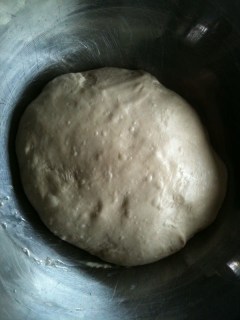
This is the same white sourdough dough, after its third lot of ten minute rises.

At each stage the dough will have relaxed a little and started to grown. At first, when you’re only leaving it for 10 or 30 mins, you won’t notice it so much. But when you get to the longer proving times, you’ll see how it stretches out and relaxes. When you first get back to the dough you’ll also feel  how it’s softer and starts to stiffen up as you knead it.

Don’t be tempted to knead it more than 10-15 seconds.
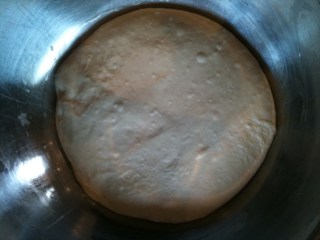
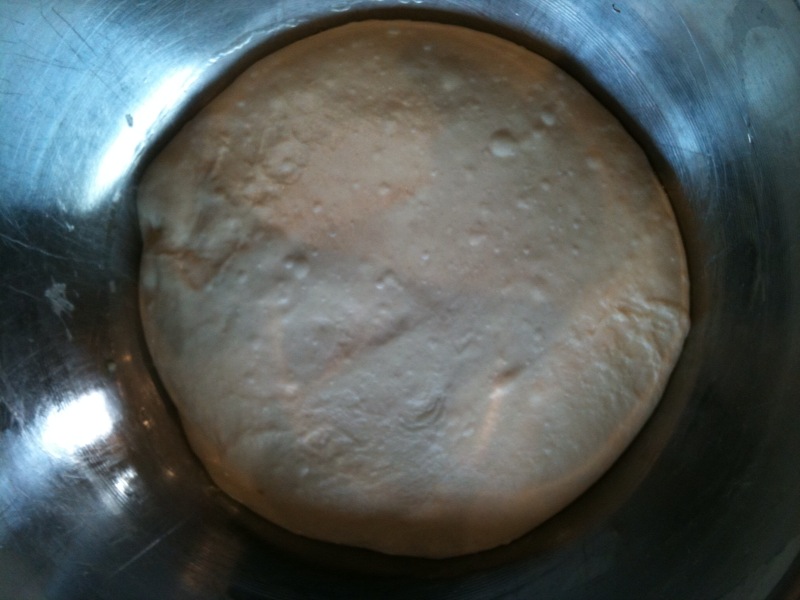
Et voila le dough after the first one hour rise. You can see bubbles on the surface yes? Good sign.
After the second, 1hr rise. The dough is bigger, more relaxed, smoother. A bit like me after Christmas.
Here it is after its 2hr rise. Just before it’s shaped and put into a banneton for its overnight sleep.

I should point out that the bread-heads always say that if it’s warm (like a hot sunny day or just if your kitchen is warm) then you might be able to leave your bread for less time, say 40 minutes instead of an hour. I’ve never bothered with this particularly and always do what time suits me. Equally, if you leave the bread for longer than ten minutes (or 30mins or an hour or whatever rest you’re on), cos the phone goes, or Corrie is on, it doesn’t matter either. Obviously you can’t completely take the piss, but sourdough is a bit like a very loving/drunk parent/partner: it is very forgiving.

When you’ve done your resting and kneading for the last time, you shape it into a ball, let it rest for ten minutes and then shape it into the final shape you want and put it to prove in a lined bowl or banneton for the last rise of whatever the recipe says (usually about 4hrs or so). I always do the final prove (prove = rise) in the fridge, cos that’s what works for me. I leave it for 10-36hrs for white dough, and up to 72 hours for wholemeal/rye etc. I haven’t experimented with longer than that  yet.
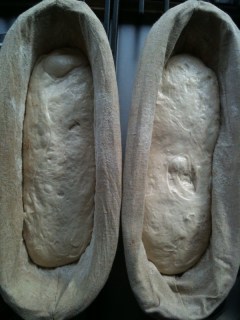
These are my little loaves after ten hours in the fridge. They don’t look massively risen, but comparatively, they are. I wanted two smaller baton shapes. Had I put all the dough in one basket it would have been up to the top by this stage.

In the morning this is what I do: I preheat the oven to 220C. I put in two baking trays, the one I will bake the bread on goes on the top shelf. The tray I will put the ice cubes on will go on the bottom shelf. Don’t use your best tray for the ice cubes.

When the oven is up to temperature, fill a glass with ice cubes and get your polenta ready. Take out the top baking tray – the one that will receive the bread – and dust it with polenta. You can’t put the polenta on before this (i.e. at the time of first putting the tray in the oven) or it will burn.

Turn the bread out onto the polenta. This is where the linen lined bannetons really come into their own, because it makes the process easy.

These are the loaves, turned out onto a polenta dusted tray and slashed.

Don’t be afraid to slash the loaves. Even if they look like they’re collapsing a bit when you do it. They will recover in the oven. Use a bread knife: be confident and slash the dough deeply, the deeper you slash the more room the bread has to rise in the oven. Try to cut, rather than push: in other words let the knife do the work, not you pushing down. I do about four slashes for a 600g baton shape. Experiment with what works for you.

When you’ve slashed, put the bread into the oven, and just before shutting the door, pour the ice cubes onto the bottom tray. They will fizz and steam. That’s good. That steam will keep the bread moist. If you have a water sprayer, you should also spray the top of the bread. This is important because once the crust has hardened, the bread can no longer rise, so the longer you can leave it before the crust hardens, the more chance you have of ‘oven spring’ – the bread making that final push upwards in the oven.

Things that really make a difference:

Slashing – your bread won’t be so aerated without it.
Ice cubes –  you won’t get such a good crust or so much rise.
Preheated baking tray – you won’t get such a good crust or such a good rise.
Polenta – you can do without it, but it produces a really professional finish, even if it is only on the bottom.

The finished product

That’s it!