Category Archives: Consumer

Mozzies

“Have you been in a car crash?” one of my 147 (just on my mother’s side, and last counted in 1982, although that is first and second cousins) asked me.  My legs were covered in those circular cotton wool pads you get, and each disc was held on by a strip of American tan coloured Elastoplast.  Underneath each was a mosquito bite and I had 23 on my left calf alone.

Every year it was the same story. Every year I’d go to Italy and be told by alligator-skinned relatives that there were no mosquitoes. Every year, like an idiot, I’d believe them and until I woke up covered in bites like mini volcanos. I’m not allergic to mozzie bites, but I do react really badly to them, each one growing bigger by the day until it starts to ooze pus and get infected and I was effectively  house-bound.

It’s not surprising I didn’t lose my virginity til I was 22.

In 1996, after one famous holiday to the North when my dad told me there were, positively, no mosquitoes and that I was being a girl about it and I then got half eaten alive until I was just one big mound of bites and just to walk hurt…well after that I decided, rather belatedly, to never ever listen to anyone ever again on this subject.

Since then I have not been bitten in Italy, although of course, you get mozzies here now.

As I write I have a bite on my toe, right at the point, sustained last night, and three – THREE – on my bottom. Bastards. But so far anyway, the mozzies here are just nowhere near as bad as the ones in Italy (“you want parmesan with that madam, black pepper?”) and I can control the bites simply with an application of Germolene (it has a local anaesthetic). It’s so far never got so bad that I try to pull the poison out with one of those suction pens, which is what I’m reduced to in Italy. When this doesn’t work, and I burst all the blood vessels around the bite, I then try to squeeze the poison out using just my fingernails. I cannot imagine why my bites get infected and I then get paraded round the local farmacia like a freak. “Ma GUARDA!”

I have of course, become the world’s most annoying self-styled expert about mosquitoes so here’s what I’ve learned.

It’s the females what bite (they need the proteins from your blood, or mostly my blood, to lay eggs). There is no relevance to this other than to make women feel it’s their fault. If you get close enough to them the females have long proboscis, the male have shorter ones.

All but one species lays its eggs on standing water, so be aware if you have any outside your bedroom window. Left paddling pools, ponds, guttering, buckets. The bastards aren’t fussy.

They find you through the carbon dioxide you exhale. Again, this is of no help to you unless you plan on not breathing.

Mosquitoes don’t like ‘air currents’, so although it’s not a good idea to sleep with the window open, an electric fan, sleeping in the wake of a Jumbo Jet or having the air conditioning on may help, although I wouldn’t rely on those alone.

Never believe locals who tell you there are no mosquitoes.

Start your defence early. I use plug in mosquito repellent in the room I’ll be sleeping in and start plugging them in at about tea-time (4pm) and carry an Autan stick with me everywhere. I’m very partial to Autan, but I’m sure any old make will do. Use a stick or cream rather than a spray because it lasts longer, because you get more on your skin rather than it dispersing through the air. (I use a stick cos it’s easier to carry and apply, you don’t need to get your fingers all greasy.) That said, the ‘effective for’ times given on the packet are the maximum. Like suncream, they start to lose effectiveness as each hours passes so if in doubt, apply again.

The three main ingredients you will find in most commercially available, topically applied repellents are:

Deet (usually listed as dimethyl benzamide or diethyl toluamide)
KBR-3023 (more commonly known as picaridin or icaridin)
IR-3535 (listed on products as ethyl butylacetylaminopropionate or 3-ethyl aminoproprionate).

Deet is regarded as the most effective, because lower doses of it last longer. However, there have been rare cases of children reacting to it. Also, be aware that Deet can ruin synthetics, leather and hard plastic so be particularly careful when applying it near watch-faces, sunglasses or camera lenses.

Mosi-guard, (www.mosi-guard.com) is made from lemon eucalyptus and is suitable for babies from three months.

You may also want to consider a mosquito net. However, be aware that these are usually impregnated with insecticide. Unimpregnated nets are not recommended because you would have to be absolutely sure that there wasn’t an arm or leg touching the net, through which the mosquito could bite, or that the net wasn’t torn.

Although mosquitoes can and do bite through clothing, they tend to prefer bare skin if it’s available, so whatever product you go for, you need to apply it all over any exposed skin.

Products containing citronella have been shown to have some effect in tests, but don’t last long at all – approximately two hours and usually aren’t recommended for children under two.

Please note that if you are travelling somewhere where there is malaria, follow the instructions of your GP and never rely on a repellent alone.

Sun creams

When I was 18, I went to Spain for my first foreign holiday without adult supervision. I went with five girl-friends. Before our holiday, we set up a production line making bikinis. We were all, more or less, the same size then so one size sort-of fitted all. We made a pattern consisting of four triangles: two for the top half, two for the bottom.

One person cut, one person sewed a thick seam, through which another threaded cord with which to tie up the bottoms, or hold up the tops. We had all manner of lovely fabrics, but it was the gingham I remember the most.

We were tremendously pleased with ourselves, until we got to the beach and realised that swimwear is not made out of cotton for a very good reason. It sags. After one friend went into the sea and came out carrying a litre of water in her pants, we relegated the home-made bikinis to sun-worshipping duties only.

Because I was a right little miss I had the entire Lancome suncare collection with me. This was in part because I adored Isabella Rossellini, who was then the face of Lancome. But also I liked a bit of luxe and, importantly, I had been working every weekend since I was fourteen; so my pocket money situation was fairly buoyant. I have so many happy memories of that holiday, but the smell of the Lancome sun oil (in particular) stays with me.

(I need to pause here whilst I have a little reminisce.)

Whilst I adore Natura Bissé and Sisley and their sun products are excellent (and expensive), the Lancome sun oil factor 6 is still what I reach for if I’m just going to be out in the sun for half an hour or so. I love an oil. Obviously if you are in the sun all day then you need something a little more robust and remember to re-apply often. You don’t really need me to tell you that (note: this is why I avoid really high protection creams cos I think they give you a false sense of security).

Sun protection basically comes in two types: chemical or physical. The easier to put on ones tend to be chemical sunscreens. That is, they contain chemical ingredients (usually one or more of these: benzophenone-3, homosalate, 4-methyl-benzylidene camphor (4-MBC), octyl-methoxycinnamate, octyl-dimethyl-PABA, isotridecyl salicylate, octyl salicylate and octocrylene) that protect against the sun. There is some controversy around these: some studies have shown some of these ingredients to be oestrogenic or to double the uterine growth rates in rats before puberty. Some research also links chemical sunscreen with an increase in skin damage/cancer as the chemicals absorb the UV rays and keep them close to the skin.

Physical sunscreens contain either titanium dioxide or zinc oxide which reflect the sun’s rays. These are greasier to put on and can look ‘white’.  The more ‘child friendly versions are usually physical sunscreens although (of course) there is also some controversy over the use of nanotechnology both in physical and chemical sunscreens. But look, this isn’t a science blog, I’m not a trained scientist (I am a trained shopper however) so if this concerns you and you want to read more, I’m sure you know what to do.

Next: mozzie repellent.

Ice-cream makers

Those that know me in real life will know that my father opened up an ice-cream shop when he turned 70. As you do.

I wrote about him, and ice-cream for The Economist’s Intelligent Life magazine. If you look carefully at the collage you can see a picture of me in a school photo, and one of my dad by the round pond in Kensington Gardens, holding me next to our giant pram (actually I think it may be my sister, but I couldn’t find many pictures of me with my father because, being the second child, the novelty of taking pictures of me had obviously worn off).

He sold the business about four years ago. But I’ve kept the ice-cream making going on a domestic scale, inspired by the creations my father made.

Making ice-cream is really easy. I’d say “you don’t need an ice-cream maker” but let’s face it, you do. If you want to pour your ice-cream into a container, put it in the freezer, and then take it out again every few hours to break up the ice-crystals, then please do so. But if you do that you’ll think making ice-cream is as real faff and will, quite understandably, just go and buy it in the supermarket.

But I like making my own ice-cream for two main reasons:

1) I am nearly always avoiding a deadline
2) I  like knowing what’s gone into it. Because ice cream really doesn’t need the input of things like xanthan gum and emulsifier.

Ice-cream makers come in two types. Ones that cost about in the £40 range, with these you need to pre-freeze the bowl; or ones that cost about £300 and have an inbuilt freezer. These are the pros and cons:

Pre-freeze ones:

  • take up less space
  • are cheaper

BUT

  • you need to either be organised to put the bowl in the freezer (to pre-freeze it)
  • so you need to have room in the freezer to do this
  • the capacity is often less than those of the bigger, more expensive models
  • they tend to take longer to make the ice-cream

Built-in freezer ice cream makers:

  • are quicker
  • have a bigger capacity
  • require no pre-freezing of the bowl

BUT

  • they take up a lot of space on the counter top
  • are very heavy so really you need to keep them out, because also..
  • when you move them you have to then keep them level for 24hrs
  • can be very noisy, although remember they’re fast so you only need put up with the noise for about an hour.
  • some of them need priming of the bowl with alcohol

The best ice-cream maker on the market, that sort of straddled the two, was the Panasonic BH-9441P. It was a brilliant little machine that didn’t look bad either. But the beauty was that it was battery run, so no need for pre-planning. You just made your ice-cream, popped it into the machine and stuck the whole thing in the freezer. It cost about £35 and I recommended it many times but it’s no longer easily available and the demand for it has pushed the price up to over £50 when you can buy it.

Philips, Magimix and Cuisinart all make models of the former for about £40 (with the odd model costing nearly double that), and they get good reviews. Have a look on Amazon (which is what I would do) before deciding which one you get. Remember that if you have a food mixer, you can often get ice-cream maker attachments to go with them. I have no idea how they work.

Because we make ice-cream regularly in our house we have three models:

two Panasonics because I bought one for my dad when he ‘retired’ and have since nicked it back from him.
one Cuisinart Professional Ice-cream maker.

 The Cuisinart Professional Ice-cream Maker. A distinct lack of buttons to press but a lovely machine.
 

The latter is the one we use most now because since we swopped our giant American fridge freezer for a smaller freezer/fridge freezer I rarely have the room for my Panasonic. The Cuisnart PIM is very beautiful, rather monolithic and stainless steel. I mention this because I think it’s important how they look, but not so important that looks is everything. I very carefully researched it before buying it. It needs no priming. It’s super simple to use. In fact when you get it (if you do) you might be disappointed with the number of buttons to press. There aren’t any, just a timer dial to turn.

You have a little bucket (1.5l capacity) which you put the ice-cream mixture into, then attach the arm/lid and turn the clock timer to how long you think it’ll need (maximum an hour but it stops automatically if it’s ‘done’ before then and there’s nothing to stop you running it for longer if it still needs it, just put the timer back on) and that’s it. It has a plastic churner turner that turns as the machine freezes the  mixture.

It’s very noisy however. The noise doesn’t bother me so much as all my kitchen appliances can be hidden with stainless steel shutters so that buffers the noise somewhat. Then you take the bucket out, decant the ice cream into a freezer container and put it away to harden up/for later.

Home made ice cream is very soft when just made. Lots of people don’t realise this and think it’s not done properly. You can absolutely eat it straight out of the machine and it’d make a great after dinner-party dessert justlikethat.  And this is how I rather like it. It’s very velvety and you can really taste the flavours. I made a ricotta ice cream recently which was so tasty out of the machine. It’s very dangerous however as you can eat LOADS like this.

So be careful.

Or you can freeze it and it makes a lovely made-in-advance dessert, so one less thing to think about when you have guests. It keeps for ages in the freezer.

The  machine is not cheap: about £250, although you might be able to pick up a very good second hand model for less. It comes with a five year guarantee. The Gaggia Gelateria is another model that some friends have, but I’ve never used it so can’t comment on it with any authority. If you have it let me know.

I’ll post up some ice-cream recipes up another time as I’ve spent years trying to finesse some of them. Note: I didn’t like the recipes that came with the Cuisnart. In fact finding good ice-cream recipes is a bit of a bug-bear of mine. I am an absolute snob about it and only consider it to be proper ice-cream if it’s made from a custard (egg yolks, milk, cream, sugar) base. (Obviously you can also make frozen yoghurts and sorbets which is a different thing.)

I’m lucky because my father can get me ‘tasting cones’ (tiny cones) from his ice-cream industry contacts. This means that if you have children coming, or just people who work in the fashion industry who don’t each much, they can have a miniature ice-cream cone. But for everyone else, serving home made ice cream in a sugar cone is a lovely way to finish a meal, however posh the rest of it was.

Update February 2015: I wrote the avoe nearly five years ago now. I now have lots of ice cream recipes on this blog. I still use my ice cream maker regularly in the warmer months, although have also now got some recipes on here (see link) that don’t need them. The Panasonic ice cream maker comes and goes; sometimes you can buy it, sometimes you can’t. Heston Blumenthal has also brought out an ice cream maker as part of his Sage range which is meant to be very good, although I’ve never tried it. And the Cusinart Professional which I have (although it’s been redesigned), is now available, new, for under £200.


The most fantastic child’s quilt ever

Liberty patchwork quilt by Charlotte’s Cot Blankets, £110, buy buy buy.
A few days ago, my boyfyhusband (see, readers, this is what you’re reduced to calling your boyfriend of THIRTEEN YEARS and the father of your TWO CHILDREN when you’re not married. Learn by my mistake and insist on an engagement ring within two years of dating, or else. I do have an engagement ring, presented to me about four years ago, but by then it was TOO LATE) took a real awwww picture of our youngest asleep, and covered with her Liberty patchwork quilt, like the one above except obviously with her details on it. I would post it up here except it shows her name and those that know me know that I never name my children in print. Anyway, I sent the pic around the globe to family and friends and have been besieged by requests ever since asking Where Does the Quilt Come from. Even my sister, who is able to crochet, sew and knit like (*insert name of extreme crocheter, sewer and knitter here*) asked me.

Imagine how tempted I was to say “I made it!” and leave it at that. But I just couldn’t take the glory. Even though a) I love patchwork and b) I’m rather good at it. Or I was aged 14 when I last made anything in patchwork and that something was a pencil case.

But let me tell you what I really loved about that pencil case: I made it using scraps of fabric that really mattered to me, from items of clothing no longer in use but that evoked something. I couldn’t ever wear anything patchwork, but I think, as a method of using up bits of sentimental clothing, you can’t beat it. One day in the future, when I have loads of time on my hands, I intend to make a big patchwork quilt using up clothes that once mattered.

The Liberty Patchwork quilt from Charlotte’s Cot Blankets, was given to my youngest by her Godfather. Well I say her Godfather, but I know that the idea came from his wife, aka my best friend Emma. It’s made, by hand, in Norfolk, so the county just up from me (local produce!). It’s really beautiful and would make a wonderful Christening present or ‘new baby’ present.
You can also get it in blue-y colours, but this combination is just lovely.

Pane e amore

I’m really pleased with the loaves I’ve made so far. Whilst they may not all look as presentable as those I’ve bought in (proper, artisan, baker) shops, they’re really delicious. So delicious I have difficulty believing I’ve made them myself.

But the more I learn about sourdough, the more I realise it’s a bit like hi-fi’s (or whatever they’re called theseadays). You can get to the point where you finesse, finesse, finesse so much that you’re still going long past the point anyone else stopped caring.

I remember standing in a hi-fi shop with a hi-fi geek friend of mine, who was trying to show me the difference between one system (and we’re not talking those vertically racked systems, please, we’re talking individually bought and unmatching components) that cost £5K and one that cost £7K. “Can you hear the difference?” she asked.

No, I couldn’t. This is where I feigned an epileptic fit and asked to leave the shop.

There are a couple of questions I have at the moment about sourdough. I’ll have so many more, but at the moment a few are really bugging me. What I want is a really technical, but hand-holdy book (and if you know of one, please let me know) that will explain the science in a bit more detail than The Handmade Loaf.

And as I try to find these out on the web, I get more drawn into super-geek bread sites (trust me they make this look like Grazia) that make me feel like a miserable failure.

Even though, I have to remind myself, I think my bread is great and it does everything a good loaf should. It rises, it looks lovely and it tastes wonderful. What more could I want? At which point does it get good enough and people stop wondering if the addition of one extra ice cube will make for that super-perfect crust, or if they’d just turned the dough another 180 degrees during their crumb improvement proof, it would have had elongated holes to rival a natural sea-sponge.

Does it matter? I’m beginning to suspect it does. But I also want to scream at some of these sites and say:

“Are you shagging enough?” because surely you can’t be. I can’t believe anyone who is having enough sex can get that into bread.

And I include myself in this. But look. I have an excuse.

Must go now, have a loaf in the oven.

A completely gratuitous picture of Sofia Loren NOT baking bread.

Children’s cutlery

I get really cross with children’s cutlery. Growing up, we happened to have a fork that was smaller than the rest, like the runt of the cutlery drawer. For some known-only-to-me reason, I called this fork “Bluey”…anyway, it was MY fork and I used it for every meal my mother made. Even pizza. Which she used to make for me without the tomato sauce on top as I had a bad experience at school involving giant plum peeled tomatoes, which I’ll detail another time.

Children’s cutlery invariably consists of blunt-ended forks with chunky handles, knives that cut nothing and spoons that are so wide, said child would have to have a letterbox for a mouth to get them in. Useless. Or super chunky, plastic-handled crap with stupid designs all over it. When what you surely want is a plain, simple, stainless steel set of cutlery that is just smaller. How hard can this be to find?

Hard.

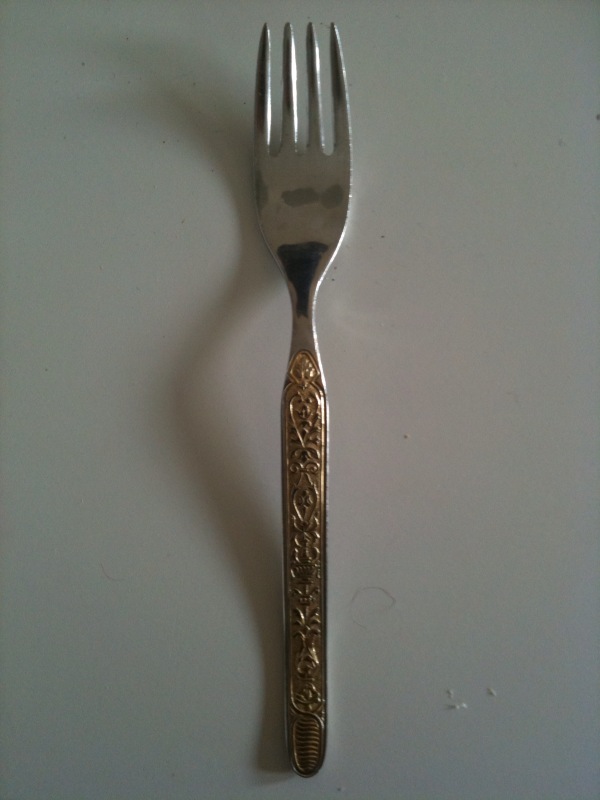
When my eldest was born, my mother produced, with a flourish, a set of cutlery that belonged to me as a child and which had been given to me by an erstwhile next door neighbour. It consisted of fork, knife, spoon and teaspoon (the latter has been mislaid somewhere, probably under the new kitchen), perfectly normal, perfectly functional just scaled down for children. I have no memory, whatsoever, of ever having used this set of cutlery. Probably because, in the way of Southern Italians (which my mother is) she was dazzled by the inlay of ‘gold’ each piece had along the handle, saved it for ‘best’ and then promptly forgot where she’d put it.

Here it is, childhood fork. I have no memory at all of ever using it.


When she gave the set to me for my eldest, my first thought was “I’ll hide these in a drawer somewhere”, but it became apparent quickly that it was actually really useful. Number 1: my daughter loves having her own cutlery (although I daily remind her that it’s MY cutlery), number 2: it makes sense for her to use something scaled down. Number 3: I actually love that my mother kept them all these years.
So I was able to dispense with the other, totally useless, totally rubbish, children’s cutlery I had accumulated since my daughter was born in an attempt to find Scaled Down Cutlery That Actually Worked.
I’d tried the Miniamo melamine children’s cutlery: totally crap. The fork’s prongs were so rounded as to render them totally useless.. They have anyway now been recalled, not because they are a crime against the trade descriptions’ act, but because fragments of the fork can break off and pose a choking hazard. 
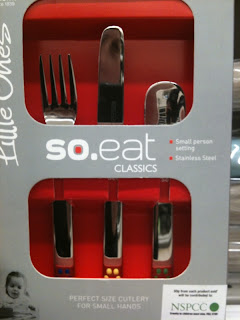
Then I bought the So.Eat set from Waitrose. A knife, fork and spoon for £10, which seemed a lot, but they looked like good, solid specimens and the only child-related insignia was a smiley face at the base of the stem of each piece (why, why, why?), which I could live with, just about. 
Don’t buy these.


I was full of hope as I got these home. But immediately it became apparent to me that they had, to my mind at least, there was a design flaw. Each piece was really heavy. When I take these out of the cutlery drawer, I have to almost engage my abdominals. And the spoon! You can probably see from the pic above that the ‘bowl’ of the spoon is huge! And this is meant to be for a little mouth!
I was really pretty cross by this stage. My youngest, who is just over a year now, feeds herself and always has (honestly, don’t bother with all that spoon-feeding of pureeing stuff, no need). Sure she very often throws her cutlery on the floor, but when she does want to use cutlery she doesn’t want to be hindered by weight-lifting. 
Anyway today, I was in our local kitchen store, which I go to on a weekly basis, wondering round the aisles aimlessly, sure that I need at least one new gadget (I have the best stocked kitchen ever, probably only Martha Stewart beats me). Then I saw it. The answer.
An oyster fork. 
An oyster fork, (okay, two) slightly Georgian in feel, I feel, and the answer to all my prayers.
Okay I haven’t sorted the knife problem yet (you can get small butter knives, but they aren’t right). But let’s face it, mostly my youngest, dexterous though she is, doesn’t actually cut up her own food yet. She’s fine with a regular teaspoon but what she needed was a small fork. This is perfectly sized for her. There was another one, slightly bigger, with four prongs, which I’ll probably buy in a year or so but this is great for now. It cost £2.50 and it’s fucking brilliant (sorry); it’s really good quality stainless steel and I’m sure I’ll find a use for it (other than oysters, one of the few things I really don’t like, like having some gob into your mouth excuse me) when she’s outgrown it.
From L to R: a regular sized fork, my child-hood, gold embossed fork and the soon to be famous oyster fork, so you can compare sizes. Look, this is important.


Mummy’s Chocolate Mousse

Chocolate mousse, detail from.
Chocolate mousse was a big thing in the Barbieri household when I was a bambina. Mostly, I have to say, because my mum would serve it in those saucer champagne glasses – the sort that very few people use now (they let the bubbles out too fast, but how long does one hold a glass of champagne for??) but growing up, in the 1970’s, you used to see them far more.
I fully intend to serve my chocolate mousse in those glasses just as soon as I can nick them from my folks’ house. In the meantime I serve them in little white pots – Gu desserts used to come in them when Gu desserts first came out.
 
Having a six year old meant it was only a matter of time before I’d have to revive the tradition of chocolate mousse. We used to have it only occasionally when I was a child, but these days, we have it after Sunday lunch, every Sunday. Rituals are important to small children (and me). This is also a great dessert to make in advance and stick in the fridge, so it’s one less thing to think about if you’re entertaining.  It uses raw egg, which I guess I must point out you shouldn’t eat if you’re pregnant/old/young/allergic to eggs. Etc. Otherwise, this is the recipe and how you make it. And yes I will stop talking about food soon-ish.
 
This is a bastardisation of my mother’s recipe and Nigella’s. I’ve tried many others but this makes for a really nice, light, mousse that has zero added sugar, has all the natural goodness of high cocoa content chocolate, has a good chocolate hit without alienated small children or making them fly around the room afterwards. 
You will need:
 
For four people (this makes quite a small amount, the idea is that you have a good hit of chocolate so you don’t need to pig out on it). It’s easy to double up on if you need more.
 
50g 70% cocoa chocolate (I use Waitrose Continental Plain Chocolate, 70%. I recommend you do too, it’s excellent).
50g 37% cocoa chocolate (I use Green and Black’s Cooking Milk Chocolate)
2 eggs at room temperature separated. It doesn’t really matter if they’re medium or large, whatever you have. Remember it’s the white of the egg that changes with the size of the egg, not the yolk. So it figures that if you use large, or extra large eggs you’ll have more white of egg, ergo more whisked egg whites, ergo more mousse…so it’s quite a good way of making less go further or ending up with a slightly lighter mousse. *
a pinch of salt
 
Put the chocolate in a bowl above a simmering pan of water. When melted, take off the heat and leave to cool for a few minutes. In the meantime whisk the egg whites in a clean bowl, until they’re stiff and you can turn the bowl upside down.
 
Beat the yolks and the pinch of salt into the chocolate mixture, then gently fold in the whisked egg whites with a metal spoon. I find it works better with a metal spoon.
 
Poor into suitable receptacles: small espresso cups, ramekins, small pot things and chill overnight or for a few hours. I’d personally not keep this for more than about two days.
* update March 2013. If I need to make this mousse go further, or I just want to make it lighter, I just add more egg whites.
A nice topping for this is the white chocolate cream.

Saturday morning pancakes

 Saturday morning pancakes. And yes I know I posted this on a Sunday.

I saw Jamie Oliver doing these on the television just before Christmas. He was making them with his two eldest daughters. I’m not short of pancake recipes, but I’ve never been wholly pleased with the result. Not least, most pancake recipes need you to rest the mixture overnight or for an hour. Despite being really organised in many respects, I just get annoyed at the thought of having to make pancake mixture in advance like that. But I guess I’d have been able to get a*** into gear if the result had been worth while. And, have I mentioned, it’s not been.

Three things struck me about the Jamie pancake recipe that made me want to give it a try:

1) Its immediacy: you mix it up and away you go

2) You don’t have to weigh anything, you just use a cup – any coffee or tea cup – and that’s the measure you use for both flour and milk, so it’s great if you haven’t got scales/can’t be bothered with them.

3) It has grated fruit in it. This could only be a good thing. Then I made them and they were so delicious that they’ve become a regular Saturday morning fixture ever since.

Here is the recipe:

One cup of self raising flour (update, to make these more ‘wholegrainy, I now make them with half a cup of self raising flour and half a cup of wholemeal plain and then add half a teaspoon of baking powder)
One cup of milk (I use semi skimmed since that’s what we get)
One egg
Pinch of salt
A nice pear or apple or banana

to serve: blueberries, maple syrup and live yoghurt. (Jamie’s recipe called for yoghurt and honey, I prefer to serve them slightly differently.)

Here is what you do:

Whisk together the flour, milk and egg. You can use an electric whisk if you want, or a hand whisk or even a fork. It doesn’t need much, just enough to make a smooth batter. Add the pinch of salt – I use Maldon sea salt. Take a nice ripe pear or apple and wash it, then great the whole thing into the mixture, peel and all. Jamie did it pips and all, I fish those out, or grate around them. Bananas work well too but it makes for a very strong banana flavoured pancake and we’re not so fond of them done this way in this house. Pears and apple are, I’ve found, the best. They impart a sweetness with no obvious presence. I don’t say this as one who believes you have to hide fruit from children. I don’t like subterfuge like that. But what I’m getting at is you end up with a really delicious pancake that just happens to have fruit in it.

Once the mixture is mixed together, heat a frying pan with a tiny bit of oil (I use sunflower, any relatively flavourless oil would do) and a tiny bit of butter. (You’ll need to repeat the oil and butter for each batch, but you only need tiny amounts.) Then I use two tablespoons per pancake and in my pan I can fit three in in one go. They don’t take very long to cook on each side – about a minute or so, just use your common sense – you’re looking for golden brown to fairly dark brown. Flip and repeat. I put mine in the warming drawer whilst I’m doing the rest but if you don’t have one then wrap them in silver foil or pop them in a very low oven. The whole batch is fairly fast to make and I’ve never had to ‘sacrifice’ the first few, like you do with regular pancakes. Using a true cappuccino cup (which I can measure if anyone is interested) I get about 12 pancakes done this way.

I serve with live yoghurt, blueberries and maple syrup and they are truly delicious and a great way to start the weekend.

ps: I’ve just enabled comments on this blog as I get quite a few emails/comments on Facebook. If you have a comment on this blog, please can I ask you put it here so I don’t look like Noddy Nomates. Thank you.

An addendum to this, written on 29th November:

I’ve since experimented with adding half wholemeal and half white self raising and it makes for a really delicious pancake, slightly nuttier in taste but not at all off-puttingly ‘worthy’. But it fills me up for longer because the GI (glycaemic index) is lower in wholemeal flour than white. If you can only find plain wholemeal flour, then add half a teaspoon of baking powder to the mix as well.

UV Tent

UV tents are a great idea in principle, you pop them up and they instantly protect everyone in them from the sun. Except they’re not all equal. If your tent is too small, or doesn’t allow for adequate ventilation, what you end up with is a UV shelter, but one that is so unbearably hot you can’t sit in it.

I like the idea of personal shelters on the beach/in the park/in my own front room if need be. But then I am half hermit and I like to have somewhere to retreat to. I like the idea of my own little zone. But UV tents are also a great idea in the garden, in this weather. And children love them because I guess it taps into some primal response of having a ‘nest’ (you only have to watch children play to see how they love making hidey holes).

A few years ago, when I was writing the Personal Shopper column in the Guardian, I came across the UV Protector by Shelta. It’s this one here. My one hasn’t got any garish yellow, it’s all blue, which is much more chic but the yellow probably serves a purpose.

Anyway,  it’s an excellent tent – think very hard before buying an inferior one and here’s why.

It’s big, but folds up small. The base is nearly 2m squared and when assembled it’s 135cm high or thereabouts. Small children can easily walk around in it.

It’s got poles in the design, but there’s no having to thread them through. To assemble it is a synch (although there is a rider, which I’ll tell you about in a moment), you just pull on two cords and up it goes. I struggle a bit as I’m only 5’2″ and so I’m at arm’s reach doing the initial pulling bit. But I just get someone to help me or stand on a chair. Taller people won’t struggle at all and you don’t need brute strength.

It’s also very easy to take down, takes seconds.

The carry bag it comes with is compact, but roomy. By that I mean it’s not one of those products that looks great when you first buy it, but to ever get it back in its carry case is impossible. You’ll have no problem getting the folded up tent back in.

It’s light and easy to carry and doesn’t take up much room in a boot.

You can vary the ventilation quite a lot, so you can have it open on both sides, or variations thereof. Plus cos it’s bigger than the average UV tent, it’s not so claustrophobic.

You can fill it up with blankets and pillows and be very comfortable. Although that yellow…

Fly curtains

IMG_2315 IMG_2316

Fly curtains hold a very special place in my heart. No regularly open door in Italy is without them, and it was through them that I first learned to view the world. When strange guests came calling, and in large Italian families there are many strange guests that you are urged to kiss and who pinch your cheeks until they glow cherry-red, I would hide amongst the strip-y stripes of fly curtain, chewing on them. As I grew older, I would spy on boys on motorini through them. I all-seeing whilst remaining totally invisible to them. The plastic strips would also make great fly swats.

So you see, fly curtains are incredibly romantic. Not boy-romantic, but life-romantic. I like the way the sunlight diffuses through them. But mostly of course, I like the way the flies stay out. Now, Italy is big on brightly coloured fly curtains made of semi-opaque, fairly hard (hence why they make good fly swats) strips. A bit like strips of hanging boiled sweets. Nice in Naples, where Farrow and Ball hasn’t visited yet, but in my house: no. I didn’t even really think they were necessary in this country until I got me a back door (glass, stable) which is nearly always open during fly-season. I.e. now.

I started looking for a fly curtain that wasn’t awful. It wasn’t easy. The most stylish I could find was by a German company using silver link chain. But even that wasn’t great and cost £100. Then I went to a friend’s barbecue and she had this great matt grey fly curtain. If Kelly Hoppen had a fly curtain it’d be this one. I did some research and tracked it down and ordered one too.

Officially it’s called the Silver Slat Blind. I got mine custom made as our back door isn’t a standard size. It looks great. The service was unbelievably superb – I struck up a correspondence with someone called Sue who was incredibly helpful – and I paid about £8.50 for it all in. I recommend it all highly. All from Holland Plastics.

The first picture is of a double white fly curtain for the terrace doors (the terrace, dahlink!). The second pic is of the original grey one.