Rye and Wholemeal bread

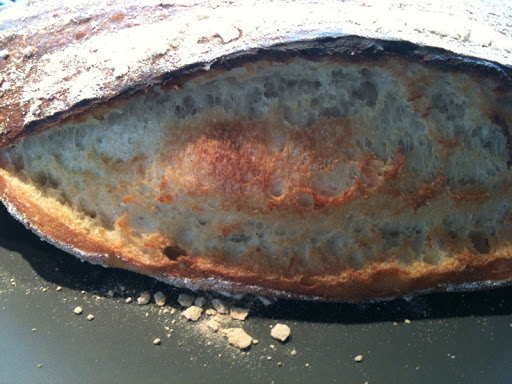
Rye and wholemeal, supposed to be Barley and Rye bread, cept I got distracted.
Proved in two whicker 600g baton bannetons for ten hours at 4 degrees. Cooked on preheated tray at 250 for ten minutes then 220 for ten minutes. Slashed with a professional Mure and Peynot grignette with a curved blade. One worked more successfully than the other. Not sure why.
Today’s bread was supposed to be Barley and Rye bread from Dan Lepard’s The Handmade Loaf. I’ve rather overdosed on white flour bread and even though sourdough is low GI, and I use stoneground, organic white flour, I really started to feel I needed to make a loaf that wasn’t just white flour.
The majority of sourdough bread has a tendency towards white flour use. White flour does the work in keeping the bubbles of sourdough up in a way that other flours can’t. This recipe called for a rye leaven, 300g white flour and then 100g each of rye and barley. I’d just had a chat with another budding baker friend about wanting to use more wholemeal so that’s what was in my head and that’s what I reached for instead of the barley flour. Anyway, it’s no bad thing. As you’ll see it still uses mostly white flour. *sucks teeth*
I’d made this loaf (using the correct ingredients) before and it’s delicious. A really subtly delicious loaf and great for sandwiches (what I also love about sourdough, because have I mentioned that I love it, is its keeping qualities).
Rye and wholemeal crumb, second slice, it will only get better as I get further into the loaf.
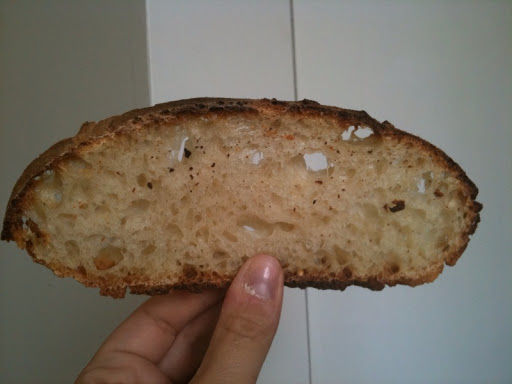
 Barley and rye bread made with proper ingredients and an 11hr rise at about 12 degrees. Dan Lepard described this loaf as having a “bold beauty”.
 

Mr Potato Bread

 Potato bread. 
Proved in a 400g round whicker banneton with linen lining for 13hrs at 4 degrees.
Cooked on a preheated baking tray at 250C for ten minutes then at 220 for a further ten minutes.

A couple of years ago, at the excellent Whitecross Street market, I bought a Tortano bread from The Power Station. This was a large ring shape and it had potato in it. The potato wasn’t obvious, but the flavour of the bread was exceptional.

I’ve dreamed of it ever since, buying it when I can, but that hasn’t been often. When I saw Dan Lepard had a recipe for potato bread in his book The Handmade Loaf, I decided to try it.

The recipe calls for honey and grated potato. This was my first long rise (prove) at such a low temperature (I usually prove my bread for about eight hours at about 15 degrees), and I was dubious it would work. My suspicions were deepened when I got the dough and it didn’t seem to have risen as much as my bread usually does. It had spring to it, and I tipped it out onto a preheated, polenta dusted tray (I always use Mermaid trays) and it still deflated slightly. I had two shapes on the go, one in a 400g round (which you can see above) and one in a 600g baton (which you can see in a minute). The slashes on the round one didn’t really have much effect and the loaf sort of burst out of one end. The recipe had called for a central fold, rather than slashes, but I hadn’t done this (tut, see what happens when you go off piste).

The baton shape I’d slashed on the top but also along one length.

Both breads rose beautifully, with a fabulous (I think anyway) crumb. The baton ended up being more successful in terms of loaf-look because of the beautiful fanning open of the long cut I’d made. I must warn you that this bread is just superb tasting. I had some for lunch with griddled peppers and a tomato salad. You can taste the sweetness of the honey, but not in an off putting way at all – even if you didn’t like honey I reckon you’d still love this. My boyfyhusband is currently eating his way through the second loaf whilst I remind him that it’s fodder for our daughter’s lunch box. I can’t even begin to think how delicious this bread would be if used for a bacon sandwich, with some chilli jam. Be warned.

The potato bread baton slash. Bootiful.

First fumblings with sourdough.

The reason sourdough, or natural leaven bread means so much to me, the reason I go on about it so, is that bread is the final frontier in cooking that I’d never been able to master. I’ve baked since I was seven (I used to make the cakes for my parents shop on the Bayswater Road in west London, probably illegally but there you go). But I’d never been able to make bread. I never worked out why. When I was a child I couldn’t wear a watch, they’d stop when I put them on. And if I ever tried to make anything with yeast in it, it’d die.  My bread was awful. I tried things like Danish pastries, thinking that maybe cos they were a cakey thing, I might have more luck. But no. It was actually hard to take failure, over and over again and I felt like you do when computers give you problems. Like it’s personal.

Some years ago, I went diving and fishing with a Michelin starred chef. I told him about me and bread. He laughed. “Anyone can make bread” he said, sounding like the chef in Ratatouille. “I can’t” I answered mournfully. “Come to my kitchen,” he offered. So I went.

He made the dough for the day and put it in this huge mixer. Then he asked me to shape it or something. I can’t remember now, but anyway, I touched it. We were making the bread for the entire evening’s covers. To cut a long story short, cos you must surely know what’s coming,  the bread I’d touched failed. The fact that I’d told him this didn’t appease his temper. He looked at me like I was a witch and not long after I found myself on the pavement outside, crushed.

Eventually bread makers came onto the market and I even failed with those, but I realised that’s because we had a shit bread maker. Our downstairs neighbour, the lovely Sarah, used to produce these huge loaves for her and her husband Ben. Her bread machine was a Panasonic (still the only make of bread maker I’d recommend) and eventually we bought one and what do you know, as long as I stayed away from the mixture with my hands – very easy to do with a machine – we were okay. As time went on, I got confident again. I really don’t know if bread senses fear but maybe it does. Because as I got more confident, I started making bagels and pizza, using the machine to make the dough and then shaping it myself. Success was mine. I don’t know, perhaps having children changed whatever freaky wiring I had going on that was such an efficient killer of bread dough. Perhaps the hands that had always been so cold, but made great pastry, were starting to warm up. The point is, I was able to make bread.

But my eye was always on the big prize:  sourdough. Proper Italian bread is sourdough bread: made without yeast but by using a starter of, basically, flour and water which uses wild yeasts that are present in the air and on the flour. In Italy we call this leaven a ‘biga’. Some bakers call it ‘La Mamma or La Madre’ – the mother. Fitting because the starter you, yes, start with, you make all your subsequent bread from. You use a bit of your starter every day to make your bread (or discard it if you’re not making bread) and then feed (or refresh) it with more flour and water. Some starters date back many years. It’s said that the starter that makes the famous Poilan bread dates back to 1932. Certainly the longer a starter has been going, the better it is and the more flavoursome the bread.

Sourdough bread is big, holey bread which you can’t squash into putty. It is deeply flavoursome, has a low GI (thus very satisfying) and can make a meal out of the most humble of ingredients. Add a squash of Brie and a few roasted peppers in olive oil and I’m happy. If you live in a big City – certainly London – you can buy sourdough bread pretty easily. But here, in Suffolk it’s not so easy.

Every weekly trip to London saw me coming back with something from Flour Station or Paul’s and I’d text my boyfhusband on the way home and say “we have good bread, we have a meal.” But I wanted to be able to make this bread myself.

I’d bought Dan Lepard’s The Handmade Loaf some years previously. I’d started a starter from his instructions which had looked promising, but then I got pregnant and other things occupied my mind. My friend Lucy gave me a bit of her starter but I’d let it go off in the back of the fridge. Then finally my friend Emily offered to send me some of hers. This seemed such an act of friendship and I liked the fact that Emily – whom I’d only ever got to know on line (I used to co-run a parenting forum), could send her starter across the country, in the post, and I could make bread from it.

It came. I tipped it into a Kilner jar, fed it for two days and opened the first recipe in Dan’s book, which was for white leaven bread. Dan’s recipes are deeply prescriptive: 8am, do this, 8.10am do that. They had put me off at first because it seemed you had to spend all day making bread. Maybe this was why sourdough loaves cost so much. But in fact it wasn’t so. It suited me perfectly. I found the bit that took the most time was the beginning, and refreshing the starter. Otherwise you hardly kneaded it at all – 10/15 seconds at a time. Leaving it to rest for 10 mins, 30 mins, an hour…it meant I could do it in between feeds/reading to my children/preparing dinner etc.

The first loaf I made I started just after school pick up, which is still the best time for me to make bread. I had already decided to be Master of the sourdough in terms of this: the final rise called for a time of 4-5 hours. I knew I could never stay up that long, so I decided to just leave it to rise overnight in a bowl lined with a teacloth on the concrete floor of the laundry room. At a temperature of about 15 degrees. I decided that the bread either had to cope with this, or it had no place in my life.

The next morning I got up and very clumsily took the bread off the teatowel, which it had stuck to, and wobbled it onto a cold baking tray (my technique finessed incredibly fast, fear not). Dan said an oven temperature of 220 for 50-70 minutes. After 30 minutes my loaf was frazzled.

I was upset, of course, but as I cut into the loaf I realised that there inside was proper sourdough. What’s more, as it cooled, I realised the crust had this wonderful taste. I was so excited that I sent a picture of it to Dan (whom I don’t know, but I figured he’d not be too freaked out as we work for the same newspaper) and he replied saying he thought it looked great and it looked better than his first sourdough. He probably says this to everyone, but I chose to believe him.

We – boyfyhusband and I, not me and Mr Lepard – ate it with a poached egg (Burford Browns) topped with herbs from our garden. I almost died of happiness that morning. I told everyone, all day, all week, that I had made bread. With my hands. I think I sent a picture of my sourdough bread to everyone with an email address. Finally.

First ever sourdough. Look at that crumb! This was proved in a bowl lined with a teatowel for nine hours at 15 degrees. I didn’t slash it, I cooked it for 30 minutes at 220.
And it worked.

Mummy’s Chocolate Mousse

Chocolate mousse, detail from.
Chocolate mousse was a big thing in the Barbieri household when I was a bambina. Mostly, I have to say, because my mum would serve it in those saucer champagne glasses – the sort that very few people use now (they let the bubbles out too fast, but how long does one hold a glass of champagne for??) but growing up, in the 1970’s, you used to see them far more.
I fully intend to serve my chocolate mousse in those glasses just as soon as I can nick them from my folks’ house. In the meantime I serve them in little white pots – Gu desserts used to come in them when Gu desserts first came out.
 
Having a six year old meant it was only a matter of time before I’d have to revive the tradition of chocolate mousse. We used to have it only occasionally when I was a child, but these days, we have it after Sunday lunch, every Sunday. Rituals are important to small children (and me). This is also a great dessert to make in advance and stick in the fridge, so it’s one less thing to think about if you’re entertaining.  It uses raw egg, which I guess I must point out you shouldn’t eat if you’re pregnant/old/young/allergic to eggs. Etc. Otherwise, this is the recipe and how you make it. And yes I will stop talking about food soon-ish.
 
This is a bastardisation of my mother’s recipe and Nigella’s. I’ve tried many others but this makes for a really nice, light, mousse that has zero added sugar, has all the natural goodness of high cocoa content chocolate, has a good chocolate hit without alienated small children or making them fly around the room afterwards. 
You will need:
 
For four people (this makes quite a small amount, the idea is that you have a good hit of chocolate so you don’t need to pig out on it). It’s easy to double up on if you need more.
 
50g 70% cocoa chocolate (I use Waitrose Continental Plain Chocolate, 70%. I recommend you do too, it’s excellent).
50g 37% cocoa chocolate (I use Green and Black’s Cooking Milk Chocolate)
2 eggs at room temperature separated. It doesn’t really matter if they’re medium or large, whatever you have. Remember it’s the white of the egg that changes with the size of the egg, not the yolk. So it figures that if you use large, or extra large eggs you’ll have more white of egg, ergo more whisked egg whites, ergo more mousse…so it’s quite a good way of making less go further or ending up with a slightly lighter mousse. *
a pinch of salt
 
Put the chocolate in a bowl above a simmering pan of water. When melted, take off the heat and leave to cool for a few minutes. In the meantime whisk the egg whites in a clean bowl, until they’re stiff and you can turn the bowl upside down.
 
Beat the yolks and the pinch of salt into the chocolate mixture, then gently fold in the whisked egg whites with a metal spoon. I find it works better with a metal spoon.
 
Poor into suitable receptacles: small espresso cups, ramekins, small pot things and chill overnight or for a few hours. I’d personally not keep this for more than about two days.
* update March 2013. If I need to make this mousse go further, or I just want to make it lighter, I just add more egg whites.
A nice topping for this is the white chocolate cream.

Saturday morning pancakes

 Saturday morning pancakes. And yes I know I posted this on a Sunday.

I saw Jamie Oliver doing these on the television just before Christmas. He was making them with his two eldest daughters. I’m not short of pancake recipes, but I’ve never been wholly pleased with the result. Not least, most pancake recipes need you to rest the mixture overnight or for an hour. Despite being really organised in many respects, I just get annoyed at the thought of having to make pancake mixture in advance like that. But I guess I’d have been able to get a*** into gear if the result had been worth while. And, have I mentioned, it’s not been.

Three things struck me about the Jamie pancake recipe that made me want to give it a try:

1) Its immediacy: you mix it up and away you go

2) You don’t have to weigh anything, you just use a cup – any coffee or tea cup – and that’s the measure you use for both flour and milk, so it’s great if you haven’t got scales/can’t be bothered with them.

3) It has grated fruit in it. This could only be a good thing. Then I made them and they were so delicious that they’ve become a regular Saturday morning fixture ever since.

Here is the recipe:

One cup of self raising flour (update, to make these more ‘wholegrainy, I now make them with half a cup of self raising flour and half a cup of wholemeal plain and then add half a teaspoon of baking powder)
One cup of milk (I use semi skimmed since that’s what we get)
One egg
Pinch of salt
A nice pear or apple or banana

to serve: blueberries, maple syrup and live yoghurt. (Jamie’s recipe called for yoghurt and honey, I prefer to serve them slightly differently.)

Here is what you do:

Whisk together the flour, milk and egg. You can use an electric whisk if you want, or a hand whisk or even a fork. It doesn’t need much, just enough to make a smooth batter. Add the pinch of salt – I use Maldon sea salt. Take a nice ripe pear or apple and wash it, then great the whole thing into the mixture, peel and all. Jamie did it pips and all, I fish those out, or grate around them. Bananas work well too but it makes for a very strong banana flavoured pancake and we’re not so fond of them done this way in this house. Pears and apple are, I’ve found, the best. They impart a sweetness with no obvious presence. I don’t say this as one who believes you have to hide fruit from children. I don’t like subterfuge like that. But what I’m getting at is you end up with a really delicious pancake that just happens to have fruit in it.

Once the mixture is mixed together, heat a frying pan with a tiny bit of oil (I use sunflower, any relatively flavourless oil would do) and a tiny bit of butter. (You’ll need to repeat the oil and butter for each batch, but you only need tiny amounts.) Then I use two tablespoons per pancake and in my pan I can fit three in in one go. They don’t take very long to cook on each side – about a minute or so, just use your common sense – you’re looking for golden brown to fairly dark brown. Flip and repeat. I put mine in the warming drawer whilst I’m doing the rest but if you don’t have one then wrap them in silver foil or pop them in a very low oven. The whole batch is fairly fast to make and I’ve never had to ‘sacrifice’ the first few, like you do with regular pancakes. Using a true cappuccino cup (which I can measure if anyone is interested) I get about 12 pancakes done this way.

I serve with live yoghurt, blueberries and maple syrup and they are truly delicious and a great way to start the weekend.

ps: I’ve just enabled comments on this blog as I get quite a few emails/comments on Facebook. If you have a comment on this blog, please can I ask you put it here so I don’t look like Noddy Nomates. Thank you.

An addendum to this, written on 29th November:

I’ve since experimented with adding half wholemeal and half white self raising and it makes for a really delicious pancake, slightly nuttier in taste but not at all off-puttingly ‘worthy’. But it fills me up for longer because the GI (glycaemic index) is lower in wholemeal flour than white. If you can only find plain wholemeal flour, then add half a teaspoon of baking powder to the mix as well.

UV Tent

UV tents are a great idea in principle, you pop them up and they instantly protect everyone in them from the sun. Except they’re not all equal. If your tent is too small, or doesn’t allow for adequate ventilation, what you end up with is a UV shelter, but one that is so unbearably hot you can’t sit in it.

I like the idea of personal shelters on the beach/in the park/in my own front room if need be. But then I am half hermit and I like to have somewhere to retreat to. I like the idea of my own little zone. But UV tents are also a great idea in the garden, in this weather. And children love them because I guess it taps into some primal response of having a ‘nest’ (you only have to watch children play to see how they love making hidey holes).

A few years ago, when I was writing the Personal Shopper column in the Guardian, I came across the UV Protector by Shelta. It’s this one here. My one hasn’t got any garish yellow, it’s all blue, which is much more chic but the yellow probably serves a purpose.

Anyway,  it’s an excellent tent – think very hard before buying an inferior one and here’s why.

It’s big, but folds up small. The base is nearly 2m squared and when assembled it’s 135cm high or thereabouts. Small children can easily walk around in it.

It’s got poles in the design, but there’s no having to thread them through. To assemble it is a synch (although there is a rider, which I’ll tell you about in a moment), you just pull on two cords and up it goes. I struggle a bit as I’m only 5’2″ and so I’m at arm’s reach doing the initial pulling bit. But I just get someone to help me or stand on a chair. Taller people won’t struggle at all and you don’t need brute strength.

It’s also very easy to take down, takes seconds.

The carry bag it comes with is compact, but roomy. By that I mean it’s not one of those products that looks great when you first buy it, but to ever get it back in its carry case is impossible. You’ll have no problem getting the folded up tent back in.

It’s light and easy to carry and doesn’t take up much room in a boot.

You can vary the ventilation quite a lot, so you can have it open on both sides, or variations thereof. Plus cos it’s bigger than the average UV tent, it’s not so claustrophobic.

You can fill it up with blankets and pillows and be very comfortable. Although that yellow…

Chambord

About three years after our eldest was born, I bought my boyfyhusband a cocktail shaker. I searched very high, and very low for one that looked good and would last and finally found it at Alessi, that Italian design emporium that produces some truly wonderful, but also truly awful, designs.

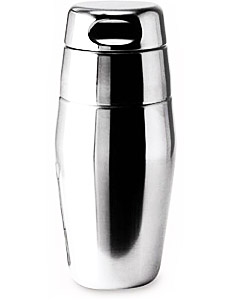
alessi-cocktail-shaker
 This the 870/50 Alessi cocktail shaker in 18/10 matt stainless steel which at the time of writing costs £63. It’s worth it.
 

Thus Friday nights became cocktail nights.  At the end of every week, when our daughter had gone to sleep and I was reasonably sure she wouldn’t want a feed til morning, I’d indulge in some beautiful, hard liquor.

Now my favourite cocktail has always been a vodka Martini, straight up, with three olives. (No idea if shaken or stirred since I never make my own, I just say “my usual” and it’s made for me.)

I love Martinis so much that I wrote it into my birth plan that immediately after the birth of our second daughter, and whilst I was waiting for placental transfusion to stop (the cord to stop pulsating) I was to be offered a vodka Martini. And indeed, I was.

But with a cocktail shaker comes the need for a proper cocktail book. Again, here is a field that is saturated with offerings but I went into a proper old fashioned book shop (okay, the Selfridges book department) to select. I ended up choosing Drink.ol.o.gy, which is a neat little tome with no pictures but lots of smart writing and a very comprehensive list of recipes. It’s the cocktail book I’d recommend still.

What has any of this to do with Chambord? Very little directly. Except when you get into making cocktails you do need to start thinking about having something very grown up: a well stocked drinks’ cabinet. And in that cabinet appeared a very ornate bottle of ‘black raspberry liqueur’ aka Chambord.

The Chambord bottle is hideous, all plastic, gold coloured ornateness topped with a crown. The sort of thing the Pope would drink, if he drank, and he should if he doesn’t. I’ve heard that people feel the bottle is so ‘special’ they don’t know what to do with it when it’s empty. So instead of putting it in the recycling bin, they donate it to charity. Chambord made a feature of its bottle last year, releasing a very limited edition of one jewel encrusted version for $2million.

The world’s most expensive bottle of booze.


Chambord is an excellent liqueur. You can make all sorts of complicated cocktails with it (the website tells you how) but I like it best splashed into the bottom of a glass of fizz. It can turn even a humble Cava into something rather tasty and lovely. It’s very easy to drink and of course you’ll get drunk quickly. But it’s raspberries so it’s one of your five a day.

Fly curtains

IMG_2315 IMG_2316

Fly curtains hold a very special place in my heart. No regularly open door in Italy is without them, and it was through them that I first learned to view the world. When strange guests came calling, and in large Italian families there are many strange guests that you are urged to kiss and who pinch your cheeks until they glow cherry-red, I would hide amongst the strip-y stripes of fly curtain, chewing on them. As I grew older, I would spy on boys on motorini through them. I all-seeing whilst remaining totally invisible to them. The plastic strips would also make great fly swats.

So you see, fly curtains are incredibly romantic. Not boy-romantic, but life-romantic. I like the way the sunlight diffuses through them. But mostly of course, I like the way the flies stay out. Now, Italy is big on brightly coloured fly curtains made of semi-opaque, fairly hard (hence why they make good fly swats) strips. A bit like strips of hanging boiled sweets. Nice in Naples, where Farrow and Ball hasn’t visited yet, but in my house: no. I didn’t even really think they were necessary in this country until I got me a back door (glass, stable) which is nearly always open during fly-season. I.e. now.

I started looking for a fly curtain that wasn’t awful. It wasn’t easy. The most stylish I could find was by a German company using silver link chain. But even that wasn’t great and cost £100. Then I went to a friend’s barbecue and she had this great matt grey fly curtain. If Kelly Hoppen had a fly curtain it’d be this one. I did some research and tracked it down and ordered one too.

Officially it’s called the Silver Slat Blind. I got mine custom made as our back door isn’t a standard size. It looks great. The service was unbelievably superb – I struck up a correspondence with someone called Sue who was incredibly helpful – and I paid about £8.50 for it all in. I recommend it all highly. All from Holland Plastics.

The first picture is of a double white fly curtain for the terrace doors (the terrace, dahlink!). The second pic is of the original grey one.

Secret holiday cottage in Devon

When I used to write travel pieces, people used to ask “do you have a secret place that only you know about?”. And I’d lie a little and say “no”. The lie was only a little lie, in that, obviously I wasn’t the only one to know about my special cottage. But there was no way I was going to write about it and splash it across the papers so it could get booked up and then there’d be no room for me.

This has happened to me before. Many years ago I wrote about the Rasul Mud experience at the Elemis Day spa. This was a totally affordable little treat for two people and I never had any problems booking it. Then I wrote and raved about it and not only was there a six month waiting list but the price rocketed, completely pricing me out. Don’t even get me started on the MaltEaster bunny shortage this year which I think is entirely due to me writing about them because of course I like to think that I am that important that I can trigger such an event.

When I first started going out with my boyfy-husband (boyfband? husfriend?), thirteen years ago, he introduced me to this cottage in Devon, just minutes from Dartmoor. It took me a few days to realise how completely special this place was. At the time, I was pretty entrenched in five star hotels (through work) and being flown first or business class. Even though I didn’t live like this at all, going away meant a certain amount of luxe. This cottage isn’t really about that. Parts of it are a bit ramshackle. But God is it wonderful.

For one, it’s down a tiny lane so it’s completely secluded. I’m talking peace and quiet like you got in the 1950’s. You can’t hear any traffic at all. But it’s not secluded because the people (lovely, lovey people that are there if you need them but not if you don’t) that own it live opposite.  Children can play in the courty-yardy bit at the front. The gardens are spectacular. And there is a – walled – vegetable garden of about an acre that is the finest I’ve ever seen (and I talk as someone who has been to lots of National Trust places).

So why am I mentioning it now?  Well the whole place is for sale. I don’t want it to be sold. We’ve had the most special holidays there ever. Our eldest loves it. It’s got a sort of magic about it even when it’s raining. The thought that we might never be able to go there again (we went at Easter this year) or that our youngest won’t remember it, makes me sad. But the owners are “getting old” (their words not mine) and it’s a big place to look after. So it’s very likely this will be the last year you can ever stay there and well, I thought I should be generous.

Also those of you with £2 million to spare might want to buy it. I envy you if you do because I am not sure there is a finer place. (To stay in the cottage is about £400 a week though!)

There is tons to do when you get there. Dartmoor, magnificent, moody, dangerous, is not far at all. Then there are wonderful villages to explore: Chagford, Lustleigh..I will write more about these another time because Chagford contains one of my favourite shops ever. And there’s Castle Drogo nearby which is my favourite NT property of all time.

2012 Update: The property was eventually sold. To the National Trust. This makes sense as it owns Buckland Abbey next door but I’m sad it didn’t sell to a wonderful family who could enjoy this. But, the good news is that the house and two cottages, at least inasfar as I know, will be refurbished and anyone will be able to stay there. We used to stay at Tower cottage which isn’t yet up for rent, but this one is, Cider Cottage next door. We never stayed there as it was always rented out on a long-let but it’s right next door to where we did used to stay and I’m sure it’s fabulous.

Junior Style Sales

It’s been a long time. That’s cos I’ve been off busy consumin’.

Anyway, before I forget; there is a great sale of children’s clothes that I’ve been going to for years and have got a large part of my eldest daughter’s wardrobe at (now passing slowly onto daughter no. 2) which is the Junior Style Sales, the latest of which starts tomorrow.

More information about them here

It costs a £1 to get in, and I’ve found them to be hit and miss. Sometimes I find so much stuff I want to buy I start shaking with the excitement, other times I come away with nothing, or just one or two pieces. There is stuff there I loathe, and more for those people who like to dress their children in labels like Dolce and Dior; but you can also find some lovely things. We’ve got some great pyjamas with space rockets on (and those style of pyjamas I think of as ‘continental’, i.e. stretchy cotton leggings with long sleeved t-shirt tops rather than flannelette buttoned up jobbies), lovely, lovely pointelle t-shirts (the sort that look like long-sleeved thermal vests but in great colours and are super useful) which cost about a fiver but were nearly £40 (forty pounds!!!) in the shops. Great sun hats. Fabulous cashmere jumpers.

In fact when I look at my children’s most successful clothing pieces, they have mostly come from these sales.

Latest great buy was a pair of cashmere trousers for the baby in moss green which kept her snug all winter; well when she wasn’t in her Patagonia bunny suit. And if you think cashmere for a baby is mad, you can’t have ever tried it: it’s beautifully warm, so they only need one layer, so you don’t end up with a baby looking like a pass the parcel; it washes brilliantly, and yes I do mean in the machine (if you have a hand wash cycle that is and silly you if you bought a washing machine without one), and it’s super soft.

I don’t get to go as often as I’d like now that I live in Suffolk, sadly.