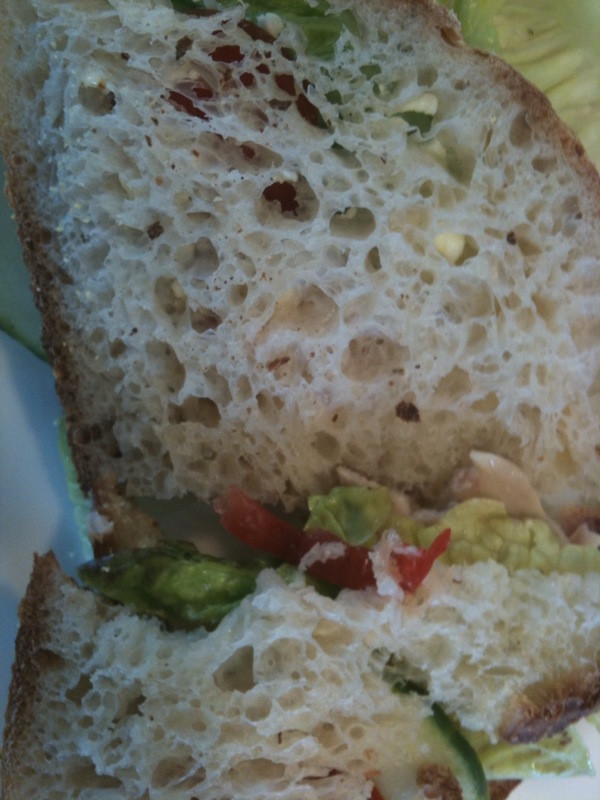
 |
| Here it is covering a chicken salad sandwich. It was perfect. |
36hr prove potato bread crumb
Leave a reply
|
| Here it is covering a chicken salad sandwich. It was perfect. |

Because we had guests coming for Sunday lunch, I decided to make a double batch of potato bread on Saturday. I had an inkling it would be good, because the dough was really frisky: I could barely contain it on the chopping board I use to knead my dough. It was so alive there was no way I could knead it and leave it on the board, covered with a large stainless steel bowl, as I normally do, because it would have pushed right out from the bowl. So instead I had to put it back into the bowl, and cover it with a tea towel whilst it rested.
I also discovered that it’s so much easier to fold dough, in the fancy way they tell you to (basically folding the dough into three, so take one third of it, fold it into the centre and then the other side, fold in on top) with so much dough. It was really easy to fold in this way, although not easy to keep in any sort of shape. I practically had to pour it into the bannetons.
I cooked one lot in a 1k round on the Sunday but the other I left in a 600g banneton (in the fridge at 4C) til this morning. It had risen hugely and spread out lots on the baking tray the moment I turned it out. I slashed it four times and it looked very collapsed, but I’m used to that with long-prove breads now and hoped it would revive in the oven. It did.
Instead of what I usually do, which is put it in the oven at the highest temperature and then turning it down, I’ve been experimenting with putting the bread in the oven at 220C for the first 8-10 mins, then putting it up higher to 250C, then back down. This is what I did this time.
The bread rose beautifully, had a great crust (heavier and darker than the one I did for Sunday lunch, probably cos of the shape) and OMG it tastes divine. The longer prove has definitely improved the flavour.
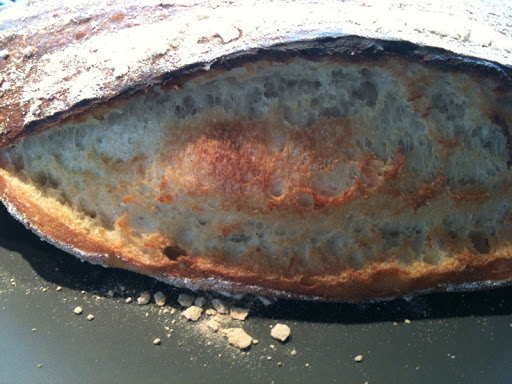
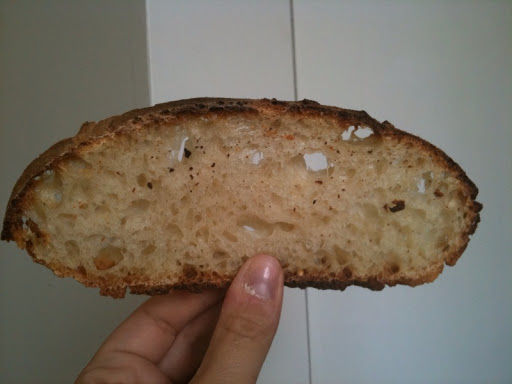
I’d go as far as to say it’s very probably the best tasting bread I’ve ever made. I will try to photograph the crumb later (if there is any left), it’s really good. Not overproved (as I feared), kinda waxy, very white. And so moist.
Swoon.
Now that I’m getting a bit more cocky confident about sourdough bread making, I’m starting to experiment a bit more. I know that the bread geeks might poo-pooh at my experiments, and how tame they are. But I’m new to all this and hoping to help other rookie bakers, not really teach anything to anyone, let alone seasoned bakers. Although if I manage that, too, then hoo-RAH.
I wrote in another post about long proving of loaves. I regularly prove our ‘house bread’ (Dan Lepard’s Mill Loaf) for 72 hours now. But thus far I’d only proved white sourdough for about ten hours regularly, and 24 hours max.
So the other day, my partner (I’m so fed up of saying boyfyhusband, it sounds so fucking twee) was going to London and I decided to send my Italian Daddie – who lives there with my Italian Mamma – a loaf of my bread. He’s the sort of man who eats bread at every meal and he buys his baguettes from the supermarket, and I think they’re a poor substitute for the sort of bread he grew up with.
He likes his bread to be white and crusty. So I made a batch of sourdough, shaped one into a round for us, and one into a baton for him, proved it overnight and got up at FIVE O’CLOCK IN THE MORNING to cook it as my partner was leaving at 6am. I kept the other loaf and cooked it yesterday morning, after a 36 hour final prove in the fridge at 4 degrees.
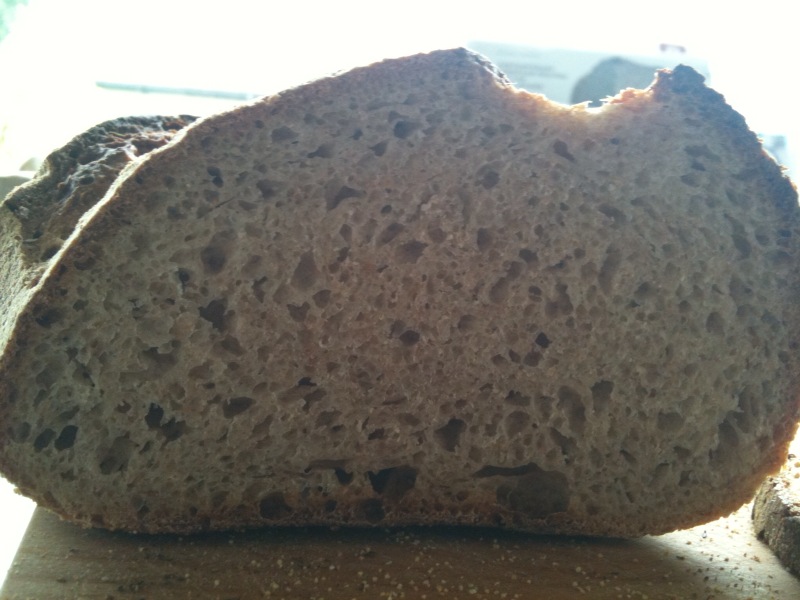
I am pleased to report that it was splendid. I cooked it for only 20 mins, 15 mins at 250 and 5 at 220, as I was after a slightly softer crust than the usual blackened, sour crust I go for. It was delicious, delicate and here it is, photographed in the morning sunlight.
 |
| White sourdough, cooked after a 36hr prove. |
Because making your own bread seems to make other people feel guilty, one of the questions I get asked a lot, rather accusingly, is “how do you find the time to make your own bread?”
The ironic thing is that since I’ve been making my own sourdough I have:
Lost weight
Saved money
Spent less time shopping
This is because sourdough is low GI, it’s so delicious it’s almost (I said ALMOST) like eating cake but without the sugar lurch. So I snack in more satisfying fashion. Because a loaf of bread and some scraps make a meal, I spend less time shopping, ergo I save money. (Because although I do go shopping with a list, I always go off-list, too, so I go in for a tin of tomatoes and come out having spent £23.)
But also, sourdough, as my friend Lucy told me, is forgiving and easy to fit into a busy schedule. Aside from the beginning bit, the rest you squeeze in in amongst the laundry folding etc. The only thing it doesn’t work with is when I am actually away from the house, because sourdough requires lots of little bits of time spread out throughout the day. It suits me perfectly.
What I’ve also discovered is that you can make a double batch, prove it in the fridge, bake one lot and then keep the rest in the fridge. So far I’ve done this for 12 hours, 24 hours, 36 hours, 48 hours…you get the picture. This means that you can have fresh bread without having to have actually made it the day before.
This was a genius discovery for the likes of me.
A pure white sourdough doesn’t seem to like proving over about 24 hours (although more experimentation is needed). Any longer than this and it overproves. It’s still delicious, but you’ll get big air bubbles at the top of the bread and the crust starts to come away. But with darker flours it works better. I made a three flour loaf (white, rye, wholemeal) the other day, proved one over 12 hours at 4 degrees then cooked it. But kept the second loaf for 72 hours at 4 degrees.
The 72 hour loaf looked like it would be my first failure. As I slashed it, it collapsed alarmingly. I checked it after 15 mins at 250 degreees and it still looked collapsed and I prepared myself for failure. But after it’s second 15 mins at 220 degrees it looked completely normal. It had risen, it looked great.
But.
It tasted absolutely delicious. The longer the prove the longer the taste has to develop, see.
The subject of slashing is big in the bread world. Before I started baking bread, I had no idea that those slashes were there for anything other than decoration.
Oh how simple my world must have been.
If I’ve understood it correctly, and it’s entirely probable I haven’t, you slash your bread so that it can rise to maximum height without exploding. This is because the heat of the oven causes something caused “oven spring”- that final push upwards. Because the bread has a certain surface tension, you want the bread to rise as much as possible before the crust bakes hard and doesn’t allow any further growth. So in this respect slashing helps, (but so does causing a moist environment in the oven – steam. More on this another time).
If you slash, you control where the bread expands. If you didn’t and it needed to expand, it might burst in an uncontrollable fashion. So slashing can be decorative and serves a purpose. Btw, you only really need to slash with certain types of bread. Some bread that don’t rise much, such as a pure rye, don’t need slashes.
But how to slash?
People are nervous of slashing the dough, with good reason. You’ve spent the best part of a day making your sourdough baby and when you tip it out on a (preferably pre-heated) tray or stone you don’t want to muck about with it anymore than you have to. Slashing takes a bit of confidence and good slashing also depends on the proving. If you’ve overproved, slashing is more likely to make your bread deflate, for instance.
When I first started slashing I used a really sharp knife. I found this dragged and it made me panic, because the bread seemed to deflate (although it seemed to recover fine in the oven).
I never need a reason to buy a new gadget or a specialist tool so I looked up what you could use.
Naturally, I decided, I needed one of the latter.
You can get ones with rotating blades (so you can use both sides, although there’s nothing to stop you swopping hands and doing it but I guess that requires some dexterity), ceramic blades, steel blades, replaceable blades. They are used “by the professionals”.
I got this one:


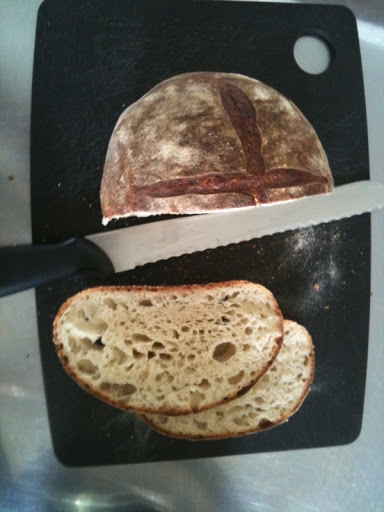

Conclusion: it may not be a wallet-busting exercise, buying a professional grignette, but I think a bread-knife does the job better. With the money you save you’d be better off buying a banneton, which is worth the money. But, more on this another time.


A couple of years ago, at the excellent Whitecross Street market, I bought a Tortano bread from The Power Station. This was a large ring shape and it had potato in it. The potato wasn’t obvious, but the flavour of the bread was exceptional.
I’ve dreamed of it ever since, buying it when I can, but that hasn’t been often. When I saw Dan Lepard had a recipe for potato bread in his book The Handmade Loaf, I decided to try it.
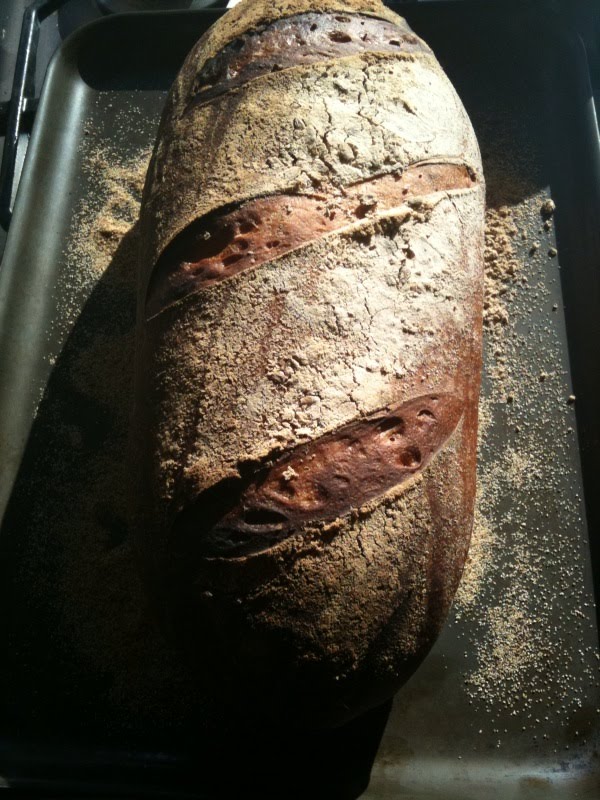
The recipe calls for honey and grated potato. This was my first long rise (prove) at such a low temperature (I usually prove my bread for about eight hours at about 15 degrees), and I was dubious it would work. My suspicions were deepened when I got the dough and it didn’t seem to have risen as much as my bread usually does. It had spring to it, and I tipped it out onto a preheated, polenta dusted tray (I always use Mermaid trays) and it still deflated slightly. I had two shapes on the go, one in a 400g round (which you can see above) and one in a 600g baton (which you can see in a minute). The slashes on the round one didn’t really have much effect and the loaf sort of burst out of one end. The recipe had called for a central fold, rather than slashes, but I hadn’t done this (tut, see what happens when you go off piste).
The baton shape I’d slashed on the top but also along one length.
Both breads rose beautifully, with a fabulous (I think anyway) crumb. The baton ended up being more successful in terms of loaf-look because of the beautiful fanning open of the long cut I’d made. I must warn you that this bread is just superb tasting. I had some for lunch with griddled peppers and a tomato salad. You can taste the sweetness of the honey, but not in an off putting way at all – even if you didn’t like honey I reckon you’d still love this. My boyfyhusband is currently eating his way through the second loaf whilst I remind him that it’s fodder for our daughter’s lunch box. I can’t even begin to think how delicious this bread would be if used for a bacon sandwich, with some chilli jam. Be warned.

The reason sourdough, or natural leaven bread means so much to me, the reason I go on about it so, is that bread is the final frontier in cooking that I’d never been able to master. I’ve baked since I was seven (I used to make the cakes for my parents shop on the Bayswater Road in west London, probably illegally but there you go). But I’d never been able to make bread. I never worked out why. When I was a child I couldn’t wear a watch, they’d stop when I put them on. And if I ever tried to make anything with yeast in it, it’d die. My bread was awful. I tried things like Danish pastries, thinking that maybe cos they were a cakey thing, I might have more luck. But no. It was actually hard to take failure, over and over again and I felt like you do when computers give you problems. Like it’s personal.
Some years ago, I went diving and fishing with a Michelin starred chef. I told him about me and bread. He laughed. “Anyone can make bread” he said, sounding like the chef in Ratatouille. “I can’t” I answered mournfully. “Come to my kitchen,” he offered. So I went.
He made the dough for the day and put it in this huge mixer. Then he asked me to shape it or something. I can’t remember now, but anyway, I touched it. We were making the bread for the entire evening’s covers. To cut a long story short, cos you must surely know what’s coming, the bread I’d touched failed. The fact that I’d told him this didn’t appease his temper. He looked at me like I was a witch and not long after I found myself on the pavement outside, crushed.
Eventually bread makers came onto the market and I even failed with those, but I realised that’s because we had a shit bread maker. Our downstairs neighbour, the lovely Sarah, used to produce these huge loaves for her and her husband Ben. Her bread machine was a Panasonic (still the only make of bread maker I’d recommend) and eventually we bought one and what do you know, as long as I stayed away from the mixture with my hands – very easy to do with a machine – we were okay. As time went on, I got confident again. I really don’t know if bread senses fear but maybe it does. Because as I got more confident, I started making bagels and pizza, using the machine to make the dough and then shaping it myself. Success was mine. I don’t know, perhaps having children changed whatever freaky wiring I had going on that was such an efficient killer of bread dough. Perhaps the hands that had always been so cold, but made great pastry, were starting to warm up. The point is, I was able to make bread.
But my eye was always on the big prize: sourdough. Proper Italian bread is sourdough bread: made without yeast but by using a starter of, basically, flour and water which uses wild yeasts that are present in the air and on the flour. In Italy we call this leaven a ‘biga’. Some bakers call it ‘La Mamma or La Madre’ – the mother. Fitting because the starter you, yes, start with, you make all your subsequent bread from. You use a bit of your starter every day to make your bread (or discard it if you’re not making bread) and then feed (or refresh) it with more flour and water. Some starters date back many years. It’s said that the starter that makes the famous Poilan bread dates back to 1932. Certainly the longer a starter has been going, the better it is and the more flavoursome the bread.
Sourdough bread is big, holey bread which you can’t squash into putty. It is deeply flavoursome, has a low GI (thus very satisfying) and can make a meal out of the most humble of ingredients. Add a squash of Brie and a few roasted peppers in olive oil and I’m happy. If you live in a big City – certainly London – you can buy sourdough bread pretty easily. But here, in Suffolk it’s not so easy.
Every weekly trip to London saw me coming back with something from Flour Station or Paul’s and I’d text my boyfhusband on the way home and say “we have good bread, we have a meal.” But I wanted to be able to make this bread myself.
I’d bought Dan Lepard’s The Handmade Loaf some years previously. I’d started a starter from his instructions which had looked promising, but then I got pregnant and other things occupied my mind. My friend Lucy gave me a bit of her starter but I’d let it go off in the back of the fridge. Then finally my friend Emily offered to send me some of hers. This seemed such an act of friendship and I liked the fact that Emily – whom I’d only ever got to know on line (I used to co-run a parenting forum), could send her starter across the country, in the post, and I could make bread from it.
It came. I tipped it into a Kilner jar, fed it for two days and opened the first recipe in Dan’s book, which was for white leaven bread. Dan’s recipes are deeply prescriptive: 8am, do this, 8.10am do that. They had put me off at first because it seemed you had to spend all day making bread. Maybe this was why sourdough loaves cost so much. But in fact it wasn’t so. It suited me perfectly. I found the bit that took the most time was the beginning, and refreshing the starter. Otherwise you hardly kneaded it at all – 10/15 seconds at a time. Leaving it to rest for 10 mins, 30 mins, an hour…it meant I could do it in between feeds/reading to my children/preparing dinner etc.
The first loaf I made I started just after school pick up, which is still the best time for me to make bread. I had already decided to be Master of the sourdough in terms of this: the final rise called for a time of 4-5 hours. I knew I could never stay up that long, so I decided to just leave it to rise overnight in a bowl lined with a teacloth on the concrete floor of the laundry room. At a temperature of about 15 degrees. I decided that the bread either had to cope with this, or it had no place in my life.
The next morning I got up and very clumsily took the bread off the teatowel, which it had stuck to, and wobbled it onto a cold baking tray (my technique finessed incredibly fast, fear not). Dan said an oven temperature of 220 for 50-70 minutes. After 30 minutes my loaf was frazzled.
I was upset, of course, but as I cut into the loaf I realised that there inside was proper sourdough. What’s more, as it cooled, I realised the crust had this wonderful taste. I was so excited that I sent a picture of it to Dan (whom I don’t know, but I figured he’d not be too freaked out as we work for the same newspaper) and he replied saying he thought it looked great and it looked better than his first sourdough. He probably says this to everyone, but I chose to believe him.
We – boyfyhusband and I, not me and Mr Lepard – ate it with a poached egg (Burford Browns) topped with herbs from our garden. I almost died of happiness that morning. I told everyone, all day, all week, that I had made bread. With my hands. I think I sent a picture of my sourdough bread to everyone with an email address. Finally.
 Pane Amore e Cha Cha Cha