Category Archives: Bread

The most AMAZING soft bread baps

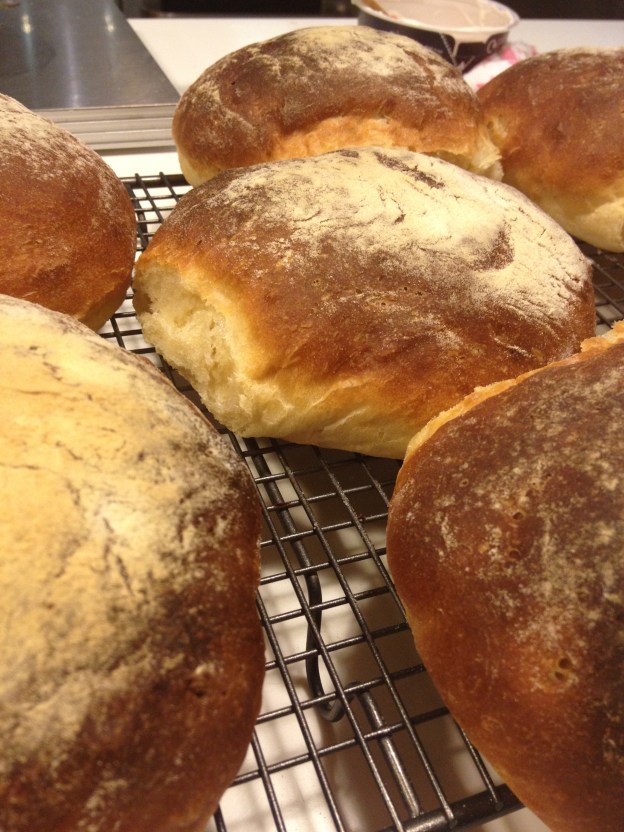
My nine year old first made these with a bit of help from her dad. We needed something for burgers so my partner looked in my Dan Lepard Short and Sweet book. I was no doubt upstairs working, but when I came down to have one I could not believe how good they were. The memory of them stayed with me for weeks. The taste was amazing and they were substantial without being heavy.

I made them again recently to house a frankfurter. I have such a weakness for frankfurters and they are of course, mostly crap. I even went to a posh restaurant recently and ordered a hot dog. I can report that it tasted no different to the ones I buy in the supermarket (I do try to buy the best quality ones but, come on, they are hardly a health food).

Note that following the recipe just as it is, these make BIG baps. They were actually a little too big for me so I cut them in half. We froze half of them and late one evening, after we’d got in after a long drive home, we fished them out. They resurrected beautifully. My partner zapped them up in the microwave and they felt fresh and warm. I had one with just butter. I can’t even begin to tell you how good the flavour is, suffice to say that my mouth is watering at the memory.

Once you’ve tasted these, you will feel so cheated every time you eat a cotton woolly bap from the supermarket. And as they’re pretty easy to make, no excuse for not doing them, and freezing some for some very deserving burgers or sausages one Saturday lunchtime. Or hot dogs.

I’d make them smaller next time, so I’d end up with more, smaller baps, and no reason why you couldn’t make them in ‘finger roll’ shapes should you wish to, for sausages shapes. Or hot dogs.

I have a pretty ferocious oven and mine were done after about 15 mins. But do look at the original recipe here and check yours after fifteen and take them to the full 25 mins if you think they need them. Other than that, I had no problems.

Bread bags

You know that recent BBC class calculator that showed there were now, apparently, seven new classes? Well one of the questions was about who your friends are, as in, what they do. There weren’t enough boxes for me to tick because I’m proud that my social circle includes all sorts of people. I’m perfectly comfortable talking to members of parliament, the aristocracy, cleaners, sales people, chief executives. It’s not that I don’t care what people do, I care a lot, as people spend so much time at work and it matters. But I’m fortunate in that I was brought up being able to speak to everyone, as long as they are happy to talk to me and are polite.  I choose my friends according to what sort of person they are, not what they do.

My parents were also immigrants, you see. They did hard physical work at times because they didn’t have a huge amount of choice. That didn’t make them stupid or not worthy of conversation. Far from it, they are two of the most successful people I know. They also spoke two languages, albeit one with an accent. This already made them more accomplished than most of the English people I met. I worked in my mum and dad’s cafe from the age of seven until I was 18. I saw how people treat waiting staff. Not always good. After I became a journalist, my father opened an ice cream shop and when I used to help out, people were generally lovely. But a few would treat me appallingly. If we got talking, how we got talking I’m not sure, but if we did, and they found out what I did, their attitude to me would change. I found that short sighted.

Anyway, the point is that I get invited round to lots of different sorts of houses. And whilst I can hold a conversation with anyone, the area I used to stall over, is gifts.

It shouldn’t be a problem, but I would get into a tizz over what to bring really rich people who are friends but I don’t know really well. I just felt that, as they could buy themselves anything they wanted, what constitutes a gift, a treat? With friends that I’ve grown up with I’m more familiar with their tastes. Thoughtfulness goes a long way towards the currency of a gift.

I remember being invited to the house of a friend of mine once. He was hugely wealthy, had stables, horses, a chauffeur. When we became friends he gave me five phone numbers. His number in the country, his number in London, his number in the car, his driver’s number and his number in the stables. This was a bit before mobiles were really wide-spread so not as ridiculous as it sounds. Well, not quite. You get the picture. I knew he liked cigars, so I saved up all month to buy him two cigars. Two cigars. Before I took them out he said to me he asked me if I’d like to see his wine cellar. (Really, to choose the wine, this wasn’t foreplay.) As we descended the spiral staircase, I saw row upon row of wines. Really expensive wines like Pichon Lalande, 1982. And then, to my slight dismay, I saw boxes piled high, stuffed full of cigars. I shouldn’t have, as my offering was genuinely meant, but I felt embarrassed and I never gave him my paltry two cigars. This was stupid as he’d have been gracious, but part of me also thought ‘he has loads, I’ll keep these for myself’.

I learned right then that if in doubt, don’t spend money. You can never compete. Or, I can’t. Make something. I’d always known this as it’s in the very structure of my DNA, being Italian where no-one goes into a house without a small jar of something home made or grown. Be it some biscuits, a jar of passata, perhaps a dishcloth full of hazelnuts or some limongello. But I’d somehow forgotten. The first time I made something home made was for my friend K. This was the sort of girl who would take me to her house for the weekend, and blow £80 in a deli on ‘breakfast’.  I couldn’t compete with her wealth. So I made her a cake. As I handed it over she said (slightly teary eyed as I remember) “in all the years people have been coming to my house, no-one has ever made me anything”.

This is a rather roundabout way of telling you about bread bags. If, like me, you make bread for people then what do you give it to them in? Not a plastic bag, as you’d lose your lovely crust. A fancy dishcloth perhaps, but who has those? Plus if they’re really nice dishcloths I don’t want to hand them over. Look, my generosity only goes so far. These bags are great. They have tiny air holes in them so they let the bread breathe (and therefore they also let out any crumbs and flour that’s lurking around the crust). They’re inexpensive and they’re better and cheaper than the Lakeland ones  which were too big in the wrong way (long but not correspondingly wide). I got the 30cm x 40cm ones but they also come in different sizes and I paid about £2.88 for 25. (Lakeland ones are £3.29 for 12.) My Lakeland bags also kept breaking when I put the bread in. So far I’ve not had that problem with these.

Here is a close up where you can see the tiny holes. I do apologise for the pictures. They aren’t great. For some reason it was hard to capture what I wanted to. But it’s really the bread wot’s the star here, the bag is simply a method of transportation.

IMG_0727

Dan Lepard’s raisin (and perhaps cinnamon) bread

The actual recipe that I followed, now that I am on a fresh yeast baking frenzy, was from Dan Lepard’s The Handmade Loaf. If you haven’t bought this yet I really recommend you do.

The recipe in THL calls for fresh yeast, rye levain (although I used regular levain as I no longer keep a rye one), rye flour as well as white flour. It’s got a good old list of ingredients, including cinnamon which I didn’t use as this loaf was for my mother and I wasn’t sure if she liked it or not.

I don’t really have a problem eating “too much” bread, like I know some people do.

However. There have been three types of bread that I’ve come across recently that have caused me to eat beyond the realms of comfort. This bread was one. Dan’s soft baps (from Short and Sweet), which I shall report on another time, were another, and this schiacciata that I made and in which you will see I repeat myself about the bread eating thing, was another.

The dough to this bread is fairly sturdy. I wasn’t overly confident of it coming out okay. But it did. It was lovely. So tasty, moreish and would be excellent with something savoury like cheese but I ate it just on its own, like a not sweet cake. I loved it. And I had some the next day, dipped into my caffe latte.   I especially like it in a ring shape. I do, of course, have a special banneton but if you don’t then you can just use a tea towel, pulled through the hole in the dough.

IMG_0700

Anyway. I asked Dan if there was as recipe on line that was similar to the Raisin and Cinnamon bread in HML, and he said to try this one, but he said to sub raisins for the cranberries.

Baking with fresh yeast. Milk loaf

When I was a child, my mother would cook regularly with fresh yeast. We would have pizza every Friday night, which she would  make in a large rectangular tin; leaving one small section free of tomato sauce for me, as I didn’t like it.

Then the local supermarket stopped stocking it and we bought it from this ‘exotic’ – at the time – little shop that was a Chinese health food shop and I’d have to go far into the back to find the small squares of fresh yeast.

These days it seems impossible to find commercially. Which surprises me given the resurgent interest in baking. Those who do buy fresh yeast either beg it from the bakeries of huge supermarkets or order it in in bulk.

I believe it was the latter that my friend Wendy did, as she took delivery of 2K of yeast. Wendy cooks and bakes ALOT and hangs out with professional bakers and really knows her shit where food is concerned (and antiques). Generous to a fault, she offered a large chunk of this purchase to me and thus it was that on Saturday, the postman delivered half a kilo of fresh yeast to my Suffolk mail box.

(n/b: Wendy tells me you can also get fresh yeast from local bakeries, but I have none near me.)

It had been decades since I touched fresh yeast. I’d forgotten how squidgy it is. But I immediately set about baking with it. When I first bought Dan Lepard’s The Homemade Loaf, the book that set me off on my sourdough journey, I was disappointed to see how many recipes called for fresh yeast. Dan helped me convert fresh yeast = dried yeast but the moment I have to substitute an ingredient for another I feel like I’ve failed (it’s okay, I’ve had years of therapy).

I have never cooked with fresh yeast so I started off with something simple, which is Dan’s Milk Loaf in the Handmade Loaf. It uses plain and strong bread flour, butter, milk, maple syrup and fresh yeast. It was so easy to make. Minimal kneading, then a final prove of an hour and a half. As it was very cold in my kitchen yesterday, I let it go a little longer. I’m so used to being upstairs working when my timer goes off for sourdough. And being able to play loose with timings, and just ignoring the timer, that when I came down to see the loaf, I was a bit shocked to see how much, and how fast, it had risen and for a moment worried that I had let it overprove. But no.

It came out gloriously. It looks like a pair of breasts (a friend thought this was why it was called milk loaf..) this is because you put it in in two ball shapes, although you could do it in whatever shape you want; and the crumb is superb. Wendy tells me this is not a traditional shape for a milk loaf, that it should be cooked in a cylindrical tin with ridges but I do not have one.

IMG_0613

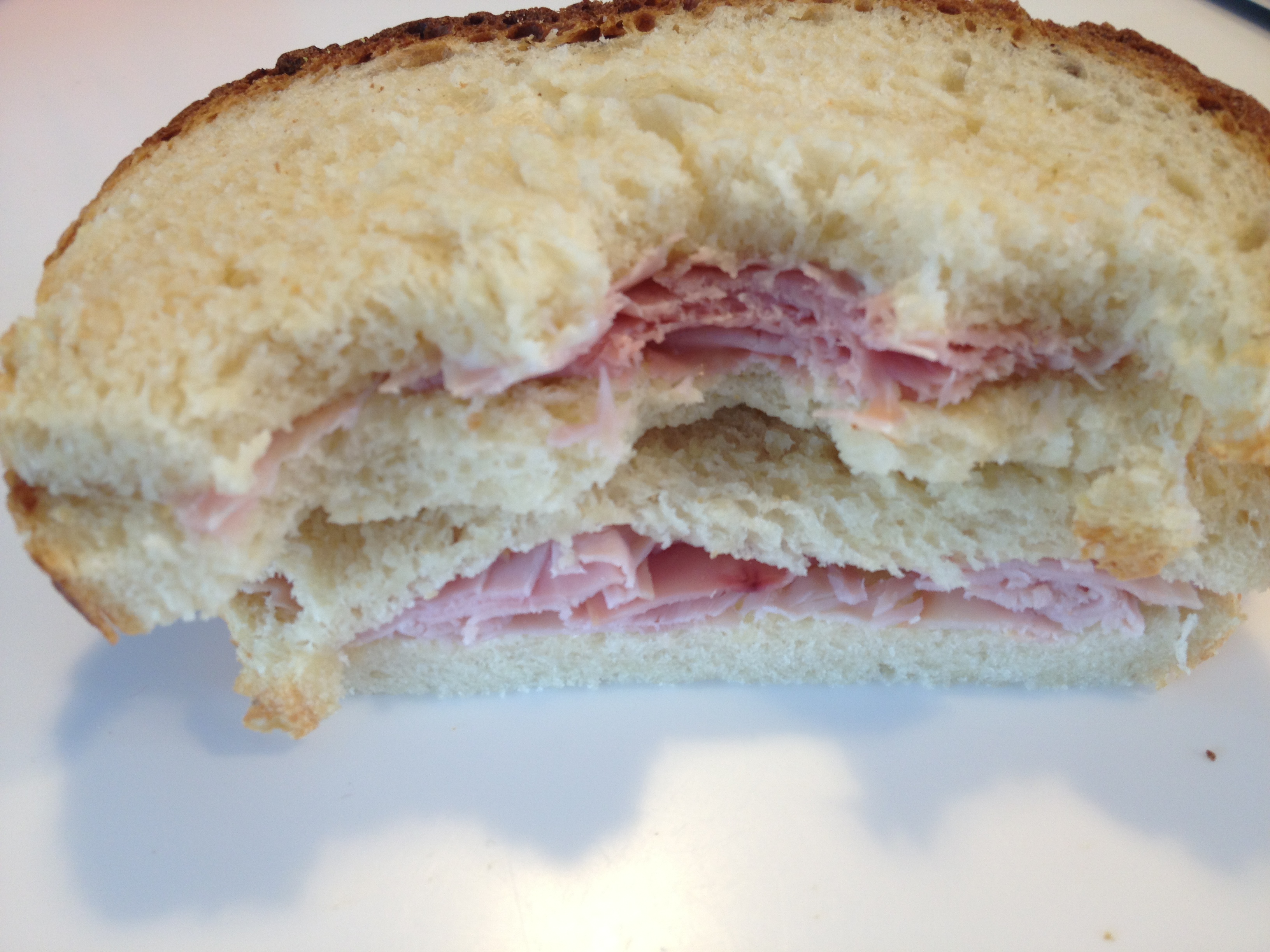
We all had the most delicious ham sandwiches made out of it. It’s an old fashioned taste and not like anything you could buy. I adore my sourdough, but it was so nice to be able to have a loaf on the table in time for lunch, having just thought about baking it in the morning.

IMG_0614

Because I understand how incredibly frustrating it is being given a recipe which ingredients you don’t have, here are Dan’s milk loaf recipes containing more readily available dried yeast. I might try his chocolate chip milk buns next…

I froze the rest of the fresh yeast, in 15g batches in little sealed bags. Weighing it out, tipping them into those little bags. My eldest helped so we had quite a production line going.

Update. I made them into rolls and divided up half and put chocolate chips in them. The rolls make great sandwiches for picnics, the chocolate rolls make a nice, not too sweet alternative to a pain au chocolat, dipped into caffe latte.

IMG_0646

IMG_0647

Day after notes: This bread stales up pretty quickly. It makes great toast/toasted sandwiches though, so no fear. Also we just had it several days old made into French toast and I can report that it was excellent.

The spawning of the sourdough

Photo ©Ben McPherson


I have now shared my sourdough amongst at least four people. Possibly more but I forget. The latest recipients were my friend Ben McPherson and his wife Charlotte, who live in Norway and are keen to get started on sourdough making.

This is the furthest my sourdough starter has ever travelled and I told Ben that part of the deal, now that we were sharing wild yeast spores, was that he had to keep me in touch with how his starter was doing.

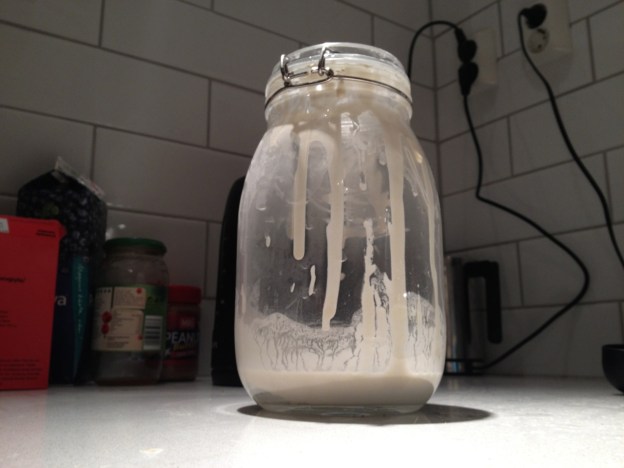
You can probably tell that Ben is a writer, producer and director by this photo of his starter, which he has put in an ENORMOUS jar and obviously crouched down to take this photograph from as dramatic an angle as possible. I said that it – the starter – looked like it needed its own TV show.

Anyway, I sent it heat sealed in a very strong plastic bag and that bag was in a plastic security sealed envelope. And yet the starter burst out of the heat sealed bag (which is made to withstand sous vide cooking) and only the plastic envelope stopped it escaping further. This just shows the power of the sourdough starter.

Ben has refreshed it and will hopefully start baking at the weekend. I hope to convince him to do a guest-post soon. Maybe with sub titles.

Every day sourdough baking

A gratuitous picture of a loaf of sourdough, baked this morning

I get asked, a lot, if sourdough bread is hard to make. I am tempted to say “really hard” to make myself look clever but the truth is, it isn’t.

Sourdough seems uniquely complicated amongst bread baking. I don’t know if it’s purposely shrouded in mystery. I know that it took me about two years to finally get down to it, to be brave enough to try, as it seemed magical and mystical. It is, but it isn’t difficult. The hardest thing about sourdough baking is being mentally ready.

Because once you have a good starter going, sourdough baking is almost bomb proof.

I bake sourdough about three times a week. Mostly I bake this bread, which is half wholemeal and half white.

Although I only bake half of the amount in that recipe, so 500g of flour, 200g levain (starter), 333g of water and I’ve got the salt down to just one teaspoon.

I divide the dough up to prove over two baton shaped bannetons so I have bread for two bakes. The bread in the picture above was proved in one of those bannetons.

It’s easy. The hard bit with sourdough, in terms of faff, has always been the starting off of it. Once I’ve weighed it out and refreshed the starter I know I need to be relatively close for the first three kneads (ten mins apart) and not too far for the one that requires a 30 minute rest. But after that I can do the school run or go out or do whatever. If I know I’m not going to be back in time – be really ages – then I put it in the fridge, and when I get back, simply bring it back to room temperature and take up where I left off.

You could never do that with bread with commercial yeast, because the yeast would get exhausted.

I’ve had a sourdough loaf going over three days.

Various people have said to me that they want to try sourdough baking. Instead of abstemious resolutions that make you feel miserable (isn’t January miserable enough?) try a resolution that will make you feel really good. With a good loaf you always have a meal. And when everyone else is out panic buying because it might snow, you can be smug knowing that with your starter, some flour, water and salt you can turn those tins of stock-piled baked beans into something really glorious.

What to do when someone gives you some of their starter so you can start your own starter..

A present of a little of your established starter really can be the present that keeps on giving

My starter came from my friend Emily; about three years ago now. Her starter was already going on for 18 months old itself, if I recall correctly.

Since I got that fantastic, promising present, my own starter has gone on to spawn many other sourdough starters, not least that of John-Paul Flintoff.

Anyway. I’ve been meaning to, for ages, write up here about What To Do when someone gives you some starter, so here I go.

You could of course give someone a full jar of starter ready to go since, if you have some levain on the go, it wouldn’t take long at all for you to build it up to a whole other working jar size. But this isn’t madly practical unless you can actually hand it over in person. And, also people like to build it up themselves. So what I do when I’m sharing starter is send it on the dry side, so it’s less frisky and likely to tire itself out. I either send it in a small plastic lidded box or double bag it in those sealable sandwich bags.

Hopefully, before you are sent a starter of starter, you will have ready:

A large jar
Some white, strong bread flour.
Weigh the jar when it’s empty and make a note of it.

What you do when you get it is this:

Put the starter in your jar. Add 50g white strong bread flour, and 40g of out of the tap water. Mix it up well and put the jar aside. In the fridge or a cool place in your kitchen.

You don’t need to remove any starter, you do that when your starter is big and to keep refreshing it would mean you’d end up with unfathomable amounts of the stuff.

The next day, if you want to, take out a tablespoon of starter and discard it. There is no reason for this, it just kinda feels authentic. Add another 50g white strong bread flour and 40g of water.

What you want to do is build up so that you have about 300g of starter in your jar (because for most breads you use about 200g of starter). So you keep repeating this until your jar is about 3/4 full when it’s just refreshed.

Never fill it up to the top as if you do, as the starter grows (because it will go up and down during the day until it settles) the jar can explode. Don’t worry if you look at your starter during the day and it regularly goes up to near the top, that’s normal. What it mustn’t ever be is that full when it’s just been refreshed.

When you’ve got about 320-350g of starter going (this is why you weigh the jar empty) you’re ready to go. Every time you bake – presuming you use 200g of starter, refresh your jar with 120g of white bread flour and 100g of water. Or, if it’s looking a bit full already, 100g of flour and 80g of water.

And you’re ready for a life time of baking.

Unless you bake every day, keep your starter in the fridge. I bake bread about 2/3 times a week and never need to discard starter to refresh it, I just use it straight from the jar.

I hope this makes sense, do ask any Qs if you need to (on here please so others can benefit).

Schiacciata

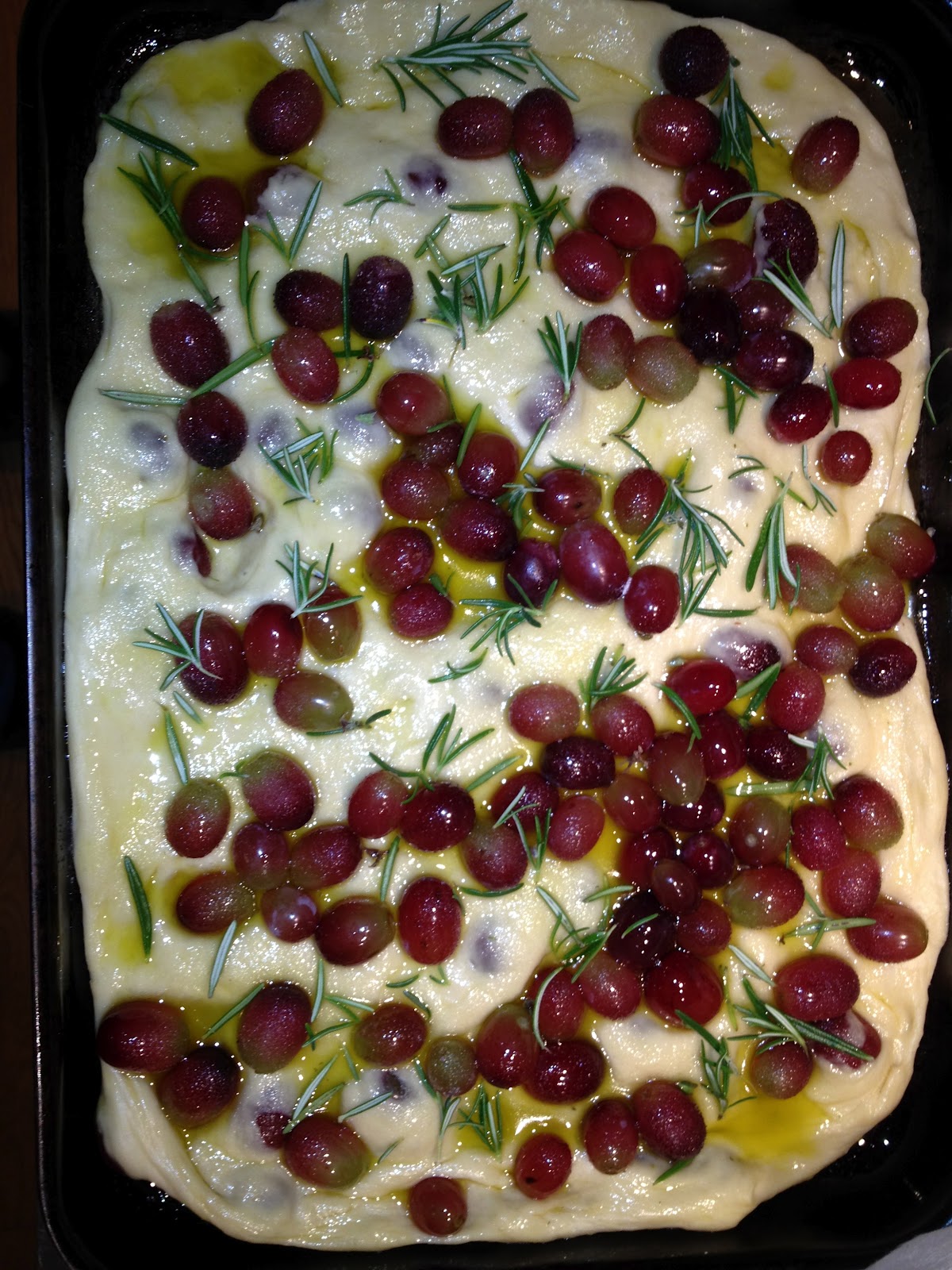
Aerial view before going into the oven

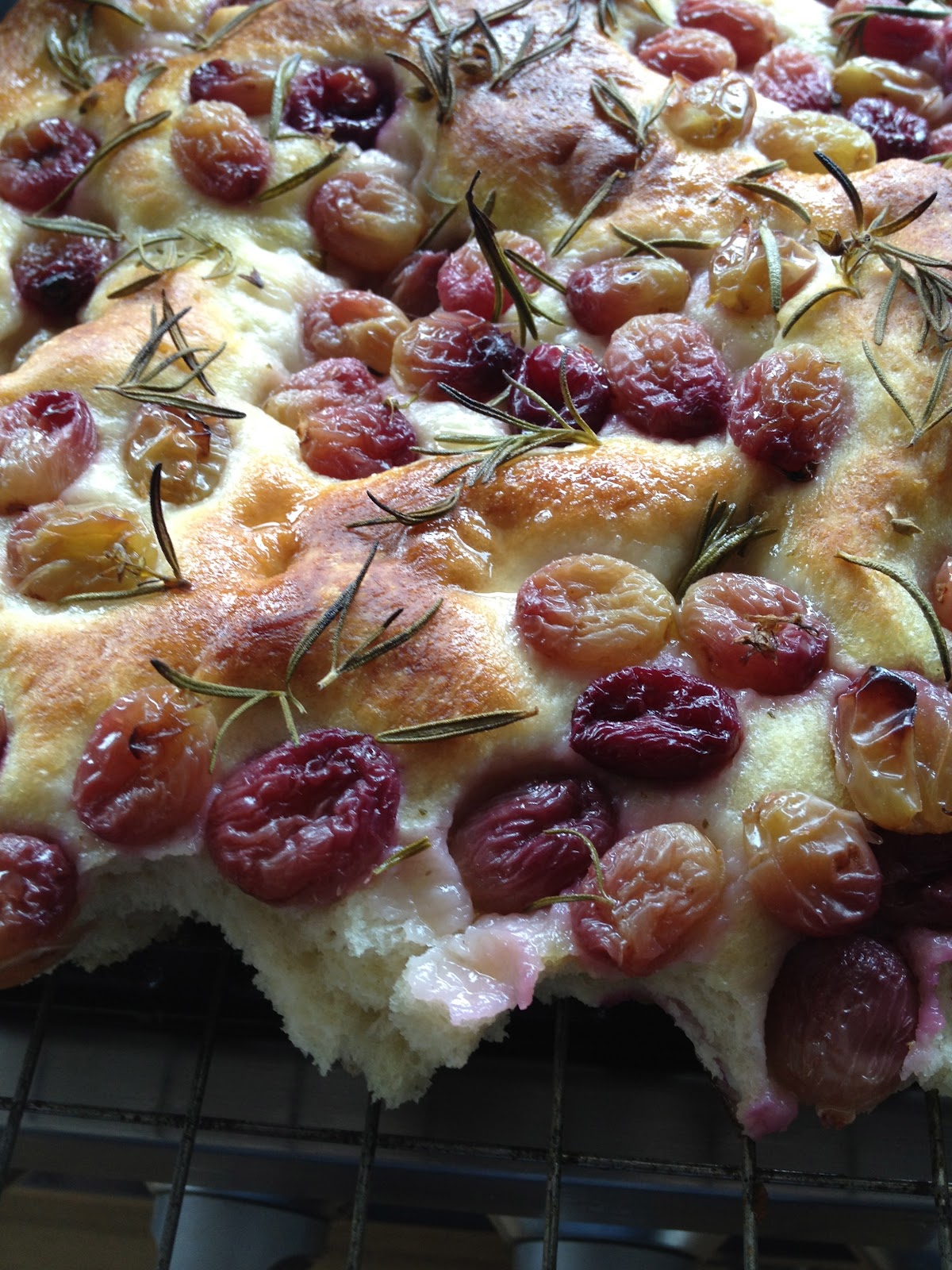
Schiacciata means squashed in Italian, and this is a recipe for a sort of foccaccia bread with grapes squashed into it. It’s not a sourdough recipe, you don’t need a bread maker. It’s really very simple. I have had this recipe for ages, cut out from an Italian magazine and converted into English stuff.

It’s an odd bread though. People often say to me things like “oh God I couldn’t make my own bread I’d just spend all day eating it”. Well, I don’t spend all day eating bread. I think this is largely because sourdough (what I usually make every day) is delicious, but satisfying. Even though it’s a sum of parts of water, flour and salt, the way it’s made makes it far more satisfying than bread made with commercial yeast plus those same parts. My partner makes a foccacia that is so addictive I am as bloated as a puffer fish by the end of a meal as I carry on eating it well after my stomach is stretched to fullness.

This is an odd bread, however, because what would you eat it with? Well cheese is an obvious one. A salty cheese especially I think (actually, almost any after-dinner type cheese, I just really wanted to write the words ‘salty cheese’). And I think it would be perfectly wonderful with Parma ham. Whatever you have it with, it makes for a very attractive centre piece, would make a lovely present, is easy and quick to make but really needs to be eaten within a day of making it. It’s lovely warm, but not too hot, from the oven. And it’s very hard to resist, so don’t make this if you’ve just gone on a diet (loathsome word). You won’t get a big, airy crumb. This is altogether a more cakey bread.

So, this is what you need:

1tsp of dried, fast acting yeast (I use Dove’s)
1tbsp of caster sugar
80ml extra virgin olive oil
Fresh rosemary sprigs, I dunno, like about five or six
200 strong white bread flour
200-300g red or black seedless grapes, washed and dried, all off the stems.
a generous half a teaspoon of salt

You can easily double up or treble the recipe. I double it usually and make it in a big rectangular tin. But really, that gives you enough for a dinner party and you don’t really want that unless you are actually having a dinner party. And as this bread doesn’t keep I’d keep the quantities modest until such time as you know you’ll be feeding the five thousand.

This is what you do:

Chop up the rosemary sprigs (take the leaves off the stems) until you have very finely chopped bits, about a tablespoon’s worth. Put in the olive oil in a pan and warm very gently through for a few minutes. Then take it off the heat and let it cool and infuse. You want it to be back down to kinda blood temperature, honestly as long as it’s not boiling hot you can’t go wrong.

Whilst that’s happening, mix the yeast in 90ml of warm water and a scant tsp of the caster sugar (more like half really, kinda like a pinch). Whisk gently and leave for 10 mins until frothy. Maybe longer, but it will have frothed and puffed up a bit.

Now add the flour and salt to a bowl, make a well in the middle and then the yeast mixture and half the rosemary oil. Mix together roughly with your hands until you’ve got it mostly together. Leave, covered, for about 8-10 mins.

Turn out onto an oiled board and knead for about ten seconds. Leave for 8-10 mins.

Turn it out onto an oiled board again and knead for about ten seconds. It should be all nice and smooth now. If not then do it one more time. If it looks good and smooth, cover with a bowl and leave to rise at room temperature for 1-2 hours. Sorry not to be more accurate, but it depends on your room temperature. Until it’s doubled in size. As a guide, my kitchen was at 22C and it took about 90 mins.

When you feel it’s ready, oil a suitable oven proof dish – you can use a round cake tin (23/24cm) or a rectangular one. You need something with sides really as you’re going to be brushing it with a lot of oil and you want to keep the oil in the dough, not escaping out onto a baking tray. I sort of squash the bread in, and over about 10 – 15 mins (so the dough is nice and relaxed) I push it out to the sides of the tin so it fills it. You want a thin layer of dough, not thin-crust pizza thin, but about 1-2cm thick.

Now squash the grapes in. I say squash but don’t break them, kinda push them in. Brush the bread with the remaining oil. yes it will see like a lot. Now scatter over some more rosemary, sprinkle over some caster sugar (not loads) and set aside for about half an hour, covered with cling film or a very wrung out damp teatowel.

In the meantime preheat the oven to 250 (or as high as it will go if not as high as that). Bake for about 10-12 mins, then turn down to 220 for a further ten mins or so. It’s done when it’s golden brown.

Cooked and heavily nibbled by someone.

What to do with your starter when you go away

This piece in the Guardian today is getting quite a lot of attention on Twitter. I think some people have taken it a tad too seriously…(it’s about checking your sourdough start into a hotel).

But it does bring me onto something pertinent, which is that people who I’ve got into sourdough (I’m a sourdough pusher) and have shared my starter with, have gone into a panic about going away.

It’s really no big deal. If you go away on holiday:

Make sure your starter is in a big enough jar to cope with any expansion.
If you’re worried about your start erupting (I never do, but I know some people do) then refresh it about 24hrs before you go away, not just as you leave. So you can keep an eye on it.
Keep the starter drier than usual so it’s less frisky.
Put your starter in the fridge.

I have to say, I don’t do anything different as I know my jar is big enough and I know how my starter behaves, but just to be extra cautious.

It’ll be fine. When you come back, refresh it as normal once or twice before you bake.

That’s all. Happy hols!

Burger/hotdog buns

The hole in my bread-making repertoire was, until yesterday, burger-bun shaped. Despite making my own sourdough, bagels, monkey bread, pizza, I hadn’t managed to make (in truth hadn’t ever really tried as I thought it was beyond me) any sort of soft roll to enclose a burger or sausage or hot dog. And any time we bought them in the supermarket, those cotton woolly rolls, I felt more annoyed with myself.

I really dislike supermarket bread.

Yesterday we had people round and we were going to make spicy butternut squash soup and sausages in a roll. So I determined to finally make my own rolls.

I remembered, a while back, Dan Lepard had written about making burger buns (the article and full recipe is here), and the response had been that they were very good. So I gave them a go.

Because we had so many people round I doubled the recipe, and I hope Dan will forgive me for reproducing it here, but I just find it easier to have everything in one place.

You need: (Dan says this makes about 6-8, I made them smaller and submarine roll shaped and got about 24 out of doubling the mixture).

275g sliced white onion
50ml sunflower oil plus extra for greasing the surface you knead on
75g low fat yoghurt (I used Greek yoghurt, as that’s what I had)
2tsp of honey (oil the spoon first so the honey just drops off)
1 medium egg
1 sachet or 7g fast-action yeast (I use Dove’s Farm)
75g wholemeal (normal, plain) flour
425g strong white bread flour
2tsp salt (I grind up Maldon sea salt)
poppy seeds

The first thing you do is put the onions, with the oil and a bit of water, into a pan and let them sweat until very soft and translucent, with all of the moisture gone. Leave to cool then tip into a large bowl (with any oil that’s still in the pan). To this add yog, honey and egg. Then add 125ml warm water and the yeast, the flours and salt. Mix together. You will very likely have to add more water – Dan suggests 50ml – it depends on how much moisture is in the onions and how you like your dough to be. I’m quite confident now with a very soft dough. But add the water bit by bit to see how you go.

Leave for 10 mins then tip it out onto an oiled surface and knead lightly for 10 seconds. Cover with a bowl or put back in the bowl and cover..and repeat this twice more – leaving it for ten mins then kneading it for ten seconds.

After the third knead, leave it covered and undisturbed for one hour.

Then take bits off it and start shaping – either large round buns, or long ones, whatever you like. Put on a baking parchment lined tray. Brush with water and sprinkle on poppy seeds (or you know, any seeds you like or no seeds). Cover and leave to rise for about 90 mins – Dan says until they’re 50% risen. In my kitchen (about 21 degrees) this timing was pretty spot on.

Put rolls into a preheated oven: 220C. Dan says 15 mins, mine were done in 10 (my oven is very hot), they’re done when they’re just “brown on top”.

They are delicious – really soft and tasty. I didn’t tell the children there was onion in the dough and they all seemed to love the rolls. And it saves having to add onions to the burger/hot dog, although you can add more if you want to. There’s really no sharp taste of onion or anything like that. That said, if you want to leave the onion out, I asked Dan and he said “the precooking of the onions sweetens them and softens the flavour, but leave them out if you like and only add in half the oil to the dough.”

Really top notch, so easy and delicious. I have frozen some for emergency burger needs.

Now, someone gave me a recipe for panettone last year: if it was you please could you let me have it again?