Category Archives: Patisserie

Eclairs

The best compliment I got was from a nine year old girl (not mine) who said “these are like real eclairs”

Here is a confession. I really am not that into eclairs. I know people who go cuckoo for them. Not me. I’m not overly a fan of choux (unless in a Paris Brest), nor whipped cream. Basically, eclairs aren’t piggy enough for me.

The first time I made choux pastry I was very young, about eleven and it was in HE. No-one told me it was difficult so I didn’t sweat over the choux pastry and I made the most amazing profiteroles. (Equally, no-one told me puff pastry was difficult and I used to make a great puff pastry.)

As I got older, and everyone went on about how hard choux pastry is, well that, coupled with my slight meh-ness towards them…meant I didn’t really try.

My children love eclairs so I decided to give them a go. They were easy. So easy I was expecting the sky to fall in.

I’d love to hear how you customise them.

The recipe for choux is pretty standard:

125ml water
50g butter
75g plain flour
3 medium eggs (at room temperature, this is important)
pinch of salt (I think this is key, choux is pretty tasteless, but the salt adds something).

The filling

I just used double cream, about 300ml, whipped up with a spoon of vanilla essence and a tablespoon of icing sugar. Or try delicious white chocolate cream, which is what I use as a default filling these days.

The topping

I used 150g 70% cocoa chocolate and a teaspoon of vegetable oil, melted in a bowl, over a pan of boiling water. Then manually just dipped the eclair tops in and set them down on a cooling rack. Hardly any drips..

Obviously with both filling and topping you can change it. Next time I’m going to try something a bit more adventurous.

You also need a piping bag and plain nozzle of about 1cm diameter. A baking tray and some baking parchment.

Oven to 180C.

Put the water and butter in a sauce pan and cook over a high heat. Stir until butter is melted and bring to the boil. When this happens, lower the heat and add in the flour. Beat with a wooden spoon until smooth and the mixture leaves the sides of the pan. For me this happened almost immediately.

Remove from the heat. Now. Some recipes say to let the mixture cool and then add the eggs. I can only tell you how I did it which was to add the eggs straight away to the mixture, once in the electric mixer bowl.

So. Put the butter/water dough in an electric mixer with the whisk attachment and add the eggs one at a time.

This is the important bit. After you’ve added the first egg, the mixture must be absolutely smooth before you add the next egg. At first the mixture seems to curdle, more so if your butter/water dough is hot and the eggs are very cold. It will look like scrambled eggs. You will want to cry.

Don’t. And don’t panic. Keep mixing. It will eventually blend together and go smooth. Honestly mine took a good five-ten minutes during which I started to panic and think “why the hell did I not LISTEN to everyone who told me choux pastry was so hard.” Keep the faith. Keep mixing. It will smooth out. Then, add the next egg and mix until smooth and then the next one. I added the salt with the third egg. No idea why just did.

The mixture is ready when you lift the whisk and it leaves ribbon marks – indentations in other words.

Put into the piping bag. I find it useful to a) use a clip to secure the top of the icing bag – just above the nozzle – so that the mixture can’t ooze out. By clip I mean like those Klip-it things you use to keep food in a plastic bag fresh. b) put the bag in a tall glass and fold the top of the bag over so you can spoon the mixture in. Obviously when you are ready to pipe, you take the Klip-it off.

This mixture pipes really beautifully, so pipe eclair shapes (or profiterole shapes) onto the tray, leave a good gap as they do grow.

Put in the oven. I cooked mine for 30 mins and they were perfect, dry and crispy. My patisserie expert said that’s how high quality eclairs should be – kinda dry and not soggy like shop bought ones. You can’t really overcook eclairs (well, actually you can but you know…). I cooked some profiteroles another time and gave them 35 minutes and they were fine.

Don’t be tempted to open the oven at all if possible and certainly not before about 25 minutes.

They should be puffed and golden. Mine were almost empty inside. There was no need to dry them out inside as some recipes suggest, by placing them back in an oven.

I just cut them lengthways when they were completely cool and did the topping first (put the topped eclairs in the fridge for five mins to make the topping set if you’re in a hurry), then I added the cream with another piping bag (I was piping bag mad by this stage).

They all got eaten that day. And when I served them the second time round, because I had some salted caramel left, I added a dollop of that in too. I am salted caramel crazy though.

The reason I’m writing about these is that they were so easy and the return to effort ratio so madly unbalanced in favour of the return part, that I did wonder why I had left it so long.

Update on 6th March 2013. I thought it might be useful to have some troubleshooting here.

There are a couple of key important bits in making eclairs. The bit in the saucepan, with the flour and the butter/water…make sure you really dry this mixture out. By that I mean, even when it starts to come off the sides, keep going for a minute longer. The more you dry it out now, the more eggs you will be able to add (more on this later). The more eggs you can add, the more the eclairs will rise.

What do you mean, the more eggs I can add? Don’t you say three eggs?

Yes, yes I do. But here’s the other thing. I make this all the time with three eggs but mine are medium (in fact I’ve altered the recipe above to say this). Eggs differ in size, although it’s usually the amount of white in an egg that differs between the different sizes. So if you were to crack open a medium and extra large egg, the real difference is in the white, not the yoke.

Anyway, when you’re at the adding the eggs stage, if you’re new to this, I’d whisk up the third egg before adding it and then add it a bit at a time. What you want is a mixture that’s thick. Don’t be afraid to give it a really good whisking, don’t stop just the moment you think it’s done. You want the mixture to be able to stand in stiff peaks. If it’s not thick enough at this stage, it won’t get any thicker at the piping them out stage. So when you stop whisking you need to be absolutely sure it’s thick enough, otherwise,  you pipe it the eclairs will spread.

If you add too much egg, then the mixture might get too sloppy which is why I recommend adding it in stages if you’re new to this.

Should I cool down the butter/water/flour mixture before putting it in the mixer?

Almost every recipe tells you to do this, to cool it down otherwise it will cook the eggs.

I don’t. I know, madness, but I’ve tried it both ways and for whatever reason I’ve found that if I add this to the mixer and add the eggs straight after the sauce pan stage, my eclairs rise more. Yes you do need to beat the first egg in for much longer and it will go through a scrambled egg phase. Try it whichever way you want and see how you go. I’m fairly brave with patisserie making so I like to fly by the seat of my pants. You may want to go more slowly. Both are fine approaches.

If you’d like more ideas about what to fill them with, other than cream: chocolate ganache filling recipe here; white chocolate cream filling here (this is YUM). And not long after I originally wrote this I stopped cutting the eclairs in half and instead using a piping nozzle to fill them.

Madeleines

Spot the eager small child trying to reach up for a madeleine

It started with the purchase of a madeleine tray. Because, ya know, I don’t have enough baking tins. Then came the hunt for the perfect madeleine recipe.

Big disappointment. Many were nothing more than a sponge recipe that you then baked into a shell-shape.

Then I came across a recipe by Heston Blumenthal in, I think, The Times. If I recall the tale correctly he made these for his wife when he was courting her. They are exquisite.

Here’s what you need:

125g unsalted butter, plus a bit extra for greasing the mould
100g icing sugar
40g ground almonds
40g plain flour, plus again a bit extra *
3 large egg whites
2 teaspoons of honey
Finely grated zest of a lemon
Salt

*I have made these, really successfully (like can’t tell the difference successful) with rice flour for those that can’t have wheat. I made these for the super talented opera singer Sarah Connolly with rice flour and she LOVED ME FOR IT. I think she may have even shed a tear, although that may have  been at my singing.

This is what you do.

Don’t preheat any ovens just yet.

Put the butter into a small sauce pan over a medium heat and melt it, keep it on the heat until it starts to sizzle and, Heston says, have a nice nutty scent to it. I have an atrocious sense of smell so this never happens for me and I do it by eye, it goes darker is the only way I can describe it and takes about five minutes. You’re making beurre noisette.

Don’t panic. It’s not like making caramel. Set it aside and take a deep breath. You’re about to make something delicious.

Take your madeleine tray and grease it with some of that extra butter. Unlike when you make friands (more on them another time), don’t be tempted to melt the butter and brush it on. It makes the mads too greasy. Once you’ve buttered the moulds, sprinkle some flour over and tap off the excess.

This is where a flour duster must really come in handy. A flour duster is a kitchen gadget I do not (yet) possess.

Now, sieve the icing sugar, ground almonds and flour into a bowl. You’ll no doubt have some bits of round almond left over in the sieve, just chuck that in too when you’re done. Using a fork, whisk the egg whites into the sugar/almonds/flour. Just lightly and with no panic. You’re not making meringues.

Now add the honey, whisk it up a bit more. Now add the butter which should be warm, but not hot. Now the lemon zest and mix until everything is homogenous. To use Heston’s very particular word. Now add a bit of salt. I grind up some rock salt for this.

Now press some cling film or baking parchment onto the surface of the mixture and rest it in the fridge for at least an hour. I’ve left it overnight and longer. The gluten relaxes to produce a madeleine that is, to quote Ross in Friends (The “Manny” episode) “Lighter than air”.

I have, at this stage, transported the mixture on holiday, or to friends’ houses so that I can cook up fresh madeleines on a whim. But what you’re meant to do next is fill the moulds (which you could of course grease whilst the mixture is resting) with the mixture. Heston says they make 10 but I’m sure I’ve made 12. Anyway you fill with madeleine mixture and put it in the fridge again for half an hour (or longer if need be).

No-one said this was going to be quick.

Preheat oven to 170C.

Cook for 10-15 minutes. They should be dark brown around the edges but golden otherwise. Turn out (you may need to prise the edges with a knife) and leave for five minutes before eating. You REALLY need to eat these warm from the oven, they will never be that good again.

Nearly all gone..

Update, 24 June 2012

After several requests from my children to make chocolate madeleines, I decided to try to adapt this recipe. What I did was melt 50g of plain chocolate and divide the mixture made above into two.

Into one of the halves half I drizzled the melted chocolate and stirred it well. I then dolloped a spoon of the chocolate mixture into my madeleine tray, a spoonful of the plain mixutre and cooked as above. Result: fantastic. The chocolately bit was really chocolately. I had worried it might alter the mixture in some way, but only for the better!

The only thing I’d change is that, next time, I’d swirl the chocolate mixture into the plain mixture using  a skewer or something, to make it more marbled. Dunno why, just think it’d be nice.

But generally, I feel really very clever.

You can also add a handful of chocolate chips to the plain mixture.

IMG_1407

Cherry Bakewell Slices for a picnic

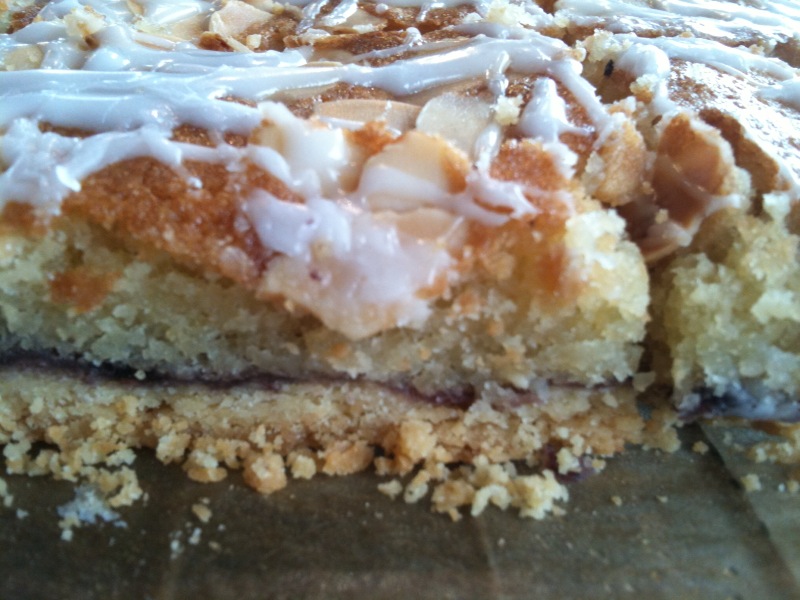
The Bakewell slab, before it was liberated into slices. Please note how crumbly my pastry is thanks to my super cold heart and hands.

We went to Southwold at the weekend, and central to this, central to most trips in my life, was a picnic.

We had everything other than something treaty to take with us (like sourdough bread, home made coleslaw and pork pie aren’t treat enough, spoiled bastards that we are). I had some ground almonds I wanted to use up and decided to make individual little clafoutis, until I found out that mostly the recipes I had for clafoutis didn’t really involve ground almonds and anyway I didn’t have enough cherries. But I did have a can of ‘black cherries in syrup’ and lots of ground almonds.

What could I make?

I make a really superb (look, there’s no immodesty in the truth) Bakewell Tart, the recipe for which came from the Waitrose magazine long ago. Believe me when I say you don’t need to search for any other bakewell tart recipe as the Waitrose one cannot be beaten.

But I didn’t want a bakewell tart. I wanted little individual things to pick up. So I thought: bakewell slices.

So I adapted the recipe slightly. First I made the pastry:

200g plain flour
2 tablespoons icing sugar
100g cold unsalted butter, cubed
2 egg yolks
(you may also need a bit of extra water).

I whizz the flour, sugar and butter in my Magimix, then add the egg yolks and a bit of water if necessary. Don’t overdo it with the water and try to keep the pastry so that it’s just holding together, it shouldn’t be all smooth and one big ball. If you haven’t got gadgets of course you can do this with your fingers and then use a fork to mix the yolks in or something. I don’t know, it’s ages since I didn’t have gadgets.

I never roll out pastry. Life is too damn short. It’s not too short to make your own pastry though cos shop bought really isn’t the same and how long does it take to weigh out a few ingredients and slam them in a blender?

When it’s blended, I just take bits of the pastry and flatten it out into the bottom of whatever tin I’m using, welding it all together with a thumb like a giant pastry jigsaw. In this recipe I used a small Mermaid roasting tin which is about 30cm by 23cm. I lined it first with baking parchment/paper.

Then when you’ve covered the bottom of the tin with pastry in this piece meal but completely acceptable fashion, chill the pastry for about half an hour (perfectly do-able to chill for longer of course).

In the meantime, preheat the oven to 190C. When the pastry has rested, cover with foil, pour on baking beans (sorry, apparently you can use rice too, never tried it, I’ve had baking beans since I was seven, I’ve always been very serious about pastry). Bake blind (this means with nowt in it but the baking beans on the foil) for 15 mins. Then remove the beans (take care they’ll be hot) and bake for a further five minutes.

The filling part 1

Now I have a problem with jam. It’s just too damn sweet. The only shop bought jam I really like is Bonne Maman’s apricot conserve, although I can’t eat the chunky bits of apricot as they scare me. When I make my Bakewell Tart, I use strawberry jam, very thinly spread. But I had that can of black cherries in syrup that I was determined to use up.

So I poured the whole contents of the can into a saucepan and boiled it until it was mush. This takes about 10-15 mins. It makes for a really nice fruity layer which isn’t too worthy (it has got syrup in it after all) but isn’t as teeth-jarring as jam. *See note at bottom. Just use jam or compote if you don’t have cherries in a tin.

Whilst you’re reducing the cherries in syrup, make the filling pt 2:

125g caster sugar
100g very soft unsalted butter
3 eggs
half a teaspoon of almond extract
150g wonderful ground almonds (I LOVE ground almonds)

Mix the butter and sugar together until it’s light and fluffy, this is quite a good work out for your arms and you’ll expend about 12 calories to offset against the calorific value of these slices, then add the eggs, one at a time, mix well, la la la,  then the almond extract and finally fold in the ground almonds.

Spoon the black cherry mush onto the pastry case, then on top spread the topping. It looks like you might not have enough but unless you’re using a giant tin, in which case you haven’t read my instructions, you’ll be fine.

I also like to top it all with flaked almonds, like a handful scattered on top. You can never have enough almonds, rich in protein (so they bring down the GI of anything), calcium and essential fatty acids. How can you go wrong. Unless you’re allergic to nuts of course.

Cook for 25 mins or so, the top should be definitely golden, not pale blonde. When out, tie your hands behind your back and dive in face first. Or alternatively, slice into Mr Kipling type slices, big or small depending on what suits your psyche. You can also drizzle some icing on in that fancy filigree way (50-75g icing sugar with a few teaspoons of water, do it slowly so you have a fairly thick mixture, not too runny but not so thick it blobs on). I do like icing, but remember you’re adding on a whole heap of sugar for that bit of icing, so go easy.

These keep lovely in an tin for a few days and make lovely treats. My boyfriend cries slightly when he eats one.

*update. March 2014. I made these today and I did exactly what it says up there. But. I found that this time, the cherries weren’t enough to cover the base. I’m not sure if the tin was smaller (I don’t think so). I did use a different make so maybe they were just different. Anyway, the point is that I realised that not all tins are equal and I’d hate for you to make this and it not work. So have some jam or compote on stand by just in case, or you know, FORGET THE GODDAMN cherries in a tin altogether and just use jam or compote. It’ll be cheaper, too.