Category Archives: Pudding

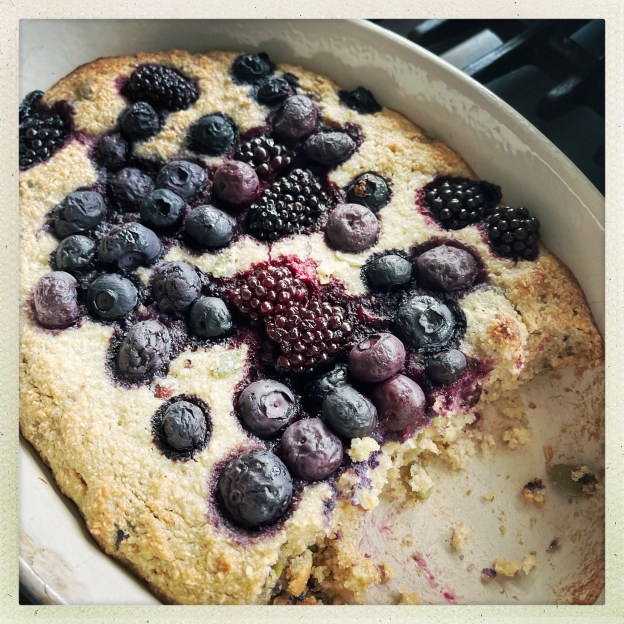
A super healthy clafoutis

So, first up this is from Tim Spector’s excellent The Food for Life Cookbook which you should buy.

I have a very restrictive and healthy diet (no dairy or soya, minimal animal products, nightshades and sugar). Regular cakes, biscuits n ting are a thing of the past. I do taste chocolate as that’s my job, but in tiny amounts. So Tim’s book (as well as some of the Deliciously Ella books: the first one was awful but they’ve got really good since) is a Godsend for me. I still make yummy things for my family and friends but I rarely have anything for me to eat that’s desserty. Don’t feel sorry for me! I look great, have lost a ton of weight, feel pretty good most of the time and can, and still do, eat pasta and bread because my nutritionist – Pr Valter Longo – is Italian!

I didn’t have much hope for this but I made it for some girlfriends and I really loved it and my friend Katie went mad for it, but I thought I could improve it (sorry Tim) and so this is my adapted version.

55g light brown sugar
3 tablespoons of extra virgin olive oil
1 egg
200g kefir (I use coconut kefir)
100g oat bran
100g ground almonds
35g toasted hazelnuts (or nuts of your choice, or more seeds), chopped
35g pumpkin seeds
half a teaspoon of baking powder
Pinch of salt
160g frozen berries or fresh ones (I particularly like cherries when they are in season)
Zest of one lemon

Oven to 200C, oil an oval baking dish (the sort you might make a crumble in, Tims says 23cm round one).

Basically put everything together, mix well, spoon into the dish, whack in the oven for 25 mins. Best eaten warm, it also makes a rather nice breakfast. Serve with whatever you want/can eat. I have mine with coconut yoghurt.

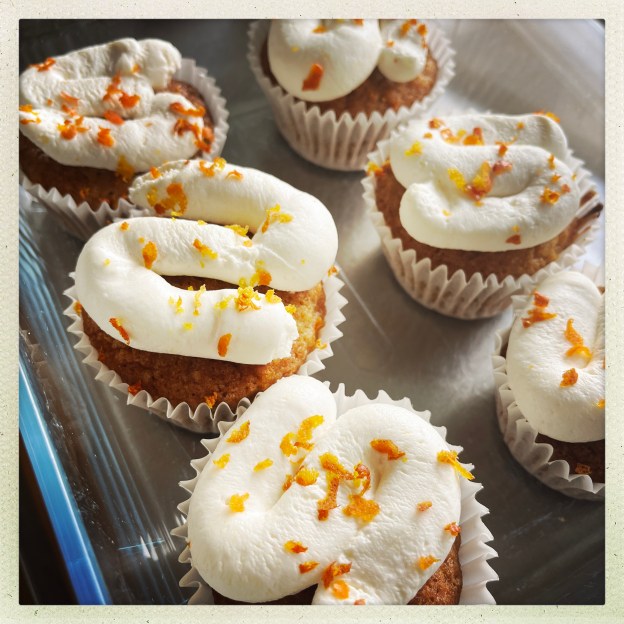
Carrot and Cardamom cupcakes

These are delicious, fresh and light and adapted from a Waitrose recipe which you can find here.

I changed the frosting as I can’t bear an overly sweet one and the addition of the Fiori di Sicilia is, if I say so myself, inspired…

Unfortunately they don’t travel well and need to be kept in the fridge – if you can let them chambré at room temperature for a bit before eating. I guess you could make this into one giant cake but not sure why you’d want to…

Ingredients for the cakes

12 cardamom pods
175g light brown sugar
200g self raising flour
Half a teaspoon of baking powder
Quarter a teaspoon of fine sea salt
2 eggs
150ml of olive oil
200g of carrots, coarsely grated (I hate grating things)
Two oranges, preferably organic as you are using the zest. You’ll only need the zest of one for the actual cakes. So if you’re short you really don’t need two but the zest, grated, as a decoration – see later – does look nice.

Ingredients for the icing/frosting

250g mascarpone
85g Greek yoghurt
55g icing sugar
Optional but wonderful: a good few drops of Fiori di Sicilia essence. You can also add this into the cake mixture if you prefer.

Oven to 180C.

You’ll need a 12-hole muffin tin lined with muffin papers. Open the cardamom seeds, discard the shells and grind up the little seeds as best you can. It’s good if you’re in a bad mood here as you can really bash away with a pestle and mortar.

Whisk together the sugar, flour, baking powder, salt and the ground up cardamom when ready.

In a separate, larger bowl whisk together the eggs and olive oil then pour over the dry ingredients with the grated carrot and zest of one orange. Gently mix until combined well and then pour equally into the muffin cases.

Bake for about 20 mins until a skewer comes out clean and they bounce back when gently pressed (careful not to burn a finger). When done take out and let cool completely (I take them out of the tin, still in their cases of course, about ten minutes out of the oven).

You can make the frosting whilst they are cooking and put it in the fridge for later. Here you just mix the mascarpone, icing sugar and yoghurt together with a few drops of the Fiori di Sicilia. You should have a fairly thick mixture. If it’s not thick enough for you (and sometimes it isn’t due to the water content of the dairy) then add a bit more icing sugar.

When the cakes are cooled you can ice the frosting on – it looks really good if you can be bothered to do this but I admit sometimes I just can’t be so I just spoon/spatula it on thicky and then, if you had another spare orange, grate zest on top. Voilà.

Plum and Olive Oil Cake with Lemon Cream

This is a slightly adapted recipe from The Waitrose magazine and it is wonderful. Soft, moist, delicious, simple. Just the perfect cake to have in.

You need a round tin measuring 20cm/8″ lined with baking parchment – you can line just the bottom.

Oven to 190C, cooking time 1hr

Ingredients

150 plain or spelt flour

75g ground almonds

Two teaspoons of baking powder

Zest of an unwaxed lemon

Pinch of salt

Three eggs

200g caster sugar

180g natural yoghurt (I used Greek organic)

100ml of very good (or as good as you can) extra virgin olive oil

400g ish of plums stoned and cut into pieces

(I’m sorry, there’s no reason for these gaps in between the ingredients, I have no idea why WordPress does this, if anyone knows do let me know!)

Lemon Cream

225ml double cream
Two tablespoons of lemon curd

Preheat the oven to 190C. Mix together the flour, ground almonds and baking powder and then add the lemon zest and the salt.

Whisk together – preferably using an electric whisk or your arms will fall off – the eggs and sugar until pale and thickened. About 5-7 minutes. Then slowly whisk the yoghurt and olive oil until all combined.

Now slowly fold in the dry ingredients. I used the whisk to do this but switched off if you see what I mean.

I placed the plums on the base of the cake tin and poured the mixture over the top. Mine was done in an hour, but after 20 mins I covered the top with foil. Yours might need a tad longer – check with a skewer or dry piece of spaghetti, it should come out clean.

You can serve this nicely warm, about 30 mins out of the oven. Or you can let it go cold. In warm weather, store in the fridge and to take the chill off give it 10-15 mins in the microwave. Serve with the cream which you have whisked together with the lemon curd – it all comes together very nicely, very fast.

Yorkshire Eclairs

These were a beautiful accident.

We had guests coming, and I had planned to make normal eclairs, stuffed full of white chocolate cream. But as I went to get the mixture out of my Kenwood mixer, I noticed the whisk attachment, which I’d had for about twenty years, had splintered and broken. There were really sharp filaments of metal sticking out, and I couldn’t risk the possibility that some had got into the mixture (and you can’t really sieve eclair mixture). So I had to start all over again.

However, my Magimix food processor whisk wasn’t strong enough to give me that really ribbony eclair texture, so I knew the dough would be too soft to pipe. But I wasn’t about to waste a whole other mixture so I thought sod it, I’m going to pour it into my Yorkshire Pudding tins – which are like shallow four circle shapes per tin – that’ll contain the mixture. And it worked beautifully. You could treat these like a normal eclair, by splitting them and coating the top with chocolate and injecting the insides with cream. But I didn’t want the faff after such a relatively stressful baking morning. So I just placed the cream on top, put some berries on and as an homage to the usual chocolate topping I poured on some Bare Bones Chocolate Syrup (seasonal produce) but you don’t need this latter.

Just to bring everything up to date here are the recipes for the eclairs and the white chocolate cream.

Eclairs (makes eight in my Yorkshire tins)

125ml water
50g butter
75g plain flour
3 medium eggs (at room temperature, this is important)
pinch of salt

Preheat oven to 180C.

Put the water in a sauce pan with the butter and salt and heat until the butter has melted. With the heat still on, beat in with a wooden spoon, the flour. Mix around vigorously until it forms a dough and doesn’t stick to the sides of the pan.

You can let the mixture cool here, you’re meant to, I never do.

Put the dough in a stand alone mixer with the whisk attachment on, then add the first egg. When fully incorporated add the other egg and then the third. Strictly speaking you only add enough egg til it comes together to form a thick, ribbon-y dough, that is to say that when you lift the whisk out of the mixture it leaves trails of visible ribbons behind for a few seconds. But I just add three eggs in and if you’re making Yorkshire eclairs the consistency of the dough should be thick, but it doesn’t matter if it’s not super thick because you’re not piping it.

When the dough has some substance to it, pour it into your Yorkshire tins (you do not need to grease them in anyway). Bake for about 25-35 mins. Longer will give you a dryer, crisper eclair if that’s what you want. For this recipe, ie in this shape, I like them a bit fluffier and softer so I check after 25 mins.

When cool, dollop on the white chocolate cream and top with berries and you are good to go. Once assembled eat immediately.

The eclairs can be kept in a tin for a day or two but they will soften. I rather like them like this but you may not.

White chocolate cream

Ideally make this just before you do the eclairs (even the day before) so it can set in the fridge.

You need 300ml of double cream and about 100-125g of white chocolate.

Heat half the cream in a saucepan, break up the chocolate, as small as you can, and then pour the heated cream over the top of the chocolate and stir until melted. (You can of course just put both together in a bowl and melt over hot water but I find that’s more of a faff.) When it’s all melted, put this chocolate/cream mixture in the fridge until it’s cool. When it is, mix in the other half of the double cream and whisk until stiff. It’s now ready to serve when you are.

Crème brûlée rice pudding

Sometimes you keep a recipe hanging round for years, meaning to make it. And then you do, and you’re glad you did – keep the recipe and, eventually, make it. This is one such. Like a lot of people, I was late to like rice pudding. In my Italian family we tended to have more of a rice cake – served sliced. I mean I liked it but I didn’t love it. And then of course, the more sloppy rice pudding was served at school and was, like everything about school dinners aside from the fluted shortbread rounds we were occasionally served (which were nectar) – awful.

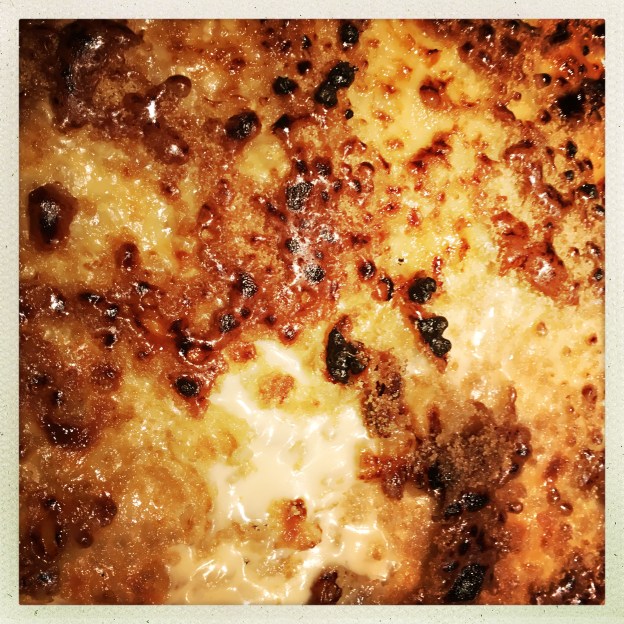
Anyway when I finally made this it was supremely good. The original recipe calls for light brown sugar for the topping for brûlée-ing but I don’t think it worked great. We have three blow torches, of various degrees of industry and I couldn’t really get any of them to do what I wanted, so in the end I shoved it under the grill. This recipe is originally from BBC Good Food, some time ago now..

75g butter

175g short-grain pudding rice

140g light muscovado sugar

500ml double cream

1 teaspoon of vanilla extract

500-600ml full fat milk

Demerara for sprinkling on top to make the brûlée topping (optional but really good)

Get a large-ish sauce pan that can eventually take all the ingredients. Melt the 75g of butter until it starts sizzling and then add the rice. Stir the175g of rice around for 4-5 minutes until the butter starts to turn golden, then stir in the 140g muscovado sugar and cook for a few minutes more until the sugar starts to dissolve.

Now pour in the 500ml of cream, stir and boil gently unil all the sugar has dissolved and you have a thick butterscotch sauce, now gradually stir in 500ml of the milk and the vanilla.

Simmer all of this for 45 minutes, I stirred every three minutes to stop it catching at the bottom as it has a tendency to at the beginning. Towards the end the rice should feel cooked – not mushy – and if you need to add the extra 100ml of milk (I never need to). You should have what looks like a creamy risotto.

When it’s done pour into a shallow heat proof dish – I use a square Le Creuset. Sprinkle the sugar over the top and either blow torch or put it under a grill for about 5 minutes until the top is golden and set. This might not happen uniformly: don’t worry. It’s still delicious. TBH it’s still amazing without its brûlée hat.

I like this about 30 mins after it’s done, but it’s also good later, if kept at room temperature. It can of course be stored in the fridge – and should be if you are leaving it for more than a few hours – but give it a quick blast in the microwave before eating to loosen it, if you don’t have time to bring it back to room temperature. That said my eldest loves it cold. I don’t.

It’s delicious and comforting and that’s what I need right now.

Lemon bars

I needed to make “something lemony” for someone. And whilst I love lemony things I just couldn’t think of anything immediately, that wasn’t a huge lemon curd filled cake and ergo difficult for them to take home (I like to think of a present’s impact beyond the mere eating of it). I asked a bunch of people for their favourite lemon recipes, then decided to ignore all of them (sorry about that) and remembered seeing these amazing lemon bars somewhere.

I remember seeing Pioneer Woman (yes I love her) making some lemon bars and although her recipe looked good, and easy, and used a sheet pan (I love sheet pans) I just couldn’t be bothered to translate the recipe from cups ‘n’ spoons ‘n’ sticks into ounces so I went to good old BBC Good Food, which is where this recipe comes from.

Anyway, these are so good. I mean so good that they should be much harder to make. I use organic lemons for anything that uses zest since I read about how many chemicals citrus gets sprayed with. Shall we get on with the recipe?

The base

175g plain flour (I increasingly use spelt now)

50g rice flour

85g caster sugar

140g cold, diced butter

1 tablespoon of milk or cold water

Tiny pinch of salt

The filling

The zest of three lemons

200ml of lemon juice (for me this was the juice of four lemons)

3 eggs

200g caster sugar – don’t skimp on this

25g plain flour

Icing sugar to dust although good luck getting yours to settle, mine didn’t, it was like December snow.

Oven to 200C. Line a 21/22cm square tin with baking parchment. It’s really worth cutting out the bottom and sides so you get nice, neat, sides. I didn’t. I was lazy and just scrunched a sheet in there so it sort of bunched up round the corners and ended up with unsatisfactory lemon bar-sides. Tsk. Dot a tiny bit of butter to the baking parchment so it sticks to the tin, otherwise when you pour in the lemon mixture the parchment sides will collapse and you will cry.

Put the flours, sugar and butter in a bowl and cut with a pastry cutter or put in a food processor and pulse until it’s like fine crumbs. Now add the milk/water. The beauty of this is no rolling out. Just pile everything into the tin and press down well. Bake for 15-20 minutes until lightly golden.

Remove the base from the oven, and lower the oven down to 180C.
Now whisk together the lemon juice and eggs and into that sieve the flour (do this otherwise: danger of clumps, trust me), add the sugar and zest. Whisk away until all nicely combined. Pour this onto the base. If there are white specks this is because you didn’t sift the flour so don’t blame me.

Bake for 15 mins, maybe a tad more depending on your oven. It should be just set, but look a bit wobbly. But the surface MUST be set/slightly dry to touch. Cool in the tin until really cool, then either slice and eat, try to dust with icing sugar, or store in the fridge if you plan to keep them for a while. Let come up to room temperature before eating. Truly gorgeous.

Sourdough doughnuts

I first made these in the summer of lockdown 2020, when we would ‘go’ for a picnic each Wednesday, which involved us getting into the car, basically driving into the turning circle on our drive and then getting out and having a picnic.

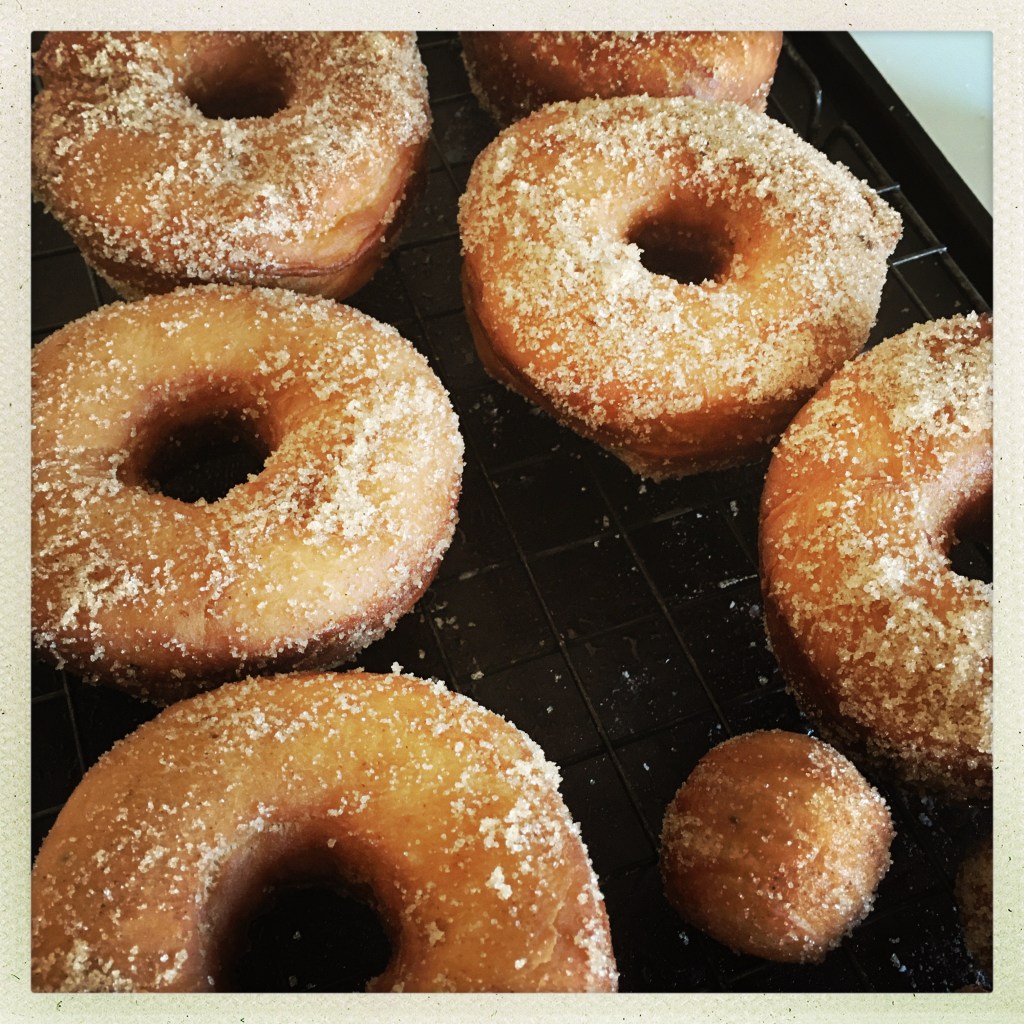
Listen: you make your fun where you can. My friend T gave me this recipe which I have tweaked a bit. It makes a lot – about eight. And they don’t really keep, they’re not the same even two hours after making them. You can use only half the dough at a time and make the rest the next day. (Note: I have pushed these to a 144 hour prove at 4C and they are delicious, so you can absolutely make the dough, cut into doughnuts and keep in the fridge and make in batches, the 144 prove doughnuts were amazing – they puffed up to life-saving-rubber-ring size and tasted amazing.)


Warning: you need to start these the day before you need them.

This doughnut had a 144 hour prove.

These are the ingredients:

240 ml whole milk warmed to 50C (I use a thermapen for all my kitchen thermometer needs)

1 large egg at room temperature

Four tablespoons of melted butter, cooled slightly

225g sourdough starter, also at room temperature. This should have been recently refreshed – about 5-6 hours ago at room temperature, the day before if kept in the fridge

500g plain flour

110g granulated sugar

1 teaspoon of salt

1 teaspoon of cinnamon

You’ll also need quite a lot of oil for frying (try not to think about it, I am not a fan of deep frying but you need to for this) and some caster sugar mixed with cinnamon for coating later.

Once the milk has reached 50C mix it together with the butter, starter and egg. You can do this by hand or in a mixer with the whisk attachment. Then add the sugar and the flour.

Now with this bit you can either mix it all up and knead on an oiled board, leave for ten minutes, knead for ten seconds, leave for ten minutes, knead for ten seconds, leave for ten seconds until you have a smooth elastic dough (so repeat one more time if needed). Or you can do it all with a dough hook attachment in a mixer for about 15 mins until it all clumps together.

Once this bit has been reached you get a big bowl, oil it and put the dough in, cover it and refrigerate it overnight/until the next day when it’s needed.

About 2-3 hours before you want to eat your doughnuts, take the mixture out, roll it out on an oiled surface until it’s about 3cm thick. I use a round cookie cutter to cut the doughnuts out, using a small one to make the ‘hole’. See what sort of size you want them to be, mine are about 10cm with the hole in the middle about 2.5cm. You can also do them as round doughnuts but I like ring ones best. The first time I made these I tore the edges slightly and was really upset that they wouldn’t be all perfect but actually, those little tears made (see main picture) something gloriously layered and even tastier! I’ve tried to recreate it ever since and can’t..

Put them on an oiled tray, or one lined with baking parchment and cover with cling film which you can also lightly oil if you are nervous (tbh I cover mine with a tea towel). Leave to rise for about 1-2 hours – depends on how warm your kitchen is. You know the dough is ready when your finger gently pressed makes an indentation but also don’t sweat it.

Fry a pan of oil up (use something light and not highly flavoured: I use a blend of olive oil and sunflower oil). Now here it depends a) how brave you are b) how wasteful you want to be with the oil c) how many you have made and intend to cook d) how many you want to cook at once. I tend to use about a litre of oil in a medium sized sauce pan and cook two at a time. DO NOT OVERFILL and of course be sensible, this is oil you are heating up. When it reaches 175C (use your thermometer) you’re ready to go, using a slotted spoon lower down however many doughnuts you intend to cook. Like I said I do two at a time. They take about 2-3 mins per side, flip with the slotted spoon; the colour is the guide here: you’re looking for a true golden brown. Take out using your slotted spoon and immediately flop the doughnut into caster sugar and cinnamon in a bowl.

Then place on a drying rack. When all are done you’re about to experience something wonderful so take a moment to enjoy it.

And try not to eat more than one.

And try not to eat more than one.

Sticky date and ginger toffee pudding cake

My friend Lucy throws amazing bonfire night parties and at one, a couple of years ago, she made this. Now, I don’t like sticky toffee pudding or any sort of steamed pudding or treacle tart or anything like that. They all make me feel ‘claustrophobic in my mouth’ is the only way I can describe it. So when my partner said “have you tried this sticky toffee pudding” I said “er no, I hate that sort of thing.”

But he persisted and it was so good I ate his portion and then immediately asked Lucy for the recipe. It comes from a book called Friends at My Table by Alice Hart, which seems to be out of print now. And I wanted the original recipe so badly that I actually tracked it down and bought it second hand.

I’ve made this a few times, although nothing comes close to what I remember Lucy’s being like. It makes quite a lot but I’m pleased to report it freezes beautifully – (see note at the bottom).

It’s best made either the day before you want to serve it, or a few hours before and then reheat it before serving (as said, I do it piece by piece in the microwave but you could do the whole cake – or as much as you know you want to serve – in a 120C oven for about ten mins, you just want to revive it). This is in order to let the sauce soak in. But honestly if you serve it all immediately it’s just not the end of the world. But if you want to make the whole thing way in advance and freeze it, it works amazingly that way too – see note at the bottom.

The cakey pudding

250g medjool dates, stoned, chopped

100g dark brown sugar

150 unsalted butter, soft

4 little balls of that stem ginger you get in syrup, in jars – finely chop it (don’t throw away the syrup)

2 room temperature eggs

250g plain flour

1.5 teaspoons of baking powder

1 rounded teaspoon of ground ginger

a pinch of salt

60g finely chopped pecans (or walnuts will do but pecans better)

The toffee sauce

300ml of double cream

200g dark brown sugar

pinch salt

3 tablespoons of syrup from the ginger jar

a pinch of ground ginger

This is what you do

Oven to 180C. Line a 20cm x 30cm tin with baking parchment.

Cover the dates with 150ml boiling water and set aside for 20 mins or until you remember them (don’t throw away the liquid they’re in).

Beat together the sugar and butter either by hand or in a food mixer with the whisk attachment. Add three tablespoons of the syrup from the jar (this is separate to the 3 tablespoons you need for the sauce).

Beat in the eggs, one at a time. Now add the flour, baking powder, ground ginger and salt. You can either fold these in gently or just add them to the processor bowl on a slow whisking speed. I am lazy and often do the latter. Add half the nuts, the chopped ginger and all the dates and their soaking water.

Pour into the tin and cook for about 45 mins. I have to check mine after 30 mins as my oven is capricious and does what the hell it wants.

Whilst that’s cooking, and when it’s about 20 mins from being ready, make the sauce as you’ll need to pour it on whilst the cake is warm, but the sauce is warm-but cooled slightly. Nothing is easy in good pudding making.

So to make the sauce you put all the sauce ingredients into the pan and simmer whilst stirring until they are all one beautiful sauce.

When the cake is baked and out of the oven, and the sauce is still warm you prick the cake all over with a skewer and pour over half the sauce (retain the other half for serving with the cake, later). This takes time and if the sauce has gone too cold then warm it up again. It needs to soak in. I don’t always get this right and I often end up with a cake that’s just got sauce on top. Lucy’s was wonderfully unctuous. It’s still nice but not really gooey.

It’s best if you cover and leave it over night, but see above.

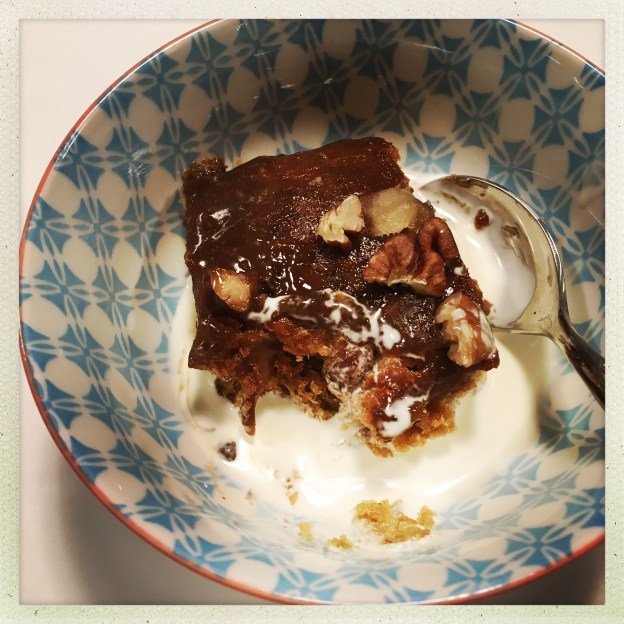
To serve, sprinkle over the rest of the nuts and serve with the rest of the sauce (warmed through) and ice cream or cream.

Freezing note: This freezes amazingly well. Just cover with any remaining sauce/nuts and put in an air-tight box. If you wanted to make this way in advance, for a really easy pudding on the day, you could freeze the whole lot: just put all the sauce on the cake and all the nuts and freeze it. If you really wanted to you could then make extra sauce for pouring over on the day but really you don’t need to.

Defrost it for 24hours in the fridge and then either heat up the whole lot in the oven – I would probably do it at 160C for 20 mins for the whole cake but in truth have never done it so see how you go. What I do with left overs is microwave it piece by beautiful piece and then serve with cream.


Un tiramisu che ti tirasu

A few years ago, when we fancied making a tiramisu (it means pick me up, or pull me up), I looked at loads of recipes. I was quite shocked (I’m a bit of a purist when it comes to Italian cooking) at the variations. I mean, Nigella, whom I love, had one, in How To Eat, using no coffee or chocolate and meringues instead of sponge fingers. It caused me to  to slam the pages of the book shut in mock horror.

It is the coffee, and the chocolate that is supposed to act as a ‘tiramisu’. Anything else, to my mind, ti spinge giu (pushes you down).

I have hundreds of cookery books, and a world of recipes at my fingers tips, as do you, on the internet. But nothing was really saying Italian tiramisu to me. Then I thought of looking in my Italian cooking bible: The Silver Spoon.

In these days of celebrity cookbooks, stuffed full of photographs, the recipes in this book are easy to overlook: simple, very few pictures and the list of ingredients for each recipe is short. But don’t overlook them because not only is this a fantastic cookery book, the recipes are accomplished – some of them go back fifty years. As you may expect, some of the recipes are as good as they’re ever going to get.

And the tiramisu recipe is no exception. It is one of the few with a photo which I admit helped…I made it and it is the only way we make tiramisu now. It’s simple, anyone can do it (my bambine frequently do) and once made sits in the fridge for a good few days, yielding to your spoon just when you need a…pick me up.

It has no alcohol – so if you feel the need for some after dinner, serve that separately – which means children can easily eat this. Although beware of eating it too late as there’s quite a caffeine punch.

My friend Tamsin doesn’t like coffee, so she doesn’t include it in her tiramisu. Of course I have told her it’s not really a tiramisu, but more of a creamy pudding. Don’t even think of using cocoa powder (other than, maybe, on the very top but I don’t) instead of grated chocolate. The chocolate shavings make this stand out and allow for some bite in what is a wallowy pudding which offers little resistance: you could easily eat aged 98, when all your teeth have fallen out.

And use icing sugar, not caster, which can result in a runny mess.

Here is the original recipe but the adaptions I now make are in italics.

2 egg whites, 4 egg yolks (freeze the 2 extra egg whites)
because I end up with a plethora of egg white I now use all of the four eggs and it just makes for a slightly softer, fluffier tiramisu.

150 icing sugar

400-500g mascarpone (mine comes in 250g tubs so I just use two)

because the mascarpone I buy comes in 250g tubs I now use 500g of mascarpone to no ill effect

200g sponge fingers I use as many as I need to cover the base of my container and the second layer.

175ml espresso coffee

200g plain chocolate, grated I often use less and lately have started using really good hot chocolate mix instead of grated chocolate. Really good hot chocolate is just chocolate flaked..see update note below

NOTE: grating chocolate is one of my least favourite jobs but I do it for this. 200g is what the original recipe asks for, but I’ve made this dozens of times now and I never use this much anymore and in fact I use less than half of it and it’s plenty. My advice is go for 100g of it, because also, grating 200g of chocolate is a total yawn. Jan 2021 update: I’ve discovered that really good hot chocolate comes in flakes and now I use this….

What to do:

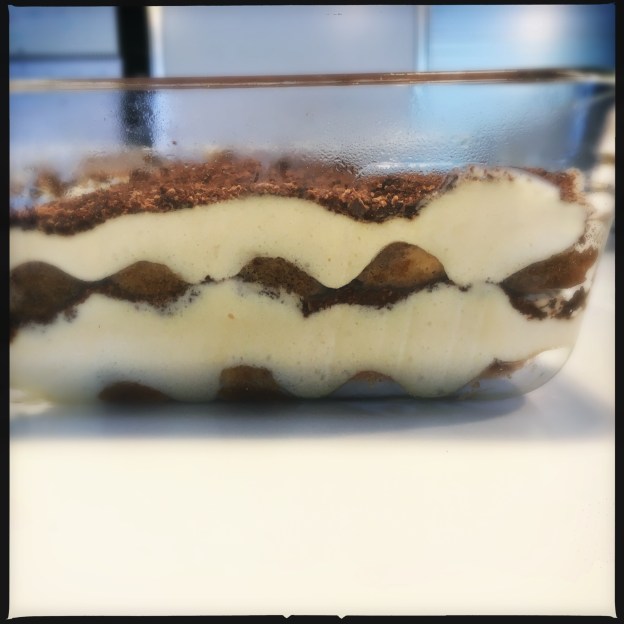
I make this in a rectangular Pyrex, which also has a handy lid so I can save it for a few days. Mine is about 17cm x 25cm and it makes two layers. But of course you can make it in a different shape so you get more layers, or even make it circular or in individual portions, just break the sponge fingers up to fill the spaces.

It would, I think, easily serve eight people depending on the size of portion.

First you whisk the egg whites until stiff, set them aside for a moment whilst, in a separate bowl you beat the egg yolks with the icing sugar, then you fold/whisk the mascarpone into the egg yolks and sugar and finally, into this you gently fold in the egg whites. This is your creamy bit.

Lay the sponge fingers onto the base of your dish and brush or pour the coffee on top. Because I know mine makes two layers, I pour half the coffee on now. Then spoon on a layer of the cream and sprinkle with the grated chocolate. Repeat this, ending with a layer of mascarpone/sprinkling of chocolate. I usually end up with more chocolate than I need for this, for some reason, so if so just keep it in a jam jar for next time.

It is better the next day, but can be eaten within a few hours of making it and chilling it to allow the ingredients to meet each other, and mingle.
A healthier waffle recipe

When I bought my waffle maker, I diligently followed the recipes that came with it and they were very good. But I wanted something un peu healthier. There are thousands of waffle recipes on the internet and in books. I personally like to add my sugar, if I add any at all, afterwards in the form of fruit or maple syrup. I found one on an American site which looked good and had a tweak around and now this is pretty much the waffles I make.

This recipe makes about 18 but they freeze well (freeze them flat on a tray then bag up together) and cook splendidly from not quite frozen, but ten minutes out of the freezer. If you toast them straight from the freezer by the time the toaster has defrosted them the waffles have got quite dry. Far better to take a waffle out of the freezer when you first get up, let it defrost at room temperature for ten minutes (who wants to eat when they very first get up anyway?) and then pop it into the toaster for a minute or two.

I eat mine with live yoghurt and berries and maple syrup and, incredibly, this breakfast keeps me going til lunchtime.

I’m sure you could up the wholemeal flour even more if you wanted to.

120g plain wholemeal flour

225g plain white flour

50g porridge oats

110g rice flour

2 teaspoons of bicarbonate of soda

2 teaspoons of baking powder

2 teaspoons of fine sea salt

1 litre of full fat milk (or use a combination of milk and yoghurt for an even lighter waffle)

4 eggs, separated

115g melted butter (or coconut oil)


Combine all the dry ingredients – the flours, oats, bicarb, baking powder and salt – in a bowl. In a separate bowl combine the milk, egg yolks and melted butter or coconut oil.

In a third bowl, whisk the egg whites until they are stiff. Make a well in the dry ingredients, pour in the butter/milk/egg yolk mixture. Mix everything together until nice blended. Now dollops the egg whites on top and gently fold in.

In my waffle maker I cook these for about 2m45s on the buttermilk setting, but you’ll have to experiment with yours.