The food writer Nicola Miller introduced me to what I think is the best bacon roll, from 5 Angel Hill in Bury St Edmunds. Their soft pretzel rolls, filled with salty bacon slices can see me going pretty much all day. Few breakfasts do this.
So when I saw this recipe for soft pretzel rolls in BBC Good Food magazine a while ago, by Edd Kimber (who I think is a genius and the only person I pay for on Substack) I had to make them.
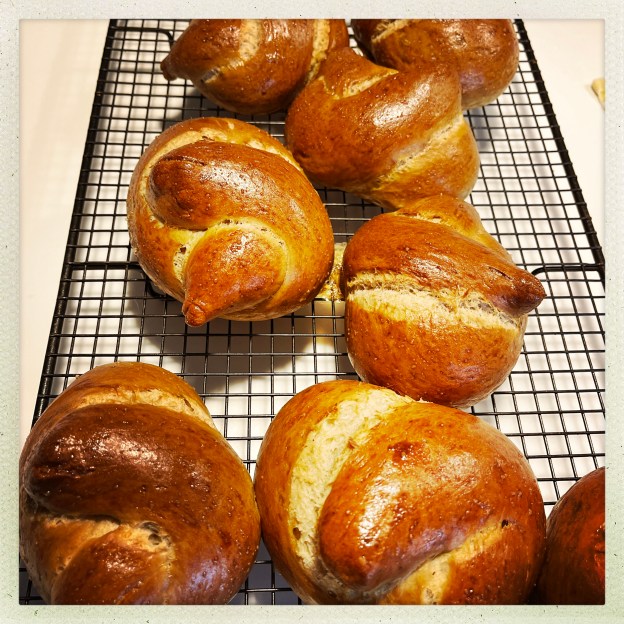
I gave up hope of making them so they looked like pretzels, mine just look like in the picture. They make great rolls for sandwiches, sweet – but not too sweet – and soft. And of course with bacon for breakfast, and maybe an egg. I also really like them on their own.
The baked bicarb bit is a pain but you only need to do it once to yield a jar of baked bicarb which lasts for a good few batches, and it is worth it (I’ve done it without and they are fine but the baked bicarb does add something). I’ve reproduced the recipe here, eversoslightly tweaked, largely to help me as the way it’s laid on in BBC Good Food I always found confusing.
For the pretzel rolls (makes eight)
500g strong white bread flour
7g dried yeast (I use Dove’s Farm)
25g dark brown muscovado sugar
300ml of luke warm water
50g unsalted butter
(I sometimes put 50g of fridge-cold butter into a jug of 300ml of just boiled water and wait til the butter melts, thus cooling the water, and then wait until the water is at the sort of temperature that when you dip your finger in it feels neither hot or cold)
1 teaspoon of salt
For when ready to bake
2tbsp baked bicarb (see later)
An egg for egg wash
Sea salt for sprinkling if you want.
I put all the ingredients for the pretzel rolls (not the ‘for when ready to bake’ bits) into a food mixer with dough attachment and mix for ten minutes. Then I take out the dough hook and leave at room temperature for an hour (less if it’s really hot).
When ready, take the dough out and divide into eight. You roll each piece out into a long sausage and then shape into a U then cross the ends up and over. If you get stuck just YouTube How to shape a pretzel but don’t get fixated on making large holes or gaps. You can also just shape these into little normal buns. Place on parchment covered tray.
Then you can either set these aside for – as the original says – 20 mins (covered with a cloth) or do as I do which is put them in a fridge which is at 4C (on a parchment covered tray, covered with a tea towel). I bake them the next day. Note these won’t keep for ever in the fridge so if you want them the next day, make them late afternoon/evening.
When you are ready to cook, preheat the oven to 200C and bring a large pan of water to the boil put in the two tablespoons of baked bicarb (I will tell you how to do this at the end). Take your tray of pretzel rolls out of the fridge. Depending on how big your saucepan is you put in, say, two pretzel rolls and a time and boil for 20 seconds each side (flip over using the slotted spoon). Take out the pretzel rolls with a slotted spoon and place back on the parchment covered baking tray.
When all are done like this you brush the rolls with beaten egg, sprinkle with sea salt if you so desire and bake them at the 200C for 20 mins. They will be a rich golden brown. As soon as you are able to place them on a cooling rack, off the parchment (otherwise they can go soggy). Wait as long as you can to start enjoying them.
Once cooled these also freeze beautifully, I defrost them in the microwave on the defrost function for about 2 minutes.
Baked bicarbonate
Preheat oven to 120C. Foil line a baking tray and pour a whole tub of bicarbonate of soda (the sort of size you get in the supermarket) . Spread out so it’s all even and bake for one hour. When cool put in a specially marked container so you have it for next time.


 Pane Amore e Cha Cha Cha