Author Archives: Annalisa Barbieri

Chorizo, courgette gnocchi


Gnocchi – aka potato dumplings – are big in northern Italy. My paternal grandmother, from Parma, used to make them and I would help her by swooshing them along the prongs of a fork, which is how you get the pattern on them if you make them at home. She made it look so easy so of course I thought it was easy.

It isn’t. I don’t try to make them now as it’s so dependent on things like ambient temperature, how much water the potatoes take up. Well that’s how I’ve found it anyway. Hard and with unpredictable results. So gnocchi is not something I try to make.

I originally got this from the now defunct Easy Living and, as time has gone on, I’ve adapted it and made sure it has more veg. My children love this.


This dish is so easy but so delicious. I thoroughly recommend it. It serves four.

This is what you need:

Olive oil

120g chorizo – but I never weigh it and just use what I have/fancy

1 clove of garlic, crushed

3-4 courgettes, julienned (I use a peeler from Lakeland), easy as.

350-500g gnocchi

Basil leaves to serve (not essential)

grated Parmesan.

This is what you do:

Heat 1 tbsp of the oil in a large frying pan, everything in the ingredients list will end up in this pan so make sure it’s big enough. Add the chorizo and throw it around the pan for about 2 mins.

Have a pan of boiling, salted water on the go.

Now to the frying pan, add the garlic and courgettes and cook, stirring, for about 3 mins. Meanwhile cook the gnocchi according to the instructions (1-2 mins usually), drain when ready and then mix into the frying pan with the courgettes, chorizo etc. Mix and serve with sprinkled Parmesan and basil.

Eclairs

The best compliment I got was from a nine year old girl (not mine) who said “these are like real eclairs”

Here is a confession. I really am not that into eclairs. I know people who go cuckoo for them. Not me. I’m not overly a fan of choux (unless in a Paris Brest), nor whipped cream. Basically, eclairs aren’t piggy enough for me.

The first time I made choux pastry I was very young, about eleven and it was in HE. No-one told me it was difficult so I didn’t sweat over the choux pastry and I made the most amazing profiteroles. (Equally, no-one told me puff pastry was difficult and I used to make a great puff pastry.)

As I got older, and everyone went on about how hard choux pastry is, well that, coupled with my slight meh-ness towards them…meant I didn’t really try.

My children love eclairs so I decided to give them a go. They were easy. So easy I was expecting the sky to fall in.

I’d love to hear how you customise them.

The recipe for choux is pretty standard:

125ml water
50g butter
75g plain flour
3 medium eggs (at room temperature, this is important)
pinch of salt (I think this is key, choux is pretty tasteless, but the salt adds something).

The filling

I just used double cream, about 300ml, whipped up with a spoon of vanilla essence and a tablespoon of icing sugar. Or try delicious white chocolate cream, which is what I use as a default filling these days.

The topping

I used 150g 70% cocoa chocolate and a teaspoon of vegetable oil, melted in a bowl, over a pan of boiling water. Then manually just dipped the eclair tops in and set them down on a cooling rack. Hardly any drips..

Obviously with both filling and topping you can change it. Next time I’m going to try something a bit more adventurous.

You also need a piping bag and plain nozzle of about 1cm diameter. A baking tray and some baking parchment.

Oven to 180C.

Put the water and butter in a sauce pan and cook over a high heat. Stir until butter is melted and bring to the boil. When this happens, lower the heat and add in the flour. Beat with a wooden spoon until smooth and the mixture leaves the sides of the pan. For me this happened almost immediately.

Remove from the heat. Now. Some recipes say to let the mixture cool and then add the eggs. I can only tell you how I did it which was to add the eggs straight away to the mixture, once in the electric mixer bowl.

So. Put the butter/water dough in an electric mixer with the whisk attachment and add the eggs one at a time.

This is the important bit. After you’ve added the first egg, the mixture must be absolutely smooth before you add the next egg. At first the mixture seems to curdle, more so if your butter/water dough is hot and the eggs are very cold. It will look like scrambled eggs. You will want to cry.

Don’t. And don’t panic. Keep mixing. It will eventually blend together and go smooth. Honestly mine took a good five-ten minutes during which I started to panic and think “why the hell did I not LISTEN to everyone who told me choux pastry was so hard.” Keep the faith. Keep mixing. It will smooth out. Then, add the next egg and mix until smooth and then the next one. I added the salt with the third egg. No idea why just did.

The mixture is ready when you lift the whisk and it leaves ribbon marks – indentations in other words.

Put into the piping bag. I find it useful to a) use a clip to secure the top of the icing bag – just above the nozzle – so that the mixture can’t ooze out. By clip I mean like those Klip-it things you use to keep food in a plastic bag fresh. b) put the bag in a tall glass and fold the top of the bag over so you can spoon the mixture in. Obviously when you are ready to pipe, you take the Klip-it off.

This mixture pipes really beautifully, so pipe eclair shapes (or profiterole shapes) onto the tray, leave a good gap as they do grow.

Put in the oven. I cooked mine for 30 mins and they were perfect, dry and crispy. My patisserie expert said that’s how high quality eclairs should be – kinda dry and not soggy like shop bought ones. You can’t really overcook eclairs (well, actually you can but you know…). I cooked some profiteroles another time and gave them 35 minutes and they were fine.

Don’t be tempted to open the oven at all if possible and certainly not before about 25 minutes.

They should be puffed and golden. Mine were almost empty inside. There was no need to dry them out inside as some recipes suggest, by placing them back in an oven.

I just cut them lengthways when they were completely cool and did the topping first (put the topped eclairs in the fridge for five mins to make the topping set if you’re in a hurry), then I added the cream with another piping bag (I was piping bag mad by this stage).

They all got eaten that day. And when I served them the second time round, because I had some salted caramel left, I added a dollop of that in too. I am salted caramel crazy though.

The reason I’m writing about these is that they were so easy and the return to effort ratio so madly unbalanced in favour of the return part, that I did wonder why I had left it so long.

Update on 6th March 2013. I thought it might be useful to have some troubleshooting here.

There are a couple of key important bits in making eclairs. The bit in the saucepan, with the flour and the butter/water…make sure you really dry this mixture out. By that I mean, even when it starts to come off the sides, keep going for a minute longer. The more you dry it out now, the more eggs you will be able to add (more on this later). The more eggs you can add, the more the eclairs will rise.

What do you mean, the more eggs I can add? Don’t you say three eggs?

Yes, yes I do. But here’s the other thing. I make this all the time with three eggs but mine are medium (in fact I’ve altered the recipe above to say this). Eggs differ in size, although it’s usually the amount of white in an egg that differs between the different sizes. So if you were to crack open a medium and extra large egg, the real difference is in the white, not the yoke.

Anyway, when you’re at the adding the eggs stage, if you’re new to this, I’d whisk up the third egg before adding it and then add it a bit at a time. What you want is a mixture that’s thick. Don’t be afraid to give it a really good whisking, don’t stop just the moment you think it’s done. You want the mixture to be able to stand in stiff peaks. If it’s not thick enough at this stage, it won’t get any thicker at the piping them out stage. So when you stop whisking you need to be absolutely sure it’s thick enough, otherwise,  you pipe it the eclairs will spread.

If you add too much egg, then the mixture might get too sloppy which is why I recommend adding it in stages if you’re new to this.

Should I cool down the butter/water/flour mixture before putting it in the mixer?

Almost every recipe tells you to do this, to cool it down otherwise it will cook the eggs.

I don’t. I know, madness, but I’ve tried it both ways and for whatever reason I’ve found that if I add this to the mixer and add the eggs straight after the sauce pan stage, my eclairs rise more. Yes you do need to beat the first egg in for much longer and it will go through a scrambled egg phase. Try it whichever way you want and see how you go. I’m fairly brave with patisserie making so I like to fly by the seat of my pants. You may want to go more slowly. Both are fine approaches.

If you’d like more ideas about what to fill them with, other than cream: chocolate ganache filling recipe here; white chocolate cream filling here (this is YUM). And not long after I originally wrote this I stopped cutting the eclairs in half and instead using a piping nozzle to fill them.

Gingerbread porridge

I have just come off deadline for a hideously complicated piece about mackerel. The research on anything to do with fish quotas is almost enough to drive me to a drug habit (JOKING). So I’m indulging myself with something blissfully easy to write about, something comforting, that I hope you will find useful.

Porridge. We all know how healthy it is. Rich in fibre, lowers your cholesterol, makes you strong and gives you a glow etc.

However.

I am always STARVING five minutes after eating it and I have a bit of a guilt trip going over porridge in that I feel it should be made with steel cut pinhead oatmeal and stirred for one hundred hours and eaten with almost nothing, bar a grimace.

I do lighten up occasionally and use jumbo oats and semi skimmed milk and water and cook it on the hob with my spurtle (NEVER NEVER NEVER in the microwave) and then flood it with sliced fruit and maple syrup, but in my Catholic guilt-ridden heart, I know I am sinning.

Thus I hardly eat porridge which is stupid. Like not letting yourself buy cut up fruit because you should cut it up yourself and therefore never eating fruit (not relevant to me but you know what I mean).

This morning, as I was wafting round Waitrose and taking my commission for my mackerel piece and slightly panicking as I do before I start to write any piece (I can’t do it I CAN’T DO IT), I spied something. Dorset Cereals Gingerbread Porridge. In the packet are premeasured and sealed daily sachets (so wasteful!). It had stuff added to it to make it tasty (so indulgent!) and it recommended you do it in the microwave (shocking!).

I hadn’t had breakfast.
I’d had to dig the car out of the snow that morning.
I had been coerced into buying my child Smarties (I don’t buy Nestle products usually).
I had a hideously difficult piece to write on mackerel.
So I bought it.

I came home and made it – in the microwave – and ate it with a dollop of nut butter (to up the protein) and it was DELICIOUS. I am still going on it six hours later (bar the handful of nuts and an apple that I ate an hour ago but that was more out of deadline avoidance than hunger).

Am now going to eat this every day. Every day.

Rice pudding with salted caramel syrup

Donna Hay’s chilled rice pudding with caramel. ©donna hay

Rice pudding isn’t something I grew up liking. My mother made it, although hers was more of a rice pudding cake – you could cut big slices of it. It was perfectly nice but not for me.

Then one day I discovered this rice pudding, which was all creamy and vanillay and slow cooked and I was hooked. (The recipe for the actual rice pudding is in the article, the article however refers to oat pudding and I do realise that…)

I am a big fan of Donna Hay. I get her magazine whenever I can find it, and even though she often talks about winter recipes when it’s summer here in the UK (she’s Australian), it’s beautiful and her recipes are amazing. And unlike Martha Stewart Living, the recipes are converted to metric: it’s not all a cup of this or a stick of that.

Anyway. Here is her recipe for Chilled Rice Pudding with Caramel. A few notes.

It’s a helluva lot of milk and cream. I think you could probably get away with not adding the extra lot of cream and milk you add when you take it off the heat. See how you feel. Or add less. I added the full amount and it makes for a very wet and loose pudding.

Delicious, but you can’t really cut into it with a spoon and leave an indentation, as seen in her picture above.

Two: I didn’t use dulce de leche. I use my own secret recipe for salted caramel and I just poured it on ever so slightly warm, I didn’t loosen it with more cream like the recipe suggests, as by that stage, I was starting to fear for my heart.

Even though it’s a chilled pudding, it’s immensely comforting. Here is a picture of my version:

Every day sourdough baking

A gratuitous picture of a loaf of sourdough, baked this morning

I get asked, a lot, if sourdough bread is hard to make. I am tempted to say “really hard” to make myself look clever but the truth is, it isn’t.

Sourdough seems uniquely complicated amongst bread baking. I don’t know if it’s purposely shrouded in mystery. I know that it took me about two years to finally get down to it, to be brave enough to try, as it seemed magical and mystical. It is, but it isn’t difficult. The hardest thing about sourdough baking is being mentally ready.

Because once you have a good starter going, sourdough baking is almost bomb proof.

I bake sourdough about three times a week. Mostly I bake this bread, which is half wholemeal and half white.

Although I only bake half of the amount in that recipe, so 500g of flour, 200g levain (starter), 333g of water and I’ve got the salt down to just one teaspoon.

I divide the dough up to prove over two baton shaped bannetons so I have bread for two bakes. The bread in the picture above was proved in one of those bannetons.

It’s easy. The hard bit with sourdough, in terms of faff, has always been the starting off of it. Once I’ve weighed it out and refreshed the starter I know I need to be relatively close for the first three kneads (ten mins apart) and not too far for the one that requires a 30 minute rest. But after that I can do the school run or go out or do whatever. If I know I’m not going to be back in time – be really ages – then I put it in the fridge, and when I get back, simply bring it back to room temperature and take up where I left off.

You could never do that with bread with commercial yeast, because the yeast would get exhausted.

I’ve had a sourdough loaf going over three days.

Various people have said to me that they want to try sourdough baking. Instead of abstemious resolutions that make you feel miserable (isn’t January miserable enough?) try a resolution that will make you feel really good. With a good loaf you always have a meal. And when everyone else is out panic buying because it might snow, you can be smug knowing that with your starter, some flour, water and salt you can turn those tins of stock-piled baked beans into something really glorious.

Ice grippers for your shoes

The walk to school.

I have, once before in this blog, lamented the loss of the apres ski boots I bought when I was 14. They were by a Canadian make called Blondi (or something like that) that were the most amazing boots for the snow and the ice that I’d ever come across.

They had what seemed like a sticky rubber sole and for years I thought I had imagined this.

But I hadn’t.

There is indeed something called ‘sticky rubber’ which is used on snow boots.

Anyway, the boots are now long dead although they lasted about 20 years. But I contemplated buying a replacement until I saw that really good apres ski boots cost about £150 and for only occasional use, that seemed a bit luxurious when I had my Ecco boots and my sheepskin boots.

But my research led me to ice grips that you slip onto your boots or shoes. They are really good to keep in a bag when the weather gets like this. They slip relatively easily onto footwear, are good quality and are nice and grippy on ice. But, on normal pavements they can make you feel very unstable so if you’re walking on and off icy surfaces do be aware of this and decide whether you want to have them on or off.

I got mine in December (because I am ORGANISED) and they cost £3.19, now they’ve gone up a bit according to what size you want. Still cheap though and useful to have.

I am a size 37/4.5 and the medium fitted me perfectly.


A cake to cheer you up and natural firelighters

A really rather superior cake.

I’ve been pretty flat thus far this month. In part because there is loads of bad news around, it’s end of year accounts time, tax is due, it’s not Christmas, all those things you put off until after Christmas can no longer be ignored, everyone is miserable, George Osborne is still chancellor and also because January just generally is the arse-end month of the calendar. The only good point in it is my mother’s birthday.

We usually book a little weekend away in Jan or Feb to cheer ourselves up. But not this year.

Anyway. Two things that cheer me up are real fires and cake and the two are connected today by: oranges.

Orange peel, left to dry a bit, makes excellent firelighters. I doubt they’d be an alternative to shop-bought, kerosene soaked firelighters, but they are a good addendum to them and also smell nice. I had two oranges that I’d studded with cloves for Christmas, you know the sort of thing. And they’d started to go off and dry up and I put them on a really roaring fire and the smell was amazing. As was the glow of the cloves..nut shells also burn well (because of the oils, same reason orange peel does). So save up all your pistachio shells to put on the fire.

Jesus, could that sentence sound more middle class.

Cake. I saw this recipe in the Waitrose magazine this month and earmarked it for the weekend (I don’t eat cake during the week). I made it last weekend and it’s a really excellent cake. The sponge is heavy with ground almonds which gives it a dense crumb but an amazing taste. I loathe icing sugar heavy icings – those that are nothing more than icing sugar and water or butter (why why why would anyone eat such things?) and have a glycaemic index of 112, and this is at least a bit better for you as it uses mostly Greek yoghurt and mascarpone.

I would link to the goddam recipe but Waitrose magazine hasn’t put it online yet the bastards.

for the cake

125g unsalted butter, softened
200g caster sugar
3 large eggs
100ml single cream
250g ground almonds
125g plain flour
1 teaspoon baking powder
half a teaspoon of salt
zest of one orange
3 tablespoons of seville orange marmalade

for the syrup

the juice of one orange
1 tablespoon of seville orange marmalade

for the frosting

150g mascarpone
125g Greek yoghurt
4 tablespoons of icing sugar
2 tablespoons of seville orange marmalade
the zest and juice of half an orange

You need two 20cm cake tins lined in baking parchment.
Oven to 180C.

Using an electric mixer (I used the whisk attachments) beat the butter and  sugar for five long, boring minutes until it’s light and fluffy or at least, til 5 mins have passed.

Beat in the eggs, one at a time, then the cream, then the almonds. Once mixed together, I took it off the whisk and did the rest by hand: folded in the flour, baking powder and salt, then the orange zest and marmalade.

Divide between the tins and bake for 20-25 mins until a skewer comes out clean. You know the drill.

The recipe says to wait til the cakes are cooled to pour on the syrup. I didn’t really. I left them for a bit then made the syrup and poured on whilst the cakes weren’t cool. Be warned however: keep the cakes in the tins whilst you pour the syrup on as there’s a lot of syrup and you want to contain everything.

So, to make the syrup you combine the two ingredients and warm gently in a saucepan  until the marmalade has dissolved, then prick the two cakes and pour over evenly.

Now leave the cakes until they are completely cooled. Disrobe them from their parchment and now make the icing which you do thus:

Beat all the frosting ingredients together, reserving a sprinkle of orange zest which you’ll use for decoration. Sandwich the cakes together with it, then put some icing on the top. Sprinkle with the zest.

Delicious.

Although I haven’t tried it, I think this cake might respond well to being made with rice flour.

Alternative Christmas ‘pudding’ ideas

Jamie’s Winter Pudding Bombe
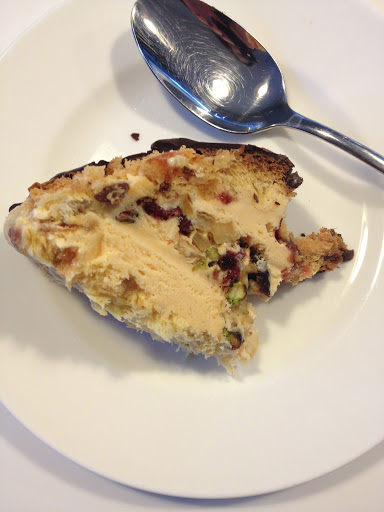
My actual bombe

I don’t mean as a direct alternative to that dried fruit pudding English people have after Christmas dinner (which I now love, I actually made my own two years ago for the first time and make them a year in advance now). But I mean, something to eat for pudding on or around Christmas Day.

Chocolate Chestnut Rum Roulade

Every Christmas I make this amazing Chocolate Chestnut Rum Roulade. It’s an Icelandic recipe that I got from the Waitrose magazine twelve years ago. It is so good. I make it every Christmas and my eldest asked for it for her birthday this year. It’s really not that difficult, can be made ahead and put in the fridge.

Another thing I make is Jamie’s Winter Pudding Bombe. This is superb made in advance and stuck in the freezer. I do make some changes to this as the clementine he asks for just freezes solid (obviously) and I don’t find it very nice to eat. So I do his recipe but instead of the bits he asks for  I add some dark glace cherries, some candied fruits, some sour cherries soaked in marsala (I use marsala instead of vin santo throughout) and then some toasted pistachios and hazelnuts. I think you could easily customize this bit.

I also use home made vanilla ice cream because it’s tastier and cheaper.  The quantity in that recipe I’ve linked to make the perfect, perfect amount for this recipe.

Need I point out that you don’t use expensive panettone for this.

You can make it in advance, as I said, and then just turn it out when you want to serve it, and pour the chocolate over the top.

Annie Bell’s Blackout cake, as near to chocolate cake perfection as possible.

Lastly, for something that doesn’t look as festive but is really, really delicious. Annie Bell’s Brooklyn Blackout cake which is as close to chocolate cake perfection as I can take you. I guess you could make it more festive with gold leaf or something. I don’t know, up to you. It’s sensational however and once people start eating it they won’t care if it looks festive or not.

Do feel free to share your Christmas pudding alternatives.

update: mid January 2013. We just at the last of the bombe, which had been nestling in the freezer since I made it on 21st December. I thought you might like to see inside. It was still really really good.

What to do when someone gives you some of their starter so you can start your own starter..

A present of a little of your established starter really can be the present that keeps on giving

My starter came from my friend Emily; about three years ago now. Her starter was already going on for 18 months old itself, if I recall correctly.

Since I got that fantastic, promising present, my own starter has gone on to spawn many other sourdough starters, not least that of John-Paul Flintoff.

Anyway. I’ve been meaning to, for ages, write up here about What To Do when someone gives you some starter, so here I go.

You could of course give someone a full jar of starter ready to go since, if you have some levain on the go, it wouldn’t take long at all for you to build it up to a whole other working jar size. But this isn’t madly practical unless you can actually hand it over in person. And, also people like to build it up themselves. So what I do when I’m sharing starter is send it on the dry side, so it’s less frisky and likely to tire itself out. I either send it in a small plastic lidded box or double bag it in those sealable sandwich bags.

Hopefully, before you are sent a starter of starter, you will have ready:

A large jar
Some white, strong bread flour.
Weigh the jar when it’s empty and make a note of it.

What you do when you get it is this:

Put the starter in your jar. Add 50g white strong bread flour, and 40g of out of the tap water. Mix it up well and put the jar aside. In the fridge or a cool place in your kitchen.

You don’t need to remove any starter, you do that when your starter is big and to keep refreshing it would mean you’d end up with unfathomable amounts of the stuff.

The next day, if you want to, take out a tablespoon of starter and discard it. There is no reason for this, it just kinda feels authentic. Add another 50g white strong bread flour and 40g of water.

What you want to do is build up so that you have about 300g of starter in your jar (because for most breads you use about 200g of starter). So you keep repeating this until your jar is about 3/4 full when it’s just refreshed.

Never fill it up to the top as if you do, as the starter grows (because it will go up and down during the day until it settles) the jar can explode. Don’t worry if you look at your starter during the day and it regularly goes up to near the top, that’s normal. What it mustn’t ever be is that full when it’s just been refreshed.

When you’ve got about 320-350g of starter going (this is why you weigh the jar empty) you’re ready to go. Every time you bake – presuming you use 200g of starter, refresh your jar with 120g of white bread flour and 100g of water. Or, if it’s looking a bit full already, 100g of flour and 80g of water.

And you’re ready for a life time of baking.

Unless you bake every day, keep your starter in the fridge. I bake bread about 2/3 times a week and never need to discard starter to refresh it, I just use it straight from the jar.

I hope this makes sense, do ask any Qs if you need to (on here please so others can benefit).

Laptop lunches, the best lunchboxes ever

The Laptop Luncbox. Clockwise from top left: a popping candy chocolate lolly; grapes; fennel; ham sandwiches. Most of these inner boxes also have lids. But we never rarely feel the need to use them as the main lunch box has a lid that closes down on everything.

I need to warn you, immediately, that these lunchboxes are neither cheap, nor easy to get.

But they are worthwhile if you can get hold of one. Let me tell you about them.

Some years ago, in early 2008 to be precise, I was still co-founder, and a very active part of an excellent parenting website called I Want My Mum. It doesn’t exist anymore as we shut it down last year. But it was a great place for collective wisdom.

When my eldest was due to start school, I asked the mums and dads on there what lunchboxes they’d recommend and a few of them said Laptop Lunchboxes. Which were, then, available to buy in the UK.

LLBs consist of a main lunch box with a lid, and in this are four other boxes, some with lids, some without. The whole lot sits in an insulated, zip up bag. The beauty of it is that it helps you think outside the box (yes, yes) with what you put in the lunchbox, and also you don’t end up with loads of un-eco wrapping or loads of renegade plastic boxes. Of course, despite best intentions, our eldest still goes to school with sandwiches 99% of the time, but she also has crudites, potato salad, orange segments, grapes etc. They all fit beautifully inside and are protected from the disdain that a young child, quite rightly, treats its lunchbox. Her lunchbox (made mostly by her father) is a thing of beauty and the one I’ve photographed above is my youngest’s first lunch made in her lunch box. It was incredibly boring but she wanted something fast to take on a great cycling expedition around the garden and it’s the only photo I have. But imagine colourful wonderfulness spilling from every box and beautifully cut sandwiches that perfectly, perfectly fit the boxes and you’ll get an idea of the care taken by my partner in making his daughter’s lunch.

That first lunchbox cost about £25 as I remember. Not cheap but really good. It was so good I decided to buy us all one, but when I went to reorder, the website no longer did them and instead were offering frankly vastly inferior things that were little more than stacks of plastic boxes. I found LLBs in the States and emailed them. Good news! I could order direct from them! Bad news? With taxes and shipping it came to about £70.

It’s a good lunch box, but not that good.

My youngest is due to start school in a year’s time. My excellent friend and Godmother to one of my daughters, CC, was in American and due to come home for good. This was an excellent time to ask her if I could buy one and get it shipped to her and she could bring it back for me.

This is what happened and hence the youngest now has her own, and it cost £25-£30.

Of course, in the way of things, my eldest went through a stage of hating her lunch box and wanting one like everyone else. But now has come round to the fact that her lunch box is really cool and looks like new, after four years of continuous school service (she has a packed lunch every day, occasionally she will have soup in a food flask). This is something to remember when you buy something cheap that might not’t last. I reckon I’d have spent more than that by now on replacement boxes.

So I know this is a bit of an annoying post, but look, we live in the world of travel and have foreign friends. If you are going to America, or live there or know someone who does and can get it shipped to them and they send it on to you,  this is feasible.

And these are really good lunch boxes.

The selection is a bit mind blowing, you can get just the bag, just the box etc; but the ones I got were in the Bento Kit (bag, box with compartments, knife and fork). And although the colourway we have isn’t shown at present, this is identical to ours in all but colour: this one, with the bag with shoulder strap which I think is useful for children.

I had really good service from this company. There was a problem with my payment and a real person answered my emails and tried to help.