Category Archives: What’s for lunch?

Polenta ‘pizza’ with cherry tomatoes and some sort of cheesy topping.

This is not, of course, pizza. But it is delicious.

Polenta featured large in my father’s home cuisine – northern Italy. But it didn’t feature in my mum’s – southern Italy. And because my mum was the cook when we were growing up, I feel I can safely say we never had polenta. I would hear about it, but I could not get my head around what it was. Sometimes it was a powder, then it was solid, then like mash.

When I got older I tried making polenta and it was a disaster. Since then things have improved and it features in my home cuisine and I always find it comforting.

This recipe is from Delicious magazine. I like that the making of the polenta doesn’t involve loads of butter and parmesan – sometimes you want that, but not all the time. Of course you can vary the topping to have what you want on it. Because my children aren’t so keen on dolcelatte I bought some brie with truffles in it as a treat.

Anyway this is just delicious. It easily fed four of us and I had the left overs for lunch the next day (heat up for a few minutes in a dry frying pan, if you can cover it to catch the steam) and it was wonderful.

2 courgettes, sliced thinly (I used a potato peeler)

200g or so of cherry tomatoes, halve them

Olive oil for drizzling

600ml of milk

400 ml of chicken stock, either your own or made from a cube

250g instant polenta

50g cheddar, grated (or use some other cheese it’s okay)

80ml of passata

80g of dolcelatte or brie, thinly sliced

a handful of basil leaves to scatter

Method

Heat the oven to 200C. Spread the courgettes and tomatoes over a large baking tin, drizzle with the oil, season with salt and peper and roast for 10 minutes. This bit is important as you won’t be cooking the finished pizza for long enough to get the courgettes and tomatoes sufficiently roasted. When done set aside but leave the oven on.

Meanwhile, put the milk and stock in a large sauce pan and bring to the boil. Put the polenta in a jug and when the liquid boils, pour the polenta in a stream and stir continuously with a wooden spoon or large whisk. You want the mixture to thicken and bubble on the surface, like larva. Now turn down the heat and stir in the cheddar and season well.

Pour the polenta mixture onto a baking sheet (I find some baking parchment helps but is not essential), spread out thinly to a circular or rectangular shape. Spread the passata over – it will be very thin. Top with the roasted courgettes/tomatoes and the thin slices of cheese. Bake for 15-20 minutes until golden. Scatter basil leaves atop.

You can serve this with a salad but I like it on its own, with one fork, and my feet up on the sofa.

Besto pesto

Pesto is not something I have ever made particularly successfully. Lord knows why. It is not difficult or complicated. My eldest can make it before she takes her coat off (but has washed her hands) after school. But the pesto I make never makes me shut my eyes, momentarily transported, and go ‘mmm’.

A friend called Vonetta first made me pesto, with farfalle shaped pasta, when I was in my 20s. Incredibly, I had never had it before. It does not feature highly in the cuisine of my father’s province: Parma, nor my mother’s: Avellino.  Italian cuisine is incredibly regional you see – there is very little cross fertilisation; each region fiercely proud of everything they do and determined it can’t be bettered. They rarely invite in new dishes, however old.

I made this pesto in a great rush, after tearing the recipe out of a magazine (the superb Donna Hay’s) as an afterthought. As I orchestrated dinner, and everything came together a bit too fast, a bit too suddenly, I didn’t have time to taste anything until I was sat at the table, and then I was blown away.

This pesto was the basis for another dinner, which I will post another day, which was so successful, that my youngest, who likes almost nothing savoury that I make aside from my sourdough bread, ate four helpings.

For now, here is the pesto recipe, ever so slightly adapted:

Ingredients

80g baby spinach leaves

25g basil leaves

150g roasted cashew nuts – these are absolutely key, and they must be roasted. I gave mine about 4 mins at 190C, watch them carefully.

1 clove of garlic

1 teaspoon of salt (I used pink Himalayan salt just because I had that in)

The juice of half a lemon

The zest of one small lemon

2 tablespoons of olive oil

2 tablespoons of water

Method

(Note: no parmesan, that is correct!)

Put the spinach, basil, cashew nuts, garlic, salt, lemon juice and rind in a food processor until everything is well chopped and blended. While the motor is running slowly add the oil and water. Scrap down the sides of the processor if need be so everything is finely, and uniformly, chopped. That’s it. Use it there and then, keep it for a few days in the fridge or freeze it for another day. It’s superb in pasta, of course, but also spread as an extra layer in sandwiches, in salad dressings or used on cauliflower pizza.

A simple paella

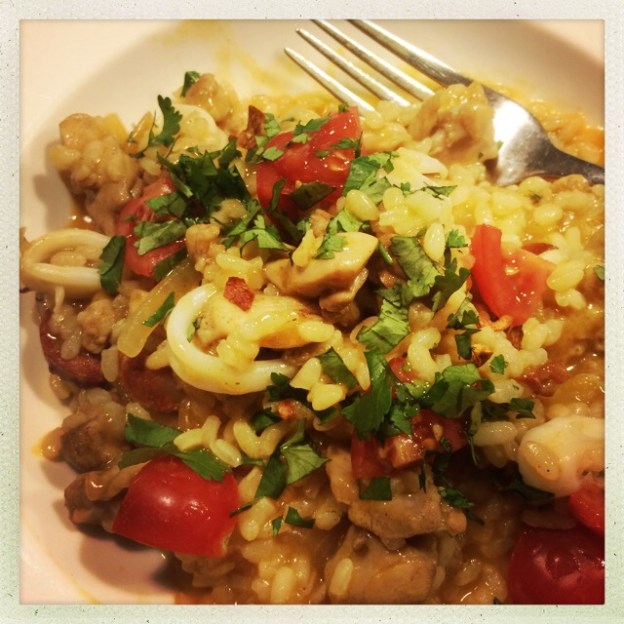
Spanish folk: don’t judge me too harshly. I know this isn’t authentic. But it’s still delicious.

I first ate paella when I went to Spain with my homegirls, aged 18. What a holiday we had. Insane. Six girls in a non-tourist region of Spain…there was this little restaurant which made absolutely fantastic paella. And chips. The best chips and the best paella. I absolutely adore dishes that you can eat with just a folk, and not have to worry about gristle or bones or fat or nasty bits. Okay so we did have to shell the huge prawns that sat atop their rice deathbed, but stuff like that doesn’t scare me. This recipe doesn’t use shell on prawns so you can sit, cross-legged on the sofa and eat this with one hand, preferably with a fork in it.

Before this, I had never attempted to make paella at home. It seemed so scary, and it involved paella pans that you had to treat with love and care, lest they rust. Then I saw this recipe in Donna Hay’s Simple Dinners and we made it and we loved it. My children aren’t so mad on it, but the beauty of this dish (and oh there are so many beauties to it) is that you can pick out the bits you don’t like and eat those you do.

This is the perfect dish for when you don’t really know what to eat (meat? fish?) and don’t have much time, but still want something relatively healthy and comforting. If you ate everything in it you could get those ‘seafood pie’ mixes from the frozen compartments.  We don’t because my partner can’t eat bi-valves and those things usually have tons of mussels in them. But we did, as sharp eyed readers may note, add squid rings into this one.

Don’t be tempted to use chicken breast meat, it’s all about the tasty thigh meat here.

What you need for four good portions:

1 red onion which you have sliced

1 teaspoon of dried chilli flakes (leave out for those that don’t like it)

1 teaspoon of smoked paprika

Half or so of a chorizo, it really depends how much you like it and what you’ve got

4-6 chicken thighs, de-boned, skin off, made all nice so you can just eat them without fear of scary stuff and cut into bite-sized chunks

250g short grain rice (no expensive paella rice, you don’t need it, but it must be short grain not wild or basmati or anything healthy, save that for another time)

1 litre of chicken stock

A quantity of raw prawns, again depends how much you like them. We use about 150g

A handful of coriander leaves, chopped up

200g or so of cherry tomatoes, halved

Lemon wedges

What you do:

Heat a large, deep non-stick frying pan over a good strong heat. add the onion, chilli if using, paprika and chorizo and cook for 3-5 minutes until it’s all golden looking. Now add the chicken and cook for five minutes, turning it so that all sides get lightly browned. Add the rice and stir until all coated, now add the stock and bring to the boil and cook for ten minutes. Add the prawns and cook for a further five minutes until they are pink and the rice is tender. Serve with the coriander sprinkled on top and the cherry tomatoes and a lemon wedge each.

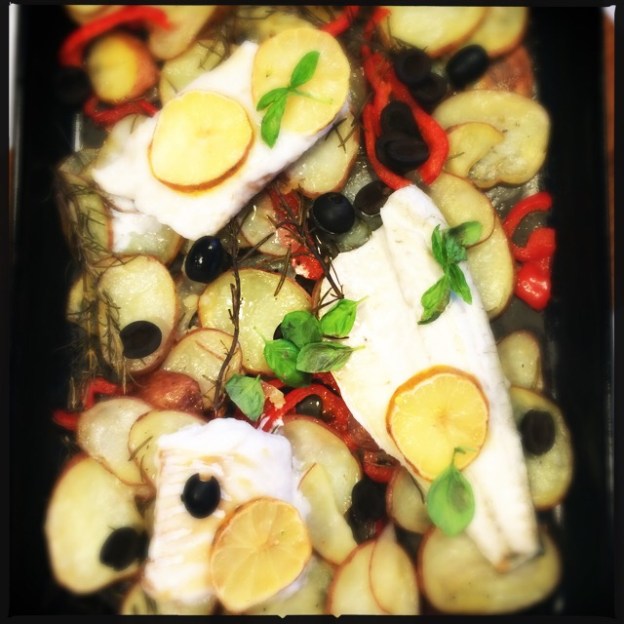
Roast sea bass, with lovely potatoes and vegetables, all done in one tray

This is a deceptive recipe, taken from the BBC Good Food magazine last year. Deceptive because, despite the relatively simplicity of ingredients, everything mixes together to produce something rather good, rather, as my friend Linda would hate me to say, lovely.

(She is not keen on the word lovely, and now, every time I use it, I think of her and the disdain she must hold me in for not thinking of something better, but, to me, when you need to say something is lovely there is no better word.)

Anyway. The price of seabass doesn’t make this a cheap dish*; nevertheless, what you get is something very tasty and that needs very little further accompaniment, save for some green vegtables. So it’s not the world’s most expensive dish, either, and, I would suggest, you can make this for an alternative to a ‘big roast’ for someone who doesn’t eat meat, or is gluten free, and they wouldn’t feel in any way cheated.

You can, and I have, substituted sea bass for cod – as you can see in my picture where there is a mix of the two – but the bass has the edge here in delicate flavour.

This recipe is for two, but you can double or treble it at will.

300g of red skinned potatoes. Important, the flavour of the potatoes is a valuable scaffold to this dish. Wash and dry the potatoes, you don’t peel them, and then slice them very thinly (don’t be a wuss, you don’t need a mandoline) into rounds.

1 red pepper cut into slices

2 tablespoons of olive oil

1 rosemary sprig, you’re meant to remove the leaves and chop finely. I go into the garden, pick two or three sprigs and shove them in. This does, however, mean that when I made this recently, my youngest asked why I’d put the Christmas tree in the dinner.

2 sea bass fillets

25g pitted black olives, sliced or halved

half a lemon, thinly sliced

basil leaves to scatter (don’t fret if you don’t have them, the dish can survive without)

You need a large baking dish. Note that if you are making this for lots of people, you need lots of oven capacity, and more than one baking tray, as it’s important you space out the potatoes so they crisp up. This doesn’t mean each and every slice needs its own zone, but they shouldn’t be crammed together – gently overlapping is what you’re aiming for. The more crammed together they are, the less the moisture can evaporate and the soggier the potatoes will be. You want something that’s crisp on the outside, soft on the inside and for this to happen the potatoes need space, man.

Oven to 180C.

Lay the sliced potatoes onto the baking tray with the pepper slices. Drizzle over one tablespoon of the oil and scatter over the rosemary, add a pinch of salt and a good grinding (snigger) of pepper. Toss everything together, rearrange so that they take up the maximum amount of tray space and aren’t all bunched together and roast in the oven for 25 minutes. Turn over half way through. If the edges aren’t brown, give it a bit longer than 25 mins.

Then, arrange the fish fillets on top of the potatoes, scatter over the olives, and place lemon slices on each fillet. Drizzle the fish with the remaining oil.

Roast for a further 7-8 minutes and you’re done.

*Waitrose sells frozen farmed seabass fillets for £4.39 for two (at time of going to press).

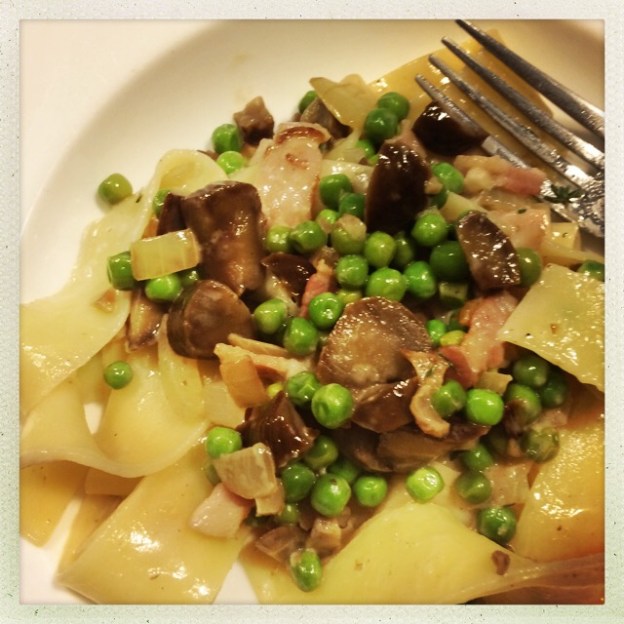
Pancetta, thyme and chestnut pappardelle

This is a delicious, easy, stand-by meal. The ingredients all have at least a week’s life-span (the majority a lot longer) so you can get them in, and when you want to eat something delicious but fast, you can.

I use fresh pasta for this. Dried pasta has a lower glycaemic index, but there is no greater lie in all the world, than the cooking times advertised on the front of dried pasta packets.

Although chestnuts make it festive, you could cook this at any time of year and if you were to do some prep before hand (not that you really need to) you’d have this on your plate in minutes. It’s a great thing to throw together for friends who you weren’t expecting to stay to lunch/dinner, or when you fancy something really flavoursome and delicate. It’s so much better than you think it’s going to be.

Adapted from Delicious magazine.

Serves 4 for moderate appetites, two if you’re greedy pigs.

Ingredients

300g fresh pappardelle pasta – fret not you can also use tagliatelle or spaghetti or really, let’s face it, any pasta. But pappardelle is a great shape for this recipe. And using fresh just makes the whole thing faster and easier.

1 tablespoon of olive oil (not virgin)

1 onion, finely chopped

200g ready cooked chestnuts, roughly chopped

A few sprigs of fresh thyme, leaves taken off the woody stems

100g thinly sliced bacon, not too much fat on

a garlic clove, finely chopped

200g frozen petit pois. Make sure they are petit pois and not normal peas and you cook from frozen

a jar of 20cl Isigny Creme Fraiche  any other creme fraiche would do but I really love this one and the glass jars make great little storage pots, not least, they perfectly hold one cupcake.

Method

If you are using dried pasta, put it on to cook now because we know those cooking times are all damned lies. If using fresh pasta, don’t put it on yet but have a pan of water boiling away in the background.

Heat the oil in a large frying pan (at the end everything will end up in it) and fry the onion for a few minutes until soft. Add the bacon strips and fry for 5 mins, then add the garlic, chestnuts, petits pois and thyme.

(Put the fresh pasta on to boil for the 3-4 minutes it needs.)

Fry for a further 3-4 minutes. Drain the pasta then stir the creme fraiche through the stuff in the frying pan and finally add the pasta. Season with salt and pepper and serve.


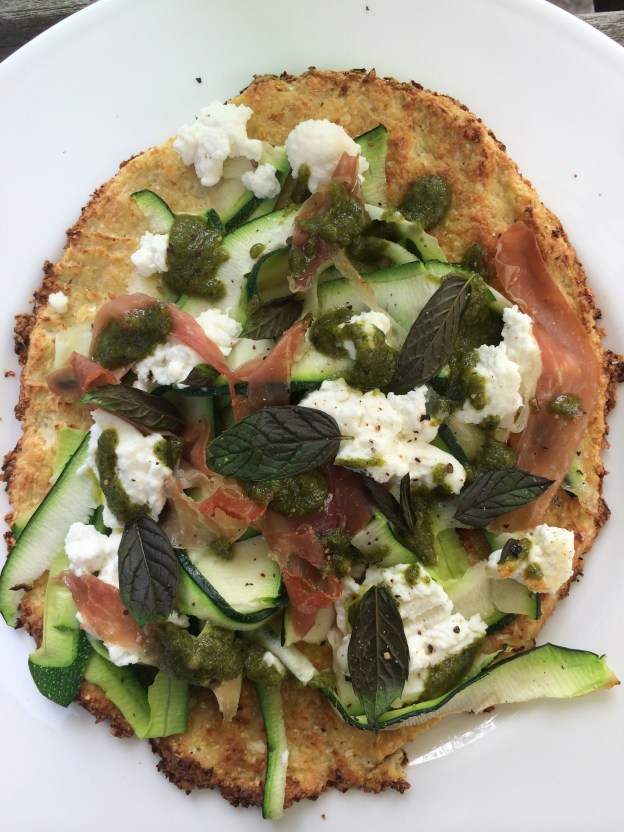
Cauliflower-crust pizza (gluten free)

I am not a fan of food, which, under the umbrella of ‘being healthy’, pretends to be something else and in so doing, delivers only disappointment. Courgette strips instead of pasta, yoghurt when you really need cream, vegetables in cake (which I admit can sometimes work)..cauliflower instead of pizza…

This isn’t anything like a pizza. I warn you now. But if, as I do, you like to have a lunch with a ‘base’ and lots of veg then this is a really good, gluten-free, wheat-free and tasty (yes really) offering. To me, it didn’t taste like cauliflower at all, more like a lovely parmesan crust. My partner was a veggie for 20 years; he views such things with deep suspicion, having been offered beans, made into the shape of a lacklustre burger for many years. But he was impressed and delighted.

I got the recipe from Delicious Magazine (no link because it doesn’t appear to be online), and I’ve halved the ingredients to make it ideal for two, for lunch. I followed the recipe topping but obviously you can add whatever you want. We happened to have some pesto made by my eldest (she makes it better than I do, taking it off me and saying “here Mummy, let me show you”. I love how she is confident like this). You could, feasibly, leave the pesto out and add a drizzle of olive oil or chilli oil, or just, you know, BUY SOME.

225g cauliflower florets
1 medium egg
75g ground almonds
25g grated parmesan
salt and pepper
1 courgette
2 slices of Parma ham
120g ricotta
Pesto and mint to serve

Heat the oven to 200C and put in a large baking sheet. Now, put the florets in a food processor and blitz so it looks like cous cous. Put in a bowl and add the egg (which you have lightly beaten), ground almonds, parmesan and a bit of salt and pepper (not too much salt as the parmesan is also salty). Stir together.

On a piece of baking parchment, spoon out two portions. I sort of shaped it by hand, into two round shapes. It was easy, no rolling and although the mixture is wet and you think it won’t work, it does.

When you’ve done this, take out the baking sheet (which will be hot!) and gently slide the baking parchment onto the baking sheet. Cook for about 20 minutes or until golden and firm to the touch. Check after 15 minutes.

Whilst that’s cooking, slice the courgette into ribbons.

When the bases are cooked, take out and keeping them on the baking sheet, scatter over the ricotta, courgette and ham. Cook for another five minutes and then, spoon a bit of pesto and scatter some mint leaves atop.

2016 update: I just love this dish. What I tend to do is spread a thin layer of chilli jam/caramelised onion/chorizo jam over the base, then layer on the courgette and ricotta but also add (ssssh) some slices of chorizo, which I love. This really is tasty! When it’s cooked I drizzle on some olive oil (extra virgin).


My meatloaf

My mother’s meatloaf is the stuff of legend. In the past, whenever we had meatloaf at my house my children would look up, all eyelashes and downy cheeks and say “is this Nonna’s meatloaf?” and I would have to say that no, no it wasn’t, it was mummy’s. And they would look down and  eat it, making approving, encouraging noises but they would know, and I would know, that it wasn’t comparable. Every meatloaf I’ve tried, until this one, was just not right.

The thing about my mother’s meatloaf is that she minces her own meat, so it’s silky smooth and sublime. I like my meatloaf like I like my sausages: not coarse. I want it to be an easy transaction. And all the meatloaves I’d made before were too coarse, too dry, trying too hard.

Last year I bought Donna Hay’s Simple dinners, from whence this recipe comes.  It’s a great book. Her recipes are genuinely tasty, pretty healthy, made from a clever combination of not too many ingredients and easy to follow. She is, to my mind, just about the best cookery writer of the day (for meals ‘n’ stuff. Dan Lepard is still my man for bread). I’ve adapted it here because I’ve been making this meatloaf for over a year now and I’ve made it my own: I’ve adapted it slightly to suit our needs.

As such, this is now my meatloaf recipe, in that it’s the one I use as my go-to meatloaf recipe. I can’t imagine it will ever be made better by anyone else’s meatloaf recipe. Except, naturally, my mum’s.

(What I also love about it is, if you make this for a Sunday lunch, and it’s very good at Sunday lunch, you can make it in advance or the day before, keep it in the fridge and put it straight in the oven. Just give it 5-10 mins more in the oven at the lower temperature i.e. the first round of cooking.)

This is great served with the usual stuff, but I particularly like it with mash for a real comfort, fork-only meal.

You need:

a packet of thinly sliced pancetta, about 20 slices

110g breadcrumbs

60ml milk

400g rose-veal mince (all veal sold in Europe is non-crated, but I only buy higher welfare British veal, if you are not sure, substitute beef mince)

500g free range pork mince (I never, ever buy any other sort of pork)

1 tablespoon of Dijon mustard

1 large egg

a tablespoon of thyme leaves, stripped from the stem

salt and black pepper

2 tablespoons of maple syrup

What you do:

Oven on to 160C if you intend to cook it straight away. Get a loaf tin which is about 22cm by 8cm and line the bottom with the pancetta (line across the width, not length if you follow). If you imagine that the meatloaf will be turned upside down on serving, this will be the top of it. Don’t sweat it if you don’t have enough pancetta to cover the whole bottom/sides, and ditto if you have a bit too much, I also line the side/sides not just the bottom. If you have very long slices then don’t worry, you can just overlap them when the tin is full of the mince. It doesn’t have to be perfect.

Because I rarely have properly stale bread, and even if I did I hate grating bread (my mum always, always has properly stale bread which she grates), I put some day or so old bread into a food processor and whizz it up. Take it out then pour the milk over it and give it a little stir.

Now, what I do to make it all super smooth is this. I put the milky breadcrumbss back into the food processor with all the mince, the mustard,the thyme leaves and the egg. Add a bit of salt and black pepper. And then I whizz it all in the food processor. It comes out looking like awful meat slurry.

Don’t worry. You know it’s not.

Now, pack this into the loaf tin. It will seem like too much but keep the faith, pack it in, press it down, tuck over any overhanging pancetta slices if you have them. Then, either put in the oven or cover with cling film and put in the fridge for a day or so (obviously not over what the sell-by date of the meat is).

When you are ready to cook it put it in the preheated 160C oven and bake for 30-35 minutes until the meat is just cooked through. (If you’ve had it in the fridge then increase this time to 35-40 minutes maybe a tad longer, use your common sense.)

Now, take it out and onto a baking tray, invert the meatloaf. Obviously the tin will be hot so take care with oven gloves, etc. Onto the inverted meatloaf brush with the maple syrup. Turn oven up to 180C and now bake for 15-20 minutes.

Serve. It’s delicious.


Sweetcorn fritters

I’ve been a bit obsessed with vegetable fritters, ever since I had sweetcorn and courgette ones at Caravan in King’s Cross, which is across the road from my office, off the breakfast menu. These are some I’ve adapted from a Waitrose recipe. They don’t contain courgette, although there’s no reason why you couldn’t replace half the sweetcorn with courgette if you wanted to. I just haven’t, yet.

These are a regular lunch for me. I make a batch and have it across two days as it makes about six fritters.

What you need

1 x 326g can of sweetcorn (or 250g of actual corn off the cob/frozen)

75g self raising flour

1 egg

65ml semi skimmed milk

3 salad onions, sliced

some coriander (about a tablespoon’s worth)

A bit of oil to fry them.

I serve these with a rocket, avocado, tomato salad dressed with extra virgin olive oil and lime juice and a smear of Tracklements chilli jam.

What you do

Put the corn, flour, egg and milk with the salad onions and the coriander in a bowl with a pinch of salt. Mix together well.

Heat the oil in a frying pan and drop about two tablespoons of the mixture per fritter (see what size you want them to be). Cook for about 3 mins each side and presto pronto. Ready to eat.


A nice healthy lunch, that’s largely an assembly job


I eat insanely well during the week. My lunches are not calorie controlled, but because I tend not to eat dinner, I really pack my nutrients into the first half of the day.

This is a lovely lunch. It’s healthy but delicious; easy and you can of course customise it however you want. I tend to bake bread in the morning, so this is a good time to put some veg in the oven to roast it for lunch later on. I use red onion, peppers, squash, a good tablespoon of olive oil, some herbs. Whatever veg I have.

Come lunch time I either use some sourdough or, more frequently, some of these delicious flat breads: I buy the organic wholemeal version. They’ve got very few, natural, ingredients and also, unopened, keep for a few weeks so good to have in. Although I make my own flatbreads occasionally, I often just want a quick lunch and this enables me.

When I’m ready to eat I heat up my flat bread in a flat frying pan, then top it with some Tracklements Chilli Jam or Stokes Red Onion Marmalade – just spread a bit around. Then scatter some lettuce/spinach/rocket leaves atop, plus some avocado. Scoop up your roasted veg, top with some suitable protein if you so wish – goat’s cheese, crumbled feta, dry-fried halloumi, sardines etc. Scatter over some toasted nuts/seeds if you like, drizzle with olive oil. Eat. It’s delicious and you feel really good afterwards.


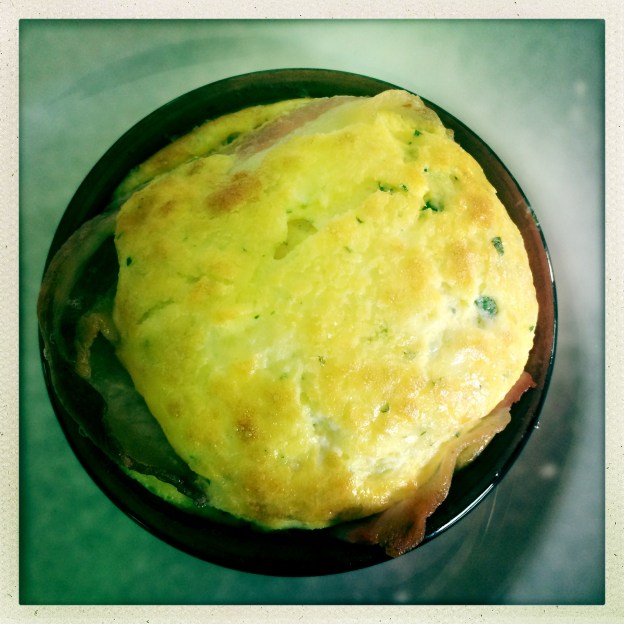
Egg and bacon pies

This little recipe was from one of Donna Hay’s books – Fast, Fresh, Simple. It makes for a great Saturday lunch but involves no pastry (sorry) – perfect for when when you want something hot, tasty and quick but would prefer to avoid falling into the predictability of sandwiches.

Obviously my children hated this and just ate the buttered sourdough I provided as a prop, and the bacon. But hey-ho. We loved it.

The recipe is here. But for convenience this is what you need for four people:

6 rashers of thin cut bacon

6 eggs

240g creme fraiche (I used a jar of it that was slightly less than that)

2 tablespoons of flat leaf parsley (I use frozen Waitrose herbs they are great for this sort of thing).

Oven preheated to 180C. You need four small oven proof dishes/tins of about 10cm across. We used these little ceramic ones we got some free pate or desserts in years ago. We seem to have accumulated hundreds of these dishes, hardly any of which are the same size. Butter said dishes and place on a baking tray.

Put the rashers around the dishes, one and a half in each, so they make a rim. Whisk together the eggs, creme fraiche and parsley and decant equally into each dish. Bake for 20-25 minutes until cooked but firm to the touch. They puff up like little souffles.