Possibly the best phone ever for older people. Plus how to really crack down on spam/phishing callers.

I don’t really get spam/phishing calls. At least, not yet. This is possibly because I’ve never been in the phone directory, I have a landline that is, primarily there for my internet, and I am very tech savvy at blocking such calls on my mobile if I get them.

However, whenever I was round at my mum and dad’s their phone would regularly ring with phishing/spam calls. They would be annoying, and of course I registered them for the Telephone Preference Service but it didn’t seem to make much difference. Some of the calls were simply annoying “do you want double glazing” etc. Some so obviously scam calls as to be not a threat. But all meant my mum had to stop what she was doing and go and answer the phone.

The obvious thing is to to get an answerphone and screen calls. But here’s the thing. Getting a separate, mechanical answering machine that works with an existing phone and is not hugely expensive, is virtually impossible – I’ve tried. You can get integrated answering machines, with cordless phones, but this would mean a change of phone for my mum, which is okay, but the phones that come with integrated answer-machines tend to have small fiddly numbers; and my mum likes a corded phone so it can’t get lost/run out of charge.

BT’s Call Minder, which you access via your handset and is ‘remote’ is an option, but she didn’t like that as it’s too confusing for her. So an answer machine or an answering service wasn’t really an option. And anyway, a very sophisticated caller, such as she eventually came across, would have not been put off by such a device and they would have left a message, lending credibility to their call.

(Anyway I think even a fairly simple answering machine would have been frustrating for my mum to master and why make her feel crap about not being able to do something when she is so good at so many other things?)

Because, one day, my mum got a call of a very different kind. Very sophisticated, believable and distressing; I won’t go into the details here but, thankfully, at the last minute my mum pulled a blinder (you can take the girl out of Naples but…) and a very serious crisis was averted. (We reported it to Action Fraud.) But it got me thinking just how vulnerable some people are and I realised that something needed to be done. When I started telling people what had happened to my mum, the stories that came out were terrifying. I learned that someone I knew, with graduate parents (English their first language, quite unlike my mum), had been scammed of £5K.  Then another similar story, and so it went on.

My mum is not tech savvy. If you need to feed fifteen people with one stick of celery and a tomato, she’s your woman. Her vigour, energy, hospitality and inventiveness is gob-smacking, but she is a technophobe. So whatever I did had to be low-tech at her end and the tech burden had to be mine alone.  I also needed something I could monitor and tweak remotely. It was no use asking her to press button 1 to stop the last caller calling her again. She needed a phone, pretty much like her old phone, with buttons to press to dial someone.

This is what I did. It’s in two parts – the remote part and the actual phone.

First, BT launched something called BT Call Protect earlier this year. I knew about this but again though it would not work for my mum, but, with her permission I took over control of her account. It’s free, but you have to be a  BT customer (your phone service may offer something similar) and how it works is that, once activated, it has a pre-set list of known spam numbers, these are automatically blocked. But there’s more.

You can see who’s calling via the website or a phone app, and you can VIP these numbers – and name them so you recognise them again when you next log on – or block them. So now my mum only has to make a rough note of the time someone called if it was a bad call and I can, via my computer or the BT app, forever more block that number.

You can also set it so that it blocks all, eg. with-held or international calls. And of course if you fall out with someone, you can put them from the VIP list to the Blocked list. Imagine the power.

With VIP numbers you can control which times someone can call you, so that, eg, you don’t get disturbed at night, or so that they can ring you 24/7 – you decide. Useful if you have a relative who keeps different hours to you or you don’t want to be disturbed at night.

All of this I can do remotely for her and with her knowledge.

If you block a number, it goes to junk voicemail (which you access via pressing 1572 on the handset although, see below, I eventually got my mum Call Minder so I access this for her now) so there’s s safety net there in case it does turn out to be genuine (there was one casualty which was a long-lost friend from Rome, but, thanks to this I was able to get her message and let her know and what’s more, VIP her number for future calls).

Since I did this my mum’s spam calls have dropped to: zero. So far.

Then there’s the phone. It was long overdue that she be able to see who is ringing her. I also wanted her to be able to access important numbers really easily.

I’ve mentioned before that I got a mobile phone for my aunt from Action on Hearing Loss (formerly RNID) so I turned to them for a phone for my mum and found this one.

It is really excellent and here’s why:

It has a caller display which lots of phones do (although they tend to be cordless) but with this one, you can tilt it up for maximum visibility and also change the contrast* – it displays the number and, if you’ve input the person into the phone’s phone book, their name will also show. (You need a subscription to a Caller Display service for this to work.)

*Someone visually impaired would still struggle to see this however, so look at the RNIB’s shop for phones for them.

The call buttons are large and illuminate when you pick up the phone.

There are four photo-buttons so you can either put people’s photos or write their name in LARGE TYPE. You programme these so that you can simply press them to dial someone but not only that: THEY ILLUMINATE WHEN THAT PERSON RINGS. Which is really like Thunderbirds!

I programmed as many numbers in as I could for my mum, no mean feat when you consider the size of our family. This you have to do with the phone in front of you but once done no further teccy-input necessary.

The phone plugs in and also needs 4 AAA batteries as back up. This it needs for the illumination/phone box storage features. It is otherwise a corded phone.

Although you can use the phone book to ring people – i.e. without having to manually press the number-keys, my mum doesn’t do this as she likes to use the number keys to ring people. There’s a volume control and also a boost in case someone is hard of hearing. So it’s packed with really useful features, but otherwise it’s a normal low-tech phone.

So now, as an added safe-guard, if my mum doesn’t recognise a number, she doesn’t have to pick it up. I’ve also put Call Minder on her line so that if she doesn’t pick up a call and it’s genuine, the people calling have the option of leaving her a message.  I control this remotely for her by ringing into it once a day (you have to set a PIN on the actual phone, but once you’ve done this you can ring in remotely). I can also hear if any spam callers who have called and left a message or not left a message.

There are other options available for protecting vulnerable relatives, such as True Call Blocker, which has rave reviews and Fuss Free Phones, which sound like a great idea but would have involved too many changes for my mum.

Some other option may work for you. This is so far what’s worked for us. I did a lot of research to come to these conclusions and what is the point of it if it doesn’t also benefit others?
 

La crostata rustica (plum galette)

La crostata (it means ‘crusted’) is oft made in my family in Italy.

It’s usually a thing of some precision, the pastry laid out, put in a tart or pie tin, filled with fruit or, sometimes, jam, and then criss crossed with thin, fluted strips of pastry.

This crostata is different in that it makes a virtue of its pulled together-ness and the pastry is, anyway, too fragile to handle much (this is because of the lard, which also gives it its deliciousness..). It has become my new favourite tart.

You can use any suitable soft fruit for this – peaches, berries, plums. I used plums as that’s what the original recipe called for. It’s really easy but, as I’ve said, beware because the pastry is very tricky to handle but that’s okay cos it’s all about a rustic look!

This is adapted from a Donna Hay recipe.

The pastry

225g plain flour

55g caster sugar

the rind from half a lemon

60g butter, fridge cold and chopped

40g lard, fridge cold and chopped

2 teaspoons of apple cider vinegar

60ml ice cold water – but you may not use all of it

1 teaspoon of vanilla extract

The filling

500g of suitable tart fruit, sliced if necessary.

75g caster sugar

1 teaspoon of vanilla extract

10g cold, chopped butter

1 beaten egg

some demerara sugar

(some juniper berries if you like and you remember)

40g ground almond

Method

Put the flour, sugar and lemon rind in a bowl and mix together lightly – you can do this by hand or in a food processor (I used the latter, work lightly). Add the butter and lard and mix to resemble the famous ‘fine breadcrumbs’. Now add the vinegar and vanilla and just enough water to bring it all together. If using a food processor, pulse and stop before the pastry has come together but looks clumpy. Bundle together and put in the fridge to rest for fifteen minutes or more (until you are ready to work with it, you can do it overnight).

When ready, roll out onto baking parchment, either into a round shape or, as I do, an oblong. I must confess to half rolling, half pressing the pastry to shape with ice-cold fingers (cold hands, cold heart). You want to get it to about 3-4mm thickness. When you’ve rolled it out so it’s at it’s final dimensions, put it back in the fridge for ten minutes.

Preheat oven to 200C.

In the meantime mix together the (sliced) fruit, sugar and vanilla.

(Note: you can make the fruit bit in advance and keep it in the fridge, but bear in mind the sugar will leach water from the fruit and you don’t want to put this (the juice) onto the pastry, so if you do make it in advance, just pour off any excess juice and serve separately over the tart, there isn’t much.)

Slide the baking parchment onto a baking tray, so the pastry base sits on the tray it will cook on.

Spread the ground almonds on the base – leaving a rim of about an inch. Now plop the fruit on top, spread it out as far as you’ve put the ground almonds, dot the butter on and fold the sides over. I find the pastry really hard to handle at this stage: do your best. Don’t worry if it looks very home made, it all adds to the charm. Brush the pastry edge with the beaten egg and sprinkle with the sugar.

Place in the oven for 15 mins, then reduce temperature down to 175C for 30-40 mins until the pastry is nice and golden and the fruit is bubbling. (Check after 30, I have two ovens and both vary hugely, one was perfect after 40 mins one was more than done after 30.) Let cool for ten minutes. I served it with this ice cream and let me tell you, it was a magical moment.


Pea, avocado and ricotta hot cakes (with or without poached eggs)

These are my new favourite thing. You might be able to tell this as there is no photo of the product all plated up, because I was too busy eating.

The original recipe is from Waitrose magazine (I’ve slightly adapted it) and it serves four. But you can easily make these for fewer and keep leftovers in the fridge (20seconds zap in microwave) for a really quick, tasty and nutritious lunch. They are much more filling than they seem as there’s a lot of protein and good fats in there (okay so the ricotta may not be the best fat you can get but come on).

You need:

110g frozen garden peas

250g ricotta

Half an avocado for the hot cake mixture, more for serving it with – as you like

100g self-raising flour, you can go part or whole wholemeal if you like

3 eggs, separated, but not for long

about 3 tablespoons of olive oil for the frying

Peashoots/avocado to serve.

The recipe shows this with poached eggs, which is how we had it, but I had the hot cakes warmed up two days later with just avocado for a super fast lunch (from conception to partial digestion in under four minutes as I had an interview to do). You can of course serve these with whatever you want and I can’t help thinking they’d make a good breakfast.

This is what you do:

Put a pan of water onto boil, when boiling add the peas and simmer for two minutes. Drain and cool under cold water. Tip into a food processor with the ricotta, half an avocado, flour and three of the egg yolks. Whizz up, season.

Separately, whisk up the 3 egg whites until stiff, then fold into the pea/ricotta mixture.

Put a large frying pan on with some oil (you will need to do these in batches unless your pan is huge). You use one or two large dollops per cake – see how you go. Cook for about two mins. Unlike almost evert-other-thing I make like this, when you turn them the underside has actually set and doesn’t stick (or mine didn’t) and I didn’t have to chase it round the pan and end up crying.

Flip (it may swidge a bit) and cook until the other side is done – I mean this is obvious right?. Keep warm whilst you make the rest.

That’s it. Serve, as above, with poached eggs, avocado and peashoots.

Leek and butter bean soup with crispy kale and bacon.

This is a lovely soup. What I also love about it is that you can leave the bacon off and it instantly becomes veggie/vegan. It’s stuffed full of probiotic-friendly leeks. It’s from the BBC Good Food magazine.

You need

4 tsp olive oil

500g leeks sliced

4 thyme sprigs, leaves picked

2 x 400g cans butter beans

500ml vegetable stock (or chicken if you like)

2 tsp wholegrain mustard

half a small packet of flat leaf parsley

3 rashers of streaky bacon

40g chopped kale, stems removed

25g hazelnuts, roughly chopped

You do

Heat 1 tablespoon of oil in a large saucepan, add the leeks, thyme and seasoning and  cover and cook over a low heat for 15 mins until soft, adding a splash of water if need be – don’t let the leeks stick.

Add the butter beans with the liquid from the cans, the stock and mustard. Bring to the boil and simmer for 3-4 mins until hot. Blend with a stick blender in the pan (or put in a blender). Stir through parsley, check seasoning.

Put bacon in a large frying pan, medium heat. Cook until crispy, set aside to cool. Add the remaining 1 tsp oil to the pan and tip in the kale and hazelnuts. Cook for a few minutes, stirring under the kale is wilted and crisping at the edge and the nuts toasted. Cut the bacon into small pieces and stir into the kale/nuts.

Reheat the soup, adding a bit of water if too thick (or have both operations going on at once) and sprinkle the bacon/nuts/kale on top.

Apricot and cinnamon breakfast muffins.

Of course, you can eat these beyond breakfast time. I made them because I was told I am borderline anaemic the other day, and apricots are a good source of iron. Not as good as a rare-cooked steak served with green leafy veg and washed down with a Guinness and an orange juice, but possibly easier to carry in your bag. These are very filling, not particularly sweet and keep me going if I can’t be bothered to eat lunch. Well, until about 4pm. I love how chewy the top apricot goes.

This recipe is from the free little newspaper Waitrose provides each week.

It makes 12 and you need to allow a little time for soaking the apricots.

You need:

250g dried apricots, I prefer the organic variety here as they have less stuff on them, it does mean they are quite dark though and not all zesty bright.

1 large orange, juice and zest

275g self raising flour (I used some wholemeal too)

2tsp baking powder

2tsp cinnamon

75g porridge oats, plus a bit extra for sprinkling

150g caster sugar

285ml buttermilk or kefir milk if you make it

2 medium eggs

50g butter, melted

3 tablespoons of apricot preserve

You also need a muffin tin lined with muffin cases.

Method

Reserve 12 of the apricots. Roughly chop the rest and put them to soak in the orange juice and zest. I do this the night before, but 30 mins is fine.

Preheat the oven to 200C. Mix together the flour, baking powder, cinnamon, oats and sugar. In a separate large bowl mix together the buttermilk, eggs and butter and add the soaked apricots sand orange zest/juice. Now add the dry ingredients and mix until must blended.

Divide amongst the paper cases – you’ll find the mixture is quite up to the top but don’t worry as it doesn’t rise much (despite the self raising flour AND baking powder). If you like use those fancy tulip-shaped muffin cases that look like someone artfully folded some baking paper, the ones that cost about £20 for ten (exaggeration).

Place a whole apricot atop each muffin and sprinkle with some porridge oats (this makes the muffins look good!). Cook in the oven for 18-20 mins. When still warm, mix the apricot jam with a tiny bit of boiling water and brush over the top for a lovely glaze. I wish I could tell you my children loved these. They didn’t. But my partner did!


Fresh sourdough, from frozen

Making sourdough, once you know what you’re doing, isn’t laborious. Sure, I hate the beginning part: all that measuring out and refreshing (I am so lazy) – and have to gear myself up for it. But once the dough is formed, it’s just a matter of revisiting it for a little fumble every now and again. Until you need to shape and put it to bed in the couche cloth or banneton, for the final prove.

That said, there are some days when you just don’t have the time to do it. And often it is the days when you are the most busy, that you need to be eating good, home made food – but you don’t have time to make it.

I’ve long thought of experimenting with sourdough, to see if you can freeze it after final shaping. And you can.

Straight after final proving, flour it well, and freeze it. Your exact method may need some tweaking. I tend to make baguettes, so I shape, put on a tray, flour well, open freeze for a couple of hours then transfer into a plastic bag. If you have a boule shape you can freeze it in the banneton (well floured) but do set a timer to take it out and put it in a plastic bag – your bannetons probably won’t like being frozen.

The night before you need your bread – or a few hours before – take the shaped dough out of the plastic bag and transfer either back into a well floured banneton or a well floured couche cloth. Just as if it were ‘fresh’. I put it in the fridge to defrost til morning and have it’s final, final prove. You can leave it at room temperature if you are in more of a rush.

Remember that frozen and defrosted dough is far stretchier, so handle it as little as possible (hence all the flouring). You then do everything as per normal – heat up the oven with a tray in it, transfer the dough when it’s time to cook, slash, ice cubes, bake. This is where my flipping board, or planchette, comes in really handy for transferring it to the baking tray as the dough is harder to handle than fresh dough.

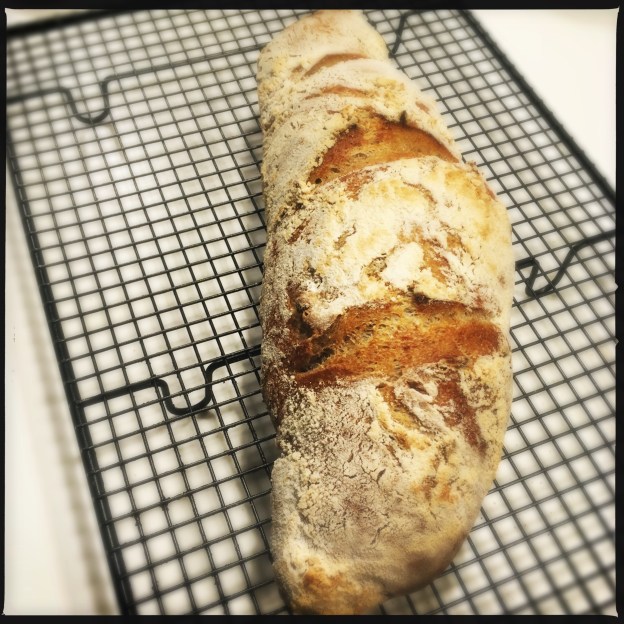
The one you see here suffered all sorts of indignities – I didn’t flour it, it was so stretchy I had to peel it off the planchette, it went into the oven full of injury and I didn’t hold out much hope for it. But sourdough is a miraculous thing and as forgiving as the best mother can be: 10 mins at 250C, 10mins at 220C and out it came: a perfectly wonderful loaf of bread, with an excellent crumb and a great taste.

White chocolate and amaretti cake

I don’t often have cake failures. I’ve been baking since I was seven. But when I do, they hit me hard.

The first time I made this – a Donna Hay recipe – it went wrong. It looked fine, coming out of the oven, but when you cut into it there was a hole running the whole width of the cake, so that each slice had a hole right through it. The sort of thing which, if you’d tried to achieve, would have been impossible.

It tasted delicious, but it was a failure. I whizzed the whole sorry thing up in a food processor and froze the crumbs. They will be delicious on some ice cream, as a topping, or put in milk shake mix ins.

I had a rare afternoon nap and then it came to me: I had forgotten to put the milk in. I had made it in a bad mood, and got distracted. The original method is also a ‘bung it all into the food mixer’, which is where I also went wrong as I lost track of the ingredients.

This is a simple cake – simple to look at, simple to make, but the ingredients add up. It has nearly £5 of white chocolate in it. Of course, you could put any old white chocolate in it, something cheap, but I think good quality white chocolate makes a difference. I use Green and Black’s white cooking chocolate. Then there’s the amaretti. The rest is regular baking fayre: butter, eggs, flour. Oh and milk.

I have adapted this so it’s all done by hand. I felt I got a better result. If you want to, you can bung everything save the amaretti crumbs into a food mixer and mix away until smooth, then rejoin the recipe at the putting into the tin stage.

Because this recipe contains amaretti – almonds – it is not suitable for anyone with nut/almond allergies.

This is what you need:

185g very soft unsalted butter

220g caster sugar

3 eggs

a teaspoon of vanilla extract

250g melted white chocolate, slightly cooled

300g self raising flour

310ml of milk

160g crushed amaretti biscuits

A few amaretti, crushed, for decoration after cooking.

This is what you do:

Preheat the oven to 180C and grease and flour a 3l bundt/ring tin.

Cream together the butter and sugar, add the three eggs, one at a time, then the vanilla extract. Now gently mix in the melted chocolate. Then add the flour and, little by little, the milk.

Pour half the mixture into the prepared tin, sprinkle the amaretti crumbs (I pulse them in a food processor) over the cake mixture. I use a skewer to gentle feather them through the mixture, but you don’t have to. Now top up with the rest of the cake mixture.

img_0611

Bake for about 45 minutes. Check with a skewer to make sure it’s cooked. Make sure it comes out clean.

Leave to cool for ten minutes, then turn out and sprinkle a few crushed amaretti over the top if you’d like.

This cake fills the kitchen with amazing Viennese coffee house smells as it cooks. It’s even better the next day. The white chocolate gives the sponge an amazing lightness and a taste you can’t quite put your finger on. And the amaretti crumb layer is just amazing and marzipan-ish in taste (so absolutely no good if you hate marzipan).


Chorizo and kale cheesy gnocchi

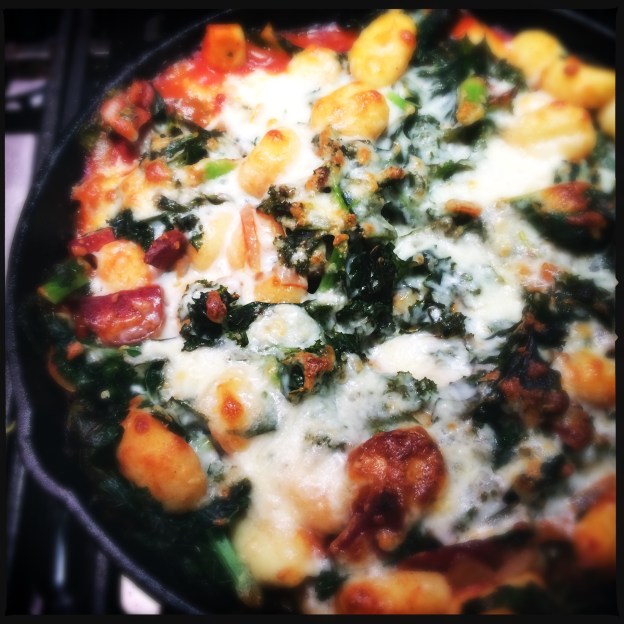
I adapted this from a Delicious magazine recipe. There is 200g of kale packed into this recipe. And you could substitute spinach if you wanted to.

This is really tasty, wonderful  autumnal dish that’s easy and fast. And if you have a cast iron frying pan that can go in the oven, you can cut down on the pots and pans needed.

Serves four.

You need

200g curly kale or spinach. If using kale take the time to shred it into smallish pieces and cut out the bigger stems.

500g potato gnocchi

1 medium onion, finely chopped

Olive oil for frying

125g approx of chorizo – a bit more if you really like it. Slice in half length ways then finely slice so you end up with half moon shapes.

200g passata

a handful of basil leaves

100g grated or sliced mozzarella

Method

Oven to 200C. Bring a very large pan of water to the boil with a dash of salt in it and drop the gnocchi and kale in, together. Cook for just 30 seconds, drain into a colander and rinse through with  cold water.

Gently heat the olive oil in a frying pan (if it can go in the oven make sure it is quite a large one that can hold the whole dish), now gently cook the onion until it’s soft. Add the chorizo for a few minutes, until the onion takes on the colour of the chorizo. Now add the passata and the basil and cook for three minutes.

Add the gnocchi and kale into the frying pan if it will fit, and mix to combine everything; if not transfer everything to an oven proof dish of about 1.5litres. Mix everything through well. Add some ground pepper (I think the chorizo has enough salt but add a bit more if you like). Sprinkle over the mozzarella or place the slices on top and put in the oven (uncovered) for a scant 15 minutes until golden and bubbly.


Lovely leek and broccoli fish pie

This is, hands down, the tastiest fish pie I’ve ever had. It is more of a work-day dinner than a dinner-party piece, but it is just tasty-gorgeous. It is from the Donna Hay magazine which is worth every penny of the £5.20 an issue I pay for it.

Ingredients

200g fresh sourdough crumbs (I keep a bag of left-over sourdough pre-grated in the freezer then you can use it when you want)

Half a bunch of tarragon (so about 12-15g)

150g unsalted butter, melted

salt and pepper

2 leeks, white part only, thinly sliced

2 cloves of garlic, crushed

300g broccoli florets, cut into smaller florets

800g of thereabouts of firm fish (fresh not frozen as in it can’t be cooked from frozen!). I have used all cod, or a combo of cod and salmon and smoked haddock. See what you like. Cut it into 3cm pieces – this is important as it gets only 10 mins in the oven.

1 tablespoon of plain flour

250g sour cream

2 tablespoons of Dijon mustard

125ml water

Method

Oven to 200C. Place the breadcrumbs, half the tarragon, half the butter, salt and pepper in a large bowl and mix to combine. Then place on a large oven tray and cook for ten minutes – until golden.

While the breadcrumbs are toasting, heat the rest of the butter in a large ovenproof pan over a high heat – the pan will eventually go in the oven with the whole fish pie in it. Add the leek, garlic and broccoli to this pan and cook, uncovered, for about five minutes or until the veg is softened.

In a separate bowl, place the fish, flour and more salt and pepper and toss to combine. Add this fish mixture, the remaining tarragon, the sour cream, mustard and water to the pan and stir to combine. Top with the breadcrumbs and cook in the oven for another ten minutes in the oven until golden brown and the fish is cooked through.

img_0540

I serve this with peas. It is so much tastier than you think it’s going to be.

img_0547

I want to say “my children lap this up.” But they pretty much hate it. But I still make it.

(Don’t forget how good leeks and garlic are for gut bacteria!)


Save

Polenta ‘pizza’ with cherry tomatoes and some sort of cheesy topping.

This is not, of course, pizza. But it is delicious.

Polenta featured large in my father’s home cuisine – northern Italy. But it didn’t feature in my mum’s – southern Italy. And because my mum was the cook when we were growing up, I feel I can safely say we never had polenta. I would hear about it, but I could not get my head around what it was. Sometimes it was a powder, then it was solid, then like mash.

When I got older I tried making polenta and it was a disaster. Since then things have improved and it features in my home cuisine and I always find it comforting.

This recipe is from Delicious magazine. I like that the making of the polenta doesn’t involve loads of butter and parmesan – sometimes you want that, but not all the time. Of course you can vary the topping to have what you want on it. Because my children aren’t so keen on dolcelatte I bought some brie with truffles in it as a treat.

Anyway this is just delicious. It easily fed four of us and I had the left overs for lunch the next day (heat up for a few minutes in a dry frying pan, if you can cover it to catch the steam) and it was wonderful.

2 courgettes, sliced thinly (I used a potato peeler)

200g or so of cherry tomatoes, halve them

Olive oil for drizzling

600ml of milk

400 ml of chicken stock, either your own or made from a cube

250g instant polenta

50g cheddar, grated (or use some other cheese it’s okay)

80ml of passata

80g of dolcelatte or brie, thinly sliced

a handful of basil leaves to scatter

Method

Heat the oven to 200C. Spread the courgettes and tomatoes over a large baking tin, drizzle with the oil, season with salt and peper and roast for 10 minutes. This bit is important as you won’t be cooking the finished pizza for long enough to get the courgettes and tomatoes sufficiently roasted. When done set aside but leave the oven on.

Meanwhile, put the milk and stock in a large sauce pan and bring to the boil. Put the polenta in a jug and when the liquid boils, pour the polenta in a stream and stir continuously with a wooden spoon or large whisk. You want the mixture to thicken and bubble on the surface, like larva. Now turn down the heat and stir in the cheddar and season well.

Pour the polenta mixture onto a baking sheet (I find some baking parchment helps but is not essential), spread out thinly to a circular or rectangular shape. Spread the passata over – it will be very thin. Top with the roasted courgettes/tomatoes and the thin slices of cheese. Bake for 15-20 minutes until golden. Scatter basil leaves atop.

You can serve this with a salad but I like it on its own, with one fork, and my feet up on the sofa.