Author Archives: Annalisa Barbieri

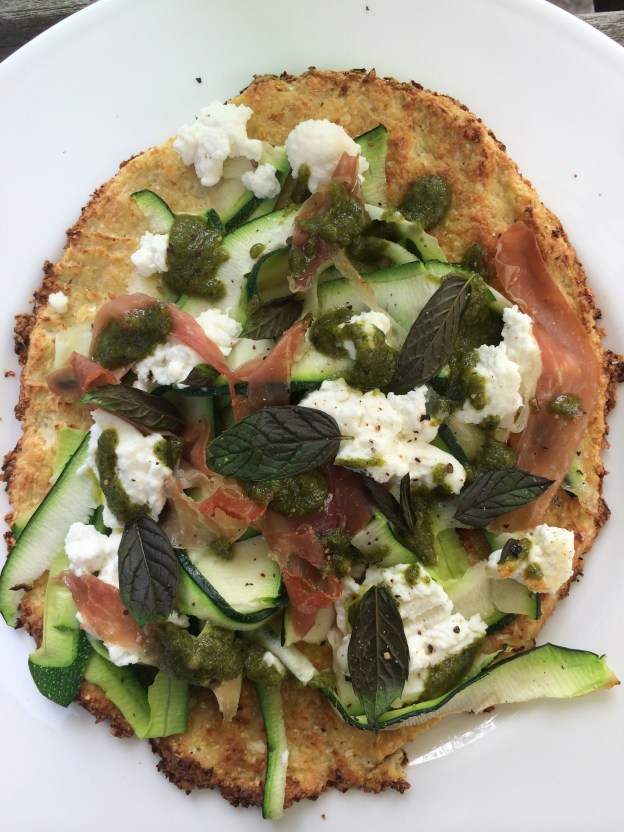
Cauliflower-crust pizza (gluten free)

I am not a fan of food, which, under the umbrella of ‘being healthy’, pretends to be something else and in so doing, delivers only disappointment. Courgette strips instead of pasta, yoghurt when you really need cream, vegetables in cake (which I admit can sometimes work)..cauliflower instead of pizza…

This isn’t anything like a pizza. I warn you now. But if, as I do, you like to have a lunch with a ‘base’ and lots of veg then this is a really good, gluten-free, wheat-free and tasty (yes really) offering. To me, it didn’t taste like cauliflower at all, more like a lovely parmesan crust. My partner was a veggie for 20 years; he views such things with deep suspicion, having been offered beans, made into the shape of a lacklustre burger for many years. But he was impressed and delighted.

I got the recipe from Delicious Magazine (no link because it doesn’t appear to be online), and I’ve halved the ingredients to make it ideal for two, for lunch. I followed the recipe topping but obviously you can add whatever you want. We happened to have some pesto made by my eldest (she makes it better than I do, taking it off me and saying “here Mummy, let me show you”. I love how she is confident like this). You could, feasibly, leave the pesto out and add a drizzle of olive oil or chilli oil, or just, you know, BUY SOME.

225g cauliflower florets
1 medium egg
75g ground almonds
25g grated parmesan
salt and pepper
1 courgette
2 slices of Parma ham
120g ricotta
Pesto and mint to serve

Heat the oven to 200C and put in a large baking sheet. Now, put the florets in a food processor and blitz so it looks like cous cous. Put in a bowl and add the egg (which you have lightly beaten), ground almonds, parmesan and a bit of salt and pepper (not too much salt as the parmesan is also salty). Stir together.

On a piece of baking parchment, spoon out two portions. I sort of shaped it by hand, into two round shapes. It was easy, no rolling and although the mixture is wet and you think it won’t work, it does.

When you’ve done this, take out the baking sheet (which will be hot!) and gently slide the baking parchment onto the baking sheet. Cook for about 20 minutes or until golden and firm to the touch. Check after 15 minutes.

Whilst that’s cooking, slice the courgette into ribbons.

When the bases are cooked, take out and keeping them on the baking sheet, scatter over the ricotta, courgette and ham. Cook for another five minutes and then, spoon a bit of pesto and scatter some mint leaves atop.

2016 update: I just love this dish. What I tend to do is spread a thin layer of chilli jam/caramelised onion/chorizo jam over the base, then layer on the courgette and ricotta but also add (ssssh) some slices of chorizo, which I love. This really is tasty! When it’s cooked I drizzle on some olive oil (extra virgin).


My meatloaf

My mother’s meatloaf is the stuff of legend. In the past, whenever we had meatloaf at my house my children would look up, all eyelashes and downy cheeks and say “is this Nonna’s meatloaf?” and I would have to say that no, no it wasn’t, it was mummy’s. And they would look down and  eat it, making approving, encouraging noises but they would know, and I would know, that it wasn’t comparable. Every meatloaf I’ve tried, until this one, was just not right.

The thing about my mother’s meatloaf is that she minces her own meat, so it’s silky smooth and sublime. I like my meatloaf like I like my sausages: not coarse. I want it to be an easy transaction. And all the meatloaves I’d made before were too coarse, too dry, trying too hard.

Last year I bought Donna Hay’s Simple dinners, from whence this recipe comes.  It’s a great book. Her recipes are genuinely tasty, pretty healthy, made from a clever combination of not too many ingredients and easy to follow. She is, to my mind, just about the best cookery writer of the day (for meals ‘n’ stuff. Dan Lepard is still my man for bread). I’ve adapted it here because I’ve been making this meatloaf for over a year now and I’ve made it my own: I’ve adapted it slightly to suit our needs.

As such, this is now my meatloaf recipe, in that it’s the one I use as my go-to meatloaf recipe. I can’t imagine it will ever be made better by anyone else’s meatloaf recipe. Except, naturally, my mum’s.

(What I also love about it is, if you make this for a Sunday lunch, and it’s very good at Sunday lunch, you can make it in advance or the day before, keep it in the fridge and put it straight in the oven. Just give it 5-10 mins more in the oven at the lower temperature i.e. the first round of cooking.)

This is great served with the usual stuff, but I particularly like it with mash for a real comfort, fork-only meal.

You need:

a packet of thinly sliced pancetta, about 20 slices

110g breadcrumbs

60ml milk

400g rose-veal mince (all veal sold in Europe is non-crated, but I only buy higher welfare British veal, if you are not sure, substitute beef mince)

500g free range pork mince (I never, ever buy any other sort of pork)

1 tablespoon of Dijon mustard

1 large egg

a tablespoon of thyme leaves, stripped from the stem

salt and black pepper

2 tablespoons of maple syrup

What you do:

Oven on to 160C if you intend to cook it straight away. Get a loaf tin which is about 22cm by 8cm and line the bottom with the pancetta (line across the width, not length if you follow). If you imagine that the meatloaf will be turned upside down on serving, this will be the top of it. Don’t sweat it if you don’t have enough pancetta to cover the whole bottom/sides, and ditto if you have a bit too much, I also line the side/sides not just the bottom. If you have very long slices then don’t worry, you can just overlap them when the tin is full of the mince. It doesn’t have to be perfect.

Because I rarely have properly stale bread, and even if I did I hate grating bread (my mum always, always has properly stale bread which she grates), I put some day or so old bread into a food processor and whizz it up. Take it out then pour the milk over it and give it a little stir.

Now, what I do to make it all super smooth is this. I put the milky breadcrumbss back into the food processor with all the mince, the mustard,the thyme leaves and the egg. Add a bit of salt and black pepper. And then I whizz it all in the food processor. It comes out looking like awful meat slurry.

Don’t worry. You know it’s not.

Now, pack this into the loaf tin. It will seem like too much but keep the faith, pack it in, press it down, tuck over any overhanging pancetta slices if you have them. Then, either put in the oven or cover with cling film and put in the fridge for a day or so (obviously not over what the sell-by date of the meat is).

When you are ready to cook it put it in the preheated 160C oven and bake for 30-35 minutes until the meat is just cooked through. (If you’ve had it in the fridge then increase this time to 35-40 minutes maybe a tad longer, use your common sense.)

Now, take it out and onto a baking tray, invert the meatloaf. Obviously the tin will be hot so take care with oven gloves, etc. Onto the inverted meatloaf brush with the maple syrup. Turn oven up to 180C and now bake for 15-20 minutes.

Serve. It’s delicious.


Sweetcorn fritters

I’ve been a bit obsessed with vegetable fritters, ever since I had sweetcorn and courgette ones at Caravan in King’s Cross, which is across the road from my office, off the breakfast menu. These are some I’ve adapted from a Waitrose recipe. They don’t contain courgette, although there’s no reason why you couldn’t replace half the sweetcorn with courgette if you wanted to. I just haven’t, yet.

These are a regular lunch for me. I make a batch and have it across two days as it makes about six fritters.

What you need

1 x 326g can of sweetcorn (or 250g of actual corn off the cob/frozen)

75g self raising flour

1 egg

65ml semi skimmed milk

3 salad onions, sliced

some coriander (about a tablespoon’s worth)

A bit of oil to fry them.

I serve these with a rocket, avocado, tomato salad dressed with extra virgin olive oil and lime juice and a smear of Tracklements chilli jam.

What you do

Put the corn, flour, egg and milk with the salad onions and the coriander in a bowl with a pinch of salt. Mix together well.

Heat the oil in a frying pan and drop about two tablespoons of the mixture per fritter (see what size you want them to be). Cook for about 3 mins each side and presto pronto. Ready to eat.


Sourdough after a 156hr prove

Ever wondered how long you can push sourdough for? I baked these rolls  after a 156hr prove at 2C. They were very dry when they came out of the fridge and I slashed them with a bread knife, not expecting much. Cooked them for 8mins at 250C (fan) then 8mins at 220C (normal).

So you can go away on holiday for a few days and leave some sourdough rolls proving for a good few days. I think if anything, they rose up more than normal…

Berry ripple ice cream (no ice cream maker necessary)

This is a super easy ice cream, but with the luxury of a ripple running through it that makes the most of all the free blackberries available at this time of year. The blackberries used in this were picked by my dad in Wimbledon, SW London. But you can use any berries. I’ve made this with raspberries or brambles.

Anyway, here’s how to do it:

For the ice cream:

A 397g can of condensed milk

450-500ml of double cream. I use an organic cream that comes in 227ml, and I use two pots, but it doesn’t matter if you add a bit more or a bit less.

2 teaspoons of vanilla extract

For the ripple

A big bowl of blackberries, or raspberries or brambles, about 300g. Don’t sweat it though if you have less as you can still make a great ripple ice cream just with less ripple.

Some caster sugar – to taste. I use a couple of heaped tablespoons as the ice cream in this is already very sweet. Don’t make it too sweet and best to add too little, taste and then add a bit more if necessary than t’other way around.

First, make the ripple. Put the berries in a sauce pan and put in the sugar.  Stir so the sugar dissolves and then simmer for about 10 minutes until it’s all mushy. Pass through a sieve to get rid of the seedy bits. Taste and see if you need more sugar but don’t over do it. Put to one side to cool. You can make this part the day before.

Now mix together the cream and the condensed milk, add the vanilla extract and whisk until thick and stiff.

I pour the vanilla ice cream into a large, shallow Pyrex dish (rectangular) so you have a large surface area. Then I spoon the ripple on top and very gently run a knife through it to disperse it.

That’s it. Freeze and eat on demand. It’s delicious. Enjoy the super psychedelic picture. I served a scoop of this with my mamma’s apple pie. My dad’s harvest, my mum’s apple pie and my ice cream. A delicious family team effort.

Speedo Swedish swimming goggles

I swim a lot. This sentence seems an incredible thing to be able to write given that, I didn’t learn to swim until I was 26 and I am scared of water. But, I control it. I swim only in pools that I know, that I’ve checked out for giant plugs into the underworld. I also swim, these days, almost exclusively outside. I don’t mean in the sea or in rivers, that would be too scary. But in outdoor pools.

And swimming outside necessitates mirrored goggles. At least, it does for someone like me who is never out of prescription sunglasses the rest of the time.

My last pair of goggles lasted about 20 years. Perhaps because there was a fifteen year gap of not swimming very much in the middle. But as they were starting to fray, I looked around for a replacement. Goggles are so individual and  you see most people, in the pool, between lengths, adjusting theirs and shaking out the water. I just thought this is what you had to do.

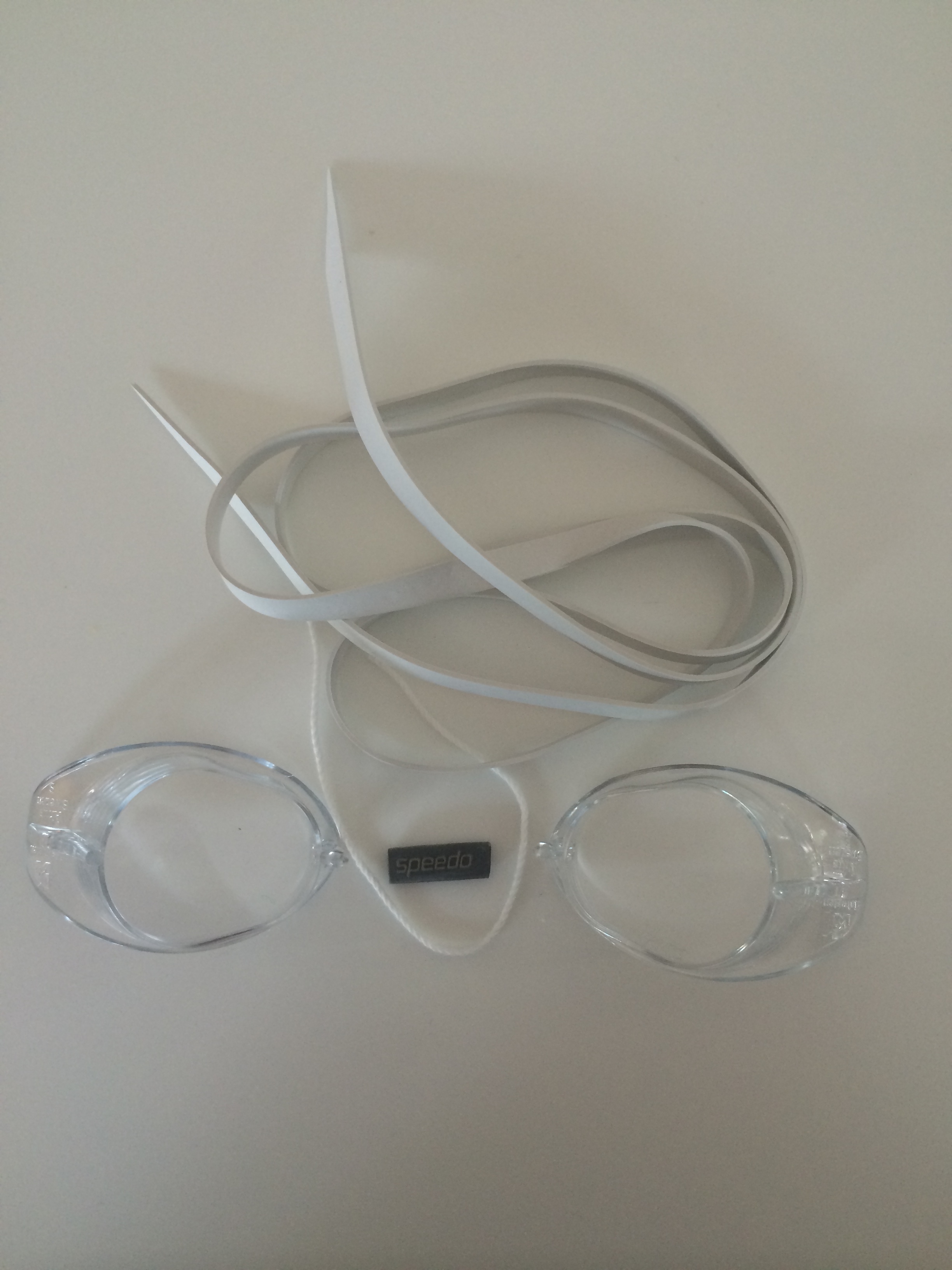
Then I saw Swedish goggles. These come in a kit. They are so cheap compared to normal goggles: I paid £10 for two pairs, one mirrored one plain, which is just what I need (mirrored is no good at night time/dusk, you need clear then). The reviews were glowing.

IMG_8486

I never think that same experience will apply to me. I read about people finding things amazing and ‘the best ever’ and I think “I bet that won’t be my experience”.

I hesitated before building the goggles because, for some reason, I thought it would be tricky. You get the goggles in pieces: a latex head band, two eye pieces, a nose bridge and a piece of string, per set of goggles. But it was easy. Sure, I got my partner to help me hold the lenses in place whilst I tied the string. And sure, I didn’t bother to tidy up the string over my nose so it looked slightly bonkers, until my friend Jess (an ex jeweller) offered to sort it out for me and made them look really cool. But it was easy.

The big thing about Swedish goggles, other than you make them yourself and fit them exactly to you, is that there is no padding. What can I tell you, they’re somehow really comfortable and… best goggles ever. They fit brilliantly, I never have to adjust them once I’m swimming and no fogging up so far. You also get great all round vision (you don’t realise how restricted your vision is with conventional goggles until you try these) and I love how minimal they are.

You will need to do an internet search for them. Mine cost £10 for two pairs, you can get them even cheaper. And if you need any help in putting them together you can look on You Tube. Just put Swedish Goggles Fitting into search.

Little towelling dress, a great buy

This is an absolutely brilliant toweling dress that comes in blue or white (I have it in blue). It zips all up the front and has a draw-string and a hood and short sleeves.

It’s perfect for putting on after a swim/on the beach. (I’d always envied children their toweling cover ups.) Because I am not tall, the style fits me really well (I didn’t want anything too short) and comes to a few inches above my knees. I’m a size 14 and the L fitted me with room to spare. I swim every day and put this on after my shower and when I can’t be bothered to get dressed back into proper clothes, but don’t want to lounge around in a dressing gown, either. I love it, and am resisting the urge to buy two in case anything happens to the first one. But be warned: doing this (buying two of the same thing) will immediately render the first less special.

£35 from John Lewis.

A nice healthy lunch, that’s largely an assembly job


I eat insanely well during the week. My lunches are not calorie controlled, but because I tend not to eat dinner, I really pack my nutrients into the first half of the day.

This is a lovely lunch. It’s healthy but delicious; easy and you can of course customise it however you want. I tend to bake bread in the morning, so this is a good time to put some veg in the oven to roast it for lunch later on. I use red onion, peppers, squash, a good tablespoon of olive oil, some herbs. Whatever veg I have.

Come lunch time I either use some sourdough or, more frequently, some of these delicious flat breads: I buy the organic wholemeal version. They’ve got very few, natural, ingredients and also, unopened, keep for a few weeks so good to have in. Although I make my own flatbreads occasionally, I often just want a quick lunch and this enables me.

When I’m ready to eat I heat up my flat bread in a flat frying pan, then top it with some Tracklements Chilli Jam or Stokes Red Onion Marmalade – just spread a bit around. Then scatter some lettuce/spinach/rocket leaves atop, plus some avocado. Scoop up your roasted veg, top with some suitable protein if you so wish – goat’s cheese, crumbled feta, dry-fried halloumi, sardines etc. Scatter over some toasted nuts/seeds if you like, drizzle with olive oil. Eat. It’s delicious and you feel really good afterwards.


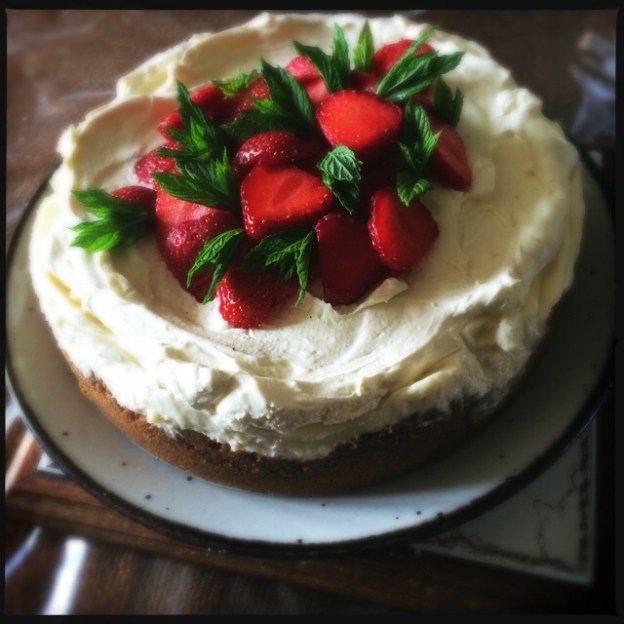
White chocolate and strawberry cheesecake (no cook)

This is a Waitrose recipe that I adapted. The original, to my mind, uses far too much butter to biscuit ratio and you end up with a greasy mass. It’s also imperative you line the base and sides. I don’t think you need the extra cream on top, either. But add it if it’s more of an occasion.

200g whatever biscuits you like at the bottom of a cheesecake

50g melted butter

400g strawberries, stalks removed and cut in half/slices for the top

200g white chocolate

400g cream cheese

25g caster sugar

170ml double cream and mint leaves to go on top (although note: you need 4 tablespoons of double cream for the actual cheesecake filling). So if you decide not to add the cream at the top, you’ll still need some double cream.

You need a 20cm/8″ loose-based cake tin which you need to line the base and sides of. I know it’s a faff but so is trying to dislodge a cheesecake that’s welded itself to the tin.

Crush up the biscuits in whatever way you see fit: food processor, plastic bag with a rolling pin. Tip crushes up biscuits into a bowl and add the 50g melted butter. Stir together and then line the cake tin with it – the base and as far up the sides as you can go. Cut the strawberries in half and place, face side down, until you’ve covered the base.

Chill it whilst you make the filling.

Melt the chocolate in a bowl over boiling water/or gently, in a microwave. When all molten, cool slightly whilst you mix together the cream cheese and sugar with two tablespoons of boiling water. To this, now, beat in the melted chocolate a bit at a time at first, then add the rest in, with four tablespoons from the 170ml of double cream if using for the topping, if not just 4tbsps of double cream. Mix all together.

Put on top of biscuit base. If you want to do a cream topping, whip the rest of the cream until just firm, put on top of the cream cheese filling, top with sliced or halved strawberries and chill, overnight if possible.

Top with mint leaves just before eating. It’s best 20mins out of the fridge.


Chocolate yoghurt

This is a really nice thing to have with some fruit. I’m all for eating yoghurt on its own but if you want to butch it up a little, or make it into an extra treaty thing then you can easily make chocolate yoghurt. This serves two.

Melt 50g of chocolate of your choice in the microwave or in a bowl over a pan of simmering water. White chocolate gives a lovely vanilla-y flavour but experiment with milk or plain. Obviously milk or plain will colour the yoghurt.

Now, for the yoghurt, use anything from 150g – 250g. We always have live Greek-style yoghurt (is any yoghurt dead yoghurt?) but use any plain yoghurt that takes your fancy. 150g gives you a very tasty dessert indeed. Chocolate-y tasting with a nice, clean tang of yoghurt. The more yoghurt you add, the more you’ll have to eat but the less sweet it tastes. Experiment..

Once the chocolate is melted you add the yoghurt, add a tablespoon in first so you get a smooth mixture then add the rest; stir it so it’s all amalgamated and serve with some nice fruit. Awesome, fairly healthy, dessert. If you want to up your good fats, sprinkle some chopped nuts on top.