Easy Berry Tart


The me I show to the world isn’t always the same as the private me. I know that, sometimes, people who think they know me, suppose my life is one big idyllic bubble. All baking and babies and countryside and long grass through which to trail my fingers.

And that is indeed part of my life, especially since our lawn mower breaks down often. But it’s also because I don’t always choose to share the more negative parts of my life publicly because I like to see the best in everything and I like to spread joy and comfort; not worry and misery.

I have this memory of being very young and  being in the playground at primary school. I sometimes found playtimes hard but pretended, largely, that I didn’t. Mostly they were okay but not my favourite time: too disorganised, too sprawly and I didn’t have a best friend til way, way later with whom to buddy up.

The school bully (someone actually very troubled, I discovered lately) only once picked on me so I was never really bullied. That wasn’t the problem. But she invariably picked on someone and I thought “Jesus this playtime is just a free for all, where are the adults to help us?” (My mother is Neapolitan and in Naples no child is allowed to misbehave and everyone parents everyone else’s child.)

And then I remembered that Kizzy was on that afternoon and I got this surge of happiness (it was to be 30 years before I realised it was actually a surge of a hormone called oxytocin and for ages I thought I was the only one who experienced these physical surges of happiness). And I realised, right there and then, that life was about a series of episodes; pockets of good things and bad things and if you could just concentrate on the good things, the bad things could diminish. Mostly. And that Kizzy moment has never left me.

This week a much loved colleague from my years at the Independent on Sunday, died. She was also a friend that I’d known for twenty years. Someone that I hadn’t spoken to in a while, because I took it for granted that she’d always be there to catch up with. As you do. I won’t say anything else about her or what happened to her, because it will probably just make you anxious and think the world is a big, scary, place. And it isn’t. It’s mostly really good.

Clare read this blog avidly, although she never commented. Even in her last message to me just last Saturday she said “I’ve really loved your blog”. Because I can’t be absolutely sure that you can’t read the internet when you’re dead (I mean, come on, who knows?). I’m giving her a shout out here. Clare was a hopeless romantic and we shared many cosy, chatty evenings at her house in Crouch End when she lived in London. This is just the sort of tart we’d have made because it would have been lovely, and shown caring and thought, but not distracted us too far  from the task in hand: putting the world to rights.

So here is an easy tart. Although usually, because I am a crashing, crashing snob about home made things, I would never entertain the thought of buying a home made pastry case, sometimes, it’s okay to. Buying the pastry case for this makes this so easy. And yet the result is glorious. I’ve put it here, today, because there are so many berries being picked right now and this is a lovely way to use them. It will make you feel good making it and even better eating it.

You need a ready made shortcrust pastry case, about…8 or 9 inches? They’re pretty standard size in the supermarkets.

500g mascarpone

3 tablespoons of lemon curd. Something artisan would be lovely

Half a teaspoon of vanilla essence

One tablespoon of icing sugar

300g berries, whatever you like

The syrupy topping (which isn’t essential):

Three tablespoons of caster sugar

The zest of half a lemon

Put your pastry case on a plate. Mix together the mascarpone, lemon curd, vanilla extract and the icing sugar until smooth and all homogenous. Spread it evenly over the pastry case. Chill for one hour. [Note: if you don’t have time and want to just assemble it all in one go, do, but you must then either leave the lemon syrup out of make sure it’s chilled, don’t pour it over hot!]

Meanwhile, make the syrupy topping which you do by putting the caster sugar and two tablespoons of water in a pan over a low heat. Let the sugar dissolve, increase the heat to boil for a few minutes (2-3). Remove from heat and add lemon zest. Cool completely.

When ready to serve put the berries on top (I find them nicer at room temperature), pour the syrup topping over the whole thing and serve.

IMG_6871


Rosemary, polenta and olive oil biscuits

IMG_2679These won’t be to everyone’s taste, but I loved them. They’re easy to make, almost impossible to get wrong (unless you chucked them on the floor or something) and unusual. Like rosemary shortbread but with the advantage of no butter at all. I gave these to my father waiting, waiting, for him to say “too rich, too much butter” (this is what he always says about all my baking). So i could pounce and say “aHA, no butter in these NONE NONE and by the way, that New Year’s Even when I said I wasn’t out in a club aged fourteen I WAS and I’ve sustained the lie over thirty years.

Ahem. Exorcising a few ghosts there. I think this would be lovely with some rich vanilla ice cream or maybe a very strong espresso.

The recipe is here, on the Easy Living site. I have to say, I was very much not impressed with Easy Living the magazine in recent times. It had gone all silly and light weight; but they really lost me when they described women who breastfeed (and, I suppose, go on about it?) as breastfeeding Nazis or the Breastapo (I can’t remember which, but you get the idea). This is such an offensive term and belies a real ignorance of history.

I complained, and some flippety gibbet replied, completely not understanding my point. That was it, it was over for me and Easy Living.

The magazine has since folded but exists on line and its recipes are really good, and definitely worth checking out, even if the rest of the content, in my opinion, is as sustaining as a rice cake.


How to make your own reed diffuser

IMG_2864

Last week I did some radio.

What usually happens when I do radio is that everyone who I know rings me up saying “YOU’RE ON THE RADIO”. Which is why you have to switch your phone absolutely off. I love doing radio, especially when it’s live, because there is part of me that just wants to take over the airwaves and say ‘fuckbollockshitcuntwank’. But of course I never do because then my radio career would be completely over.

But doing radio is a buzz and you come out of the studio all pumped up. So, now that I’ve told you that, quite gratuitously, I can tell you that I came out of Broadcasting House, having been a star for six minutes and as I blinked in the sunshine I realise that my family had quite forgotten about me. They’d gone off on a jaunt and the text messages hadn’t got through so I was completely alone. No idea what to do or where to go.

Now. Being completely alone in the West End is often the stuff of fantasy for me. I love the West End. I was born there, it’s my home. I know almost every shop along Oxford Street. The very thought of being able to wander, aimlessly and without time-limits or being asked if two women can have a baby or what’s a teenager or who decided if we should be happy or how far is it into space or how old was I when I started smoking or did I do drugs and if so were they uppies or downies, well, that thought often replays in my mind when I haven’t got two minutes to rub together.

So here I was. Alone, in the West End with no-one needing anything from me. And of course, I didn’t know what to do with myself. So I went into all the shops until I finally gave myself up to John Lewis, the floors of which I backcombed until I was so up on its stock, I could have donned me an “INFORMATION” sash and diverted any customer to any corner of its emporium.

This is when I discovered that Johnny Loulous has almost an entire floor dedicated to reed diffusers. Reed diffusers are those room fragrance things that cost a fortune and involve liquid in a glass container with sticks sticking out of them. Like the picture above. They are supposed to fragrance a room continuously, but are safer than candles

I’ve been horribly spoiled over the years by expensive fragrance. I discovered Creed when I was 26, and there was no going back. It’s not the only perfume I wear now but I never wear anything that’s cheap. You can’t cheat with fragrance.

Unlike a body perfume, room fragrance doesn’t develop over time. It just is. So if it annoys the fuck out of you when you first smell it, the high chance is, it always will. We have Jo Malone’s Room Sprays in the bathroom (I grew up with an aunt who used plug in air fresheners which was enough to put me off for life. JM room sprays are not cheap but they are beautiful and they last years) and I once stupidly bought a ‘leather one’ – I can’t remember the exact name – hoping it would grow on me. It never did. All it does is really annoy me and I now realise that I don’t like any fragrance that purports to smell like leather anything.

But because I am slightly obsessed with nice smells, but it’s not practical to always light a candle or spray the room, I’ve sometimes looked at reed diffusers and thought about buying one. But a few things irk:

  1. Whenever I’ve smelled them in people’s houses they largely smell of nothing.
  2. They’re a bit 2011.
  3. The really nice ones cost a fortune.
  4. You often can’t get refills so you have to buy the whole thing again.
  5. The containers the fragrance comes in are often overly fancy and annoying and you’re paying for it.

So I got to the department chock full of reed diffusers and started to smell all of them. And the ones I really liked were by True Grace. Two really appealed – Greenhouse, * which smells of tomatoes ripening on the vine, and Wild Lime.

[*Note, I’ve linked to the candle because the room fragrance doesn’t appear to be on the TG website, but it does exist.]

Better yet, they sold refills for £18.50 (the original kit costs £32 which I think is a bit mad. Note: if you buy the refill direct from the True Grace Website, you also get 20 replacement reeds with it; you don’t if you buy it in John Lewis, despite it still costing £18.50 which is annoying).

This got me thinking. Why couldn’t you make your own?

So I did, I bought a refill (Greenhouse), took it home, put half of it in an old, clean Stokes’ Brown Sauce bottle (this is the best brown sauce ever), stuck some wooden skewers in and hey presto. A not cheap, but cheap-er reed diffuser refill for £9 a pop, but full of really extremely nice smelling stuff.

Two tips:

John Lewis also sells replacement reed diffusers for £3 for a bundle of short ones or £4 for a bundle of long ones. Reeds, of course, have little holes in them that the fragrance works up through but honestly? I’ve found wooden skewers work really well too. Don’t tell the fragrance industry though.

Turn the sticks upside down whenever you need to revive the scent. This is why most people’s smells of nothing after a while. If it gets too intense – which it won’t – remove some sticks.

I realise there are wars on. But if there’s not one going on in your home town and you fancy a nicer smelling house, try this.

Making your own yoghurt

IMG_2883

The reason I started making sourdough was because nowhere near where I live does proper sourdough. And even if it did, it would cost a fortune. As it is, making my own bread costs me about 50 pence per half a kilo of flour loaf. That would cost about £7 in a shop.

There is no such imperative to making your own yoghurt. Sure, once upon a time, you could only get really not very nice yoghurt (thin and sour) but, now, supermarkets are full of them. Thick, creamy Greek yoghurt, drinking yoghurt, yoghurt with naughty corners, yoghurt stuffed full of fruit or delicately flavoured with vanilla or coconut. So there’s not a huge heap of point making your own – I may as well come clean.

But here are some reasons to make your own:

If you eat a lot of it, making your own does save money. I made some today which would have cost about £2 in the shop and cost me about a quarter of that.

You know absolutely what goes into it.

You can use it to make frozen yoghurts and cakes (more on these another time).

I also use rather a lot of yoghurt in Ali’s Oatmeal Pancakes which we are totally obsessed with and top them with yet more yoghurt.

You can also make just what you need.

You make it using almost any type of milk.

If you find you’ve run out of yoghurt, which I realise is hardly a crisis, as long as you have some starter and milk, you can make some overnight and have some for breakfast.

If you get any whey off the top (sometimes you do and sometimes you don’t), you can use it to make sourdough (just use it to replace some or all of the water).

You can use it to make your own drinking yoghurts and save a fortune (I’ll write about how to do this next week).

So if you’ve decided to give it a go you should know that you can make yoghurt using no special equipment at all. Just a flask, or even a bowl wrapped in towels and placed in a warm place like an airing cupboard.

But where would be the fun in that.

Regular readers will know I love a gadget. The yogurt maker I have is an electric one by Lakeland. (£19.99 so it will take a while to recoup savings made on making your own, but isn’t that always the way when you buy a gadget. Note: I get 20% discount on Lakeland products.) I liked the idea of an electric one as the temperature is controlled.

Yoghurt, like sourdough, needs a starter to get going. However, unlike sourdough, I find you can’t use a bit of your ‘old’ yoghurt to make a new batch. I find the cultures in the yoghurt weaken over time. I know some people have written about having a starter going since year dot. But this hasn’t been my experience. So what I do is buy some organic Greek style yoghurt (because that’s what I like) and freeze it in an ice cube tray and then take it out and defrost one cube per half a litre of milk (approx).  I find that one small pot of bought yoghurt provides starter for about eight batches of my own. Probably more. I was never great at maths.

You can make yoghurt using UHT milk, in which case it’s even simpler as you just use the UHT milk (at room temperature) and go straight to the bit where you put it into the yoghurt maker with the starter. Don’t dismiss this totally. I have a litre of organic UHT in the cupboard for yoghurt making emergences.

I’m totally aware of how that sounds.

So this is what you do. Get some milk, about 400ml. Don’t sweat it if you have a bit more or less. I use organic milk; either semi skimmed or whole milk. I have truthfully found no difference at all in the end product and so I use what we have. Whole milk is much better for you (less sugar) but we only get it twice a week so I usually have semi-skimmed and that’s what I use; the yoghurt in the picture was made with semi skimmed and it is so thick and creamy.

If you want to guarantee really creamy yoghurt use two tablespoons of skimmed milk powder. You stir it into the  milk before you boil it (or into the UHT milk before you add it to the starter, make sure it’s dissolved). I always use it.

I do, of course, have a digital probe thermometer which I put in and it’s great as it also has an alert so tells you when it reaches a certain temperature (more on which this is useful in a moment). As soon as it reaches 100C (at which point it will froth up so you have to be on it), take it off the heat and leave it. Note: it takes longer to cool down milk for yoghurt than it takes to heat it up so be prepared.

(Note: all equipment that you use to make yoghurt, such as a probe thermometer etc must be really clean.)

Now, yoghurt is made from milk due to two types of of bacteria: Lactobacillus bulgaricus and Streptococcus thermophilus. These multiply when the milk is at a particular temperature. If the milk is too hot it will kill the bacteria, if it’s too cold the bacteria can’t be bothered to work. This is why it is now crucial that you cool the milk to the right temperature. Some people are able to do this by dipping a clean finger into the milk, if it’s right you should be able to count up to ten with your finger in the milk. I have really cold hands so this is hard for me to get right so I use the digital thermometer to tell me when the milk has reached 44C. This is where the alert comes in.

Why 44C? Well the temperature window you’re aiming for is no warmer than 49C (kills the bacteria above this) and no cooler than 33 (bacteria can’t get going). 44C works really well for me.

When it reaches 44C you mix a bit of the milk with the starter and make sure it’s all well combined, then add the rest of the milk, mix gently but well and put in the yoghurt maker following the instructions for your own particular one.

That’s it. It’s usually done after 6-8 hours. For a milder yoghurt leave for less time but sometimes it’s not set after six hours anyway so you have to go longer. When it’s done, put it straight in the fridge and then later decant into another container (if you want to) and use as you wish. I find it keeps easily for five days, we’ve never had to test it for longer.

A few trouble shoots:

If your yoghurt doesn’t set, it’s usually due to one of three things:

Your starter didn’t have enough bacteria in it. This is why it’s really a good idea to freeze fresh yoghurt and then defrost it just before you need it. There’s no reason you couldn’t freeze your own yoghurt I suppose, but I always freeze shop bought as I think that way you’re starting with a really fresh culture.

Your milk was too warm or too cold. Temperature is key.

You may get some whey on the top, either stir through or drain off and use it to water certain plants (blueberries love them, but dilute it, about 1/10 parts water and note I’m not a gardener, this is just what I’ve read). Or as I said above use it to replace water in bread baking.

So to summarise, this is what I use:

400ml of of full cream or semi skimmed milk to make the same amount of yoghurt (i.e a shade over 400ml)

An ice cube size of starter – about 30ml, more if you want the yoghurt to set more quickly and if you want a milder taste (the less time it takes to set, the milder/cleaner the taste, more starter yoghurt means it sets more quickly, in less time).

Two tablespoons of dried milk powder.

Update: February 2014. Since I realised that a teaspoon of maple syrup was only about 15 calories, and the difference such a small amount could make to certain foods, I have been less reticent about using it. Some freshly made, but chilled, yoghurt, with a teaspoon of maple syrup and some soft, squidgy, cut up Medjool dates is really delicious and I’m not one to really say that of yoghurt based desserts.

Some good autumn buys to get now for grown ups

I know, I’m all over the place right? Last post was about summer buys, now we’re onto woolly jumpers already.

But if being a fashion editor taught me anything it is that you need to buy things not when you need them (although great if the two coincide) but when they are in the shops. When you see them. And maybe you try them on and think “this looks great, but it’s a jumper and it’s August!” Trust me, come the chilly depths of November when you wished you had a jumper, there either won’t be any, or you won’t feel like going shopping or you won’t find what you want. And you will feel wretched.

I buy any winter stuff needed in August/September, summer stuff in April at the latest (obviously with things like children’s shoes, you do need to buy them close to point of use as I have learned to my cost in the past). And then you can just be horribly smug and people can say, as they increasingly say to me (with no real understanding of my life) “it’s alright for you.”

So.

This post will seem like an advert for Uniqlo. I promise that I get no discount from there, have nothing to do with the store. But it does have some really good buys at the moment. (It also has some crap, so just ignore that.)

I buy very few things for myself clothes/shoes wise. I’m not one of those “I have 100 pairs of shoes” girls. But what I do buy is considered and lasts me for a few years until I get sick of it. When you don’t buy much you can afford to update more frequently. Also I split my life between a very urban one where I have to be presentable, and a deeply rural one where I could be ankle deep in chicken shit. I cycle, I do the school run. My clothes need to work quite hard. Sure I have some fancy dresses for cocktail parties, but mostly, mes vetements can’t be part timers.

A few weeks ago I really needed a black V-neck. Something simple, wool but not itchy and not mentally expensive. It would immediately bring cohesion to my wardrobe. I knew this because I had nicked my partner’s one once too often and my 32FF bosom had given it a shape he wasn’t entirely keen on. I went shopping. Nothing. No wool jumpers to be found. Then last Friday, bingo, the shops were full of knitwear, glorious line upon line of them.

The place to go for this sort of thing – simple, fine, reasonably priced knitwear in lots of colours – this season, is Uniqlo. There is a fabulous merino wool V-neck for £19.90. It’s not madly thick, but then you don’t want it to be. You want something that’s a wool layer and you can scrunch up in a ball and put in your bag. It comes in loads of colours and there is also a scoop neck version which may cost more (sorry didn’t look). I got one in black and was so pleased with it, I went back and got one in navy, despite the protestations of my eldest who asked me to also get it in purple. Gloriously, the small fitted me so that also went down very well.

I also might have accidentally bought a few more things. A man’s wool round neck in a lovely chocolate brown. The fit isn’t as good as the woman’s (I got it in XS but it’s still not as good a fit). Again for £19.90.

And there are some really great padded down jackets that fold up into small bags but seem really warm. These will be ideal for cycling.

They also come in longer length versions which are brilliant (I didn’t buy one as I have something similar already). These ultra light down garments manage to look slimming despite all indications to the contrary.

And a waterproof parka that founds up small but somehow (despite being water repellent) also manages to make me look passable.

Best buys for a family summer

IMG_2784Sitting on the beach yesterday, I realised just what a grumpy bastard I am. I think it may be a legacy of working in my parents’ cafe from the age of seven, where I was forced to interact with members of the public (who could be delightful or incredibly awful and I found the whole experience mostly stressful, just never knowing if a psychopath was going to walk in). Or it may be because I am a curious mixture of highly sociable or hermit. But I find situations where I am surrounded by lots of random people hard going. Especially if I am trapped in a sitting situation.

So any sort of theatre, cinema, play experience is not as enjoyable for me as it might be for others. And the beach. I’d enjoy the beach – I adore the seaside – if I could be suspended in some sort of pod, unseen but all seeing. With a supply of water, a toilet and some food. My partner said I should get a beach hut but a) I don’t have a spare £100K and b) that wouldn’t do it as beach huts are on the promenade usually and you get people walking by and looking in. Just the thought of it makes me want to dig myself a cave.

I love the beach in winter, where you can’t really sit but you have to walk and there is no-one about. My idea of heaven is the beach at Orfordness where you are surrounded by unexploded bombs and access is strictly limited.

It is surely no surprise that I chose a career as a writer.  I can’t think of a more antisocial, keeping people at arm’s length job.

This UV tent is as close to a pod as I can get. No-one looks inside. I can experience the wilds of the sea whilst feeling entirely cocooned. I can keep an eye on my children (luckily my partner is not like me and actually plays with them on the beach and *sharp intake of breath* goes into the sea). As long as all my things are in the tent, and I have a good view of my children, I am blissfully happy. It’s a best buy. It costs £65 on the site I link to in my original blog post, but if you do a search for ‘The Shelta UV Protector’ you can find it at other places too. I got mine from Little Explorers but it doesn’t seem to do it anymore, at the time of writing Amazon did it from Safetots for £40.

If you haven’t yet got your Sun San sandals then what is wrong with you? Get some. We spent all day on the beach in ours yesterday and my children paddled in the sea and by the time we got home they looked like new. If you are a regular follower of this blog however, you’d have got yours in April before they largely sold out…

Rather than fighting your children to get sun lotion put on them, don’t forget about UV suits. You can get these almost anywhere (put UV sunsuits into Google). Ours are a mixture of Ozone by Sposh (more on this make in a minute) and John Lewis own make (whose designs this year are really annoying, either pink and ‘girly’ or skulls and supposedly aimed at boys, last year I got a really cool red and grey one for my eldest). Do buy a good make though as the fabric should be properly UV50 SPF. But with a UV suit (I recommend a one piece over a two piece)  most of your child is covered and they can swim and play without you fretting that they need a top up of sun lotion every five minutes.

Now, hats. Many years ago, I picked up three floppy sun hats by Sposh Ozone at Romaine’s Junior Style Sales. What you get at these sales is very hit and miss of course, and I can’t say I saw those hats again at subsequent sales. But at that time, I picked up three hats for a £1 each. They proved to be some of the best things I ever bought for my children. These hats are floppy, have fitted from when my eldest was two to still fitting her perfectly now at aged nine, they give UV protection, wash well, fold up quite small and seem to stay on in all but really high winds. I was never able to find them again until recently when a friend saw a picture of my two girls and asked where their hats were from so I searched again and found them here. (This is the same site I link to for the UV tent, because the place I got mine from – Little Explorers  – doesn’t do the UV Shelter anymore. This site, Sunproof, also does UV suits if you can’t be bothered to look far, but you can get UV suits from most places so shop around.)

At a really good price of a penny under a fiver, postage included (they come in the red that I’ve linked to but also blue). Most other places sell them for £14 odd.

I just stocked up on four more. I really recommend these hats, they are brilliant and look great. I realise that the size we have is large which says fits from 7-14. But we have them and they are interchangeable for my four year old and my nine year old (they are cotton Lycra so slightly stretchy). But buy whatever size you think suits you.

Great children’s ruck sack


If your child walks or cycles to school, or even if they don’t but you find they have about five different bits of luggage to carry to school, this is an excellent ruck sack. It has lots of useful pockets (I love a dedicated pocket), it’s well made, has reflective stripes.. but perhaps most importantly, it’s endorsed by the Backcare Charity.

This is the small size, but I’ve found it plenty big enough for a nine year old. But, if you don’t think that will be big enough, there’s also a large size.

£25 from John Lewis.

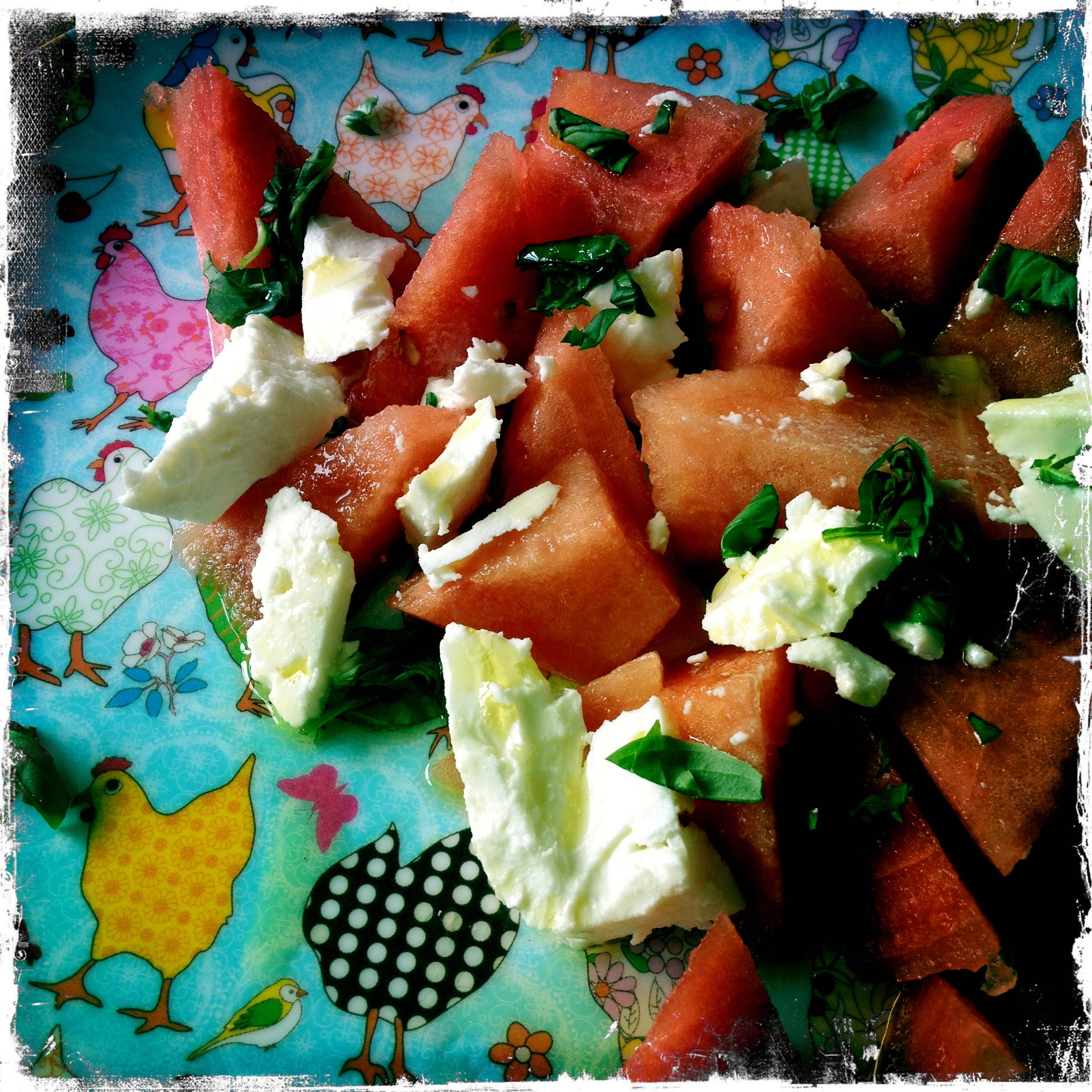
Watermelon and feta salad. The perfect lunch for a hot day.

IMG_2276

Eating watermelon makes me think immediately of southern Italy, where I spent so much of my childhood. It’s so evocative, it almost makes me want to weep.

Childhood life in Italy was so different to life in London. In London we lived in a two bedroomed flat in a mansion block in west London. Opportunities for roaming the streets were few and far between. In Italy, almost from the moment we stepped foot onto the dusty soil of my mother’s home village in provincia di Avellino, we were free. My mother had her mother, cousins, sisters etc to talk to, we had streets to explore and railings to climb and old houses to dare ourselves to enter. I spent most of my childhood summers wearing a pink and white towelling bikini, playing out with friends, until I was called in to lunch, or dinner, or ‘per la merenda’ (a mid afternoon snack). We frequently ate watermelon, spitting the black pips as far as we could, sitting in the shade of the porch, whilst the grown ups had their afternoon siesta.

This recipe is by Ottolenghi from his Plenty book. It doesn’t seem like much but it is plenty (ha ha). Ottolenghi says you should “eat this on the beach, or at least outdoors, on a hot day, with the sun’s rays unobstructed’. It’s a perfect summer lunch and basically, an assembly job.

You take some chilled watermelon which you’ve cut into wedges, some feta which you’ve cubed, some basil leaves which you’ve torn asunder and a small red onion which you’ve sliced thinly if you like (if not, leave it out). You put the melon and feta on a plate, sprinkle over the basil and onion if using and drizzle some olive oil over the top. That’s it. But don’t dismiss it because of its simplicity, it’s got lots going on.

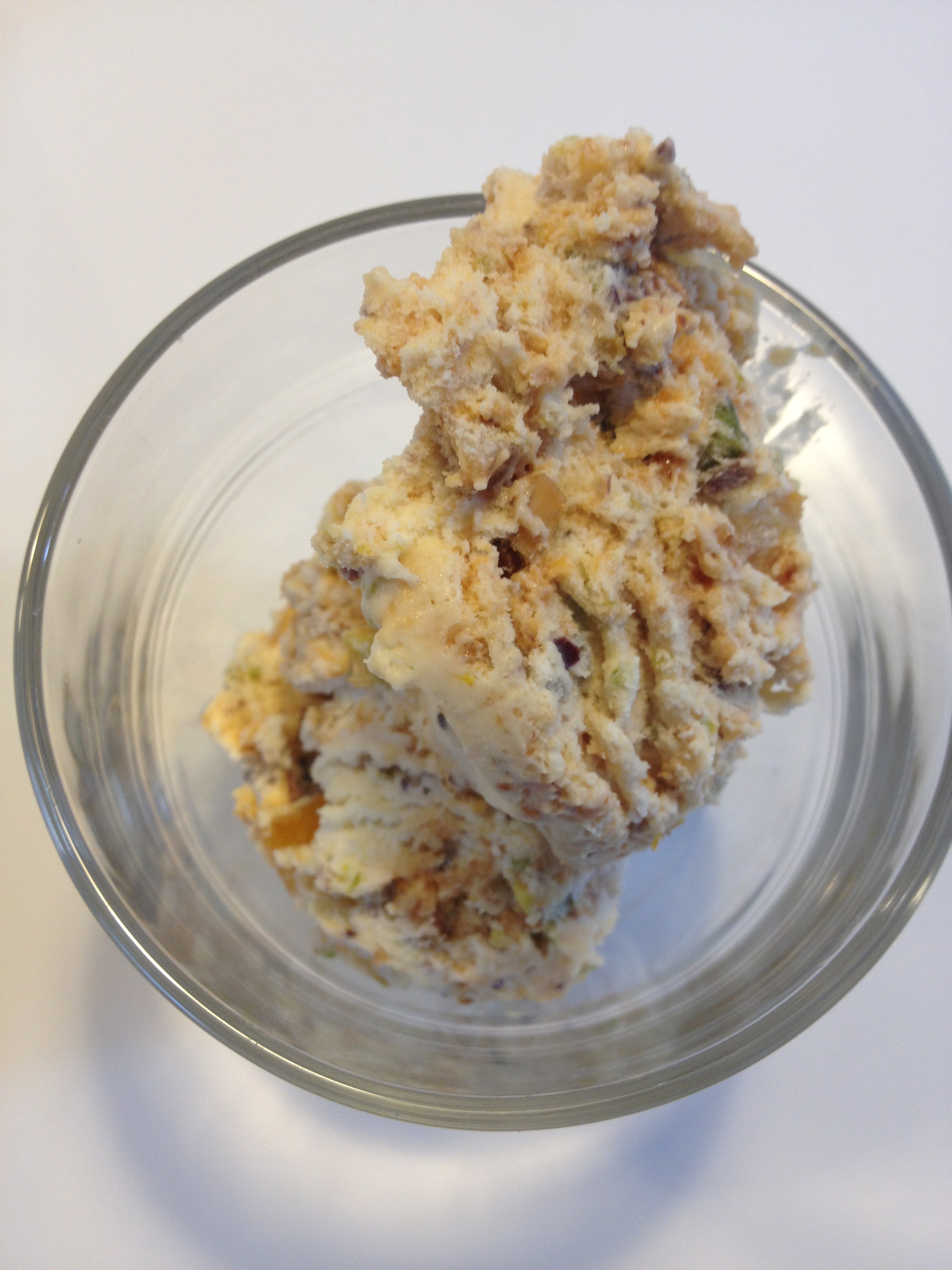
Torrone (nougat) ice cream

IMG_2345 I found this recipe, hidden amongst various others in the Guardian last week. (Scroll down, it’s the fifth one: frozen nougat, torrone = nougat.)

The great news is that you don’t need an ice cream maker to do it as this recipe doesn’t call for one. Rejoice! I’d long wanted to make torrone ice cream as I love ice creams with bits in it. I think this is in large part because my mother once made ice cream with lots of bits in it when I was a child, and it remains a taste I chase. (You can read more about it here in this piece I wrote for the Economist’s Intelligent Life.)

It is not the easiest ice cream to make. But I made it whilst in sole charge of a buoyant four year old and it was fine. I did move my mixer next to the stove, as I wouldn’t want to be carrying boiling sugar and honey across the kitchen.

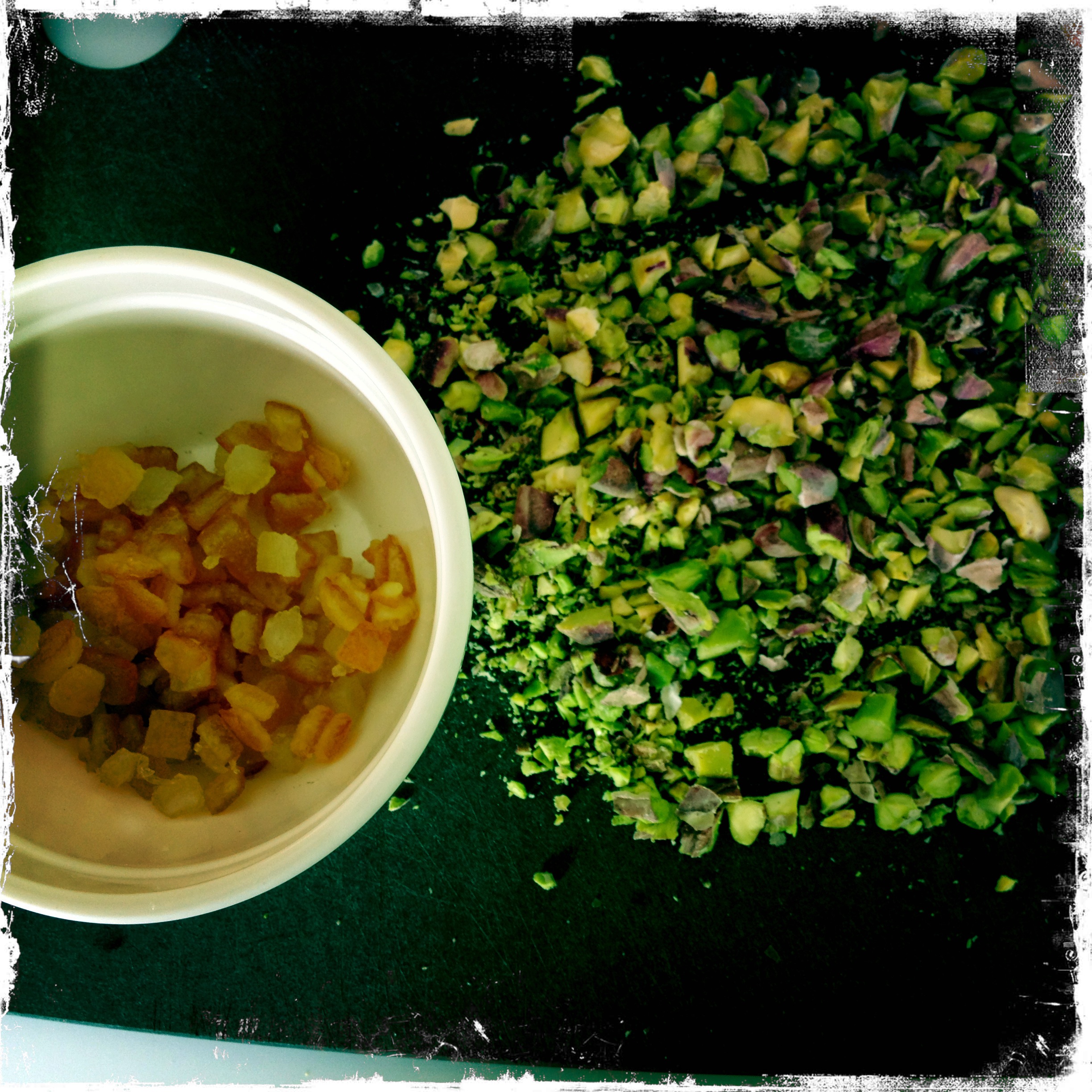
A few notes about the recipe: I used flaked almonds (which is what David Lebovitz, whose recipe this is, probably meant by sliced almonds). Toast them first, if they’re not already. I did mine in a dry frying pan for a few minutes.IMG_2332The praline bit takes hardly any time at all: be warned.  And you can easily make this in way in advance.

I blitzed half the praline in a food processor and chopped the other half by hand. Experiment to see what you prefer.

Don’t be temped to leave out any of the ingredients, please. Each is carefully considered to compliment the others: this is a highly accomplished recipe. IMG_2339Follow the recipe carefully for the same reason. Make sure you whisk the meringue until quite, quite cold, for example, before folding the cream in.

I found it hard to fold the whipped cream into the Italian meringue (Italian meringue is when you pour a very hot sugar solution into whipped egg whites whilst simultaneously whisking) so I did my best then whisked the whole lot together gently, it didn’t suffer.

This ice cream only uses egg whites. Hurrah! Another use for all those egg whites that I accumulate.

I can’t impress upon you how good this ice cream is. It’s one of the best things I’ve ever tasted. I wouldn’t, personally, have it in a cone. You really need to serve it in the plainest of dishes so that nothing distracts from the taste which is complex, sophisticated and high-pitched-singing- inducing delicious.

Couche cloth proving

IMG_2285

A couche cloth is a specialist piece of heavy linen cloth, made especially for the final proving of sourdough bread (couche = ‘laying down to sleep’). I’d wanted one for ages but for some reason never got myself one. Isn’t it weird how there are certain things that are perfectly affordable and yet they are regarded as luxuries and we never buy them for ourselves? The couche cloth came under this category for me, even though it only cost a tenner and I’ve easily wasted ten pounds on loads of other crap.

You can of course use a dish cloth in a bowl for proving sourdough, and lots of people do. But, for me, it’s not really the same as it’s clumsy and the dough can stick to a dishcloth, no matter how dusted with flour. I have umpteen bannetons now – hence why the couche cloth seemed like a luxury. But I sometimes wanted to make sourdough baguettes and rolls, just some different shapes occasionally, and I couldn’t do those in the bannetons, because the shape of the banneton determines the shape of the final loaf. And most bannetons are round or baton shaped. Here is a pic of my sourdough rolls, after they’d been proved in the cloth, and on the flipping board about to be flipped onto the baking tray, to go into the oven.

IMG_2311

Then one day, I was talking to my mother and she told me about how she and my grandmother  used to make bread when she was a girl, and she was telling me all about how they used to lay the shaped dough down in a piece of linen cloth and pinch the cloth up so that the dough held its shape. And I recognised that of course, she was talking about a couche cloth.

Well. Now I knew it was part of my heritage, I knew I had to get one. And with a couche cloth you need a flipping board or planchette. So I put both on my birthday list and I got both. They were bought from the fabulous Bakery Bits.

I got my couche cloth by the metre, going for the 60cm by 1m length, which, weirdly, ends up cheaper (£10.14) than the pre-cut cloth of the same size (£14.40).

I immediately realised that I’d got my couche cloth too big, but that’s no biggie as I cut it in half. The thing with couche cloth proving is that you then either need to keep the dough out for proving or put it in the fridge. And if you put it in the fridge you need to make sure you have a tray big enough to hold your shaped dough AND that, then, your fridge and your oven are big enough to hold the bread when you prove and then cook it. No point making a 3ft long baguette if you then can’t get it into the fridge to prove and then the oven to cook it.

Here are two great videos, that Joanna from Zeb Bakes put me onto, ostensibly to help me with shaping my baguettes (more about baguettes another time). This one shows you a couche cloth in use and this one shows you the flipping board in action.

I dust couche cloths with rice flour. I find it much better than the usually recommended rye flour – my loaves never stick – and also it gives a lovely contrast on the crust of my cooked loaves. And when I’m done, I brush the cloth with a grouting brush which I keep just for that job (being a grouting brush it has stiff bristles). Then I hang them out in the glorious sunshine to dry.