Category Archives: Presents

Sourdough bagels

I’ve long made bagels and they are a thing of beauty and deliciousness. I have made sourdough ones but not with any regularity. But recently I started making them again. They take a bit more time, in that they need to be left to rise in their own sweet time, far more than yeasted bagels. I rushed them last week and they were dense – still delicious but not so airy and light.

I tend to shape these into little round rolls first and then puncture a hole with a wood spoon handle. I tend to make these with a smaller hole than my yeasted bagels. Who knows why.

Unlike yeasted bagels these can also be left to prove for 48 hours in the fridge (maybe even longer but I’ve never left them that long), so if there aren’t that many of us, I tend to cook a batch up in two lots so we have fresh bagels for two days running. I can’t do that with yeasted bagels as they really have to be cooked the day after making (after an overnight prove in the fridge, ie they don’t ‘last’ that long in the proving stage).

If you want to make them totally vegan then don’t egg wash them.

You can of course use 500g of just white flour, or mix in a bit of wholemeal. I’m always looking for a more gut-friendly diversity so I add Vanessa Kimbell’s Diversity XXX flour. TBH these days I add 10-15% of it into almost all my bakes but here I use 20% (100g of 500g is 20% isn’t it? I failed maths..)

I think this recipe is, at least in part, from Edd Kimber but I adapted it a while ago. (I love Edd.)

What you need:

185g active sourdough starter
250g warm water
1 tbsp of sugar or barley malt syrup
1 tsp of fine sea salt
400g strong white bread flour
100g Diversity XXX flour

I mix everything together in my Kenwood Chef food mixer with the dough hook. I leave it on low for ten minutes. Then I turn the dough out onto an oiled surface, cover it with a bowl and leave it for an hour. After an hour I give it a gentle knead for ten seconds, leave it for an hour and then knead it again for ten seconds. If your house is very cold you might want to do this one more time. I kinda go on dough-feel (and no I’m not very good at it either).

When you’re ready to shape the bagels, when the dough feels lighter and a little more yielding, then cut it into 6/8/10 depending on how many you want to make (this makes eight regular sized bagels for me). I roll into little balls using my hands, then make a hole with the handle of a wooden spoon, stretching the hole out a little.

Place on a parchment lined tray.

I now leave this out, covered with a tea towel, for about another hour before putting them in the fridge overnight. I also think they benefit from coming up to room temperature after taking them out of the fridge but I never have time to do this so I put them straight away into the boil process.

Boiling and baking

Bring a pan of water to the boil. Some people put things in the water to make them more of a bagel (I don’t know what but stuff that makes it apparently taste more bagel-y) I can never be bothered. When the water is boiling I plop two in there – if you can get more in without them hurtling into each other than do. I give them a minute or two until they float and puff up a little, and turn them with a slotted spoon, another minute or two, then take them out and rest them on a tea towel. When all are done put them back on the parchment lined tray, brush with beaten egg if you want and scatter with seeds if you want and cook at 220C for 14/15 minutes. Check after 12.

These are really very good.

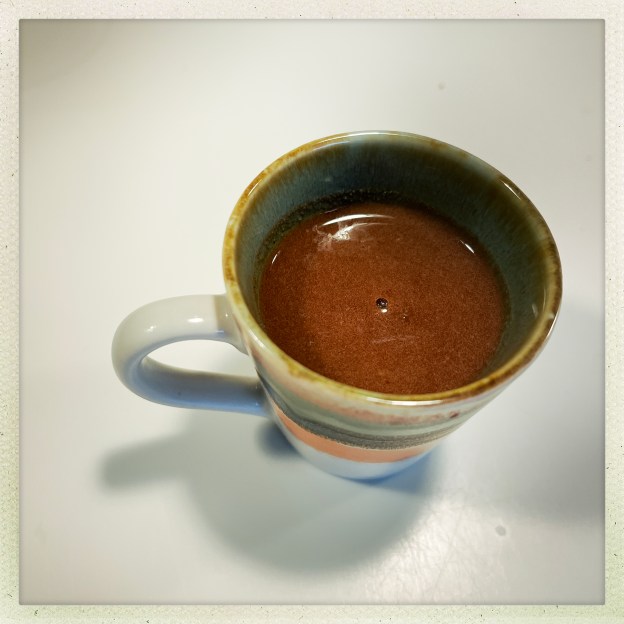
No/low alcoholic chocolate mulled wine (a thing of beauty)

Some years ago I posted about a recipe I’d found for chocolate mulled wine, and indeed I made this for some years. But I stopped drinking about five years ago and life changed and I’d not made it since.

But last week, in preparation for some friends coming round to make wreaths, I decided I’d try to make it again but this time as a no-alcohol version, this was the original plan. This was in part inspired by another girlie-get together a couple of months previously, around the fire pit, where my friend Tracy had brought round some Captain Morgan no-alcohol rum which proved a big hit. I still had some left so I decided to use that as the basis for this no/low alcohol version.

I’m very much not a throw things in a pot kinda girl. I like a recipe and instructions. Sure I sometimes – often – then vary a recipe but I always like a framework to work to. So I was super pleased with how this worked out. I realised, as I started to make it, that I didn’t have the 750ml of liquid the original recipe called for. So I started to panic a bit, looked in the fridge, found some ginger beer, realised that still wasn’t enough to get it to 750ml, panicked some more and added some red wine (hence the low-alcohol title of this post). However you could easily just make this with all no-alcohol rum, or half that and half ginger beer, or what I did. What I did is reproduced below but bear in mind you can, as I did, vary what you use. Add a bit of booze if you like or not.

Chocolate in mulled wine? Don’t knock it til you try it. Don’t be tempted to use anything other than 100% cocoa here. I used Firetree which is the best 100% but you could also use any 100%, most of it is awful on its own but here it could shine. The Fiori di Sicilia essences were, if I say so myself, inspired in this as it adds a wonderfully citrusy note to everything.

Bottled up wouldn’t this make a fabulous present for someone? Shake it up and heat it up before serving. My husband said it was one of the most delicious things he’d ever tasted.

Feeling REALLY pleased with myself over this.

Ingredients:

750ml some sort of liquid, see above. I used 500ml of no-alcohol rum, 150ml of red wine and 100ml of ginger beer. I used this Captain Morgan rum and this gingerbeer.
1 cinnamon stick
1 teaspoon of chilli flakes
1tsp ground mixed spice
5 whole cloves
100g dark muscovado sugar
(you can also use just normal caster/granulated)
80g 100% cocoa chocolate of your choice (I used Firetree), broken into pieces.
A good few drops of Fiori di Sicilia. Of course you can make this without this ingredient but I use it a lot in my cooking and I really think it’s worth buying, you can use it in so many things and it lasts for ages.

Put everything together in a sauce pan and heat through gently until the chocolate has melted. Then either serve immediately or cool, put in the fridge and heat up as required. This will happily see you through Christmas!

Chocolate, ginger and nut pavé

This is another old timer, heavy lifter of a recipe that I’ve had for ages and never committed to ether. Why? I’m not sure. But it’s such a useful thing to have/make/give at this time of year. I’ve never given it to anyone that hasn’t been anything less than delighted, asked for the recipe and asked me to make it again for them. As long as, of course, that they like all the ingredients.

There’s a possibility that you have all the ingredients at this (Christmas) time of year so you could rustle it up if you need an extra nice thing.

What you need

200g dark chocolate, broken into pieces. I recommend 70%
50g unsalted butter
60g double cream
50g of either crystallised ginger or stem ginger drained of its syrup
100g of nuts of choice: pistachio work well here cos of the colour, as do pine nuts* (pine nuts is what the original recipe called for) or almonds/hazelnuts. If you use the latter I would toast them gently first and let them cool before adding.
*if you use pine nuts use 50g, and 50g of other nuts because what are you, loaded?
25g icing sugar
Cocoa for dusting


What you need to do


You’ll need a tin of approximately 26cm x 8cm. I use the base of a 2lb loaf tin as I like my pave to be a rectangle but you use whatever shape you like just bear in mind the above dimensions. Line it with v. lightly greased baking parchment.

Atop a simmering pan of water put the chocolate, butter and cream making sure that the bowl doesn’t touch the water (or it might seize). Take off heat let cool for a minute or so and then stir in all the other ingredients.

Easy isn’t it?

Then put it in the fridge to set. When ready to eat/serve/give you just turn it out, trim the edges to make it really neat if you want (you can also nibble here to test!) and dust with cocoa powder.

I give mine wrapped in string and parchment.

Wish I had a picture but don’t currently you’ll have to trust me this is lovely.


The best flapjacks you will ever make (a bold claim)

Many years ago, I co-founded a parenting website called I Want My Mum (so named because I said this a lot when I was pregnant and after I had my first born). It was a small but wonderful little site and many of us are still friends today. Aside from mothering tips we also shared recipes.

From somewhere I got this recipe for flapjacks and they were amazing. I shared it on the board and then lost it and then over the years wondered how I’d ever find it when anyone ever talked about flapjacks…. But a wonderful woman called Sarah Green saved it and started making them.

Recently I asked on Facebook if anyone (I’m friends with lots of ex-IWMMers) just happened to have it. “No,” a few said “but Sarah Green makes the best flapjacks”. Sarah was at choir but when she came back she said “the recipe I use is the one YOU posted all those years ago.” The fact she had kept the recipe (and was so generous, she could so easily have just said it was her recipe, after all it wasn’t actually mine, I got it from somewhere) made me unfeasibly happy.

So to avoid having to hunt for it again, here is the original recipe with Sarah’s additions.

250 unsalted butter
Grated ring of one unwaxed orange
325g golden syrup
325g rolled oats (Sarah sometimes replaces 50g of oats for 50g of oat bran which is a great idea)
75g light muscovado sugar

Preheat oven to 180C/350F/Gas mark 4. You need a tin of about 28cm x 20cm which you line with baking parchment.

Put the butter, orange rind, golden syrup and brown sugar in a pan set over a low heat and stir until the butter has melted and everything is coated. The add the oats to the pan and mix it together. Tip the whole lot into the tin and spread evenly.

Bake for 15-20 mins. Don’t overcook or you’ll lose the lovely chewy texture. You know it’s done when it’s just beginning to go golden brown around the edges but don’t panic cos the mixture will be really soft still.

Leave in the tin to cool completely and it will set. Don’t be tempted to take it out before it’s cool. When it is, take the whole thing out of the tin, holding the edges of the baking parchment and cut into slices as desired.

I will make these again and post a picture but in the meantime enjoy them!

Bakewell slices (for a picnic, updated)

I first wrote about these back in 2010. I haven’t made them for years. I used to bake Bakewell tart a lot and I thought I didn’t like it anymore. But it’s late September, our government is currently shit, I can’t escape to Italy as Mussolini is basically back in power and the news is too much.

So in order to escape I got up early to make these for a craft morning tomorrow (which is mine and my youngest’s way of escaping the world).

The pastry:

200g plain flour
2 tablespoons icing sugar
100g cold unsalted butter, cubed
2 egg yolks if you want to be true to the recipe but I now just use one egg

I whizz the flour, sugar and butter in a food processor, then add the egg until it all comes together. You can do it with your hands too of course.

I never roll out pastry. Life is too damn short. It’s not too short to make your own pastry though cos shop bought really isn’t the same and how long does it take to weigh out a few ingredients and slam them in a gadget?

When it’s blended, I just take bits of the pastry and flatten it out into the bottom of whatever tin I’m using, welding it all together with a thumb like a giant pastry jigsaw. I use a square tin that’s about 21cm. Line the bottom well with baking parchment, first though, if possible with some ‘overlap’ to help you lift it out when it’s done.

Then when you’ve covered the bottom of the tin with pastry in this piece meal (no gaps though) but completely acceptable fashion, chill the pastry for about half an hour (perfectly do-able to chill for longer of course).

In the meantime, preheat the oven to 190C. When the pastry has rested, cover with foil, pour on baking beans. Bake blind (this means with nowt in it but the baking beans on the foil) for 15 mins. Then remove the beans (take care they’ll be hot) and bake for a further five minutes.

The filling

I use Bonne Maman Black cherry jam, about a third of a jar.

frangipani filling pt 2:

125g caster sugar
100g very soft unsalted butter
3 eggs
half a teaspoon of almond extract
150g wonderful ground almonds (I LOVE ground almonds)

Mix the butter and sugar together until it’s light and fluffy, this is quite a good work out for your arms and you’ll expend about 12 calories to offset against the calorific value of these slices, then add the eggs, one at a time, mix well, then the almond extract and finally fold in the ground almonds.

When the pastry base is out of the oven and cooled just a little, spoon the black cherry jam onto the pastry case, then on top spread the frangipani topping.

I also like to top it all with flaked almonds, like a handful scattered on top. You can never have enough almonds, rich in protein (so they bring down the GI of anything), calcium and essential fatty acids. How can you go wrong. Unless you’re allergic to nuts of course.

Cook for 20-25 mins or so, the top should be definitely golden, not pale blonde. When out, tie your hands behind your back and dive in face first. Or alternatively, slice into Mr Kipling type slices. I top mine with a mixture made of 50g icing sugar and 50g cream cheese, drizzle on top.

These keep lovely in an tin for a few days.

Lemon bars

I needed to make “something lemony” for someone. And whilst I love lemony things I just couldn’t think of anything immediately, that wasn’t a huge lemon curd filled cake and ergo difficult for them to take home (I like to think of a present’s impact beyond the mere eating of it). I asked a bunch of people for their favourite lemon recipes, then decided to ignore all of them (sorry about that) and remembered seeing these amazing lemon bars somewhere.

I remember seeing Pioneer Woman (yes I love her) making some lemon bars and although her recipe looked good, and easy, and used a sheet pan (I love sheet pans) I just couldn’t be bothered to translate the recipe from cups ‘n’ spoons ‘n’ sticks into ounces so I went to good old BBC Good Food, which is where this recipe comes from.

Anyway, these are so good. I mean so good that they should be much harder to make. I use organic lemons for anything that uses zest since I read about how many chemicals citrus gets sprayed with. Shall we get on with the recipe?

The base

175g plain flour (I increasingly use spelt now)

50g rice flour

85g caster sugar

140g cold, diced butter

1 tablespoon of milk or cold water

Tiny pinch of salt

The filling

The zest of three lemons

200ml of lemon juice (for me this was the juice of four lemons)

3 eggs

200g caster sugar – don’t skimp on this

25g plain flour

Icing sugar to dust although good luck getting yours to settle, mine didn’t, it was like December snow.

Oven to 200C. Line a 21/22cm square tin with baking parchment. It’s really worth cutting out the bottom and sides so you get nice, neat, sides. I didn’t. I was lazy and just scrunched a sheet in there so it sort of bunched up round the corners and ended up with unsatisfactory lemon bar-sides. Tsk. Dot a tiny bit of butter to the baking parchment so it sticks to the tin, otherwise when you pour in the lemon mixture the parchment sides will collapse and you will cry.

Put the flours, sugar and butter in a bowl and cut with a pastry cutter or put in a food processor and pulse until it’s like fine crumbs. Now add the milk/water. The beauty of this is no rolling out. Just pile everything into the tin and press down well. Bake for 15-20 minutes until lightly golden.

Remove the base from the oven, and lower the oven down to 180C.
Now whisk together the lemon juice and eggs and into that sieve the flour (do this otherwise: danger of clumps, trust me), add the sugar and zest. Whisk away until all nicely combined. Pour this onto the base. If there are white specks this is because you didn’t sift the flour so don’t blame me.

Bake for 15 mins, maybe a tad more depending on your oven. It should be just set, but look a bit wobbly. But the surface MUST be set/slightly dry to touch. Cool in the tin until really cool, then either slice and eat, try to dust with icing sugar, or store in the fridge if you plan to keep them for a while. Let come up to room temperature before eating. Truly gorgeous.

Dog biscuits

I saw these being made two years ago on Kirstie Allsopp’s Handmade Christmas. They are a great, very easy thing to make for your dog, or as present for someone who has a dog. We don’t have a dog, but I’ve made these many times for my sister’s dog and he loves them. If you are usually a bit nervous of making biscuits these need hold no fear as even if you overwork them, it doesn’t matter because the doggy won’t mind.

This is what you need:

350g plain flour

120ml of hot water (plus extra later)

A low-salt chicken stock cube

One egg

Two tablespoons of dried parsley (for fresh canine breath)

This is what you do:

Dissolve the stock cube in the hot water, then pour into a bowl and mix in all the other ingredients, adding more water if necessary, to make a soft dough.

Roll out on a floured surface until quite thin (about half a cm) and cut out (I use bone cutters of course). Place on a baking tray with baking parchment and bake at 200C for 20-30 mins. Mine take about 22 mins.

Let cool and give to a lucky doggy!

IMG_9441


Possibly the best phone ever for older people. Plus how to really crack down on spam/phishing callers.

I don’t really get spam/phishing calls. At least, not yet. This is possibly because I’ve never been in the phone directory, I have a landline that is, primarily there for my internet, and I am very tech savvy at blocking such calls on my mobile if I get them.

However, whenever I was round at my mum and dad’s their phone would regularly ring with phishing/spam calls. They would be annoying, and of course I registered them for the Telephone Preference Service but it didn’t seem to make much difference. Some of the calls were simply annoying “do you want double glazing” etc. Some so obviously scam calls as to be not a threat. But all meant my mum had to stop what she was doing and go and answer the phone.

The obvious thing is to to get an answerphone and screen calls. But here’s the thing. Getting a separate, mechanical answering machine that works with an existing phone and is not hugely expensive, is virtually impossible – I’ve tried. You can get integrated answering machines, with cordless phones, but this would mean a change of phone for my mum, which is okay, but the phones that come with integrated answer-machines tend to have small fiddly numbers; and my mum likes a corded phone so it can’t get lost/run out of charge.

BT’s Call Minder, which you access via your handset and is ‘remote’ is an option, but she didn’t like that as it’s too confusing for her. So an answer machine or an answering service wasn’t really an option. And anyway, a very sophisticated caller, such as she eventually came across, would have not been put off by such a device and they would have left a message, lending credibility to their call.

(Anyway I think even a fairly simple answering machine would have been frustrating for my mum to master and why make her feel crap about not being able to do something when she is so good at so many other things?)

Because, one day, my mum got a call of a very different kind. Very sophisticated, believable and distressing; I won’t go into the details here but, thankfully, at the last minute my mum pulled a blinder (you can take the girl out of Naples but…) and a very serious crisis was averted. (We reported it to Action Fraud.) But it got me thinking just how vulnerable some people are and I realised that something needed to be done. When I started telling people what had happened to my mum, the stories that came out were terrifying. I learned that someone I knew, with graduate parents (English their first language, quite unlike my mum), had been scammed of £5K.  Then another similar story, and so it went on.

My mum is not tech savvy. If you need to feed fifteen people with one stick of celery and a tomato, she’s your woman. Her vigour, energy, hospitality and inventiveness is gob-smacking, but she is a technophobe. So whatever I did had to be low-tech at her end and the tech burden had to be mine alone.  I also needed something I could monitor and tweak remotely. It was no use asking her to press button 1 to stop the last caller calling her again. She needed a phone, pretty much like her old phone, with buttons to press to dial someone.

This is what I did. It’s in two parts – the remote part and the actual phone.

First, BT launched something called BT Call Protect earlier this year. I knew about this but again though it would not work for my mum, but, with her permission I took over control of her account. It’s free, but you have to be a  BT customer (your phone service may offer something similar) and how it works is that, once activated, it has a pre-set list of known spam numbers, these are automatically blocked. But there’s more.

You can see who’s calling via the website or a phone app, and you can VIP these numbers – and name them so you recognise them again when you next log on – or block them. So now my mum only has to make a rough note of the time someone called if it was a bad call and I can, via my computer or the BT app, forever more block that number.

You can also set it so that it blocks all, eg. with-held or international calls. And of course if you fall out with someone, you can put them from the VIP list to the Blocked list. Imagine the power.

With VIP numbers you can control which times someone can call you, so that, eg, you don’t get disturbed at night, or so that they can ring you 24/7 – you decide. Useful if you have a relative who keeps different hours to you or you don’t want to be disturbed at night.

All of this I can do remotely for her and with her knowledge.

If you block a number, it goes to junk voicemail (which you access via pressing 1572 on the handset although, see below, I eventually got my mum Call Minder so I access this for her now) so there’s s safety net there in case it does turn out to be genuine (there was one casualty which was a long-lost friend from Rome, but, thanks to this I was able to get her message and let her know and what’s more, VIP her number for future calls).

Since I did this my mum’s spam calls have dropped to: zero. So far.

Then there’s the phone. It was long overdue that she be able to see who is ringing her. I also wanted her to be able to access important numbers really easily.

I’ve mentioned before that I got a mobile phone for my aunt from Action on Hearing Loss (formerly RNID) so I turned to them for a phone for my mum and found this one.

It is really excellent and here’s why:

It has a caller display which lots of phones do (although they tend to be cordless) but with this one, you can tilt it up for maximum visibility and also change the contrast* – it displays the number and, if you’ve input the person into the phone’s phone book, their name will also show. (You need a subscription to a Caller Display service for this to work.)

*Someone visually impaired would still struggle to see this however, so look at the RNIB’s shop for phones for them.

The call buttons are large and illuminate when you pick up the phone.

There are four photo-buttons so you can either put people’s photos or write their name in LARGE TYPE. You programme these so that you can simply press them to dial someone but not only that: THEY ILLUMINATE WHEN THAT PERSON RINGS. Which is really like Thunderbirds!

I programmed as many numbers in as I could for my mum, no mean feat when you consider the size of our family. This you have to do with the phone in front of you but once done no further teccy-input necessary.

The phone plugs in and also needs 4 AAA batteries as back up. This it needs for the illumination/phone box storage features. It is otherwise a corded phone.

Although you can use the phone book to ring people – i.e. without having to manually press the number-keys, my mum doesn’t do this as she likes to use the number keys to ring people. There’s a volume control and also a boost in case someone is hard of hearing. So it’s packed with really useful features, but otherwise it’s a normal low-tech phone.

So now, as an added safe-guard, if my mum doesn’t recognise a number, she doesn’t have to pick it up. I’ve also put Call Minder on her line so that if she doesn’t pick up a call and it’s genuine, the people calling have the option of leaving her a message.  I control this remotely for her by ringing into it once a day (you have to set a PIN on the actual phone, but once you’ve done this you can ring in remotely). I can also hear if any spam callers who have called and left a message or not left a message.

There are other options available for protecting vulnerable relatives, such as True Call Blocker, which has rave reviews and Fuss Free Phones, which sound like a great idea but would have involved too many changes for my mum.

Some other option may work for you. This is so far what’s worked for us. I did a lot of research to come to these conclusions and what is the point of it if it doesn’t also benefit others?

 

Hinza bags

I love a bag, and these are great. They are Hinza bags, which were designed in the 1950s in Sweden.

They are basically a trug in the shape of a bag. Completely impractical in lots of ways:

The strap digs into your arm if you have carry it in the crook of your arm.

A total pick pocket’s delight as everything is easily accessible.

No interior pockets so everything is chucked in together.

But also totally brilliant in lots of ways:

Because they are the same colour in, as out, you can easily see everything in your bag.

Everything is somehow easier to find as it’s chucked in together and no zips or flaps to undo.

You can sit on a beach and know they won’t get a soggy bottom.

You hose them down if they get dirty.

Really easy to carry in your hands.

They sit where you put them.

You can just chuck everything in.

They are really jolly. This matters.

They come in two sizes and lots of different colours. I got mine (the small) from Hus and Hem, which is a fabulous Scandi website and it cost £18. The service was amazing. I had barely pressed ‘confirm order’ and it arrived. But you can also get from little independents. I saw some in Burnett & Company, a lovely interiors shop in Aldeburgh, last week. (46 High Street, IP15 5AB.)


Sonia’s Swiss crescent biscuits

Growing up, my mum made friends with a woman called Sonia, who worked in the dry cleaner’s kinda opposite our flats. The dry cleaning would be wrapped in this lovely navy blue paper, the like of which we seemed to have at home for years afterwards (I guess she gave us some).

We didn’t have a car, growing up, but we used to go out with Sonia and her husband, who drove a red VW Beetle. We would go to the airport and watch the planes take off, in the days when this was still possible. We also went to Windsor castle. I loved our trips out as they were the only car-trips out we had as children. (This isn’t meant to sound sad, we went to Italy a lot and I had a great childhood.)

I have a picture, of us at Windsor castle, me with a right sulk on (I peed on my mum’s lap on the way home, I think I might have done it on purpose, the shame), wearing a very flash red coat and a rabbit fur hat, Sonia and my mum looking really glamorous, but in a totally nonchalant way.

One of the things Sonia used to bring with her were these amazing little hazelnut crescent biscuits. She would have them, layer upon greaseproof-paper layer, in a tin, and as you opened the tin, the smell of them – they were coated with vanilla sugar – would hit you. They were not like any biscuits we could buy, or that my mum made.

Because they were so occasional, they were especially delicious. Sonia also used to bring  a flask of coffee, which I would drink (I was an early caffeine drinker).

When I was seven, my mum and dad opened up a coffee shop on London’s Bayswater Road. I started making cakes and biscuits for my dad’s shop. I started baking. I tried to recreate Sonia’s biscuits but I never could. For some reason I didn’t dare ask her for the recipe, or perhaps I didn’t want to because I didn’t want to make them less special.

Occasionally, these days, I will go to my mum and dad’s house, and Sonia will have been, bringing with her a box of her special biscuits. And just opening the lid of the biscuit tin (she always brings them in a biscuit tin) will transport me back to being a very little girl, sitting in a red VW Beetle, watching planes taking off, treading that fine line between showing my appreciation for her biscuits and eating a fair few, but not toppling over into greed. It’s still a line I struggle with balancing on.

The other day, I saw Sonia and I plucked up the courage to ask her for the recipe. I don’t know why it’s taken me four decades to do so. Amazingly she had it written down (none of that “oh I do it from memory”) and she gave it to me, and, here it is:

250g plain flour

200 butter, unsalted, fridge cold

100g ground hazelnuts (I buy the chopped, toasted version and then grind them, it really makes a difference, but you can use pre-gound hazelnuts or almonds, but it won’t be *quite* as good as if you toast and grind them yourself)

80g icing sugar

5g vanilla sugar (Sonia says you can buy these in little packets but I leave this out and just add a tablespoon of vanilla essence)

Pinch of salt

Caster sugar for after (vanilla sugar if you have it)

In a food processor, pulse the butter and flour until like breadcrumbs. Add the sugar, salt and nuts and then pulse until it comes together in clumps. Don’t over mix. It will work out I promise. Of course you can do this all by hand, but I’m lazy.

If you’ve made it in a processor take it out now and, by hand, bring the mixture together. Chill for 20/30 mins.

Preheat oven to 190C

Take small bits and roll into crescent shapes. I weigh each one to make sure I don’t end up with tiny/huge biscuits, roll into sausage shapes and taper the ends, curve into crescents. If you’re interested, I do them so mine weigh about 21g in raw dough.

Put on a parchment lined trays and cook for 10 mins. Cool and then coat in vanilla caster sugar if you have it, (I put a vanilla pod in a jar of normal caster sugar and just keep it there for, like, ever) normal caster sugar if you don’t.

Then don’t eat four whilst you’re writing a blog post, because that will make you feel really, really sick.

Store in a biscuit tin, each layer interleaved with greaseproof paper.

(Sonia calls these traditional Vienna biscuits but as she’s from Switzerland, I call them Sonia’s Swiss crescent biscuits.)