Stollen

IMG_4263

Stollen was, like panettone and panforte, one of those things that appeared at Christmas that really wasn’t very nice. Of course, that was back in the days before I realised you could make, almost, anything yourself (I’ve still not been brave enough to try panettone, because to make it properly takes three days and involves hanging it upside down).

My friend Lisa Durbin, posted some pictures of the stollen she was making and they looked so delicious, I asked and she passed on her recipe. And yesterday, really quite late in the day, I decided to give it a go.

I have a few notes to add, which is that the marzipan stipulated seemed a bit mean to me to begin with, so for one of the loaves I doubled the amount from 50g for each loaf to 100g. As I was doing this, my partner walked into the kitchen and he reminded me that, actually, with marzipan in cooking more is not necessarily a good thing. So, suitably chastened, I went back to Lisa’s recommendation of 50g for each loaf for the others. I haven’t tasted the turbo marzipan one yet but the one with ‘just’ 50g held out his theory and Lisa’s recipe.

After making this stollen, ahem, a couple of times, I’ve settled on 75g per stollen as perfect for me.

I found 45mins too long in my oven. I cooked mine for 25 mins.

This stollen really doesn’t keep. If you don’t freeze it EAT IT on day of purchase. It won’t be so good again after that.

Image 3

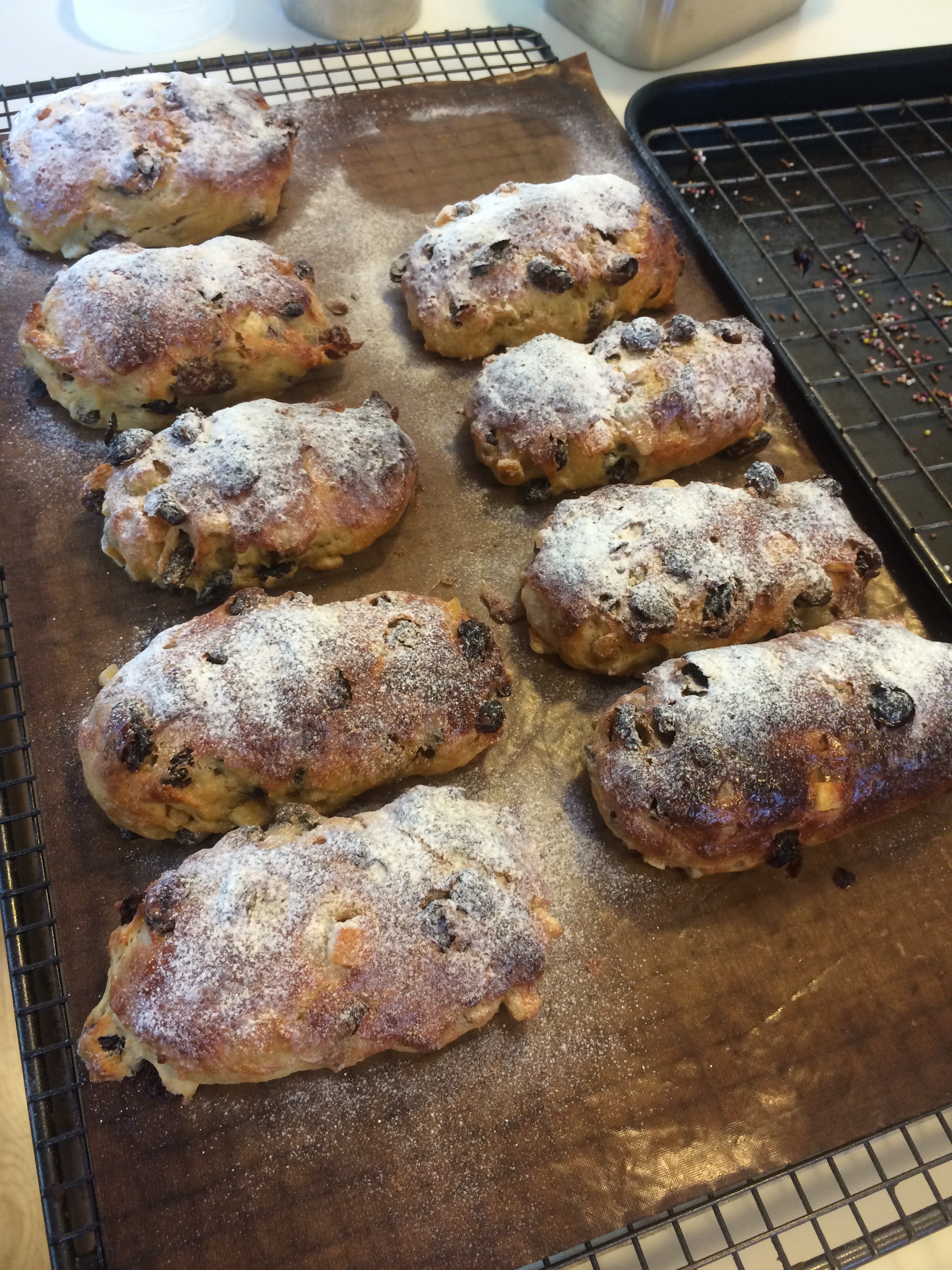
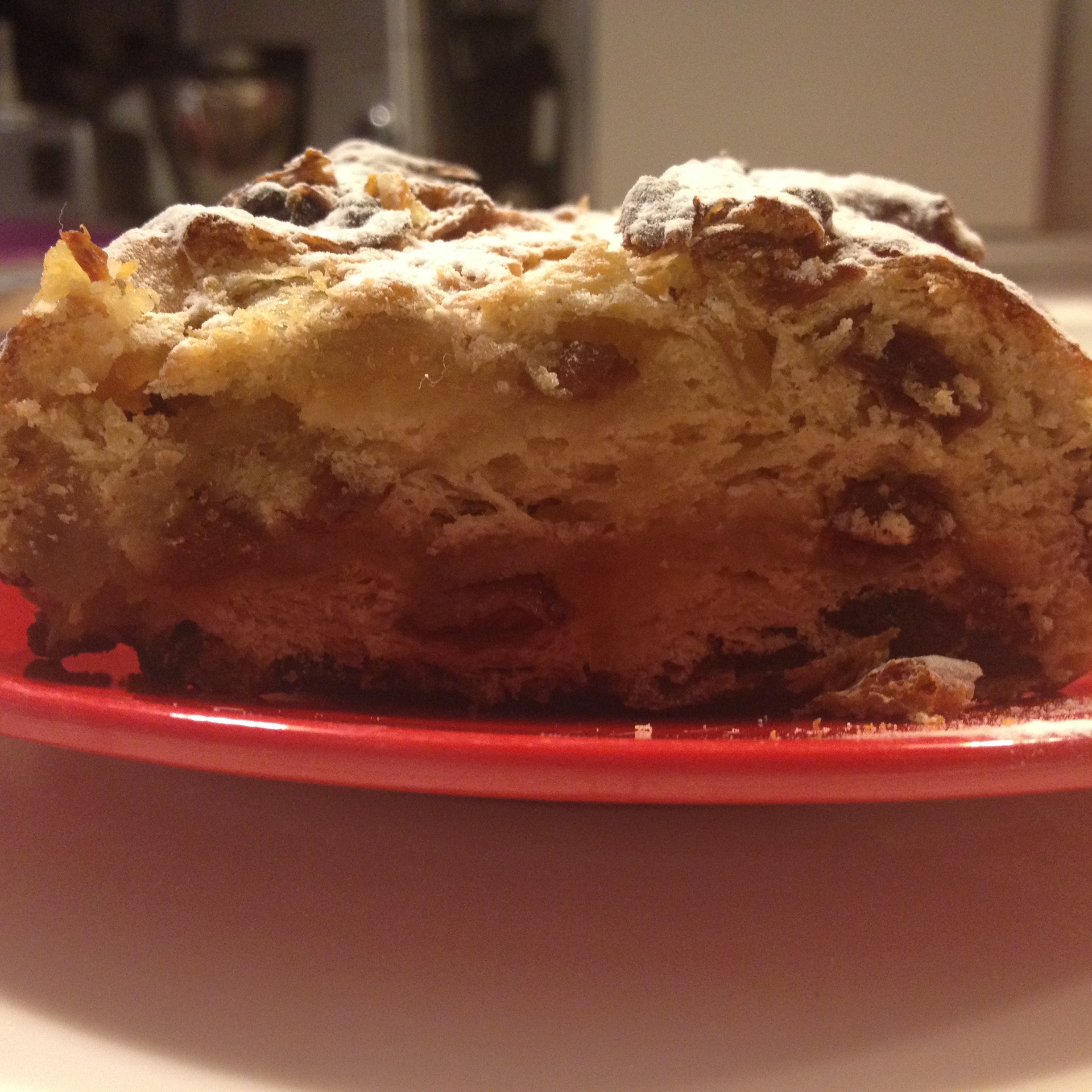
I also didn’t roll mine out on a floured surface, instead rolling out between two sheets of Magic Carpet type stuff (reusable baking parchment). It’s up to you if you make your  loaves more stout and thick or long and thin. Experiment.  As per picture above, you’ll see mine are quite flat.

I ate half of one, about 20mins out of the oven, whilst watching Masters of Sex. So the two things are now, indelibly, etched in my mind. At that temperature, just warm, the stollen are frangible and seriously delicious. If you can eat it at this temperature, at least once, do so.

Image 2

Otherwise they are really not difficult to make (although if I give you one as a present then, yes, of course they are really difficult) and you get four loaves so it’s a good result vs effort. You could easily freeze some Lisa tells me (before you add the icing sugar) for another day. Or just eat them all in a stollen frenzy. You can also leave them for the final prove (the one that takes 45 mins in Lisa’s recipe) overnight in the oven, waking up to freshly cooked stollen (well, for YOU to wake up to freshly baked stollen, someone else had to get up first to bake it, but the idea is there, yes?)

ImageChristmas 2014. I made these mini this year, just cutting bits of the dough off, and rolling it with my fingers around some marzipan. Worked really well and I got about 20 mini loaves out of it. I cooked the mini ones for 15 minutes.

IMG_0388(You’ll note one is missing, it’s very important to test the merchandise before selling.)


Chocolate sponge and chocolate custard

These have to be five of my favourite words.

And yet, when I was in my first year in primary school, two traumatic things happened to me at lunchtime (we all had to have school dinners). First, having come from a safe and loving home, I was one day confronted by a very troubled boy kicking me in the back and nobody doing anything about it. Second, another troubled boy spat in my chocolate sponge and chocolate custard. I didn’t, of course, finish eating it, but amazingly, it didn’t taint my memory of this pudding which I still see as elementally comforting. Despite history proving otherwise, I think nothing bad can happen when you’re eating a chocolate sponge and chocolate custard pudding.

I have made this several times over the years. And each and every time, I forget to take a photograph of it because everyone is in such a scramble to get it. This has nothing to do with me, other than I make it, but I think, everything to do with people’s associations with it.

This time, I only remembered to take a picture of it at the very last minute, when we were on the last slice; which is why it’s a close up, and not a very good photograph at that (still, better than Martha’s). Just out of shot, is my partner’s spoon, hovering in anticipation and annoyance at my interruption, and half the pudding already gone.

A note about the custard: it doesn’t make enough unless you eat giant portions of this at once. If you eat it like we do, in smallish portions, then you need more custard. Second, Waitrose does a perfectly good chocolate custard which you could easily use instead. It’s not as ‘good’ for you (no eggs) but come on..

A note about the pudding. It travels really well. I have made this in advance and taken it on a holiday rental, warmed it up in the microwave (10-20 seconds per portion) and it is glorious. I’ve easily kept this cake for a week and just zapped it in a microwave to make it soft and springy again.  If you like it cold cold (cold pud cold custard) then this could also travel, separately, to a picnic and be reunited to make a quite decadent pudding on the grass.  My children actually like this pudding cold, with cold custard and you can try it either way: hot hot, cold cold, hot cold, cold, hot. Knock yourself out.

This recipe originally came from Delicious magazine.

250g unsalted butter at room temperature (so soft, because room temperature in my house at the moment results in pretty hard butter still)

200g caster sugar

50g dark brown sugar

4 medium eggs

250g self raising flour

1 teaspoon of baking powder

2 tablespoons of cocoa powder

50g dark chocolate grated or chopped up very, very, very small (grating chocolate is one of my most hated kitchen jobs, I’d prefer to de-giblet a chicken)

1 teaspoon of vanilla extract

125ml warm milk

Oven to 180C. You’ll need a square 20cm cake tin which you have lined with baking parchment. I love this cut into squares but for goodness sake don’t sweat it if you don’t have a square tin and improvise.

Beat the butter and sugars together, whisk in an food mixer if you have one. If not doing it by hand is fine. BUT it does need lots of beating so if you have an electric whisk do use that for five minutes.

Gradually add the eggs and now sift over the flour and cocoa with the baking powder and grated chocolate. * Add the vanilla extract and the warm milk. It should be fairly gloopy. Put in the tin and cook for 45-50 minutes until a skewer comes out growling. I’m joking, a skewer comes out clean-ish. You know the score.

If you want to make the custard you need:

300ml whole milk (although I have used semi-skimmed and the world did not fall in)

300ml double cream

4 egg yolks

3 tablespoons of caster sugar

3 tablespoons of cocoa powder

1 teaspoon of cornflour

Heat the milk and cream together until almost boiling. Whisk the egg yolks with the sugar, cocoa and cornflour. Pour the hot milky cream over the eggy mixture, whisk and return to the pan. Cook gently until it thickens. Serve hot, warm or cool.

2016 note: I now just add chopped up chocolate to the warm milk and melt it that way if I’m in a rush. Nothing awful seems to happen. I’ve also improvised chocolate custard – the recipe above is lovely but it’s a faff and never quite makes enough – and used good quality shop bought custard and added melted chocolate and a tablespoon of cocoa to it.


The art of frothy milk, and how to make the simplest hot chocolate

What is the point of cold weather if you can’t have a reviving hot chocolate when you get in? Your fingers so unfeeling with cold you get a thrill just undoing your coat, as if you were being jollied by an attractive stranger.

When you stand in the hot chocolate aisle at the supermarket, as I never do, you will see that there are dozens of potions and powders with which to make your hot chocolate.

And you don’t need any of them.

Sure, chocolate ganache hot chocolate is the richest, most luxurious hot chocolate you could hope to have (and you MUST try it). But unless you have a stash in the fridge ready made, you’re stuffed.

No matter! Cos all you need is a small cup of milk, about 100ml tops, and two squares of chocolate. One 70% cocoa and one milk. If you have cream in the fridge, use this as well as milk (so say, 50ml cream, 50ml of milk). This gives you the perfect mix of chocolate and sugar to dairy. I believe a small, pokey, punchy hot chocolate is better than a large, diluted one that can only render a weak, milky half-slap. Put the squares in the cup, put in microwave on high for 1m 20 seconds. Take out and whisk with an aerolatte if you have one or a fork or a whisk or you know, something suitable. Then drink. I make this every day for my children, in the winter, when they come home from school (aren’t I nice?).  Although, if you’re like me, you will also top it with some milk froth schiuma which I make in my electric Dualit milk frother, which makes the best milk froth this side of a £10K commercial cappuccino machine.

1459210_10151840880983721_402930639_nThis is a cappuccino made using the Dualit electric milk frother.


Best panettone and chocolate mulled wine

I wasn’t much of a fan of panettone, growing up, despite my father coming from a region where the panettone is famous. All those raisins and candied fruit. I much preferred pandoro (‘bread of gold’) which was, to me, like panettone but without any of the bits in and you’d dust it with glorious vanilla sugar as soon as it was out of the box.

It didn’t help that the panettone you can usually buy in this country – at least until it seemed fairly recently – was pretty grim. Heavy and dry. Mine used to stay on the top of the fridge, in their cardboard box, going stale until such time as I had an idea to resuscitate them in a panettone bread and butter pudding.

This seems sacrilegious now. A few years ago, my parents got given a proper panettone. They gave it to me and I almost put it on the top of the fridge, in time honoured fashion. But something made me open it. I’m going to use words like ‘billowy’ now, so prepare yourselves because this panettone was indeed billowy. Soft, fresh….billowy. It tasted delicious and, as I remember, we ate it in one sitting. I subsequently discovered it was a very expensive panettone and it showed.

At Christmas, I usually make my Colomba in the shape of panettone. It’s not the same thing (proper panettone needs to be hung up side down when made and takes three days from start to finish) but it’s good enough. Last Christmas however, I heard, through one of my editors, Kate, at the Guardian about a panettone taste test she was doing. On her recommendation I bought the Nudo one. It was superb. Not cheap though at £15 a kilo (I’ve realised you need to spend about that much for a panettone to be any good). This year, in a fit of organisation, I went to order one on 1st November. Sold out. This annoyed me beyond explanation.

So I went to the number two one last year, Valentina and bought two. I decided to open it last weekend. Partly because I didn’t want to be disappointed if it wasn’t very good, partly because I am greedy and partly because I have decided to spread out the joys of Christmas fayre this year starting in, cough cough, late November. Anyway. It’s fantastic: everything you want a panettone to be. Really fresh, really light, tasty, glorious. You could easily eat one in a single sitting. The service was amazing and I thoroughly recommend you buy one. My children loved it too, and the sell by date is April 2014. Not that it will get that far.

It’s £12.95 for 750g and you can buy it mail order (the p&p is a bit steep at £5.95 so double up with some friends if you can) or if you can, visit one of the stores, there are five, but not sure all sell the panettone so check before going.

[Just to avoid any doubt, I paid full price for the panettone, no freebies.]

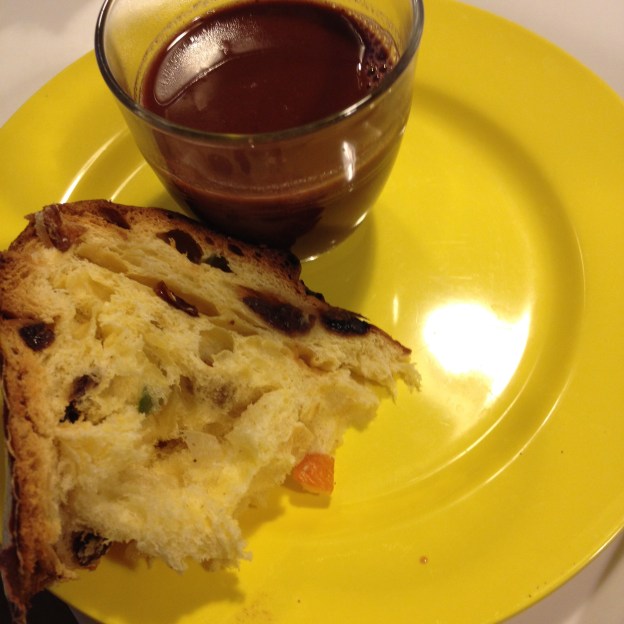
The pic above is my first slice, served with a glass of my chocolate mulled wine. Which, if you haven’t tried yet, I thoroughly recommend you, also, do.

A very good shepherd’s pie for when the weather’s bad.

I cut this out of the Independent magazine last year. It’s called Bill’s Shepherd’s Pie, but I’m afraid I know no more than that. It seems a convoluted way of making a shepherd’s pie, but you need to trust me when I tell you that it’s very very good. Leftovers seem even better, of course. And the whole thing freezes beautifully for resuscitation just when you need it.

It doesn’t have a mash topping – gasp – but chunky potatoes on top. Try it. I don’t make shepherd’s pie any other way now.

It apparently serves four, but this really depends on the size of the lamb shanks. I find it generally serves at least six, with left overs.

2 tablespoons of olive oil, plus a little extra

1 large carrot, chopped up into the usual sized pieces

1 onion, same

2 celery stalks chopped up fine

3 tablespoons of plain flour

200ml of dry white wine, or vermouth, or low alcohol cider (these latter two are what I also sometimes use)

500ml chicken stock, I tend to freeze my stock in 600ml portions so I add 600ml of stock and 100ml of vermouth/white wine

3-4 lambshanks

4 sprigs of thyme

800g-1K Maris Piper or other floury potato, these you need to have peeled and cut into chunks that are, you know, chunk sized. We tend to use 1kilo as a) we are quite partial to a potato and b) the dish I use is quite large.

A handful of parsley leaves, chopped up

The zest of 1 unwaxed lemon

2 garlic cloves, crushed or finely chopped

Now, this is what you do. I have given the conventional method first, then the slow cooker method.

You preheat the oven to 160C. You heat the oil in a large casserole dish – with a lid which you’ll need later – that can go in the oven.

Into this large casserole dish you add the chopped up carrot, onion and celery and season with salt and pepper (be aware the stock cube may also be salty). Cook until soft, about seven minutes.

Now add the flour and stir around and cook for a minute or two. Now you add the wine/vermouth/low alcohol cider, stock, shanks and thyme and bring it to the boil.

No, you don’t have to brown the shanks first.

Now cover the casserole and put the whole lot in the oven for two hours *, until the meat is tender and falling off the bone. Take it out, put it to one side for a moment, and turn the oven up to 200C.

*set a timer for about twenty minutes before times up, and put the potatoes into salted, boiling water for 20 minutes, until very tender. Drain then return them to the pan and add half each of the parsley, lemon zest and garlic. Add salt and pepper to taste and stir in a glug of olive oil, breaking up the potatoes a bit as you go. You want to rough them up a bit in an ‘Eastenders” way, not obliterate them entirely.

Lift the lamb shanks from the casserole dish, trying hard not to think of them as baby sheep’s legs. Let them cool so you can handle and then take the meat from the bones (if the meat didn’t fall off when you lifted the bone up) and break the meat up into bite sized chunks with your hands.

Return the chunks to the casserole it cooked in and now stir in the remaining parsley, garlic and lemon zest and simmer for five minutes or more until the sauce has reduced (you may need to do it for longer than five minutes). Now spoon the whole meat-sauce lot either into individual dishes, or into a suitable oven proof dish. Top with the roughed up potato chunks and bake for 20 minutes in that 200C oven until you get lovely golden bits.

Slow cooker version

I am presuming your slow cooker also has a saute function, if it doesn’t then do that bit in a conventional pan.

Put the slow cooker onto saute function and put in the olive oil. I put mine on low. Now add the chopped up carrot, onion and celery and season with salt and pepper (be aware the stock cube – if using – may also be salty). Cook until soft, about seven minutes.

Now add the flour and stir around and cook for a minute or two. Now you add the wine/vermouth/low alcohol cider, stock, thyme and lamb shanks. Don’t worry if the lamb shanks stick out a little, just try to submerge as best you can. If you cook this for a very long time (see later) then you may want to lift the lid and turn them round so that they all get a go in the juice.  Bring the heat up (still on saute setting) so it starts to bubble.

(No, you don’t have to brown the shanks first.)

Now switch off saute function, select slow cooker mode low (or medium or high if you don’t have too long) close the lid, and set for as long as you’ve got. I have done this in two 12 hour batches so that the lamb cooked for 24 hours. But you can do it on high for two hours or medium for four etc. I prefer a long, slow cook for this.

When time is up, lift the lamb shanks out – they fall apart – and put in a separate dish. Leave the juice in the slow cooker for now. Skim off the fat – there may be lots – and discard into the bin (not down the sink! We don’t want fatbergs).

Carefully take all the meat off the bones and separate out from any undesirable bits, tear the meat up into bite-size chunks and put back in the slow cooker. When all is done add half the parsley, lemon zest and garlic (the other halves will go with the potatoes) into the meat ‘n’ ting.

Now select the reduce function (again if you don’t have it at this point decant into a large pan) and reduce down for about 20 mins. It’s at this point I start attending to the potatoes, but you can do it before if you are more co-ordinated.

Now preheat the oven to 200C.

Put the potatoes into salted, boiling water for 20 minutes, until very tender. Drain then return them to the pan and add the other half each of the parsley, lemon zest and garlic. Add salt and pepper to taste and stir in a glug of olive oil, breaking up the potatoes a bit as you go. You want to rough them up a bit in an ‘Eastenders” way, not obliterate them entirely.

Pour the bite-size meat and juice into your casserole dish for the oven and top with the potatoes and cook for 20-25 mins until potatoes are tender and golden (if you have a fancy oven that can put the heat on the top only you can give them a blast for the last few minutes).

**Eat with some fortifying green veg and serve with my chocolate sponge and chocolate custard recipe.

Apologies for the picture. It’s not easy taking one that looks really good, but don’t let it put you off. At least my pics aren’t as bad as Martha Stewart’s photos of what she’s eating.

Nutty quinoa salad

IMG_3944

Today was the Big Storm. As we waited for it to pass and the 80mph winds almost bent our poplars in half and shook the beech tree like a deranged nanny, I thought about lunch. Something healthy, but not salad, something warming, but not soup.

I found this in the BBC Good Food magazine, which is about as comforting a magazine title as you can get. It says serves 2-3 and I’d say that’s about right. You can obviously up certain ingredients, such as the squash or the quinoa, if you need to make it go a bit further. I never weigh my squash incidentally. The only thing I found was that this was a bit salty for my taste – ergo delicious – so you may want to not salt the squash, for example. Anyway, this is packed with good things and if only I can resist the bourbon biscuit waiting for me in the kitchen, I will have had a wholly good lunch.

A small butternut squash, peeled, seeds out, cubed into 3cm cubes (approx 500g)

10sprigs of thyme

50ml olive oil (not virgin)

50g whole almonds, skin on

250ml stock (veg or chicken) or water

125g quinoa, that lovely middle class staple, rinsed

100g feta, crumbled

4 tablespoons of chopped parsley (we grow our herbs but struggle with the parsley, so I always have some of this in the freezer. It also stops you paying out 80pence for herbs that then go off in the salad drawer).

Preheat the oven to 200C and toast the almonds (whole) for 5-7 minutes, watch them really carefully. When they’re done take them out and at some point before serving, chop them up roughly.

Now put the squash in an oven tray and pour over the olive oil, thyme and salt and pepper. Mix it up and place in oven for 30-40 minutes until it’s tender and slightly brown at the edges. When done take out and put to one side. You’re done with the oven now.

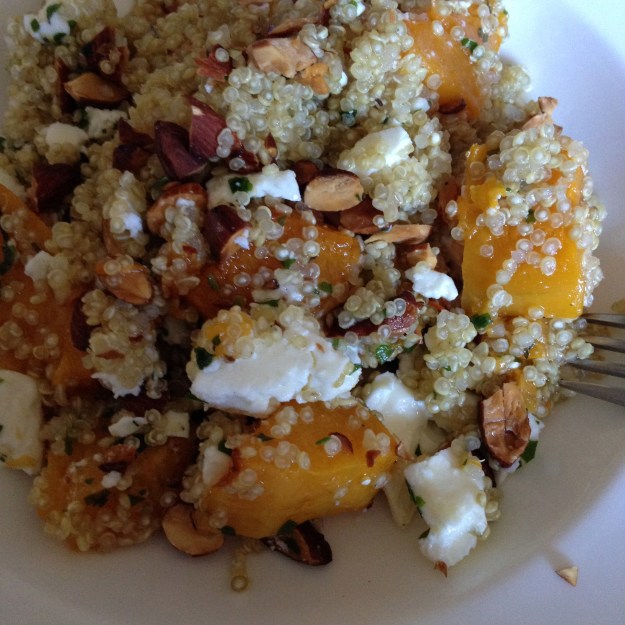
Put the water or stock in a saucepan and put the rinsed and drained quinoa in, cook for about 12 minutes, until the stock is mostly absorbed and the quinoa is tender to the bite. Now put the cooked quinoa into a large bowl or plate, put the squash on top, crumble the feta on top, scatter the almonds and some parsley and you’re done. You can have this warm (I did and it was superb) or at room temperature. Strikes me it would make an excellent packed lunch, too.

For extra veg, eat with a small green salad. I didn’t because I couldn’t be bothered to pick some salad from outside and rinse it, so I’ll, um, have that later.

Black bean, avocado and wensleydale tacos

IMG_3761

I saw this, earlier this year, in Waitrose magazine. I’m not a huge fan of beans, but I cut it out anyway and decided to try it on my eldest when she said she was going veggie. She hated it and the very next day reverted to being a meat eater.

That hadn’t been my plan at all.

Anyway, this is really lovely. Fresh, filling, tasty and pretty healthy. It makes loads, easily enough for four I think.

You need:

1 red onion, chopped up thin

2 tablespoons of olive oil

1 teaspoon of ground cumin

400g drained and rinsed can of black beans

195g sweetcorn, drained (of course you can also used fresh if you have it)

Juice of one lime

1 avocado, diced up

A large, manly handful of coriander leaves, roughly chopped

40g wensleydale cheese, crumbled

As many corn tortillas as servings – about four

Fry the onion in 1 tablespoon of the oil for five mins, until just softened and translucent. Add the cumin and cook for another minute then add the black beans and sweetcorn. Warm through and take off the heat. Season to taste and now add the avocado, lime juice, the chopped up coriander leaves, half the wensleydale and half a tablespoon of the oil.

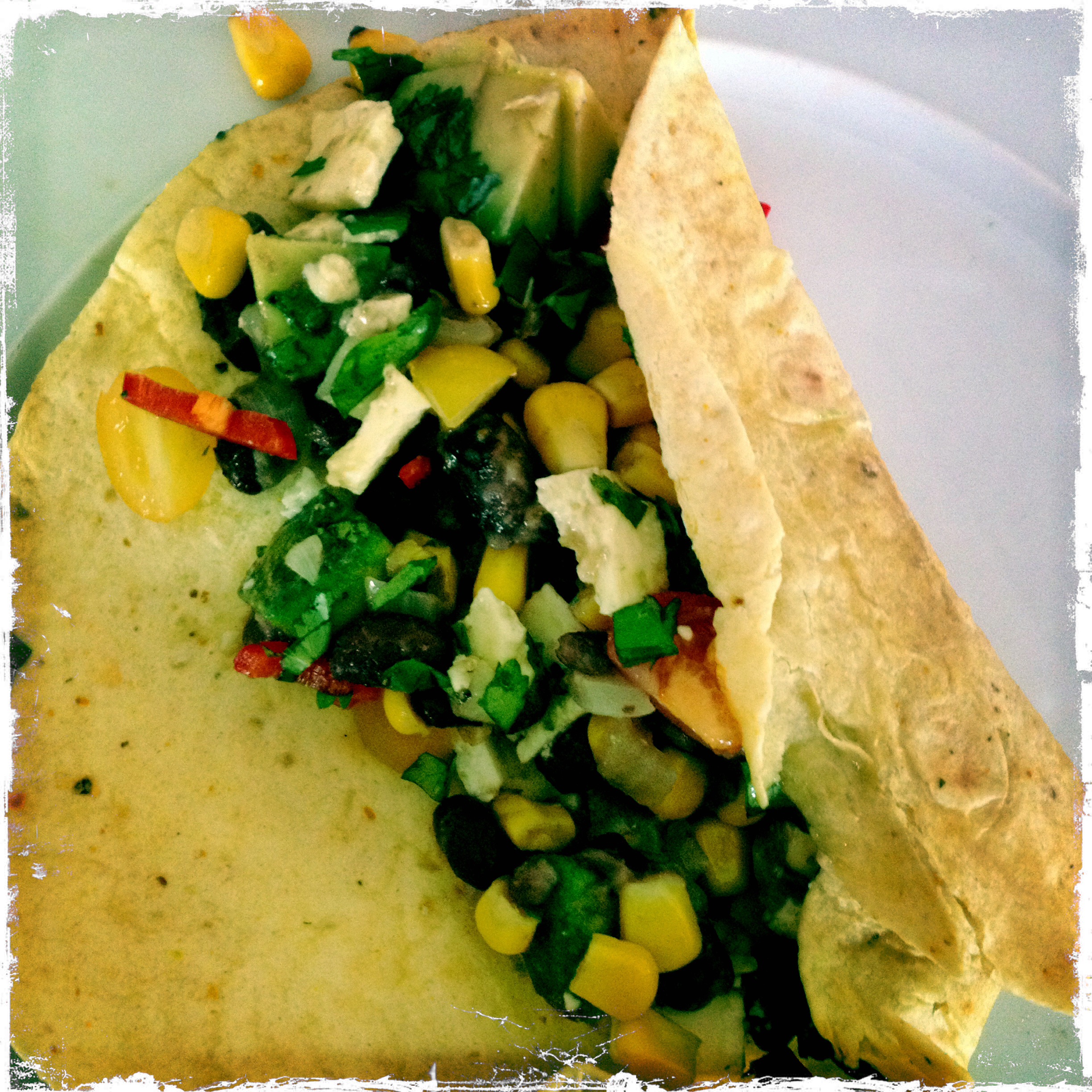
Brush the tortillas with the remaining oil and warm up in  a large frying pan and pile the bean stuff it to the tortilla. Wrap up and eat and enjoy.

ps: you can probably see we customised it with a few home grown tomatoes and some chilli. You can too. Go on I dare you.

Window vacuum, a brilliant thing.

231575442A while ago, as I fell asleep half delirious, I caught an ad talking about a wondrous looking thing called a window cleaning vac by Karcher. It was a vacuum, with a small cylinder attached to it that sucked the water up after you’d cleaned the windows, via a squeegee attachment.

Because I thought I’d dreamt it, I looked it up the next day and lo it really did exist. The reviews were fab. It was a gadget. We’ve long been looking for something that makes window cleaning a bit more efficient – it wasn’t the cleaning per se we found difficult, but how to achieve a smear free finish (even as I write those words, I am mocking myself). So of course I bought it.

It’s brilliant. You use it after you’ve cleaned the windows with soapy water. It takes a bit of technique but not much. My partner immediately seized it as his and started cleaning the windows in quite a frenzy. He even used it on the stainless steel cabinet fronts in the kitchen (brilliant, but I still think baby oil does a better job, he agreeth not). You can use it to mop up condensation if, like us, you have single glazed windows.

Buy the most basic model, the WV50. You don’t need the spray bottle (but buy it if you want), you don’t need anything else save for a cloth and a bucket. If you have teeny tiny windows you may want to buy the smaller squeegee attachment but that’s it. Save for replacements blades when you need them. It’s rechargeable. It’s fab.

Mud loving mats

This is another boring but kinda useful post. And it may not apply to you at all if you live in a city and you don’t get muddy.

But, if you have children or dogs and/or live in the country, you may find this of help.

Last autumn when it was really wet and therefore muddy, our wooden floors got unfeasibly dirty. The entrance hall comprised of dirt, wet foot prints, mud, bits of grass. No doormat could deal with the amount of detritus that was coming in.

When I was out and about in London one wet day, I noticed some rather fine establishments would put out these particular mats inside their doors, when it rained. I looked into it and they were by UK Mats.

Now, UK Mats has great customer service. I know, I used it a lot last year as I tried to work out what to get; the great thing is that it makes mats to order so in almost any size you want.

But in the end, I didn’t get my mat from there because I realised that I really needed a mat that could be machine washed. After some research one name kept coming up: Turtle Mats. These are not cheap (neither are UK Mats) and there are lots of ones out there that look the same but aren’t. People who have a Turtle Mat do rather go on about how good they are. Which both annoyed and heartened me. Annoyed because I really didn’t want to be spending nearly £90 on a doormat. Heartened because it seemed that if you did, it was worth it.

We went for the largest size (hence the price, you can get them from £23) and ours is from the Classic collection. There are lots of others in the range and I’m sure they work brilliantly, but I don’t do patterned doormats.

Anyway. We’ve had ours for a year now and it is, indeed, brilliant. It seems to suck water and mud from your feet, it doesn’t slip and when it gets too dirty you can put it in the washing machine.

I was so impressed I didn’t buy the company, but I did buy a Mud Hog to go outside, too.

(I’ve tried, but can I take a decent photo of this? Course not.)

Lost bunny

IMG_3319

Obviously this isn’t any old bunny. It belongs to my youngest’s best friend, E. And thus, it’s personal.

E lost her bunny two weeks ago in Brighton. So it’s a really long shot. It may have got lost in the hotel (The HIlton) and got wrapped up in the laundry. Do you know someone who works there who you could prompt to have a good look. It may have got lost in the streets. You may think it’s just a bunny, but it ain’t.

E’s had this bunny all her life. She’s five. It’s been in and out of hospital with her. It’s listened to all her dreams, fears, stories, what she’s done. E starts school on Monday and Bunny won’t be there. If you see it, let me know.

Thank you.