Category Archives: Buns

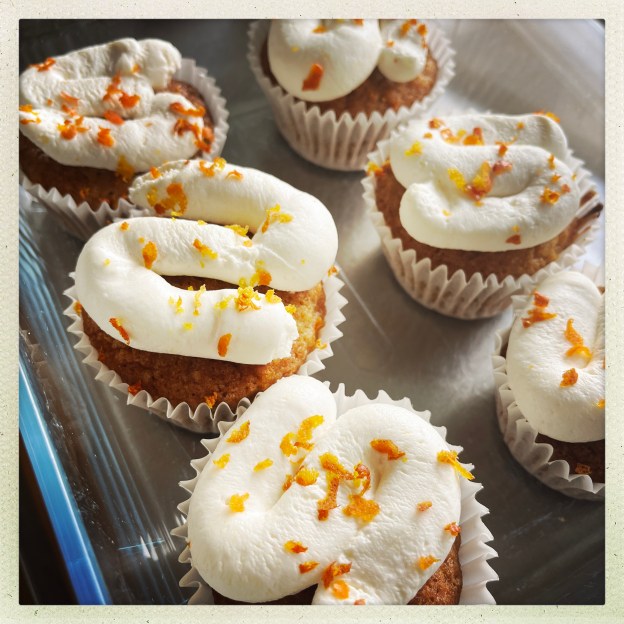
Carrot and Cardamom cupcakes

These are delicious, fresh and light and adapted from a Waitrose recipe which you can find here.

I changed the frosting as I can’t bear an overly sweet one and the addition of the Fiori di Sicilia is, if I say so myself, inspired…

Unfortunately they don’t travel well and need to be kept in the fridge – if you can let them chambré at room temperature for a bit before eating. I guess you could make this into one giant cake but not sure why you’d want to…

Ingredients for the cakes

12 cardamom pods
175g light brown sugar
200g self raising flour
Half a teaspoon of baking powder
Quarter a teaspoon of fine sea salt
2 eggs
150ml of olive oil
200g of carrots, coarsely grated (I hate grating things)
Two oranges, preferably organic as you are using the zest. You’ll only need the zest of one for the actual cakes. So if you’re short you really don’t need two but the zest, grated, as a decoration – see later – does look nice.

Ingredients for the icing/frosting

250g mascarpone
85g Greek yoghurt
55g icing sugar
Optional but wonderful: a good few drops of Fiori di Sicilia essence. You can also add this into the cake mixture if you prefer.

Oven to 180C.

You’ll need a 12-hole muffin tin lined with muffin papers. Open the cardamom seeds, discard the shells and grind up the little seeds as best you can. It’s good if you’re in a bad mood here as you can really bash away with a pestle and mortar.

Whisk together the sugar, flour, baking powder, salt and the ground up cardamom when ready.

In a separate, larger bowl whisk together the eggs and olive oil then pour over the dry ingredients with the grated carrot and zest of one orange. Gently mix until combined well and then pour equally into the muffin cases.

Bake for about 20 mins until a skewer comes out clean and they bounce back when gently pressed (careful not to burn a finger). When done take out and let cool completely (I take them out of the tin, still in their cases of course, about ten minutes out of the oven).

You can make the frosting whilst they are cooking and put it in the fridge for later. Here you just mix the mascarpone, icing sugar and yoghurt together with a few drops of the Fiori di Sicilia. You should have a fairly thick mixture. If it’s not thick enough for you (and sometimes it isn’t due to the water content of the dairy) then add a bit more icing sugar.

When the cakes are cooled you can ice the frosting on – it looks really good if you can be bothered to do this but I admit sometimes I just can’t be so I just spoon/spatula it on thicky and then, if you had another spare orange, grate zest on top. Voilà.

Pretzel Rolls

The food writer Nicola Miller introduced me to what I think is the best bacon roll, from 5 Angel Hill in Bury St Edmunds. Their soft pretzel rolls, filled with salty bacon slices can see me going pretty much all day. Few breakfasts do this.

So when I saw this recipe for soft pretzel rolls in BBC Good Food magazine a while ago, by Edd Kimber (who I think is a genius and the only person I pay for on Substack) I had to make them.

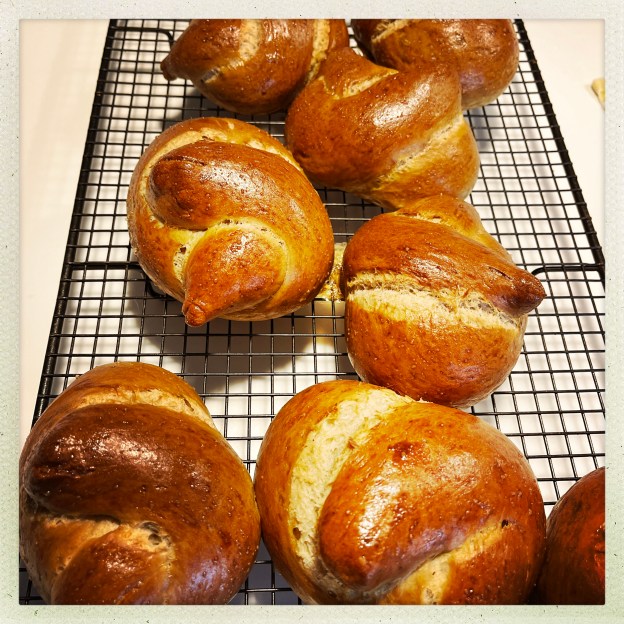
I gave up hope of making them so they looked like pretzels, mine just look like in the picture. They make great rolls for sandwiches, sweet – but not too sweet – and soft. And of course with bacon for breakfast, and maybe an egg. I also really like them on their own.

The baked bicarb bit is a pain but you only need to do it once to yield a jar of baked bicarb which lasts for a good few batches, and it is worth it (I’ve done it without and they are fine but the baked bicarb does add something). I’ve reproduced the recipe here, eversoslightly tweaked, largely to help me as the way it’s laid on in BBC Good Food I always found confusing.

For the pretzel rolls (makes eight)

500g strong white bread flour

7g dried yeast (I use Dove’s Farm)

25g dark brown muscovado sugar

300ml of luke warm water

50g unsalted butter
(I sometimes put 50g of fridge-cold butter into a jug of 300ml of just boiled water and wait til the butter melts, thus cooling the water, and then wait until the water is at the sort of temperature that when you dip your finger in it feels neither hot or cold)

1 teaspoon of salt

For when ready to bake

2tbsp baked bicarb (see later)

An egg for egg wash

Sea salt for sprinkling if you want.

I put all the ingredients for the pretzel rolls (not the ‘for when ready to bake’ bits) into a food mixer with dough attachment and mix for ten minutes. Then I take out the dough hook and leave at room temperature for an hour (less if it’s really hot).

When ready, take the dough out and divide into eight. You roll each piece out into a long sausage and then shape into a U then cross the ends up and over. If you get stuck just YouTube How to shape a pretzel but don’t get fixated on making large holes or gaps. You can also just shape these into little normal buns. Place on parchment covered tray.

Then you can either set these aside for – as the original says – 20 mins (covered with a cloth) or do as I do which is put them in a fridge which is at 4C (on a parchment covered tray, covered with a tea towel). I bake them the next day. Note these won’t keep for ever in the fridge so if you want them the next day, make them late afternoon/evening.

When you are ready to cook, preheat the oven to 200C and bring a large pan of water to the boil put in the two tablespoons of baked bicarb (I will tell you how to do this at the end). Take your tray of pretzel rolls out of the fridge. Depending on how big your saucepan is you put in, say, two pretzel rolls and a time and boil for 20 seconds each side (flip over using the slotted spoon). Take out the pretzel rolls with a slotted spoon and place back on the parchment covered baking tray.

When all are done like this you brush the rolls with beaten egg, sprinkle with sea salt if you so desire and bake them at the 200C for 20 mins. They will be a rich golden brown. As soon as you are able to place them on a cooling rack, off the parchment (otherwise they can go soggy). Wait as long as you can to start enjoying them.

Once cooled these also freeze beautifully, I defrost them in the microwave on the defrost function for about 2 minutes.

Baked bicarbonate

Preheat oven to 120C. Foil line a baking tray and pour a whole tub of bicarbonate of soda (the sort of size you get in the supermarket) . Spread out so it’s all even and bake for one hour. When cool put in a specially marked container so you have it for next time.

Sourdough doughnuts

I first made these in the summer of lockdown 2020, when we would ‘go’ for a picnic each Wednesday, which involved us getting into the car, basically driving into the turning circle on our drive and then getting out and having a picnic.

Listen: you make your fun where you can. My friend T gave me this recipe which I have tweaked a bit. It makes a lot – about eight. And they don’t really keep, they’re not the same even two hours after making them. You can use only half the dough at a time and make the rest the next day. (Note: I have pushed these to a 144 hour prove at 4C and they are delicious, so you can absolutely make the dough, cut into doughnuts and keep in the fridge and make in batches, the 144 prove doughnuts were amazing – they puffed up to life-saving-rubber-ring size and tasted amazing.)


Warning: you need to start these the day before you need them.

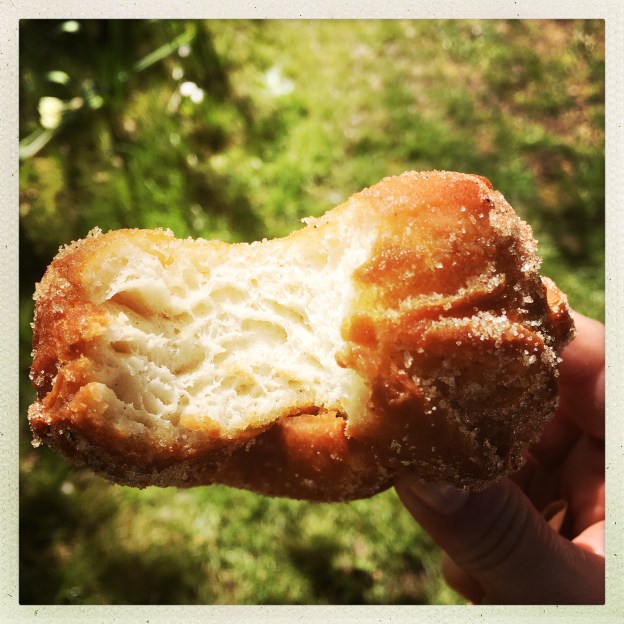
This doughnut had a 144 hour prove.

These are the ingredients:

240 ml whole milk warmed to 50C (I use a thermapen for all my kitchen thermometer needs)

1 large egg at room temperature

Four tablespoons of melted butter, cooled slightly

225g sourdough starter, also at room temperature. This should have been recently refreshed – about 5-6 hours ago at room temperature, the day before if kept in the fridge

500g plain flour

110g granulated sugar

1 teaspoon of salt

1 teaspoon of cinnamon

You’ll also need quite a lot of oil for frying (try not to think about it, I am not a fan of deep frying but you need to for this) and some caster sugar mixed with cinnamon for coating later.

Once the milk has reached 50C mix it together with the butter, starter and egg. You can do this by hand or in a mixer with the whisk attachment. Then add the sugar and the flour.

Now with this bit you can either mix it all up and knead on an oiled board, leave for ten minutes, knead for ten seconds, leave for ten minutes, knead for ten seconds, leave for ten seconds until you have a smooth elastic dough (so repeat one more time if needed). Or you can do it all with a dough hook attachment in a mixer for about 15 mins until it all clumps together.

Once this bit has been reached you get a big bowl, oil it and put the dough in, cover it and refrigerate it overnight/until the next day when it’s needed.

About 2-3 hours before you want to eat your doughnuts, take the mixture out, roll it out on an oiled surface until it’s about 3cm thick. I use a round cookie cutter to cut the doughnuts out, using a small one to make the ‘hole’. See what sort of size you want them to be, mine are about 10cm with the hole in the middle about 2.5cm. You can also do them as round doughnuts but I like ring ones best. The first time I made these I tore the edges slightly and was really upset that they wouldn’t be all perfect but actually, those little tears made (see main picture) something gloriously layered and even tastier! I’ve tried to recreate it ever since and can’t..

Put them on an oiled tray, or one lined with baking parchment and cover with cling film which you can also lightly oil if you are nervous (tbh I cover mine with a tea towel). Leave to rise for about 1-2 hours – depends on how warm your kitchen is. You know the dough is ready when your finger gently pressed makes an indentation but also don’t sweat it.

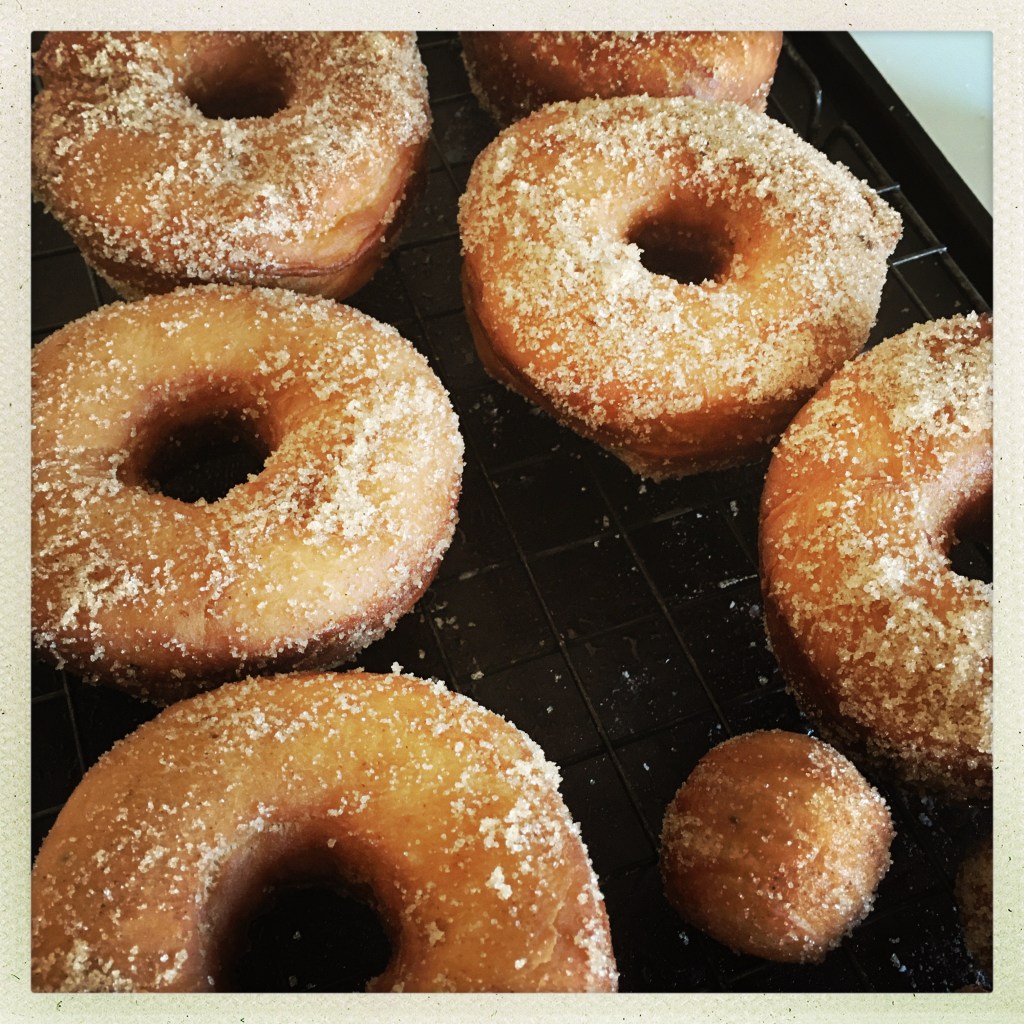
Fry a pan of oil up (use something light and not highly flavoured: I use a blend of olive oil and sunflower oil). Now here it depends a) how brave you are b) how wasteful you want to be with the oil c) how many you have made and intend to cook d) how many you want to cook at once. I tend to use about a litre of oil in a medium sized sauce pan and cook two at a time. DO NOT OVERFILL and of course be sensible, this is oil you are heating up. When it reaches 175C (use your thermometer) you’re ready to go, using a slotted spoon lower down however many doughnuts you intend to cook. Like I said I do two at a time. They take about 2-3 mins per side, flip with the slotted spoon; the colour is the guide here: you’re looking for a true golden brown. Take out using your slotted spoon and immediately flop the doughnut into caster sugar and cinnamon in a bowl.

Then place on a drying rack. When all are done you’re about to experience something wonderful so take a moment to enjoy it.

And try not to eat more than one.

And try not to eat more than one.

Chestnut marmalade muffins (gluten, wheat, dairy free but don’t let any of that put you off)

These are adapted from a Hugh Fearnley-Whittingstall recipe (from his book Light & Easy). The original calls for 75g coconut oil, which I just find too much, and 75g runny honey, which I’ve eased back on just ever so slightly. His recipe also says cook for 25 mins, but mine are done at 17.

It calls for chestnut flour – which isn’t cheap, nor madly readily available. But is delicious and so filling. Don’t be tempted to buy it in bulk, it doesn’t keep for very long.

And you really need an electric whisker unless your arms are super strong. If they are, all respect to you.

These are just so delicious though, and gluten-free if that’s important to you. I love anything to do with chestnuts as it reminds me of my Pa.

Note these make ten. I’ve been making these for a few years now and every time, with my 12-bun tray, it catches me out.

125g chestnut flour

A pinch of salt

2 teaspoons of baking powder

125g marmalade

2 large eggs

70g runny honey

half a teaspoon of vanilla extract

50g coconut oil, melted and cooled.

Pumpkin seeds to sprinkle.


Preheat the oven to 170. Line a muffin tin with…muffin cases

Combine the flour, salt and baking powder and set aside.

In a food mixer with whisk attachment, put the eggs, honey and vanilla and whisk for, frankly, ages. But about eight minutes. Until the mixture is like a thick mousse and the beaters leave trails when you lift them out.

Now gently and slowly, with the mixer running, spoon in the flour mixture and when all is incorporated whisk again for a few minutes. The mixture will go down to a batter-type one. When done, trickle in the melted coconut oil with a tablespoon of water and whisk for half a minute more. Take off from the mixer and just with a spoon fold in the marmalade.

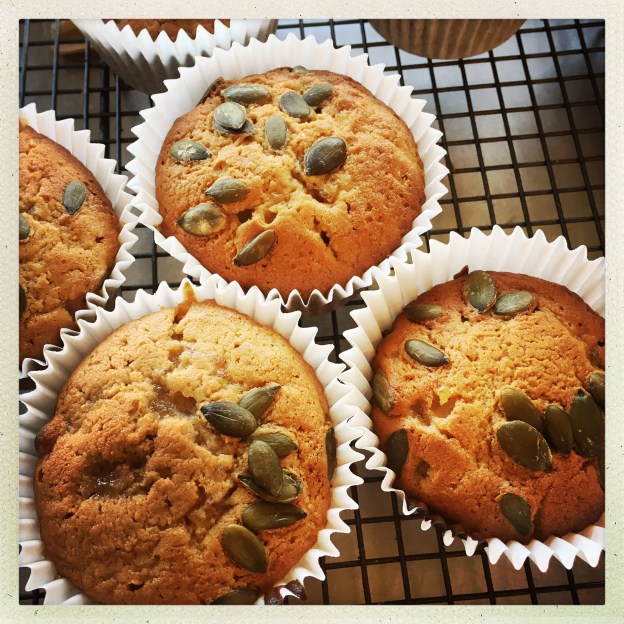
Spoon the batter into the TEN muffin cases. They won’t come up all the way, that’s how it should be, about 2/3 full. Sprinkle on the pumpkin seeds and bake for  about 20 mins – check after 15. They should be golden and bounce back when you touch them. Depends on your oven of course.

Chocolate Chip Brioches, dough made in the bread machine (especially for Connie).

So a while ago, I posted a recipe for enriched dough chocolate chip brioches. My youngest actually prefers the enriched dough version but I had long hankered after proper, buttery, brioche dough.

I wanted something I could bung in the bread maker and let machine make the dough. And although my Panasonic bread maker doesn’t have a brioche cycle (it’s nearly 20 years old) I knew the newer ones did so I did a search and found a recipe, online, in a newer Panasonic breadmaker instruction book.

These brioches are fairly fuss free. As with all brioche dough, it is very buttery and if handled too much at the shaping stage you become FULLY aware of how much butter is in there as it starts to slide across the kitchen counter and you end up needing to wipe down your hands a lot. But most of the work is done in the bread machine so don’t worry.

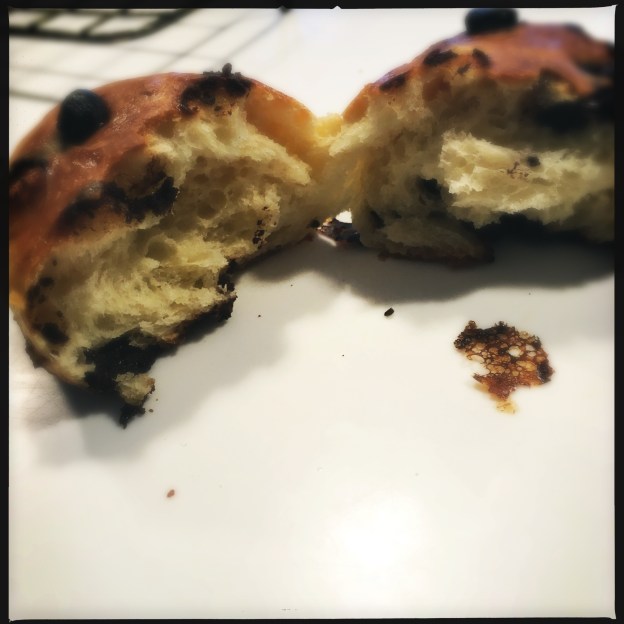
Make these the day before you want them, shape them, cover them, stick them in the fridge and the day you want them (they make wonderful breakfasts) just heat up the oven, glaze the buns and stick them in the oven. Voila. Buttery, brioches with melting chocolate inside.

I cooked some of these this morning (made yesterday) because I was making Christmas cards with my children and my friend Mary, who is super crafty came with her absolutely fabulous children and we all sat sticking, embossing and cutting; chatting, the fire burning, lovely music on. It was like something out of a Jane Austen novel, except with Spotify.  Connie, the eldest has just started making bagels and asked me for the recipe. So here it is.

One and a half teaspoons of instant yeast

400g strong white bread flour

Four tablespoons of caster sugar

15ml of rum (I seriously don’t know what this does so if you don’t have it I’m sure you can just add a bit more milk but if you have it, add it, I mean why not?)

One and a half teaspoons of salt

70g of butter, cut into cubes and straight from the fridge

90ml of milk

50g of butter, cut into cubes and straight from the fridge for later *

100g chocolate chips, I prefer dark – for when the dough is out of the machine

Makes 12

Put everything except for the chocolate chips and ‘later’ butter into the bread maker and set the dough cycle – it should be about 2hrs. Mine is 2hrs 20minutes.

At the first knead stage (about 30-50 mins in) add the ‘later’ butter. Your machine may have a beeper for ‘later butter’ stage. Mine doesn’t.

*You can add all the butter at the beginning and honestly I’ve not noticed much difference, so see how you go. If you’re around and can add it later, do, if you need to get on with something just add it all at once.

Don’t, however, add the chocolate chips now, they will melt slightly and the dough will be slightly coloured. It doesn’t affect the taste but..I just prefer it done later.

When the dough cycle is finished, take the dough out, flatten out, add the chocolate chips and sort of gently knead them in. Rest the dough for ten mins, then cut 12 pieces out of it and shape into sausage shapes (or rounds). If you find the dough resistant you can cut the 12 pieces, then rest, then shape. Or just cut and shape straight away – see how you feel.

When shaped, place on a baking parchment lined tray, cover with a tea towel and put in the fridge overnight or for a few hours until you need them.

When ready to bake, heat oven to 180C, brush the brioches with egg yolk and cook for 20 mins (check after 15).

Eat about 30 mins out of the oven when it’s the perfect mix of warm brioche and melting chocolate. You can also freeze them, when cold, for resuscitation another day.

Enriched dough rolls with chocolate chips (bread machine)

These came about trying to make chocolate chip brioches for my youngest who is obsessed with them. M&S does the best shop bought ones – most leave a really weird taste in your mouth. But we no longer have a local M&S (thanks Stuart Rose)  and anyway, shop bought bread-products are nearly always full of other ingredients I neither recognise nor welcome.

These aren’t strictly speaking brioches – there just isn’t enough butter or eggs to really warrant the name – but they are a lovely little enriched breakfast bread that’s a bit more exciting than bread, but with very little sugar. I promised my youngest I’d make her some brioches, but when the time came, I had very little time and was slightly awed by traditional brioche recipes which involve massaging an entire packet of butter into dough. Plus we were in the middle of jigsaw making and I didn’t want to “splinter off” as my youngest puts it, and start mucking about with dough when she is happy with shop bought. So I looked at my trusty Panasonic bread maker recipe book which is 20 years old; the newer models have actual recipes for brioche bread which I shall attempt anon, and also a special cycle for them which adds half the butter during the cycle. Mine didn’t, but it had a recipe for enriched bread dough. I tweaked it slightly, threw everything save for the chocolate chips into the machine – although I could have put those in too (if you put them in, put them in at the beginning with everything else not in any fancy dispenser drawer as they may melt and get stuck).

It was so easy. Ingredients in bread pan, dough cycle (which is 2hrs 20mins on mine), during which you can do a jigsaw, out, knead in about 80g of chocolate chips, shape into eight rolls – put on baking parchment, cover with cloth, prove in fridge overnight.

In the morning: oven on to 220C, little buns brushed with a bit of milk, baked for 10 mins. Eaten for breakfast. Delicious. I ate three just for testing purposes.

What you need

half a teaspoon of dried yeast (I use Dove’s Farm)

250g strong white bread flour

1 teaspoon of caster sugar

25g butter

1 tablespoon of milk

half a teaspoon of salt

1 egg

85ml water

80g chocolate chips


Pump Street Bakery, Orford

Orford ness is one of our favourite places. We go there at least once a year, for a very long walk, a picnic, and chats. Even my youngest can manage to walk around the red and blue walk (not green though, it’s never been open when we’ve been there, we always time it wrong).

(For those on Fitbit, you can rack up about 15,000 steps, or six miles  walking those routes.)

What we like to do is get up really early and head out without breakfast, fantasising about what we’ll eat from the Pump Street Bakery, when we get there. The fact that such an amazing bakery exists in what is a tiny village in the middle of nowhere astounds and delights me. And makes me very jealous. I wish we had one where I live in Suffolk.

This is a tiny bakery, that is crammed into an old house. There are very few seats. But it is glorious. Please don’t miss it if you venture anywhere near Orford (which is a very pretty village). We’ve sampled the Bear’s Claws, the doughnuts, the brownies, the Eccles cakes and the almond croissants so far. You have to try the Eccles cake to believe that currants can be held in a puff pastry and be a thing of eye-watering beauty.

We have breakfast – cappuccinos (very good) with pastries dipped in them, perched on the benches outside.  I want to try a gibassier next time I’m there. I’m afraid the pastries are so good, I completely forget to photograph them, so the picture above is a photo of my feet on Orford ness beach. Probably my favourite beach in the world.

Not to be missed.

Sticky cinnamon buns

Buns is a word you simply can’t say enough. If it’s not already, it should be a control word, used by psychologist in experiments, to put people in a good mood. It is a fabulously English word and, even though I try, there isn’t really any alternative in Italian. We have the rather more catch-all phrase meaning, simply, ‘pastries’.

Although we don’t really celebrate Mother’s Day (I really don’t need a day to tell me to appreciate my mum), if you were so minded, these would probably go down a treat if you made them today (as I write, tomorrow is Mothering Sunday), put them in the fridge to prove overnight, then cooked them in the morning.

They take almost no kneading. I got the initial inspiration from Edd Kimber who won the Great British Bake Off five years ago, but I’ve cut the sugar down (with no ill effect) and changed the kneading process so there isn’t really any, Dan Lepard style. I also don’t use currants or any dried fruit because my children don’t like them. I’d never thought of using cream cheese in an icing before but it’s wonderful and entirely Kimber’s idea, not mine. I am not a fan of sugar/water icing and the addition of a protein-rich food really takes the teeth-janglyness out of the icing. It doesn’t make them any less delicious, only more so.

These are life-affirmingly good about half an hour out of the oven, I’ve just eaten one and am in a seriously good mood. I’ve done a lot of gluten/dairy free baking recently and was just about to put up a recipe for a green smoothie, so thank goodness for these. My inner Nigellas and Gwyneths are still fighting but, for today, Nigella wins.

This made 20 for me.

For the buns, you will need:

250ml whole milk (I don’t suppose the world would fall in if you used semi skimmed)

50g unsalted butter

500g strong white bread flour

30g caster sugar

1 teaspoon of salt

7g fast action yeast

1 large egg, beaten – the egg should be at room temperature

vegetable oil for greasing

For the filling, you will need

100g light brown sugar, smash any lumps out

3 tablespoons of cinnamon – yes tablespoons. It seems a lot, but these are cinnamon buns

60g butter, melted

For the topping, you will need

50g soft cream cheese

50g icing sugar

This is what you do

Warm the milk and the butter up in a small pan until the butter has melted then let it cool until it is just luke warm. (If you haven’t taken your egg out of the fridge yet, do it now and set it aside to warm to room temperature.)

The milk/butter is ready when you put a clean finger into it and you can’t really feel hotness or coldness. If it’s too hot or cold it won’t activate the yeast efficiently. If you want to speed up the cooling process, take it out of the pan and put it into a wider-lipped vessel like a bowl.

In the meantime, in a large bowl, mix together the: flour, sugar, salt and yeast.

When the milk and butter mixture is lukewarm, make a well in the middle of the dry ingredients (the flour etc) and pour the milky buttery liquid in, followed by the beaten egg. Mix this all up as best you can using a fork. You’ll have a lumpy dough that will look most unpromising.

Leave it for ten minutes.

Turn out onto an oiled surface and knead gently for a few seconds, cover with a bowl and leave for another ten minutes. Knead again for a few seconds. You should now have a smooth, soft-ish dough (it won’t be super soft and may seem a tad dry). If not, if there’s still obvious ‘bits’ to it, give it another 5-10 minutes rest and another quick ten second knead.

Now, put  it into an oiled bowl and cover with cling film and leave it until it’s doubled. This may take much longer than you think. In my kitchen (which is kept at a Spartan 18C and a humidity level of under 50) this took nearly three hours. In a hotter kitchen it can take as little as an hour. I know this bit is scary – knowing when the dough is ready always used to scare me – but what I do is I put it in a large bowl, so that the dough fills up about half the bowl. This is because, as the dough rises, you can never remember what height it was, can you? So it’s difficult to judge when it’s doubled. But if you choose a bowl where the dough comes up about half way to begin with, and then cover with cling film, you know it’s done when the dough starts to push up the cling film.

At this point tip onto a lightly oiled surface and roll out the mixture until it’s about 40cm x 50cm. It should roll out really quite easily. You may need to oil the rolling pin – I did. You will get rounded edges, no right angles. That’s okay.

Now the mixture: mix together the sugar and cinnamon and set aside for a momentino. Now, with a pastry brush, brush the melted butter all over the slab of dough, right to the edges. This is quite meditative. Think of all the people who have done you wrong whilst you do this and think that they won’t be getting any of your cinnamon buns, the bastards.

Now, on top of the dough, sprinkle the sugar and cinnamon, making sure to go to the edges as best you can. You will spill some onto your work surface, try to pick these up and put them back on or, at the end, gather the up with a clean hand-sweep and sprinkle them on top of the made up rolls.

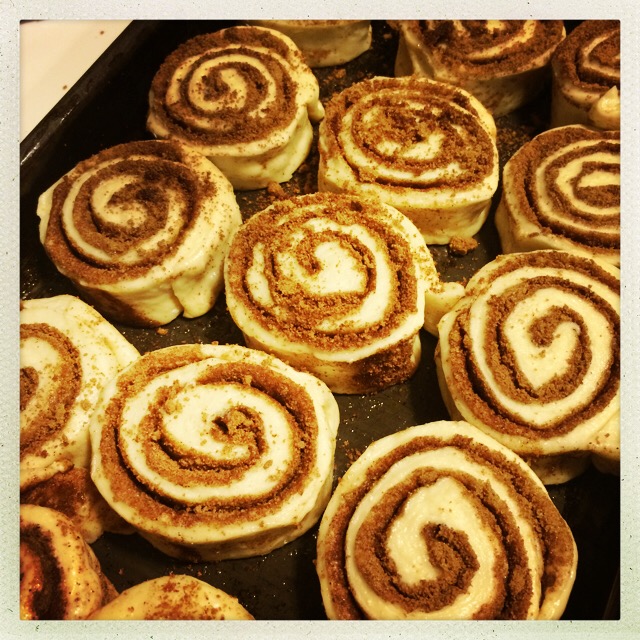
Now, with the filling all spread, roll up the dough, with the longer end towards you so you get one long cinnamon bun roll. With a sharp knife, trim the edges off, then cut slices of about and inch and a half or so. Place the buns flat down on a lightly oiled tray measuring about 23cm x 33cm (you can even got a bit bigger, but no smaller). There will be a little gap between them, see picture.

IMG_1712

(If you have any sugar/cinnamon stuff left on the work surface, don’t waste it but gather it up and sprinkle it on top at this point.)

You now have a choice. If you fancy eating them soonish, cover them with cling film and leave until they have doubled in size. Anything from 45 mins to a couple of hours. But. I put them in the fridge at this stage and leave them all night. (Also, see update, below.)

Whenever you cook them, you need to a) preheat the oven to 180C b) brush the cinnamon buns with melted butter before they go in the oven (this is important). If you prove them in the fridge you can cook them straight from the fridge, or leave them at room temperature just until the oven warms up. No longer.

Cook for 20-30 minutes (mine took 25).

Whilst they are cooling make the icing, just mix together the icing sugar and the cream cheese until it’s pourable but not too liquidy. It will really seem like it’s not going to work for a bit but then it all comes together. Drizzle on top of the buns (it’s okay to do this when they are about 20 mins out of the oven). Then, prize them apart with a spatula thing and eat with a good coffee whilst making whimpering noises.

(Have napkins handy, these are sticky.)

UPDATE 20 April 2015

Having now made these a few times, I offer these observations:

These buns are fabulous when freshly made, but they go stale disappointingly quickly. Unless you plan to eat them all in one go (!) then what I suggest you do – what I do – is I now cook these in two batches. You can easily keep them in the fridge for that final stage of proving (i.e. the bit just before they go into the oven) for two days. I divide mine up onto two smaller trays and cook them over two days, thus giving me fresh buns for breakfast two days in a row. Just mix up 25g cream cheese and 25g icing sugar for each batch. Which brings me to my next observation:

I think that 50g of cream cheese and 50g of icing sugar is AMPLE icing for these in total so I’ve amended the original recipe above.
Iced buns for a Wednesday

There are many other things that I should be doing. I am in the middle of a piece about Death, I interview somebody in an hour, I have a study that looks like a store cupboard nobody cares about, and everybody chucks their stuff into. I should be researching, planning and tidying to enable a more structured work routine.

But all I want to do is write about buns. Iced buns. I don’t even, particularly, like iced buns. I never wake up and think “I really fancy an iced bun”. But they are a perfect, unassuming little cake. Very English (to my Italian mind). And humble. My partner, who is English going back to the beginning of time, said that “iced buns were what you bought your children when they really wanted a doughnut”. I have no idea if this is true

This is how you make them. It’s a recipe from a Jamie Oliver magazine from a few years back, the method of which I’ve adapted slightly. The recipe says it makes 12, but you could easily make 24 small ones (and even then, not that small). These were, actually, iced ‘fingers’ but I prefer the word bun. I made 12 and they were as oversized as the eyes on a Bratz doll. Next time I’d make them smaller.

14g dried yeast

150ml milk, tepid

500g strong white bread flour

50g caster sugar

2 teaspoons of salt

40g very soft butter, unsalted

2 eggs

140ml of water straight out of the tap

For the icing: 300g icing sugar, 2-3 tablespoons of water

Stir the yeast into the milk and set aside. You don’t need to wait for it to froth up or anything.

Mix together the flour, sugar and salt together. Now stir in the yeast/milk mixture and the rest of the ingredients, mixing it all together.

You’ll have a very wet dough that looks almost unmanageable. Leave it in a bowl for 10 minutes.

Oil a work surface or board (wooden boards don’t work so well for bread kneading, I use a Top Gourmet one which is made of recycled cardboard and it’s brilliant for all my bread making) and tip the dough out. You may need to scrape it up with a scraper to begin with but don’t be tempted to add flour and don’t panic. You can do this. It’s buns you’re making, just think of that.

Knead it very lightly for about 10 seconds, then cover and leave for ten minutes.

Do this twice more. By the end you should have a smooth dough that is slightly more manageable. Now leave it, covered in an oiled bowl, for about an hour and a half. It should have doubled/risen quite a bit.

At the end of this time, knead it lightly one more time and cut bits off it and roll into either circles (I used flour for this last bit) or sausage shapes. If you want to be really precise, weigh the whole dough, work out how many buns you want, then divide one by the other so you end up with buns the exact same size.

Place whatever size/shape bun you’ve made onto a parchment lined tray. The buns shouldn’t be touching yet – they reach out to each other as they rise.

Cover and leave in a warm place for 30 minutes. I left them at room temperature – 20c – for 90 minutes (not on purpose, I got held up) and when I came back they’d blown up to enormous proportions. All was fine, I had very big, very light, very fluffy buns. But it was touch and go until I got them in the oven. I’d say give them an hour at an average room temperature.

Into a preheated oven of 200C, place the buns for 10 minutes or so. You want them to be lightly golden. When done, take them out and cool completely. They’ll be all squashed up against each other and you’ll have to tear them apart to reveal their inner fluffy softness.

Now  mix up the sugar and water to make the icing and spread it on top. The icing won’t be pouring consistency – it’s much thicker than that. So you need to spread it on with a knife but as it dries it smooths out so don’t worry about it not looking lovely and slick when it first goes on.

Don’t store these in an airtight container. The buns need to breathe or the icing will slide off. So you may want to freeze half (un-iced in which case make half the quantity of icing) as these make rather a lot. But they are fun to give away. Everyone seems to like an iced bun.

These are great for school fetes for that reason – children and adults like them – and they are not overly expensive to make. I think, and my eldest agrees, that these taste even better the next day. They didn’t last into a third though.


Sourdough rolls, or panini

Having a bread roll always seems a bit luxurious. Whereas a slice from a loaf is all about sharing, a panino (panino is the singular, panini the plural) is all about you: it’s all yours; from beginning to end.

I only started making rolls last year, when I got a couche cloth for my birthday (I felt lucky). They are so easy to make and I want to encourage you to give them a try, and here’s why:

You can keep the rolls proving in the fridge for days. A batch of dough made using 500g of flour yields about 12-16 rolls, depending, obviously, on how big you make them. This lasts us, on  average, three days. The longer they’re left, the tastier they become.

Thus, you can cook up just how much you need. This is really useful if you struggle to get through a whole loaf in one day. With the rolls, once you have a batch in the fridge, you can have freshly baked bread in less than 20 minutes (cook straight from the fridge) and you can cook up just one or two, or the whole lot depending on how many you want to feed that day/moment.

The longer-proved rolls do deflate when you slash them however, so don’t try – just nip at them deeply with a very sharp pair of scissor (you can see the effect in the pic above), they still rise beautifully in the oven, but you want to be quick and definite with the cutting so don’t faff around with a grignette.

They’re really, really tasty.

With rolls that have only been proving overnight, I do slash at them with a grignette, usually making four little slashes all the way around. This helps keep the round ‘boule’ shape. If you don’t mind about this, two or three slashes with a sharp bread knife is slightly easier, but the dough will expand to give you a more oval shaped roll.

I bake mine for anything from 14-20 minutes, divided up half at 250C and half of that time at 200C, but obviously a bit more or less depending on size of rolls or finish of crust that you want. (I still use ice cubes though.)

If you like to give bread as a present there is something really nice about giving a ‘bag ‘o’ rolls’. I mean even the phrase is great. Buy some brown bags (I get mine from the dreaded Amazon, sorry), because I do love a brown paper bag.

They are easy to shape and it’s also a really good way to practise shaping because if you get one a bit wrong, you have another 11 or so to practise on. Do shape them all up at the final prove stage, don’t be tempted to keep the dough to shape up for later. I can’t find the shaping video I watched now (it was by the people at King Arthur Flour), despite looking for it. But if you put ‘shaping bread rolls’ into You Tube you’ll get a few vids which will give you an idea.

You can bake them longer for a crustier crust, for less time to make a softer one for children/old people with no teeth. Whilst I love a deep, dark crust on a big loaf of sourdough, because the ratio of crust to middle is low, with a roll, I prefer a softer bite.

Have a go, and have fun with it. Just use your regular recipe for sourdough but shape them into rolls. This also means you can make the fabled ‘sourdough burger bun’ (basically a sourdough roll into which a burger has been put) which people queue for in London’s Hackney.

For the rolls with a lesser proving time you will need a planchette, but with the rolls that have been proved for a longer time, they are less frisky, drier, and you can, if you’re quick and confident, lift them off the couche cloth and onto a hot baking tray by hand. But given that a planchette is vital for baguette baking, treat yourself.