Category Archives: Children

Chocolate yoghurt

This is a really nice thing to have with some fruit. I’m all for eating yoghurt on its own but if you want to butch it up a little, or make it into an extra treaty thing then you can easily make chocolate yoghurt. This serves two.

Melt 50g of chocolate of your choice in the microwave or in a bowl over a pan of simmering water. White chocolate gives a lovely vanilla-y flavour but experiment with milk or plain. Obviously milk or plain will colour the yoghurt.

Now, for the yoghurt, use anything from 150g – 250g. We always have live Greek-style yoghurt (is any yoghurt dead yoghurt?) but use any plain yoghurt that takes your fancy. 150g gives you a very tasty dessert indeed. Chocolate-y tasting with a nice, clean tang of yoghurt. The more yoghurt you add, the more you’ll have to eat but the less sweet it tastes. Experiment..

Once the chocolate is melted you add the yoghurt, add a tablespoon in first so you get a smooth mixture then add the rest; stir it so it’s all amalgamated and serve with some nice fruit. Awesome, fairly healthy, dessert. If you want to up your good fats, sprinkle some chopped nuts on top.


Chocolate banana cupcakes with a chocolate cream frosting

My friend Vicky made this chocolate banana loaf the other day with her ducks’ eggs. I’m not usually a fan of banana bread. I want to like it, ever since I read that Nigella says making banana bread fills your house with domestic fug, or some such. But I just don’t really like it. I’m not a fan of an overly banana taste in anything other than in a, you know, banana. But this looked different, thanks to the abundance of chocolate and cocoa in it and on it. And then I had a child off sick the other day and so we decided to make it together; but into cupcakes not a loaf. And it worked brilliantly.

As you will see in the comments below the actual recipe in BBC Good Food magazine, lots of people have modified the recipe to make it even healthier with less sugar, more bananas, honey etc. I am obedient so, as it was the first time I made it, I followed the recipe.

I used Isigny Creme Fraiche instead of ‘sour cream’ (it’s the same thing anyway isn’t it?) and I used Tesco’s Finest Cooking Milk Chocolate with 40% cocoa content which is fantastic, even if you do have to go to Tesco to buy it (stock up). I hate hate hate buttercream icing so this is great for me.

IMG_5644

My youngest didn’t like the topping so I left some clear for her which was convenient as, making it into cupcakes rather than one loaf, I didn’t really have enough frosting (if you want to cover all of them, make double of the topping).

You can top with a banana chip if you want. I make my own, using my dehydrator, but obviously you can just BUY THEM.

Update: I have since made these again using coconut oil instead of sunflower oil (v nice, you don’t really taste the coconut) and also half wholemeal flour plus half a teaspoon of baking powder. Just to make it more healthy. If anything, I think the cupcakes tasted better..and because I’m lazy, I’m reproducing the recipe, as I now use it (i.e. adapted) here for my reference..

for the cupcakes

100g coconut oil, or olive oil or butter

110g caster sugar

90g white self raising flour

85g wholemeal, plain flour

half a teaspoon of bicarbonate of soda

half a teaspoon of baking powder

4 tablespoons of cocoa

100g chocolate chips – I use plain

175 very ripe banana (about two) – I weigh them with the skin on

3 medium eggs, two separated

50ml milk

For the topping (double this quantity if making cupcakes and you aim to ice the whole batch)

100g high cocoa content milk chocolate

100g creme fraiche/sour cream

a pinch of sea salt for real wowness

banana chips if desired

Line each cupcake mould with a case – this makes about 16 so you may need to cook in two batches.

Heat oven to 160C. Mix the sugar, flour, bicarb, cocoa and chocolate in a big bowl. Mash the bananas in another bowl and mix in two egg yolks plus one whole egg. To this, add the coconut oil/olive oil or butter and milk.

Beat the egg whites until stiff.

Add the banana mixture to the dry flour etc mixture, mixing well but not overmixing (I never understand why, what happens if you over mix it??). Stir in a bit of the egg white mixture to loosen it all up, then fold in the rest to keep the air in as much as possible.

Spoon into cupcake cases and bake for about 25 minutes – 30 mins. A skewer should come out clean, unless of course you hit a bit of melted chocolate chip.

Let them cool completely. In the meantime, melt the creme fraiche and chocolate together, in a bowl over simmering water, with the pinch of sea salt if desired. Then spread over cupcakes (if it’s really gloopy let it firm up a bit in the fridge first, but not too much). Top with a banana chip if you like.


The Phoenix Comic

My friend John-Paul Flintoff, who is married to one of my fabulous editors Harriet, (I’m not saying this to show off who I know, but because I think it’s so important to give credit to people, and I didn’t want to mention JP without mentioning Harriet because I actually know her a whole lot better) recently told me about The Phoenix Comic.

It’s great, he said. There are no ads, he said. Great writing, he said. There was a special offer on – first four copies free – so I thought I’d give it a go in a ‘what have I got to lose’ way.

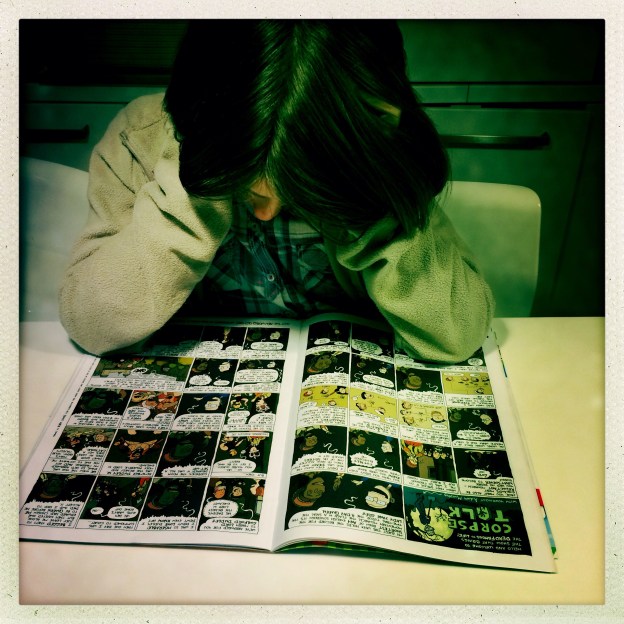
The comic arrives by post every Friday in a big, colourful envelope, addressed to the child whose name you put on the subscription form. At first my eldest (my youngest has just started reading) wasn’t that enthralled. I admit I was disappointed. However, when the time came for the free subscription to end, I asked her if she’d like me to cancel it.

“Oh NO” she yelled, “I love it!” (Corpse talk is her favourite bit.) Now, every Friday, I get my copy of The Week, she gets her copy of The Phoenix and we are both heads down for an hour. Because not all reading is about books.

Posh “Pot Noodle”

This isn’t of course, anything like pot noodle. I’m not even sure why I call it that other than, when there are left overs, I put it in a glass Weck jar/pot and it’s so easy to reheat and before you know it you have something ludicrously tasty and nutritious to eat.

My children love this. The original recipe calls for chilli (1 red, sliced), salad onions and pak choi. You can still add the former at the same time you add the star anise, if you wish, and the latter when I add the ‘veg’.

It’s wonderfully fragrant, really amazing smelling, the kind of soupy meal that feels like it’s doing good just by raising a bowl of it to your nose and sniffing it in. If you’re going out for a family day out/walk (or even, you know, by yourself) it’s great to make in advance, stick in the fridge, and within minutes of coming home you can have something to eat.

Its original name is Fragrant Chicken Hot Pot and it’s adapted from a Waitrose magazine recipe from last year.

Serves 4

2 teaspoons of vegetable oil

4-6 free range chicken thigh fillets (or still on the bone see note later) cut into chunks

2 garlic cloves, chopped

4 star anise

1 tablespoon of light brown muscovado sugar

500ml chicken stock

1 tablespoon of fish sauce

Some green veg: spinach or French beans, whatever you like: a big handful.

Two nests of Vermicelli or other noodles (or more than that if you want a more noodley experience)

This is what you do:

Heat the oil in a large saucepan, then fry the chicken for about 10 minutes until browned.

If using whole thighs on the bone (see my note later) do this for the same amount of time but to make sure the chicken is cooked simmer the actual soup for longer than the ten minutes recommended below.

Now stir in the garlic, star anise (and chilli if using). Fry for a couple of minutes, then add the sugar and stir around for a minute or so until melted.

Now add the stock and fish sauce, cover the pan and simmer for ten minutes – fifteen if you’re using chicken thighs on the bone.

Whilst this is simmering, prepare the noodles according to your instructions. The vermicelli nests I use just have to sit in boiling water for five minutes, so are simplicity itself.

Now add any veg you are using and cook for a further 2-3 minutes, depending on what you are using. Taste and add more seasoning if needed (I never need to). Serve! It’s delicious. Any left overs can be stored in the fridge for a day or two and just reheated well making for a really lovely, quick, meal.

A note about the chicken. Ready filleted chicken thighs make this more expensive, but easier. I tend to use thighs on the bone with the skin on. You could either skin and fillet them before cooking or, what I do, is just take the skin off (otherwise it makes the dish way too fatty) and cook the thighs on the bone. I think it also adds to the flavour. Then when cooked, I take the chicken out of the stock (whilst the veg are cooking, say) and take off the meat whilst trying to not scald my fingers. This is also a good way to make sure the chicken is cooked as chicken thighs vary in size and you need to be sensible.

Because I make this to last over two meals, I can get away with just taking off the outer meat to get a meal ‘for now’ and then when the meat has cooled down, I strip it all off the bone, add it to the broth and then store ready to go, like that, in the fridge.

The bank of Bankaroo.

I learned to handle cash at a very young age. The day after my seventh birthday, my parents opened a cafe on Bayswater Road and from then on, almost every weekend, and holidays were spent working there.  I had to learn fast to add up in my head, work out change, etc. Most importantly of all, I learned to handle actual money. Which children increasingly do not these days and what I’m about to write isn’t going to help in one way, but will in another.

I kept all of my cash at home in a black and gold money box. Gosh I still must have it somewherel anything that was bought was paid for in cash. Although I grew up with an excellent head for money, I must point out that I also went quite, quite bonkers as soon as I turned 18 and at one point, I had 22 credit/store cards in a concertina plastic wallet thing that would stretch down to the floor. My parents had never, ever dealt in plastic and still don’t, and I guess the excitement, the glamour, the forbidden-ness of credit cards completely got to me for a while and I had every card you can imagine. I also got into debt, which only my older, wiser, been-there-done-that, friend Joanna pulled me out of by marching me to the building society and making me take out my savings, making me pay all my cards off and making me cut them all up – bar one.

I realised my children didn’t have quite the same grasp on where money came from, when my eldest was small and she said to me one day (when I said I didn’t have the money for something)  “go to the supermarket and get some, as they give you cash back”. Having never seen me work for actual money handed over, her grasp on ‘work = money’ wasn’t quite the same as mine was. Plus there’s something about seeing your parents work, very hard, physically, for sometimes 18 hours a day, as my parents did to make you really understand about how money is earned. I think this is why I still feel guilty – even though I’ve worked and earned my own money, properly, since I was 18 years old – when I spend money.

I don’t give my children pocket money. Sure, I did, for a while but now I don’t. They have money that goes into various accounts on standing orders. But they don’t need (much) cash yet. But when they are given birthday or Christmas money I always give them the option of ‘save or spend’, all of it or some of it. It is, after all, their money. The eldest realised, very early on, that saving money meant she could buy something bigger further along the line. The youngest is still at that stage where she thinks going into a shop means you are contractually obliged to buy something. But even she is learning that one big thing may sometimes be better than 120  pieces of tat. Either way, it’s a lesson they have to learn.

That’s not the problem. The problem is this: we are so unused to handling cash now that it almost seems like pretend money. So whilst the eldest understands very much about money and what it means, our youngest is still too young to grasp that that fiver is real. She wants to keep it in her multicoloured sequinned purse but invariably, it gets lost. And even if it’s kept safe, that purse is never with them when they see something they like.

What to do.

This is when my friend Sandra, who runs a sling company (link here because she loves a plug, I bought my Moby wrap from her, which is one the best baby things I ever bought) told me about an app called Bankaroo.

Bankaroo is a virtual bank for children. It works like this. You start up accounts for them (by accounts I simply mean you put their name into the app, or a pretend name, it doesn’t matter, it’s simply for your records). Then you put in something like “five pounds from grandma for M’s birthday”. Then YOU, the parent, keep the money. When said child says “but I really want to buy that” you check their account, see how much money is ‘in there’, and then if they want to buy it you can either pay for it on your credit card or, if you have actual, you know, CASH, on you, hand it to them so they can pay for it and learn about change. You can then deduct the (virtual) money from their account so you can then put “M spent £2.50 on a crappy piece of plastic” and the total will go down accordingly.

It’s really simple but also genius as it helps children manage money, albeit with your help. Also if children do actually have the money and really, really want something (obviously suitable), I think they should be allowed the choice to buy it.


Simple sushi for the beginner

My eldest and I used to make sushi from her children’s cookery books and whilst it was okay, it wasn’t great. This however, from the Maisie Makes series in the BBC Good Food magazine makes for really delicious sushi, thanks to the addition of a few key ingredients that other, simpler, recipes leave out; such as the Japanese mayonnaise – which is absolutely essential I think. I do understand about simplifying some recipes for children, but if they leave you with a lesser product, I don’t really think they give an accurate picture of what children can achieve.

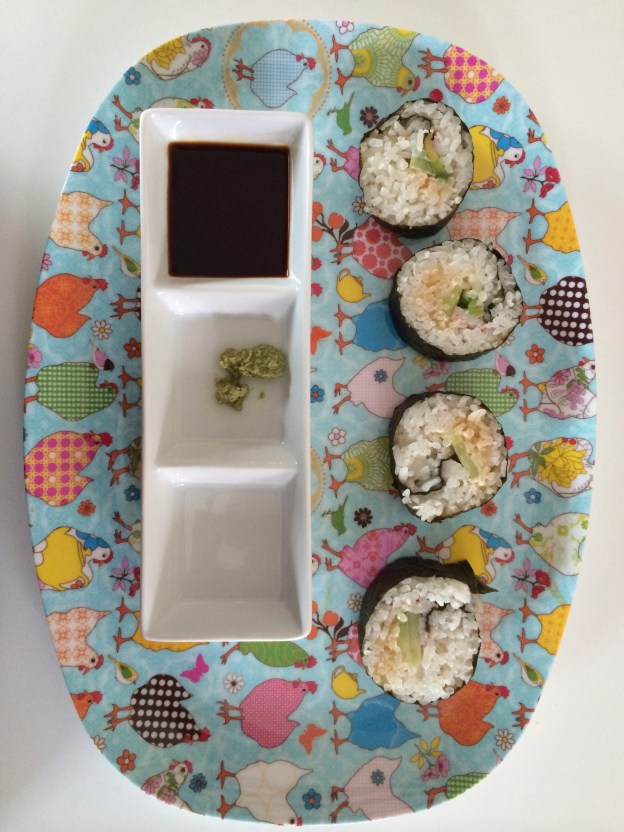
Anyway, nothing here is hard. But it does take a bit of practise and do get all the ingredients because it really makes a difference, and if you like sushi I think this will become a regular thing and the cost of each make will go down… The sushi shown here was made entirely by my ten year old and she took it in her school lunch box. Her father and I had the rest for our lunch, with lots of wasabi (I am slightly addicted to the stuff) and soy sauce.

We don’t have access to sushi grade fish here, and my daughter doesn’t like pressed sushi, so we make only the rolls.

Here is the recipe, although if you can get hold of the January 2014 BBC Good Food magazine, I’d recommend you do as there are pictures which makes this much easier!

Do give this a go. It makes for a terrific packed lunch, we make the rolls the night before and it makes that whole packed lunch thing much easier the next morning. And when you are quaffing eight of these rolls for your own lunch, you can marvel at how much you would pay for them if you bought them out.


How to make your own salted caramel wagon wheels

What I want to know is, when did this blog become almost exclusively about food? I used to write about coffee machines, and fridges ‘n’ stuff. I think it’s partly to do with laziness, greed and also that as I get more serious in my day job, I want to write about things that comfort and soothe.

This is my excuse for writing about Wagon Wheels a week before Christmas when I have at least twenty-three other things to be doing.

I never liked original Wagon Wheels. So this wasn’t about trying to recreate something I loved, but in more, ahem, nutritious format. This is entirely about being seduced by a picture in a Donna Hay magazine in which she makes them. I hesitated before posting the recipe. These are, by no stretch of the imagination, good for you. They use Fluff – jarred, spreadable marshmallow – which contains corn syrup which is really really bad for you. So you must ASSURE me that you will only make these once a year.

These biscuits are, however, really fun. They are not difficult to make, and can be made in stages. The trickiest bit, I found, was the dipping them in chocolate. There is no easy way to do this and you end up making a great big mess. I made the biscuits differently to how Donna recommended – she uses three tiers and smaller biscuits. In an attempt to recreate a more authentic WW look I went for two tiers and larger.

Big mistake. They end up being quite a biscuit. I’d say probably 500 calories a piece. Which isn’t good. I definitely wouldn’t serve these if Gwyneth were coming round to tea. When I first made them I stored them in the fridge which was a mistake as they go kinda crispy and I didn’t like them so much (so perhaps not a mistake after all). After a few hours out of the fridge and stored in a biscuit jar, they were just perfect. Strangely addictive. People I gave them to started making weird, primal noises. They started telling me they loved me.

Be warned.

Don’t go fooling yourself you will only take one bite of these and not eat the whole thing. So make them small. And make them when you have lots of people coming round so you’re not left alone with them. I made a few changes: I substituted salted caramel for jam as I had a jar of caramel that my friend Helen had made for me and everyone preferred them to the jam version (I made a few with jam to try).

And I used about 2/3rds 34% cocoa chocolate and to 1/3rd 70% cocoa chocolate to coat them instead of doing half of them with white chocolate and half with plain as Donna Hay suggested. I actually think I’d slip into a diabetic coma if I made these with white chocolate.

Anyway, enough chat, here is the recipe as I did them, and the low down.

170g unsalted, softened butter

160g icing sugar

1 teaspoon of vanilla extract

2 teaspoons of honey

1 egg

335g plain flour

1 teaspoon of baking powder

half a teaspoon of bicarbonate of soda

A jar of Fluff – marshmallow spread in a jar

Either a jar of blackberry jam/jelly or salted caramel (I say jelly as that’s all I could fine, not because I’ve gone American)

About 200g high cocoa content milk chocolate (I used Green and Blacks, which is 34%)

100g 70% cocoa chocolate (I always use Waitrose Continental)

Put the butter, sugar and vanilla extract in an electric mixer (I used the whisk attachment) and beat for 5-7 minutes. Imagine doing this by hand?! Scrape down the sides and then add the honey and egg and beat again for a bit until combined.

Now add the flour, bicarb and baking powder and beat on a low speed until combined – just a minute or so. Flatten the dough into a disc. It will be very soft. Put in cling film and put it in the fridge for about an hour (longer is fine). It should be firm before you start to roll it out.

Now, preheat the oven to 180C and line a baking tray with baking parchment. Roll the dough out bit by bit between two pieces of baking parchment until about 5mm thick. This is a very soft dough so after a few rollings out it will be hard to handle so put it back in the fridge if need be.

Cut circles of 5cm. I did larger but as I said, I think that was a mistake as I ended up with a really calorific biscuit!

Place on baking trays – they don’t spread out much so you can go quite close together but not too close. About 1cm is fine.

Bake for just a scant 4-5 minutes, until the edges are just tinged with a golden brownness. Take out of the oven and leave to cool completely. You will need to cook these in batches.

When the biscuits are completely cool it’s just a case of assembling them, then dipping. So, spread one biscuit with the salted caramel, one with fluff and sandwich together. Don’t be too mean with the filling but don’t go mad either. When they are all sandwiched together put in the fridge to firm up for a bit whilst you melt the chocolate in a bowl, atop a saucepan of boiling water.

When melted, dip the biscuits in the chocolate. If there’s an easy, non-messy way to do this, I haven’t discovered it yet. I tried painting the biscuits with chocolate and that worked but left brush marks. After several goes I discovered the best thing to do was coat the edges then dip quickly one side then another. If you end up with bald patches where your fingers were then you can remedy by just spreading a bit over with the back of a spoon. Leave to drip for a few seconds over the chocolate bowl, then leave to set on a rack. Be careful though. If you do like I did one time and put it straight in the fridge, the chocolate will set around the bars of the cooling rack and you will end up with half a wagon wheel when you prise it off.

This is no bad thing in a way, as you immediately lower the calorific value, but it makes a mess. So be aware this can happen.

Do leave them to set in the fridge at some point, then you can store them in a biscuit jar in a cool place, preferably at someone else’s house.

IMG_4336

Chocolate sponge and chocolate custard

These have to be five of my favourite words.

And yet, when I was in my first year in primary school, two traumatic things happened to me at lunchtime (we all had to have school dinners). First, having come from a safe and loving home, I was one day confronted by a very troubled boy kicking me in the back and nobody doing anything about it. Second, another troubled boy spat in my chocolate sponge and chocolate custard. I didn’t, of course, finish eating it, but amazingly, it didn’t taint my memory of this pudding which I still see as elementally comforting. Despite history proving otherwise, I think nothing bad can happen when you’re eating a chocolate sponge and chocolate custard pudding.

I have made this several times over the years. And each and every time, I forget to take a photograph of it because everyone is in such a scramble to get it. This has nothing to do with me, other than I make it, but I think, everything to do with people’s associations with it.

This time, I only remembered to take a picture of it at the very last minute, when we were on the last slice; which is why it’s a close up, and not a very good photograph at that (still, better than Martha’s). Just out of shot, is my partner’s spoon, hovering in anticipation and annoyance at my interruption, and half the pudding already gone.

A note about the custard: it doesn’t make enough unless you eat giant portions of this at once. If you eat it like we do, in smallish portions, then you need more custard. Second, Waitrose does a perfectly good chocolate custard which you could easily use instead. It’s not as ‘good’ for you (no eggs) but come on..

A note about the pudding. It travels really well. I have made this in advance and taken it on a holiday rental, warmed it up in the microwave (10-20 seconds per portion) and it is glorious. I’ve easily kept this cake for a week and just zapped it in a microwave to make it soft and springy again.  If you like it cold cold (cold pud cold custard) then this could also travel, separately, to a picnic and be reunited to make a quite decadent pudding on the grass.  My children actually like this pudding cold, with cold custard and you can try it either way: hot hot, cold cold, hot cold, cold, hot. Knock yourself out.

This recipe originally came from Delicious magazine.

250g unsalted butter at room temperature (so soft, because room temperature in my house at the moment results in pretty hard butter still)

200g caster sugar

50g dark brown sugar

4 medium eggs

250g self raising flour

1 teaspoon of baking powder

2 tablespoons of cocoa powder

50g dark chocolate grated or chopped up very, very, very small (grating chocolate is one of my most hated kitchen jobs, I’d prefer to de-giblet a chicken)

1 teaspoon of vanilla extract

125ml warm milk

Oven to 180C. You’ll need a square 20cm cake tin which you have lined with baking parchment. I love this cut into squares but for goodness sake don’t sweat it if you don’t have a square tin and improvise.

Beat the butter and sugars together, whisk in an food mixer if you have one. If not doing it by hand is fine. BUT it does need lots of beating so if you have an electric whisk do use that for five minutes.

Gradually add the eggs and now sift over the flour and cocoa with the baking powder and grated chocolate. * Add the vanilla extract and the warm milk. It should be fairly gloopy. Put in the tin and cook for 45-50 minutes until a skewer comes out growling. I’m joking, a skewer comes out clean-ish. You know the score.

If you want to make the custard you need:

300ml whole milk (although I have used semi-skimmed and the world did not fall in)

300ml double cream

4 egg yolks

3 tablespoons of caster sugar

3 tablespoons of cocoa powder

1 teaspoon of cornflour

Heat the milk and cream together until almost boiling. Whisk the egg yolks with the sugar, cocoa and cornflour. Pour the hot milky cream over the eggy mixture, whisk and return to the pan. Cook gently until it thickens. Serve hot, warm or cool.

2016 note: I now just add chopped up chocolate to the warm milk and melt it that way if I’m in a rush. Nothing awful seems to happen. I’ve also improvised chocolate custard – the recipe above is lovely but it’s a faff and never quite makes enough – and used good quality shop bought custard and added melted chocolate and a tablespoon of cocoa to it.


The art of frothy milk, and how to make the simplest hot chocolate

What is the point of cold weather if you can’t have a reviving hot chocolate when you get in? Your fingers so unfeeling with cold you get a thrill just undoing your coat, as if you were being jollied by an attractive stranger.

When you stand in the hot chocolate aisle at the supermarket, as I never do, you will see that there are dozens of potions and powders with which to make your hot chocolate.

And you don’t need any of them.

Sure, chocolate ganache hot chocolate is the richest, most luxurious hot chocolate you could hope to have (and you MUST try it). But unless you have a stash in the fridge ready made, you’re stuffed.

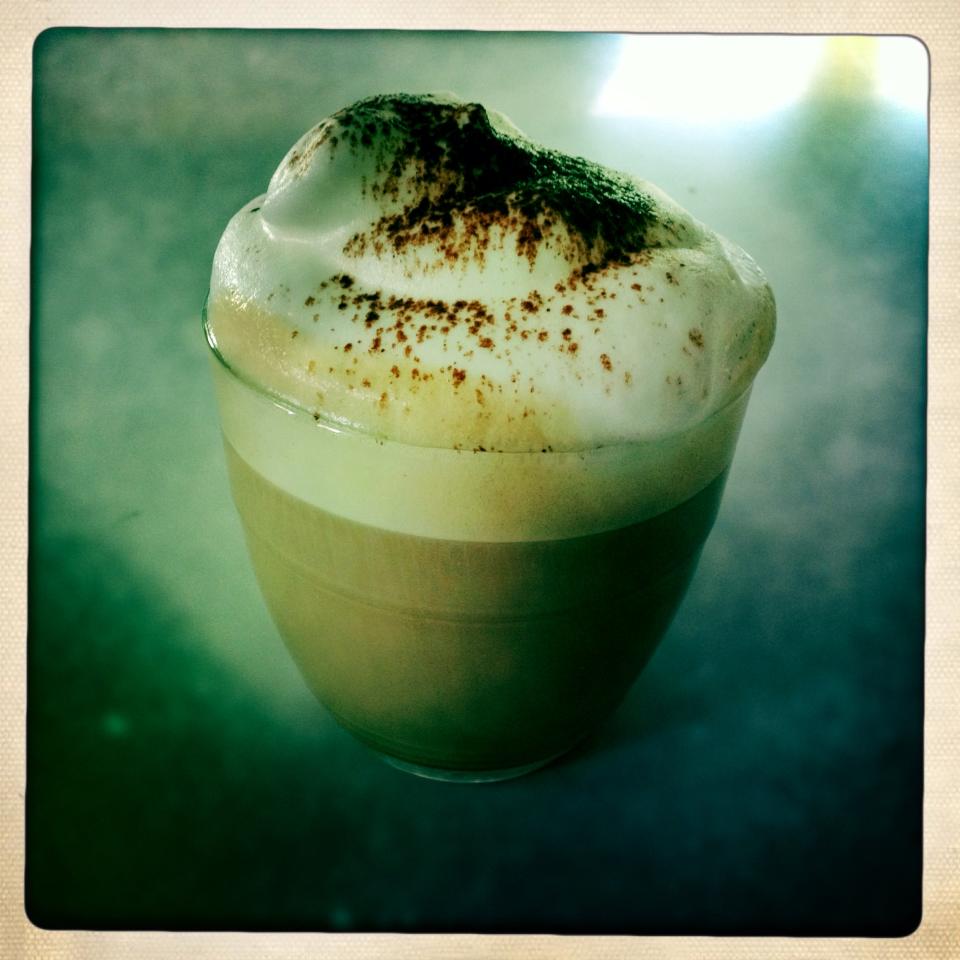
No matter! Cos all you need is a small cup of milk, about 100ml tops, and two squares of chocolate. One 70% cocoa and one milk. If you have cream in the fridge, use this as well as milk (so say, 50ml cream, 50ml of milk). This gives you the perfect mix of chocolate and sugar to dairy. I believe a small, pokey, punchy hot chocolate is better than a large, diluted one that can only render a weak, milky half-slap. Put the squares in the cup, put in microwave on high for 1m 20 seconds. Take out and whisk with an aerolatte if you have one or a fork or a whisk or you know, something suitable. Then drink. I make this every day for my children, in the winter, when they come home from school (aren’t I nice?).  Although, if you’re like me, you will also top it with some milk froth schiuma which I make in my electric Dualit milk frother, which makes the best milk froth this side of a £10K commercial cappuccino machine.

1459210_10151840880983721_402930639_nThis is a cappuccino made using the Dualit electric milk frother.


Lost bunny

IMG_3319

Obviously this isn’t any old bunny. It belongs to my youngest’s best friend, E. And thus, it’s personal.

E lost her bunny two weeks ago in Brighton. So it’s a really long shot. It may have got lost in the hotel (The HIlton) and got wrapped up in the laundry. Do you know someone who works there who you could prompt to have a good look. It may have got lost in the streets. You may think it’s just a bunny, but it ain’t.

E’s had this bunny all her life. She’s five. It’s been in and out of hospital with her. It’s listened to all her dreams, fears, stories, what she’s done. E starts school on Monday and Bunny won’t be there. If you see it, let me know.

Thank you.