Category Archives: Chocolate

How to make your own salted caramel wagon wheels

What I want to know is, when did this blog become almost exclusively about food? I used to write about coffee machines, and fridges ‘n’ stuff. I think it’s partly to do with laziness, greed and also that as I get more serious in my day job, I want to write about things that comfort and soothe.

This is my excuse for writing about Wagon Wheels a week before Christmas when I have at least twenty-three other things to be doing.

I never liked original Wagon Wheels. So this wasn’t about trying to recreate something I loved, but in more, ahem, nutritious format. This is entirely about being seduced by a picture in a Donna Hay magazine in which she makes them. I hesitated before posting the recipe. These are, by no stretch of the imagination, good for you. They use Fluff – jarred, spreadable marshmallow – which contains corn syrup which is really really bad for you. So you must ASSURE me that you will only make these once a year.

These biscuits are, however, really fun. They are not difficult to make, and can be made in stages. The trickiest bit, I found, was the dipping them in chocolate. There is no easy way to do this and you end up making a great big mess. I made the biscuits differently to how Donna recommended – she uses three tiers and smaller biscuits. In an attempt to recreate a more authentic WW look I went for two tiers and larger.

Big mistake. They end up being quite a biscuit. I’d say probably 500 calories a piece. Which isn’t good. I definitely wouldn’t serve these if Gwyneth were coming round to tea. When I first made them I stored them in the fridge which was a mistake as they go kinda crispy and I didn’t like them so much (so perhaps not a mistake after all). After a few hours out of the fridge and stored in a biscuit jar, they were just perfect. Strangely addictive. People I gave them to started making weird, primal noises. They started telling me they loved me.

Be warned.

Don’t go fooling yourself you will only take one bite of these and not eat the whole thing. So make them small. And make them when you have lots of people coming round so you’re not left alone with them. I made a few changes: I substituted salted caramel for jam as I had a jar of caramel that my friend Helen had made for me and everyone preferred them to the jam version (I made a few with jam to try).

And I used about 2/3rds 34% cocoa chocolate and to 1/3rd 70% cocoa chocolate to coat them instead of doing half of them with white chocolate and half with plain as Donna Hay suggested. I actually think I’d slip into a diabetic coma if I made these with white chocolate.

Anyway, enough chat, here is the recipe as I did them, and the low down.

170g unsalted, softened butter

160g icing sugar

1 teaspoon of vanilla extract

2 teaspoons of honey

1 egg

335g plain flour

1 teaspoon of baking powder

half a teaspoon of bicarbonate of soda

A jar of Fluff – marshmallow spread in a jar

Either a jar of blackberry jam/jelly or salted caramel (I say jelly as that’s all I could fine, not because I’ve gone American)

About 200g high cocoa content milk chocolate (I used Green and Blacks, which is 34%)

100g 70% cocoa chocolate (I always use Waitrose Continental)

Put the butter, sugar and vanilla extract in an electric mixer (I used the whisk attachment) and beat for 5-7 minutes. Imagine doing this by hand?! Scrape down the sides and then add the honey and egg and beat again for a bit until combined.

Now add the flour, bicarb and baking powder and beat on a low speed until combined – just a minute or so. Flatten the dough into a disc. It will be very soft. Put in cling film and put it in the fridge for about an hour (longer is fine). It should be firm before you start to roll it out.

Now, preheat the oven to 180C and line a baking tray with baking parchment. Roll the dough out bit by bit between two pieces of baking parchment until about 5mm thick. This is a very soft dough so after a few rollings out it will be hard to handle so put it back in the fridge if need be.

Cut circles of 5cm. I did larger but as I said, I think that was a mistake as I ended up with a really calorific biscuit!

Place on baking trays – they don’t spread out much so you can go quite close together but not too close. About 1cm is fine.

Bake for just a scant 4-5 minutes, until the edges are just tinged with a golden brownness. Take out of the oven and leave to cool completely. You will need to cook these in batches.

When the biscuits are completely cool it’s just a case of assembling them, then dipping. So, spread one biscuit with the salted caramel, one with fluff and sandwich together. Don’t be too mean with the filling but don’t go mad either. When they are all sandwiched together put in the fridge to firm up for a bit whilst you melt the chocolate in a bowl, atop a saucepan of boiling water.

When melted, dip the biscuits in the chocolate. If there’s an easy, non-messy way to do this, I haven’t discovered it yet. I tried painting the biscuits with chocolate and that worked but left brush marks. After several goes I discovered the best thing to do was coat the edges then dip quickly one side then another. If you end up with bald patches where your fingers were then you can remedy by just spreading a bit over with the back of a spoon. Leave to drip for a few seconds over the chocolate bowl, then leave to set on a rack. Be careful though. If you do like I did one time and put it straight in the fridge, the chocolate will set around the bars of the cooling rack and you will end up with half a wagon wheel when you prise it off.

This is no bad thing in a way, as you immediately lower the calorific value, but it makes a mess. So be aware this can happen.

Do leave them to set in the fridge at some point, then you can store them in a biscuit jar in a cool place, preferably at someone else’s house.

IMG_4336

Chocolate sponge and chocolate custard

These have to be five of my favourite words.

And yet, when I was in my first year in primary school, two traumatic things happened to me at lunchtime (we all had to have school dinners). First, having come from a safe and loving home, I was one day confronted by a very troubled boy kicking me in the back and nobody doing anything about it. Second, another troubled boy spat in my chocolate sponge and chocolate custard. I didn’t, of course, finish eating it, but amazingly, it didn’t taint my memory of this pudding which I still see as elementally comforting. Despite history proving otherwise, I think nothing bad can happen when you’re eating a chocolate sponge and chocolate custard pudding.

I have made this several times over the years. And each and every time, I forget to take a photograph of it because everyone is in such a scramble to get it. This has nothing to do with me, other than I make it, but I think, everything to do with people’s associations with it.

This time, I only remembered to take a picture of it at the very last minute, when we were on the last slice; which is why it’s a close up, and not a very good photograph at that (still, better than Martha’s). Just out of shot, is my partner’s spoon, hovering in anticipation and annoyance at my interruption, and half the pudding already gone.

A note about the custard: it doesn’t make enough unless you eat giant portions of this at once. If you eat it like we do, in smallish portions, then you need more custard. Second, Waitrose does a perfectly good chocolate custard which you could easily use instead. It’s not as ‘good’ for you (no eggs) but come on..

A note about the pudding. It travels really well. I have made this in advance and taken it on a holiday rental, warmed it up in the microwave (10-20 seconds per portion) and it is glorious. I’ve easily kept this cake for a week and just zapped it in a microwave to make it soft and springy again.  If you like it cold cold (cold pud cold custard) then this could also travel, separately, to a picnic and be reunited to make a quite decadent pudding on the grass.  My children actually like this pudding cold, with cold custard and you can try it either way: hot hot, cold cold, hot cold, cold, hot. Knock yourself out.

This recipe originally came from Delicious magazine.

250g unsalted butter at room temperature (so soft, because room temperature in my house at the moment results in pretty hard butter still)

200g caster sugar

50g dark brown sugar

4 medium eggs

250g self raising flour

1 teaspoon of baking powder

2 tablespoons of cocoa powder

50g dark chocolate grated or chopped up very, very, very small (grating chocolate is one of my most hated kitchen jobs, I’d prefer to de-giblet a chicken)

1 teaspoon of vanilla extract

125ml warm milk

Oven to 180C. You’ll need a square 20cm cake tin which you have lined with baking parchment. I love this cut into squares but for goodness sake don’t sweat it if you don’t have a square tin and improvise.

Beat the butter and sugars together, whisk in an food mixer if you have one. If not doing it by hand is fine. BUT it does need lots of beating so if you have an electric whisk do use that for five minutes.

Gradually add the eggs and now sift over the flour and cocoa with the baking powder and grated chocolate. * Add the vanilla extract and the warm milk. It should be fairly gloopy. Put in the tin and cook for 45-50 minutes until a skewer comes out growling. I’m joking, a skewer comes out clean-ish. You know the score.

If you want to make the custard you need:

300ml whole milk (although I have used semi-skimmed and the world did not fall in)

300ml double cream

4 egg yolks

3 tablespoons of caster sugar

3 tablespoons of cocoa powder

1 teaspoon of cornflour

Heat the milk and cream together until almost boiling. Whisk the egg yolks with the sugar, cocoa and cornflour. Pour the hot milky cream over the eggy mixture, whisk and return to the pan. Cook gently until it thickens. Serve hot, warm or cool.

2016 note: I now just add chopped up chocolate to the warm milk and melt it that way if I’m in a rush. Nothing awful seems to happen. I’ve also improvised chocolate custard – the recipe above is lovely but it’s a faff and never quite makes enough – and used good quality shop bought custard and added melted chocolate and a tablespoon of cocoa to it.


The art of frothy milk, and how to make the simplest hot chocolate

What is the point of cold weather if you can’t have a reviving hot chocolate when you get in? Your fingers so unfeeling with cold you get a thrill just undoing your coat, as if you were being jollied by an attractive stranger.

When you stand in the hot chocolate aisle at the supermarket, as I never do, you will see that there are dozens of potions and powders with which to make your hot chocolate.

And you don’t need any of them.

Sure, chocolate ganache hot chocolate is the richest, most luxurious hot chocolate you could hope to have (and you MUST try it). But unless you have a stash in the fridge ready made, you’re stuffed.

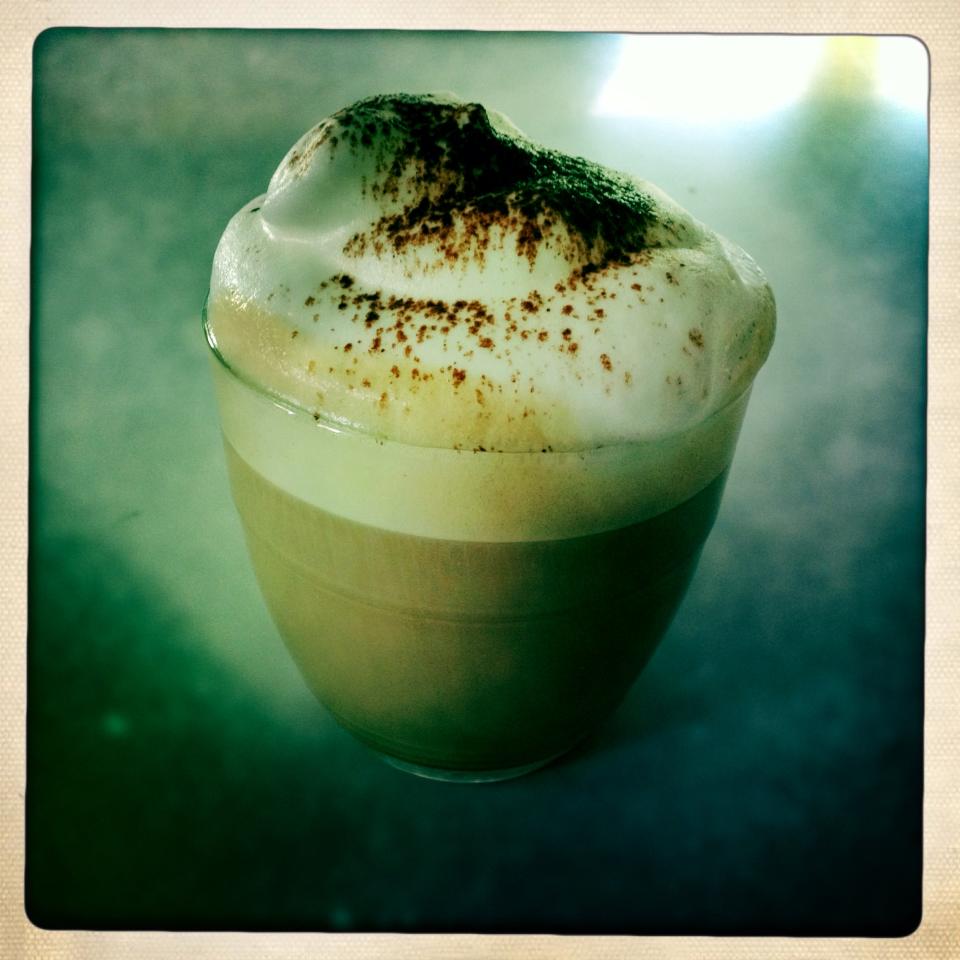
No matter! Cos all you need is a small cup of milk, about 100ml tops, and two squares of chocolate. One 70% cocoa and one milk. If you have cream in the fridge, use this as well as milk (so say, 50ml cream, 50ml of milk). This gives you the perfect mix of chocolate and sugar to dairy. I believe a small, pokey, punchy hot chocolate is better than a large, diluted one that can only render a weak, milky half-slap. Put the squares in the cup, put in microwave on high for 1m 20 seconds. Take out and whisk with an aerolatte if you have one or a fork or a whisk or you know, something suitable. Then drink. I make this every day for my children, in the winter, when they come home from school (aren’t I nice?).  Although, if you’re like me, you will also top it with some milk froth schiuma which I make in my electric Dualit milk frother, which makes the best milk froth this side of a £10K commercial cappuccino machine.

1459210_10151840880983721_402930639_nThis is a cappuccino made using the Dualit electric milk frother.


Best panettone and chocolate mulled wine

I wasn’t much of a fan of panettone, growing up, despite my father coming from a region where the panettone is famous. All those raisins and candied fruit. I much preferred pandoro (‘bread of gold’) which was, to me, like panettone but without any of the bits in and you’d dust it with glorious vanilla sugar as soon as it was out of the box.

It didn’t help that the panettone you can usually buy in this country – at least until it seemed fairly recently – was pretty grim. Heavy and dry. Mine used to stay on the top of the fridge, in their cardboard box, going stale until such time as I had an idea to resuscitate them in a panettone bread and butter pudding.

This seems sacrilegious now. A few years ago, my parents got given a proper panettone. They gave it to me and I almost put it on the top of the fridge, in time honoured fashion. But something made me open it. I’m going to use words like ‘billowy’ now, so prepare yourselves because this panettone was indeed billowy. Soft, fresh….billowy. It tasted delicious and, as I remember, we ate it in one sitting. I subsequently discovered it was a very expensive panettone and it showed.

At Christmas, I usually make my Colomba in the shape of panettone. It’s not the same thing (proper panettone needs to be hung up side down when made and takes three days from start to finish) but it’s good enough. Last Christmas however, I heard, through one of my editors, Kate, at the Guardian about a panettone taste test she was doing. On her recommendation I bought the Nudo one. It was superb. Not cheap though at £15 a kilo (I’ve realised you need to spend about that much for a panettone to be any good). This year, in a fit of organisation, I went to order one on 1st November. Sold out. This annoyed me beyond explanation.

So I went to the number two one last year, Valentina and bought two. I decided to open it last weekend. Partly because I didn’t want to be disappointed if it wasn’t very good, partly because I am greedy and partly because I have decided to spread out the joys of Christmas fayre this year starting in, cough cough, late November. Anyway. It’s fantastic: everything you want a panettone to be. Really fresh, really light, tasty, glorious. You could easily eat one in a single sitting. The service was amazing and I thoroughly recommend you buy one. My children loved it too, and the sell by date is April 2014. Not that it will get that far.

It’s £12.95 for 750g and you can buy it mail order (the p&p is a bit steep at £5.95 so double up with some friends if you can) or if you can, visit one of the stores, there are five, but not sure all sell the panettone so check before going.

[Just to avoid any doubt, I paid full price for the panettone, no freebies.]

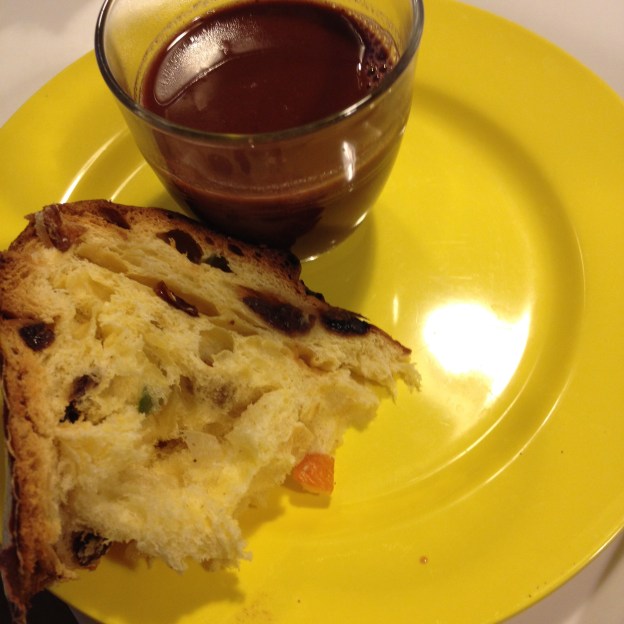
The pic above is my first slice, served with a glass of my chocolate mulled wine. Which, if you haven’t tried yet, I thoroughly recommend you, also, do.

Chocolate ganache – a great filling for doughnuts or eclairs

Continuing with my slight eclair obsession…I’ve been wanting to try a darker chocolate cream, as opposed to my white chocolate cream, for some time now in an eclair. Except I trialled it in a doughnut, first. But you could use this in anything that needs a gooey chocolate filling. It tastes like chocolate ice cream. Except not cold..

The recipe for the doughnuts is here, and of course you’ll notice immediately that these are not deep fried doughnuts. This honestly doesn’t matter. The doughnut here is simply a receptacle for the chocolate. Just like it really doesn’t matter what a drug mule looks like, they’re there to just, you know..

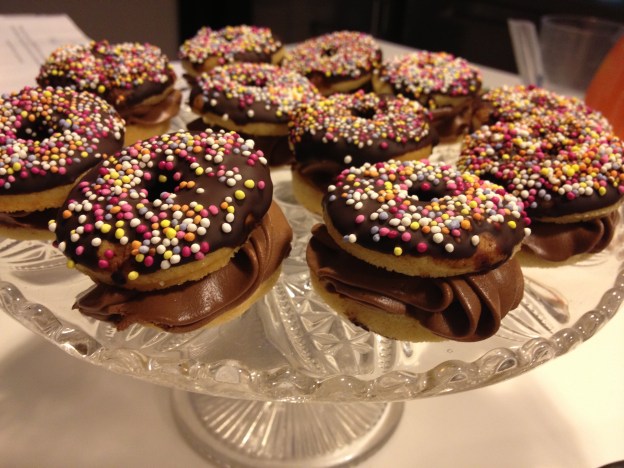
The topping you see above is just melted dark (70%) chocolate – about 50g – with a teaspoon of vegetable oil.  And sugar sprinkles of course. I’m not a man fan of them to eat. The conflicting textures confuse me: soft doughnut, soft cream, crunchy, sugary, balls. But the children love them.

For the chocolate ganache filling, all you do is (for 12 small doughnuts) put about 100ml of double cream and 50g of dark, 70% cocoa chocolate, in a bowl over some boiling water. Stir until the chocolate is melted. It should be thick. Chill. Then add about another 100ml of double cream and whisk until really thick. I then added two teaspoons of icing sugar, because I was after a very particular taste – just sweet but not sickly and without the sugar it was simple too ‘dark’. But do taste as you go. Put in an icing bag with an appropriate nozzle – depending on what you’re doing, eclairs, doughnuts etc. Chill the icing bag and the cream for half an hour. Then use.

White chocolate cream

A mini doughnut, with all sorts of gloriousness, on it and in it

A couple of weeks ago I wrote about eclairs. Which I am, now, well into. Not so much eating them (although I’m getting there…) but making them. I have just gone mental for piping stuff. I think eclairs are going to be the new macaroons which were the new cupcakes which were the new doughnuts which were probably the new eclairs.

I am slightly obsessed with thinking of new fillings and toppings. Not that I’ve got that experimental yet. But give me time.

It was my youngest child’s birthday last week, and I made her these small celebration cakes (okay, okay, they’re cupcakes, but cupcakes are so over aren’t they? I daren’t mention them…). And some bourbon biscuits with her name stamped on them. And some mini chocolate eclairs with white chocolate cream in them.

Mini eclairs with white chocolate cream.

They were delicious. But they still looked like ‘normal’ eclairs, so with a dark chocolate topping and a white cream filling. Not that eclairs have to look like this, but I wanted them to.

The white chocolate cream was amazingly good and people couldn’t quite work out what was in it but it just tasted so good.

Have I mentioned how good it tasted? So good that today, whilst making the mini doughnuts you see above, glazed with chocolate and dipped in sprinkles, sliced and with white chocolate cream PIPED inside (for I wanted to use up this wonderful stuff), I almost, almost, just stuck the icing bag straight in my mag and squeezed in the style of, probably, Homer Simpson.

But I didn’t. Time, still, for that.

So here’s how you make white chocolate cream. An idea I got from here.

For the eclair recipe here, I’d recommend 300ml of double cream (or whipping, which I will try next time, but I used double) and 100-125g of white chocolate. I only ever use Green and Black’s white chocolate as it’s fantastic.

Break up the chocolate into individual pieces and put in a heat proof bowl.

Heat half the cream in a pan, until boiling. If you use another sort of white chocolate, you may want to add a teaspoon of vanilla extract into the cream. But the Green and Black’s already has vanilla in it, so I don’t. When it’s reached boiling point stir it around for a few seconds, then take off the heat. Pour it onto the chocolate. Give it a count of 15/20 seconds then whisk together.

Chill for an hour or until needed.

When you are ready to make the eclairs, add the other cream (the one without the chocolate in it) and add to the cream with the chocolate in it. Or vice versa, just introduce them! Now whisk until firm, you know, so it’s pipe-able.

Put in a piping bag with a nozzle and pipe into your eclairs. If the piping bag happens to get stuck in your mouth, squeeze, swallow and then hide the evidence.

How to make your own jaffa cakes

Inside. Luscious. The perspective makes these look giant, they are in fact the same size as regular jaffa cakes. And that’s a three year old holding one.

I bake, not only because I love cakes ‘n’ stuff and I prefer home made, but I bake when I need to feel safe. I find baking immensely therapeutic. The fact that I’m quite skilled at it is helpful because when I’m, say, grappling with a difficult deadline, as if it were a salt water crocodile (and we know how slippy they can be)  I have a need to achieve.  I have an almost pathological need to achieve. Something. Anything.

And when that something happens to result in baking a good biscuit, just baked into a chewy crispness, with hidden little bullets of chocolate. Or a fluffy, jolly cake, heavy with a mascarpone frosting stained red with raspberries, so large that you have to dislocate your jaw to get a slice in…well where’s the fucking harm in that.

When the news makes me feel like the world is too big, baking reminds me that the gentle stirring (or sometimes, vigorous whisking) of a few fine ingredients, can come together to make something good.

This is how I found myself making jaffa cakes.

Jaffa cakes. I don’t even really like jaffa cakes. But they seemed tricky enough to take my mind off all the bad news.

This recipe is from Jamie magazine. They weren’t tricky at all, but they did result in something so excellent and delicious and authentic (similar enough to shop bought ones to not alienate fans, different enough from to entice the not so keen) I had to keep eating them to make sure.

You need:

1 egg
50g caster sugar
65g self raising (I never sift flour but I guess you should)
butter for greasing
250g marmalade
100g 70% cocoa chocolate, chopped
Finely grated zest of half an orange
2 teaspoons of vegetable oil
 (the original recipe also asks for a tablespoon of water to use when melting the chocolate) but I didn’t use it and never use water in when melting chocolate).

You need a jam tart tin or shallow ‘bun’ tin with 12 holes. Grease this well, I also dusted it with flour (not from the 65g!)

Oven to 200C.

You do:

Okay so whisk the egg and sugar together, using an electric mixer if you have one (don’t sweat if you haven’t, you think sponge cakes were never made before the advent of the electric mixer?) if not by hand. Get those biceps and triceps working. Beat until the colour has lightened and the mixture has thickened. I’ll admit this is a a hell of a lot easier with an electric mixer.

Now stir in the flour by hand.

This is so easy isn’t it?

Now dollop about a tablespoon of the mixture into each hole, evenly. So if you get it wrong you’ll need to go round and nick a bit from the moulds that have too much.

Bake in the oven for 8-10 mins. Be careful: you want them lightly golden.

When done turn out and let cool. When cool slice in half horizontally. Are you seeing these jaffas taking shape?

Hopefully you’re the sort of person who reads recipes through before embarking on making something. And therefore you’ll know that whilst the cakes are cooling, put the marmalade in a pan, on the stove. I didn’t use the whole 250g but if you have any left over, once cool, you can put it back in the jar.

The sponge cakes fresh out of the oven.

So, heat the marmalade until it’s melted and stirrable and all one big thing and not little clumps of marmalade skulking round the pan, like nervous teenagers circling each other at a party, and then take off the heat and leave to cool. You can leave it for a good 20-30 mins, perhaps more and in fact it’s easier to use when it’s cooler. You could sieve out the peel in the marmalade but come on! Butch up and leave it in. I did and it was delicious.

Note the bit with a slice off? I ate it. Couldn’t wait.

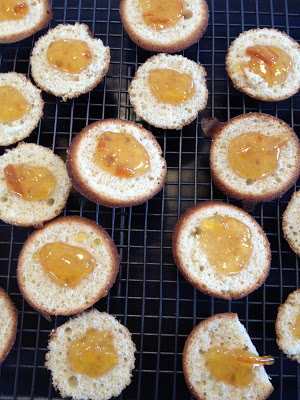
Now. Take a teaspoon of the marmalade and dollop it in the centre of each sponge.

Melt the chocolate, with the orange zest and oil (oil not essential but gives a nice gloss), in a bowl over a pan of water. When melted, spoon over each marmalade covered sponge. What I did was put the cooling rack over a baking tray to catch any drips (ahem, I took it away for the photo below for better contrast), and then pick up each sponge and spoon the chocolate over, spreading it delicatedly with the back of the spoon – you don’t want to compromise the blobs of marmalade – then putting each back on the rack over the tray to catch any drips. And there were hardly any drips. I guess you could be more slap happy and just spoon the chocolate over each sponge whilst they’re sat on the rack and let the chocolate drip gaily.

Just one left to do.

But I think that’s more wasteful.

I ate at least six of these waiting for the chocolate to set. My youngest went potty for them. My eldest doesn’t like jaffa cakes and wasn’t convinced by these.

Make them and tell me what you think.

Eclairs

The best compliment I got was from a nine year old girl (not mine) who said “these are like real eclairs”

Here is a confession. I really am not that into eclairs. I know people who go cuckoo for them. Not me. I’m not overly a fan of choux (unless in a Paris Brest), nor whipped cream. Basically, eclairs aren’t piggy enough for me.

The first time I made choux pastry I was very young, about eleven and it was in HE. No-one told me it was difficult so I didn’t sweat over the choux pastry and I made the most amazing profiteroles. (Equally, no-one told me puff pastry was difficult and I used to make a great puff pastry.)

As I got older, and everyone went on about how hard choux pastry is, well that, coupled with my slight meh-ness towards them…meant I didn’t really try.

My children love eclairs so I decided to give them a go. They were easy. So easy I was expecting the sky to fall in.

I’d love to hear how you customise them.

The recipe for choux is pretty standard:

125ml water
50g butter
75g plain flour
3 medium eggs (at room temperature, this is important)
pinch of salt (I think this is key, choux is pretty tasteless, but the salt adds something).

The filling

I just used double cream, about 300ml, whipped up with a spoon of vanilla essence and a tablespoon of icing sugar. Or try delicious white chocolate cream, which is what I use as a default filling these days.

The topping

I used 150g 70% cocoa chocolate and a teaspoon of vegetable oil, melted in a bowl, over a pan of boiling water. Then manually just dipped the eclair tops in and set them down on a cooling rack. Hardly any drips..

Obviously with both filling and topping you can change it. Next time I’m going to try something a bit more adventurous.

You also need a piping bag and plain nozzle of about 1cm diameter. A baking tray and some baking parchment.

Oven to 180C.

Put the water and butter in a sauce pan and cook over a high heat. Stir until butter is melted and bring to the boil. When this happens, lower the heat and add in the flour. Beat with a wooden spoon until smooth and the mixture leaves the sides of the pan. For me this happened almost immediately.

Remove from the heat. Now. Some recipes say to let the mixture cool and then add the eggs. I can only tell you how I did it which was to add the eggs straight away to the mixture, once in the electric mixer bowl.

So. Put the butter/water dough in an electric mixer with the whisk attachment and add the eggs one at a time.

This is the important bit. After you’ve added the first egg, the mixture must be absolutely smooth before you add the next egg. At first the mixture seems to curdle, more so if your butter/water dough is hot and the eggs are very cold. It will look like scrambled eggs. You will want to cry.

Don’t. And don’t panic. Keep mixing. It will eventually blend together and go smooth. Honestly mine took a good five-ten minutes during which I started to panic and think “why the hell did I not LISTEN to everyone who told me choux pastry was so hard.” Keep the faith. Keep mixing. It will smooth out. Then, add the next egg and mix until smooth and then the next one. I added the salt with the third egg. No idea why just did.

The mixture is ready when you lift the whisk and it leaves ribbon marks – indentations in other words.

Put into the piping bag. I find it useful to a) use a clip to secure the top of the icing bag – just above the nozzle – so that the mixture can’t ooze out. By clip I mean like those Klip-it things you use to keep food in a plastic bag fresh. b) put the bag in a tall glass and fold the top of the bag over so you can spoon the mixture in. Obviously when you are ready to pipe, you take the Klip-it off.

This mixture pipes really beautifully, so pipe eclair shapes (or profiterole shapes) onto the tray, leave a good gap as they do grow.

Put in the oven. I cooked mine for 30 mins and they were perfect, dry and crispy. My patisserie expert said that’s how high quality eclairs should be – kinda dry and not soggy like shop bought ones. You can’t really overcook eclairs (well, actually you can but you know…). I cooked some profiteroles another time and gave them 35 minutes and they were fine.

Don’t be tempted to open the oven at all if possible and certainly not before about 25 minutes.

They should be puffed and golden. Mine were almost empty inside. There was no need to dry them out inside as some recipes suggest, by placing them back in an oven.

I just cut them lengthways when they were completely cool and did the topping first (put the topped eclairs in the fridge for five mins to make the topping set if you’re in a hurry), then I added the cream with another piping bag (I was piping bag mad by this stage).

They all got eaten that day. And when I served them the second time round, because I had some salted caramel left, I added a dollop of that in too. I am salted caramel crazy though.

The reason I’m writing about these is that they were so easy and the return to effort ratio so madly unbalanced in favour of the return part, that I did wonder why I had left it so long.

Update on 6th March 2013. I thought it might be useful to have some troubleshooting here.

There are a couple of key important bits in making eclairs. The bit in the saucepan, with the flour and the butter/water…make sure you really dry this mixture out. By that I mean, even when it starts to come off the sides, keep going for a minute longer. The more you dry it out now, the more eggs you will be able to add (more on this later). The more eggs you can add, the more the eclairs will rise.

What do you mean, the more eggs I can add? Don’t you say three eggs?

Yes, yes I do. But here’s the other thing. I make this all the time with three eggs but mine are medium (in fact I’ve altered the recipe above to say this). Eggs differ in size, although it’s usually the amount of white in an egg that differs between the different sizes. So if you were to crack open a medium and extra large egg, the real difference is in the white, not the yoke.

Anyway, when you’re at the adding the eggs stage, if you’re new to this, I’d whisk up the third egg before adding it and then add it a bit at a time. What you want is a mixture that’s thick. Don’t be afraid to give it a really good whisking, don’t stop just the moment you think it’s done. You want the mixture to be able to stand in stiff peaks. If it’s not thick enough at this stage, it won’t get any thicker at the piping them out stage. So when you stop whisking you need to be absolutely sure it’s thick enough, otherwise,  you pipe it the eclairs will spread.

If you add too much egg, then the mixture might get too sloppy which is why I recommend adding it in stages if you’re new to this.

Should I cool down the butter/water/flour mixture before putting it in the mixer?

Almost every recipe tells you to do this, to cool it down otherwise it will cook the eggs.

I don’t. I know, madness, but I’ve tried it both ways and for whatever reason I’ve found that if I add this to the mixer and add the eggs straight after the sauce pan stage, my eclairs rise more. Yes you do need to beat the first egg in for much longer and it will go through a scrambled egg phase. Try it whichever way you want and see how you go. I’m fairly brave with patisserie making so I like to fly by the seat of my pants. You may want to go more slowly. Both are fine approaches.

If you’d like more ideas about what to fill them with, other than cream: chocolate ganache filling recipe here; white chocolate cream filling here (this is YUM). And not long after I originally wrote this I stopped cutting the eclairs in half and instead using a piping nozzle to fill them.

Alternative Christmas ‘pudding’ ideas

Jamie’s Winter Pudding Bombe
My actual bombe

I don’t mean as a direct alternative to that dried fruit pudding English people have after Christmas dinner (which I now love, I actually made my own two years ago for the first time and make them a year in advance now). But I mean, something to eat for pudding on or around Christmas Day.

Chocolate Chestnut Rum Roulade

Every Christmas I make this amazing Chocolate Chestnut Rum Roulade. It’s an Icelandic recipe that I got from the Waitrose magazine twelve years ago. It is so good. I make it every Christmas and my eldest asked for it for her birthday this year. It’s really not that difficult, can be made ahead and put in the fridge.

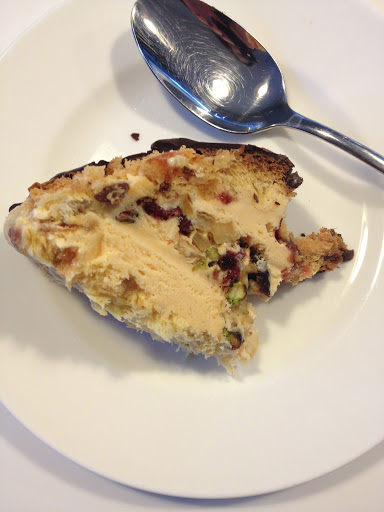
Another thing I make is Jamie’s Winter Pudding Bombe. This is superb made in advance and stuck in the freezer. I do make some changes to this as the clementine he asks for just freezes solid (obviously) and I don’t find it very nice to eat. So I do his recipe but instead of the bits he asks for  I add some dark glace cherries, some candied fruits, some sour cherries soaked in marsala (I use marsala instead of vin santo throughout) and then some toasted pistachios and hazelnuts. I think you could easily customize this bit.

I also use home made vanilla ice cream because it’s tastier and cheaper.  The quantity in that recipe I’ve linked to make the perfect, perfect amount for this recipe.

Need I point out that you don’t use expensive panettone for this.

You can make it in advance, as I said, and then just turn it out when you want to serve it, and pour the chocolate over the top.

Annie Bell’s Blackout cake, as near to chocolate cake perfection as possible.

Lastly, for something that doesn’t look as festive but is really, really delicious. Annie Bell’s Brooklyn Blackout cake which is as close to chocolate cake perfection as I can take you. I guess you could make it more festive with gold leaf or something. I don’t know, up to you. It’s sensational however and once people start eating it they won’t care if it looks festive or not.

Do feel free to share your Christmas pudding alternatives.

update: mid January 2013. We just at the last of the bombe, which had been nestling in the freezer since I made it on 21st December. I thought you might like to see inside. It was still really really good.

Hot chocolate pops

A hot chocolate pop

I cannot lay claim to this. Hot chocolate pops are all over the place. But I’d never tried them before and I gave them a go.

Here’s what you need:

Some milk or plain chocolate. I used plain, 70% cocoa
Some white chocolate, I always use Green and Black’s
Some marshmallows
Something to make them in, either cake pop moulds or something similar. I do, of course, have a special mould just for these which is just a round chocolate mould but bigger than what you’d use for chocolates.

Put the marshmallows at the bottom. Small ones work best so you can pour the chocolate around them.
Melt the dark chocolate (either milk or plain) and pour on, half way up the mould.  Put sticks in, I put mine so they stick out at the side (as seen) not so they come out perfectly at the  centre as I have no way of keeping them upright and I like the off-centeredness. Set in the fridge.
Melt the white chocolate, pour on til it comes to the top. Fridge until set.

When ready to eat, heat some milk and dip in. I can’t pretend it’s the best hot choccie you’ll ever have as the chocolate melts in bits and it’s not all homogenised. You could, I guess, whizz it up. But really the fun here is in half licking, half stirring the melting pop.