Category Archives: vegetarian

Sourdough bagels

I’ve long made bagels and they are a thing of beauty and deliciousness. I have made sourdough ones but not with any regularity. But recently I started making them again. They take a bit more time, in that they need to be left to rise in their own sweet time, far more than yeasted bagels. I rushed them last week and they were dense – still delicious but not so airy and light.

I tend to shape these into little round rolls first and then puncture a hole with a wood spoon handle. I tend to make these with a smaller hole than my yeasted bagels. Who knows why.

Unlike yeasted bagels these can also be left to prove for 48 hours in the fridge (maybe even longer but I’ve never left them that long), so if there aren’t that many of us, I tend to cook a batch up in two lots so we have fresh bagels for two days running. I can’t do that with yeasted bagels as they really have to be cooked the day after making (after an overnight prove in the fridge, ie they don’t ‘last’ that long in the proving stage).

If you want to make them totally vegan then don’t egg wash them.

You can of course use 500g of just white flour, or mix in a bit of wholemeal. I’m always looking for a more gut-friendly diversity so I add Vanessa Kimbell’s Diversity XXX flour. TBH these days I add 10-15% of it into almost all my bakes but here I use 20% (100g of 500g is 20% isn’t it? I failed maths..)

I think this recipe is, at least in part, from Edd Kimber but I adapted it a while ago. (I love Edd.)

What you need:

185g active sourdough starter
250g warm water
1 tbsp of sugar or barley malt syrup
1 tsp of fine sea salt
400g strong white bread flour
100g Diversity XXX flour

I mix everything together in my Kenwood Chef food mixer with the dough hook. I leave it on low for ten minutes. Then I turn the dough out onto an oiled surface, cover it with a bowl and leave it for an hour. After an hour I give it a gentle knead for ten seconds, leave it for an hour and then knead it again for ten seconds. If your house is very cold you might want to do this one more time. I kinda go on dough-feel (and no I’m not very good at it either).

When you’re ready to shape the bagels, when the dough feels lighter and a little more yielding, then cut it into 6/8/10 depending on how many you want to make (this makes eight regular sized bagels for me). I roll into little balls using my hands, then make a hole with the handle of a wooden spoon, stretching the hole out a little.

Place on a parchment lined tray.

I now leave this out, covered with a tea towel, for about another hour before putting them in the fridge overnight. I also think they benefit from coming up to room temperature after taking them out of the fridge but I never have time to do this so I put them straight away into the boil process.

Boiling and baking

Bring a pan of water to the boil. Some people put things in the water to make them more of a bagel (I don’t know what but stuff that makes it apparently taste more bagel-y) I can never be bothered. When the water is boiling I plop two in there – if you can get more in without them hurtling into each other than do. I give them a minute or two until they float and puff up a little, and turn them with a slotted spoon, another minute or two, then take them out and rest them on a tea towel. When all are done put them back on the parchment lined tray, brush with beaten egg if you want and scatter with seeds if you want and cook at 220C for 14/15 minutes. Check after 12.

These are really very good.
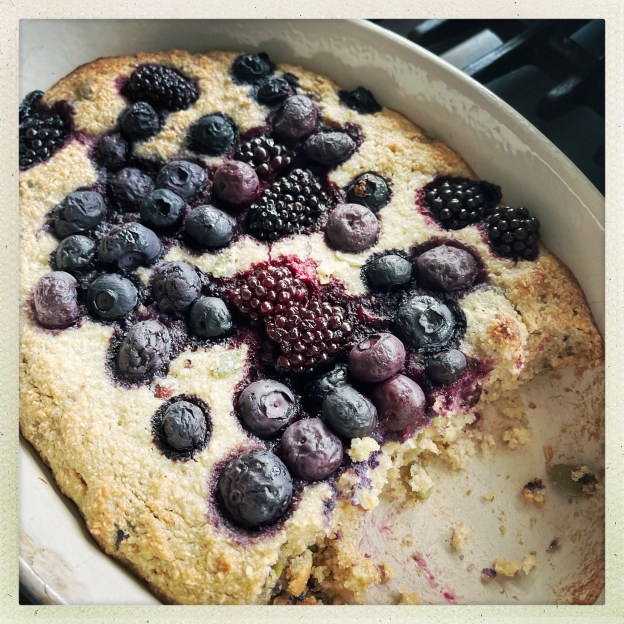
A super healthy clafoutis

So, first up this is from Tim Spector’s excellent The Food for Life Cookbook which you should buy.

I have a very restrictive and healthy diet (no dairy or soya, minimal animal products, nightshades and sugar). Regular cakes, biscuits n ting are a thing of the past. I do taste chocolate as that’s my job, but in tiny amounts. So Tim’s book (as well as some of the Deliciously Ella books: the first one was awful but they’ve got really good since) is a Godsend for me. I still make yummy things for my family and friends but I rarely have anything for me to eat that’s desserty. Don’t feel sorry for me! I look great, have lost a ton of weight, feel pretty good most of the time and can, and still do, eat pasta and bread because my nutritionist – Pr Valter Longo – is Italian!

I didn’t have much hope for this but I made it for some girlfriends and I really loved it and my friend Katie went mad for it, but I thought I could improve it (sorry Tim) and so this is my adapted version.

55g light brown sugar
3 tablespoons of extra virgin olive oil
1 egg
200g kefir (I use coconut kefir)
100g oat bran
100g ground almonds
35g toasted hazelnuts (or nuts of your choice, or more seeds), chopped
35g pumpkin seeds
half a teaspoon of baking powder
Pinch of salt
160g frozen berries or fresh ones (I particularly like cherries when they are in season)
Zest of one lemon

Oven to 200C, oil an oval baking dish (the sort you might make a crumble in, Tims says 23cm round one).

Basically put everything together, mix well, spoon into the dish, whack in the oven for 25 mins. Best eaten warm, it also makes a rather nice breakfast. Serve with whatever you want/can eat. I have mine with coconut yoghurt.

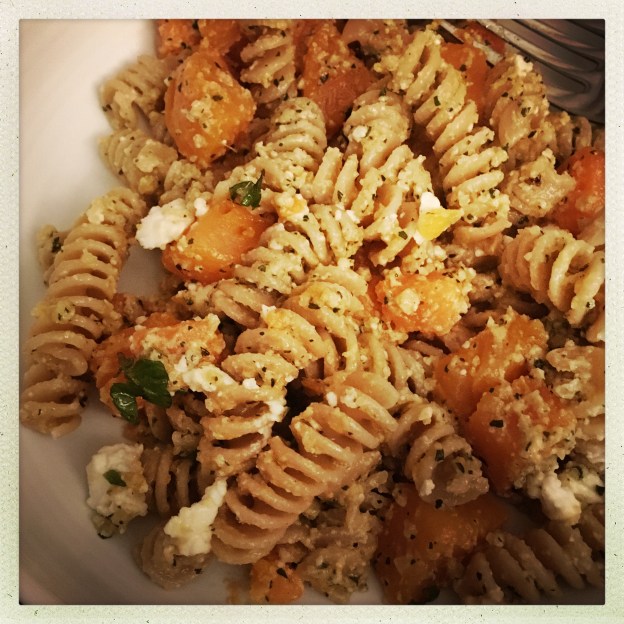
Bad mood pasta

This is actually a John Whaite recipe that was published in BBC Good Food October and we adapted it for the four of us (and also changed some of the ingredients and cooking times). It’s from Whaite’s new book A Flash in the Pan.

It’s proper title – its kennel name – is walnut, feta and mint pesto with sweet potato and wholemeal pasta. But I was in the worse mood (for no discernible reason) when I selected this for dinner and in the end was in too much of a funk to make it, so my partner very kindly stepped in.

I had reservations…because…potato and pasta is not a combo I’d usually go for. And the calories per serving, which I’m not a slave to but do glance at, look like a typo (I dare not repeat them here but it’s a hefty amount). But what can I tell you. This dish has instantly gone into my top ten pasta dishes and that’s not easy to do.

Don’t be scared by the wholemeal pasta. I used Rummo Organic Wholemeal Fusilli which I get from the excellent Sous Chef and it was delicious and just added something to it without it being obvious. I think the use of wholemeal pasta elevates this dish to something else.

Anyway, here is the recipe for four:

For the pasta:

400g dried fusilli

Two sweet potatoes, peeled and cut into little dice

For the pesto

120g walnuts

Two handfuls of mint leaves

100g feta, plus a bit extra if you want to crumble on top

200-300ml of extra virgin olive oil

First make the pesto, heat a heavy frying pan and when hot add the walnuts and stir around for about 3-5 minutes. Don’t burn them.

Fill a pan with boiling water (or boil in the pan..), and then when boiling drop in the sweet potato and cook until tender (8-10 mins), fish out and reserve, covered, to keep them warm.

Then add the pasta (in the same water if possible, add more water if you need to but make sure it’s on a rolling boil before you add the pasta), bit of salt and cook for the time on the packet (which always lies but it’s a good starting point). Ours was eight and a half minutes.

Meanwhile put the toasted walnuts, the mint, the feta and the oil in a food processor and some black pepper (Whaite says to add salt here – a teaspoon for the recipe above – but personally we found that too salty so would leave it out). Pulse until coarse.

When pasta is cooked, drain but reserve the cooking water – about a cup full, add that slowly to the pesto until you have a looser mixture – you may need less. Reintroduce the pasta to the pan (off the heat), stir through the pesto, scatter atop the sweet potato and serve in a big dish with scattered, crumbled, feta.

Sit in front of the TV or the fire, kick your shoes off and try not to eat five portions all to yourself.


Vegetable lasagna: chargrilled courgettes with a multitude of greens.

I’m actually on deadline for two pieces as I start on this. But what the hell. I see it as a warm up.

Every day I look for healthy things to make my family. And if the quest for healthy things is satisfied, my children will invariably not be impressed. The reaction to this was “but where is the pasta” followed by “it isn’t actually half bad”. My youngest – the harshest critic and who would, like her nonno, live off bread and Parma ham if she were able to – ate some. I can’t say she was a fan.

But I thought this was delicious and satisfies that urge for something healthy but tasty. And it has almost a kilo of green leafy stuff in it.

It’s adapted slightly from a Donna Hay recipe. I just love Donna.

Ingredients

About six courgettes, sliced lengthways. Not too thick, not too thin. You’re going to chargrill them.

Lots of extra virgin olive oil but not that super expensive stuff

An onion, chopped up so tears stream down your face

2 x clove of garlic, chopped small (I can’t bear to crush them)

A small bunch of oregano chopped up

Salt and pepper

About 300-400g kale, trimmed of the big thick stems in the middle – rinsed

About 300g spinach – rinsed

500g or thereabouts of ricotta

15g fresh parsley finely chopped (either sort)

Rind of an unwaxed lemon

About 100g of grated mozzarella

About 100g of grated parmesan – like with the mozzarella I do it by eye and depending on size of container.

(quantities of cheese don’t have to be super exact but don’t veer off too much. Don’t sweat it if you only have 80g of each, say).

HipstamaticPhoto-578332785.064248

Before the oven


What you do

I do love a recipe you can make in stages and this is one such. First you oil each side of the courgette slices and chargrill them.

[I use a griddle pan which I bought years ago. It’s a Le Creuset one and it’s big and rectangular shaped and you lay it across two rings. I use it for so many things: not just veg but also making toasted sarnies. I also have a griddle ‘press’ that I used to press things down on. I just looked and my Le Creuset griddle costs £160 now! But I bought it nearly 20 years ago and it’s still going strong so it is worth it on a per use basis. The press I have is something like this.]

So griddle the slices until they are marked and a bit cooked through. Put to one side. If you plan to make this later you can just put it in a lidded Pyrex and put in the fridge, otherwise just keep on a plate until you are ready to assemble.

Then you chop the one onion with the two cloves of garlic and gently saute with the handful of oregano and a little olive oil. I add the seasoning at this point:  a good pinch of sea salt and some black pepper which I always angrily grind over food, as if in a fury. When the onion is translucent set the mixture to one side. Or put it in the fridge until needed.

Now you blanch the spinach and kale and you will think “how can we eat all this green veg?” but you can because it will reduce down. What I do is blanch it, drain as best I can, then I whizz the lot up (in batches unless your food processor is ginormous) in a food processor, and then I sit it over a fine sieve atop a bowl and press down with a potato masher. Because I make this in stages, and not in a great rush, I sit it over a fine sieve over a bowl for an an hour or so. You don’t have to whizz it up, it’s perfectly fine as it is, but you will need to carefully drain it in some way. You could sandwich it between two tea towels you don’t much care about. You then mix the drained veg with the onion and garlic and herbs. What I do is add it to the pan this is in, and for a few minutes just gently steam any remaining water out of the veg.

At some point you introduce to each other, via a fork: the ricotta and the lemon rind and the parsley.

So you now have essentially three things: courgettes, ricotta mix and veg/onion mix which you can assemble now or store for later.

It’s hard to say what size dish to use. Within reason you can use a normal family-supper sized dish. But I favour a square one that is about 25/26cm. Lightly oil the bottom, then when you are ready to cook you preheat oven to 220C.

Start with a third of the courgettes. On top of this put a half the ricotta, then half the greens, then sprinkle on a third of the cheeses.  Repeat and end with a layer of  courgettes and the last of the cheese. Mine was crammed to the top so I put it on a baking sheet in case it erupted (it didn’t). Cook for about 12-15 mins until golden and bubbling and crisp on the top. I didn’t taste it during making it and honestly expected something pretty healthy but bland. Well, no. It was really delicious. I served it with a crisp green salad made with a sharp dressing. Half of it fed four of us, but I suspect for people with larger appetites it won’t go so far.

HipstamaticPhoto-578336868.528218

A cross section

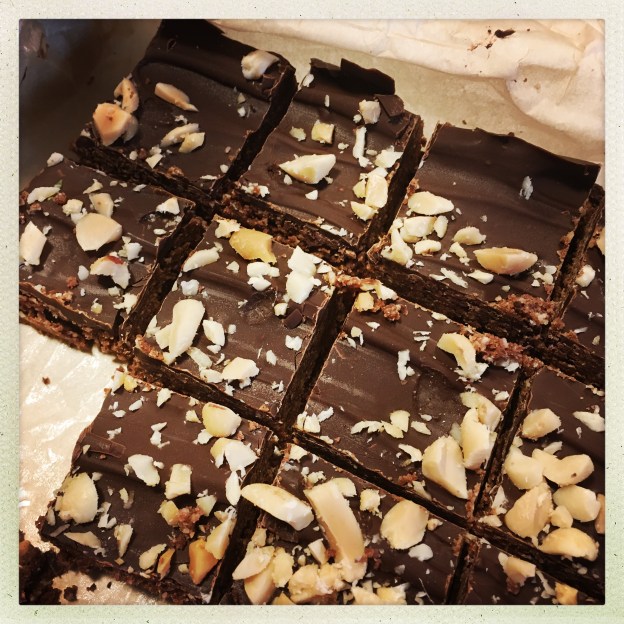
Peanut butter and date protein bars (with a bit of chocolate on top)

These came about after a desire to find something in the supermarket that was, basically, just dates and a nut butter. Because that is something I crave post-workout. I also wanted something which was as delicious as the protein bars that my ex-trainer used to get me which used to be so tasty I daren’t look at the ingredients, but they were also so filling that, with a glass of water (you should always drink a glass of water with protein bars) they’d often see me onto the next meal.

Then one day, I saw that Donna Hay published a recipe for something called peanut butter choco-coconut protein bars and I adapted them. I now make these regularly and eat them post work out, or if I haven’t got time for a meal (which is rare but does sometimes happen) or if I just fancy a little treat during the week when I try to really watch what I eat (one has to be realistic and these hit the I need a treat button without making me feel like I’ve fallen into the abyss of unhealthy eating). They also don’t make me crash, blood sugar wise and I would now, honestly, have these over pretty much any chocolate bar.

You can experiment with the amount of protein powder you put in – I did and I put more in than Hay originally suggested. But if you do that, I recommend you do so in 10g increments.

This is what you need:

260g fresh Medjool dates. You can use others but these really do make the best bars. If you use dried dates, rehydrate them in boiling water for half an hour before use, then drain them.

25g raw cacao powder

100g salted peanuts and 40g of unsalted, raw, cashews (or use half and half, depends on how big you want the salted peanut hit to be). You can of course use 140g of any nut you want, roasted or raw. A few extra nuts if you want to chop and sprinkle on top

Two tablespoons of peanut butter (or any nut butter)

50g desiccated coconut

35g unflavoured protein powder (I use an organic whey protein powder)

1 teaspoon of vanilla extract

45g cacao nibs

150g dark chocolate, melted

What you need

You can make this in a round cake tin – about 8/9″ would be ideal. I make it in my square cake tin which is 20cm. You might prefer the bars thicker but I like them like this. 20cm square is about as big as you want to go, any bigger and you’ll struggle to have enough chocolate to coat all the top – it just covers it as it is, but is still plenty, if you see what I mean.

Whatever tin you use, line with baking parchment.

Place everything except the cacao nibs and the dark chocolate (which you need to melt, for the topping) in a food processor and blitz til it’s all amalgamated – about one or two minutes. Right at the end, add the cacao nibs and blitz a couple more times.

Press this mixture into your prepared cake tin. Put it in the fridge for at least 30 mins.

Then you melt the chocolate either in the microwave or in a bain marie arrangement, and spread over the top. Add some chopped peanuts (or whatever nuts you are using) on the top if you like. Sometimes I do, sometimes I don’t. As I said, in my 20cm square tin it’s just enough to cover. You don’t really want to up the chocolate, as then it becomes all about the chocolate and turns this from an interesting, not totally nutritionally devoid treat into something else…

Refrigerate until you need them, which will be soon. Cut into whatever shape you like. I do long thin bars, little squares or if I want to pack it in my bag for a meal replacement (which I would only do in emergencies) or a good snack later, I cut it into a bar shape and take it in my bag wrapped in foil and then eat it feeling really smug and happy.

They keep for at least a week in my house and have never been around longer than that.


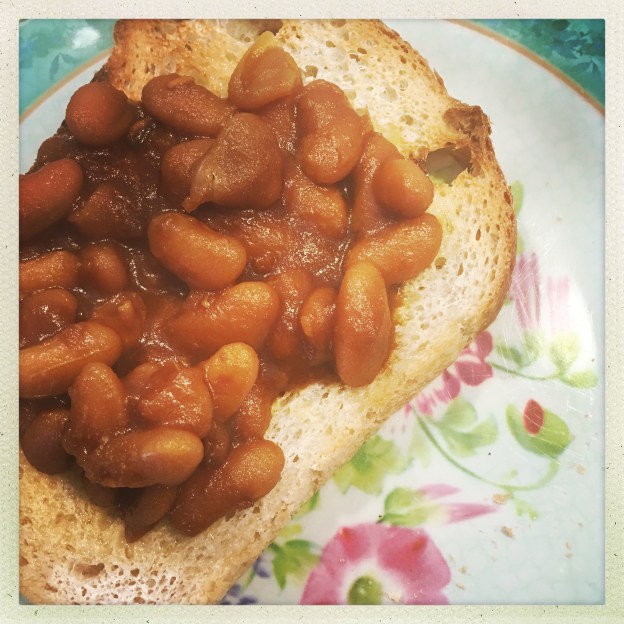
Home made baked beans

I’m not overly a fan of baked beans, but I do love these. Please note the first recipe is for dried beans, which are much cheaper using slow/pressure cooker. Below that is a recipe for ready-cooked beans. You can use haricot or cannellini or small white beans.

This is what you need

1 onion, sliced

1 tablespoon of olive oil

2 cloves of garlic, finely chopped or crushed

500g small white beans, rinsed and picked over (I’m not sure what for, mine were all fine).

1 litre of water

125ml strong black coffee (I used a big tablespoon of instant espresso powder which I keep for making coffee cakes, dissolved in 125ml of hot water)

250ml passata

55g-110g dark brown sugar (100g is what the recipe calls for but we all find it a bit sweet now so do experiment. I’ve made it with half this and will probably reduce further)

1 tablespoon of English mustard

1 tablespoon of black treacle

half a teaspoon of Tabasco sauce

1 and a half teaspoons of salt

2 tablespoons of white or cider vinegar (for the very end, I have left it out and tbh it was fine)

What you do

If you have a pressure/slow cooker which allows you to saute, put this function on, heat up the oil then add the onion and cook until soft – about five mins. If yours doesn’t have this function do this bit on the stove top in a frying pan/saucepan.

When soft, add the garlic and cook for a minute.

Now, either add the rest of the ingredients, minus the vinegar to the pot of your pressure/slow cooker, or now tip the onions/garlic into your pressure/slow cooker and then add the rest of the ingredients (minus the vinegar).

Select pressure cook 80kPa, natural steam release and cook for 35-40 mins or select slow cooker mode for 10-12 hours on low.

When time is up, add the vinegar and you need to reduce the sauce right down until it’s syrupy – either in the pressure/slow cooker if you have a reduce function or decant into a large sauce pan and do it the traditional way. Mine took 20 mins.

Update January 2021. I have since made these with a squirt of Liquid Smoke from Sous Chef which was amazing. I’ve upped the time to 35-40 mins as I really don’t think 30-35 was enough time!

Making using ready cooked beans

It’s not easy to find dried beans where I live so I now make this recipe using these beans. They are not cheap but it’s what I use and it makes a vat of baked beans and the beans are very fine.

Jar of 700g of ready cooked white beans (I use these), use all the liquer in the jar as well. You can of course use beans in tins too!

1 onion, sliced

1 tablespoon of olive oil

2 cloves of garlic, finely chopped or crushed

100ml strong black coffee (I used a big tablespoon of instant espresso powder which I keep for making coffee cakes, dissolved in 125ml of hot water)

250ml passata

80g dark brown sugar (you can alter to taste this is what I use)

1 tablespoon of English mustard

1 tablespoon of black treacle

half a teaspoon of Tabasco sauce

1 and a half teaspoons of salt

1.5 tablespoon of white or cider vinegar (you put this in at the very end, but I often forget it and it’s really fine!)

Use a slow cooker or a regular big pot on the hob. Gently soften the onion in the olive oil, then add the garlic, then tip everything else in – not the vinegar – including all the thick liquid that comes with your beans.  Give everything a good stir and either put in the slow cooker on low for 2 hrs or so or on a low hob. I’m sure they’d be fine after an hour, too. Reduce if you like it really thick but I find this is perfect. 

Here’s a 2024 picture, served with home made seeded sourdough.