Category Archives: What’s for dinner?

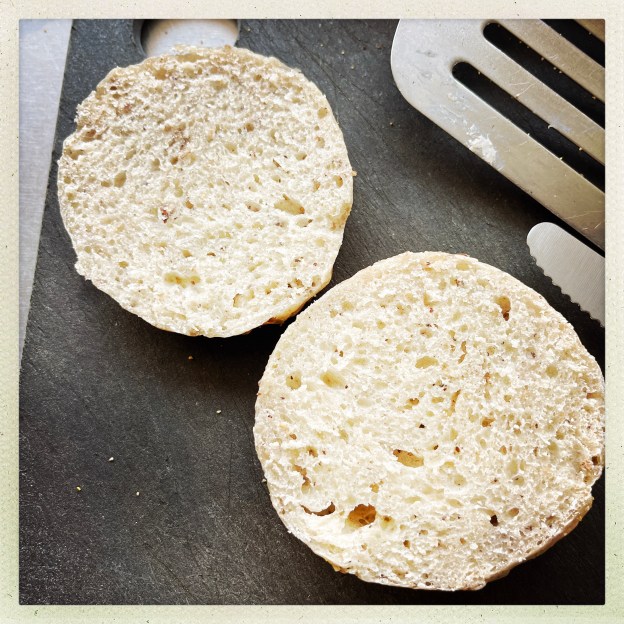
Sourdough (English) muffins


I’ll get straight to the point. These take time to make but most of that time is resting the dough in some shape or form. You have to cook them slow and low. But they are delicious and they freeze really well. I got the recipe from Facebook, from one of the many sites I follow about sourdough. The original says to use active starter, mine was a few days (in the fridge) old and it did it no harm. But I’ve adapted it slightly. You’ll need to start these the day before you want them. The bulk ferment (the bit where it stays out at room temperature for 10-12 hrs or as long as as possible) takes a long time so best to start these in the morning of the day before you want to eat them. Note you cook these on the hob, not the oven.

Ingredients


250g whole milk
115g water
55g butter (unsalted)
20g honey (or sugar, if using sugar add it with the flour)

75g starter
500g bread flour (I used 50g of Hodmedod’s Sourdough School’s Diversity XXX blend and the rest white but you can also use half wholemeal and half white depends how wholesome you want them to be)
A gently heaped teaspoon of fine grain sea salt

Method

Put the milk, water, butter and honey together in a sauce pan and gently heat til all melted then let it cool for ten minutes. If you’re using sugar then add it to the flour mixture next.

In a large bowl – for this is what you’ll eventually mix everything in, add the starter (sugar if you are using) and then add the milk/honey/water/buttery mixture and mix everything together, now add in the flour and salt. You’ll get a rough dough. Cover it and leave it to rest for 30 mins.

Now over two hours, every thirty minutes, you give it a gentle knead/fold and stretch. When this is done put in a clean bowl (oil with some olive oil) and cover it with a tea towel or a plate if you have one big enough. You leave it out for a looong time for the bulk ferment, or as long as you can. The original recipe says 10-12 hours. But if your kitchen is raging hot then probably half this. I think I left mine out for about 7 hours. Then transfer to the fridge for a day or two. I left mine in for two days.

When you’re ready to make them turn out the dough on a clean surface/board that’s been oiled or lightly floured and roll out to about 1.5cm thick. You don’t want it too thick. Get a biscuit cutter that’s the size you want the muffins to be – mine was about 6-7cm – and cut out as many as you can, transferring them to a baking tray which has either been lined with baking parchment or dusted with polenta. Re shape the dough and roll out again until you’ve used it all up. You’ll have one left that you’ll probably shape by hand. This will be the sacrificial muffin.


Leave out like this, covered with a tea towel, for about an hour. Heat up a cast iron frying pan – big as you got – but make sure you have a lid for it. You can also use a Le Creuset but make sure the heat is low. You can’t rush these babies.

When the pan has warmed up put in the sacrificial one to try out the heat of the pan and how long they take. It’s really worth doing this. Of course I thought I knew best so I ruined four finding out the hard way that my heat was too high.

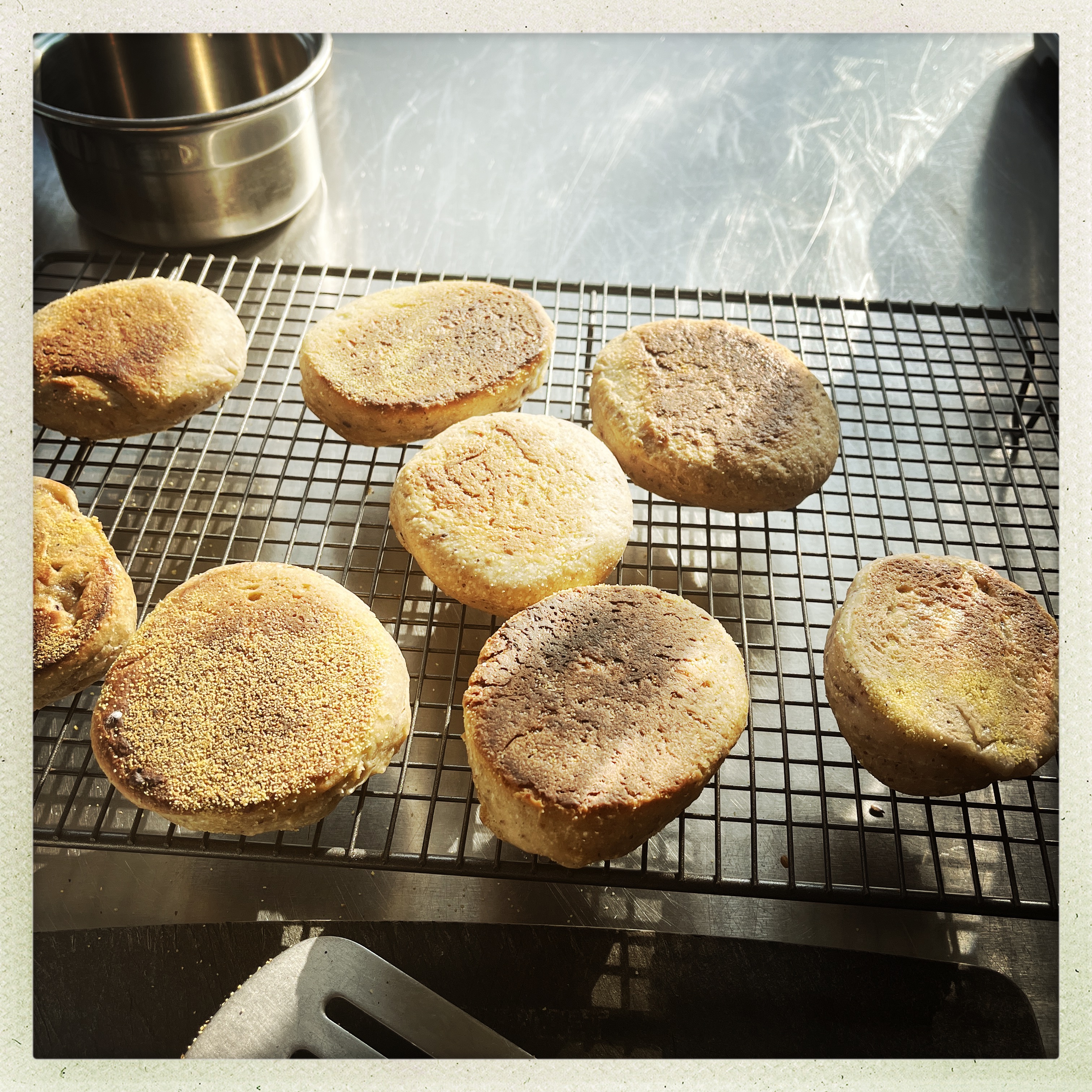
Eventually I worked out mine took about eight minutes each side, on the lowest gas setting. You want them to be gently brown, when done turn over and do the other side for eight minutes. Keep an eye on them, it’s easy for them to burn but be raw in th middle (this is also why you don’t want them to be too thick to start with). Note they do puff up a bit when cooking.

Cook in batches, put on a cooling rack and then eat. With bacon and egg, sausage, cheese and chilli jam, hummus and carrot, whatever you like. They are SO tasty and freeze beautifully. Of course you can also toast them but I had mine fresh.
Tamsin’s Houmous

I’ll have to add a picture anon and also I can never really decide how you spell houmous so I hope that will do.

Here’s the thing with me and houmous. I’ve never really liked home made, or at least I have never made any at home which pleases me.

But all this has changed. I went to my friend Tamsin’s house; Tamsin is an inaugural member of my Suffolk Chocolate Club and it was her turn to host, and she made this amazing houmous which now I make and it’s, amazingly, still amazing when I make it.

The key is a really whizzy blender. I make mine in my Sage Super Blender, which is not its real name. I find if I make it in my Magimix it needs far longer to make it smooth.

You need (I’m so sorry about the formatting, not sure what’s going on with WordPress atm)

A 400g tin of chickpeas drain the liquid and keep it separate
50ml of the chickpea liquid (but you might need a bit more, I never do though, you can keep it though for aqua faba if that’s your thing – it is mine)
60ml lemon juice, this seems to be about 2/3 of my little organic lemons. Don’t forget you can grate the peel and keep it in the freezer, for something else.
60ml extra virgin olive oil
1 garlic clove, peeled
1 teaspoon of ground cumin
Half a teaspoons of paprika
1 tablespoon of tahini
1 teaspoon of sea salt

Blend it all up til smooth, serve with a drizzle of very good olive oil.
It’s really good. The recipe says you can add 100g roasted red peppers to make it into red pepper houmous.

What I also do now is halve the houmous (how many ways are there to spell houmous?) when it’s done and then, to one half I add a small cooked beetroot and briefly whizz it up again and it makes for something even yummier.

Pea and ham pasta

This is surely a nursery stalwart, and I cut this out of a BBC Good Food magazine earlier this year and hid it as it’s pasta and it’s too easy to eat pasta. But, as I seem to be on a carb fest I scheduled this for dinner last night and it was absolutely delicious. Warming, comforting, cosy, just as our government crashes and burns the economy. We ate it in front of the fire trying to keep sane (and warm). I have changed this slightly as don’t agree what they did with the peas (they say cook them in the last few minutes of the pasta cooking but this is impractical if you want to then puree the peas, see later).

This serves two but as a small dinner, augmenting the pasta to 250g, it served three of us fine.

200g conchiglie pasta (don’t fight it like I tried to, this is a great shape for this dish, we used the smaller-size shells, not tiny tiny but just normal, recipe calls for conchiglione which are the big mofos but we didn’t use them)

160g cooked peas
1 red onion, finely chopped

A slosh of olive oil

100g cooked ham

150ml double cream

Juice of half a lemon

40g parmesan, plus extra to serve

Cook the pasta according to the packet instructions, which we know always lie.

At the same time, because cooking is all about multi tasking, heat the oil in the frying pan and fry the onion until soft. Add the ham, cream, lemon juice and parmesan, then season and mix together well. Remove from heat, try not to pick at the bits.

The recipe says to puree some of the peas which you can do if you want (we did). Drain the pasta loosely (ie keep a tiny bit of the water on it) then tip everything into a big pan/frying pan and mix together, serve from the pan if you want and add extra parmesan.

Really good focaccia

Beautiful focaccia

I am not short of focaccia recipes. I have ones that use a sponge starter, a sourdough starter, fresh yeast, dried yeast…but this one that I happened upon in Delicious magazine is my favourite to date. it is absolutely…delicious. And fairly quick and easy.

The dough is – be warned – incredibly frisky and difficult to handle, almost impossible to handle at the beginning. But don’t panic and use plenty of oil for your hands (and oil the surface you’re using). You’ll find you have to wash your hands a lot.

I used to do this in a mixer with a dough hook but a note here that the dough is easier to handle if you do the whole thing by hand.

The baking tray I use is approx 37cm by 28cm. It yields a focaccia which is a perfect depth for me.

Ingredients:

500g strong white flour

One and a half teaspoons of fine sea salt

3g/one teaspoon of dried yeast

400g water (make sure it’s not cold, I leave mine out for about 20 mins)

80g of extra virgin olive oil (note: you’ll use this during the stretching process but you’ll have quite a bit left which is okay, you use it just before baking)

toppings: salt/rosemary/chargrilled veg/olives/mozzarella (I use Mozzarella Cucina as it’s a lower hydration cheese but regular mozzarella is fine, just make sure it’s well drained)

Method

Put everything EXCEPT the oil in a bowl, mix up with a fork until it’s all come together, then add a handful of oil from the measured out oil and amalgamate as best you can, then leave it for about 20 mins.

After this, oil a surface/chopping board, again using a bit of the measured out oil to lubricate the surface you’re using (and also your hands) – or you can even use a large shallow tray. Turn the dough out, and gently stretch it out and fold it over on itself a few times. Leave for 30 mins and do the same thing again – stretch, fold. It’s nothing dramatic but you’re trying to get some air bubbles into the dough. Do this once or twice more (leave for 30 mins, stretch and fold) depending on the temperature of the room. You want it a bit bubbly and excited looking.

The recipe says to now put the dough in the fridge for 10 mins. I don’t really do this. After the final rest I pop it in the tray I’ll be using to cook it (I line mine with baking parchment but you don’t have to). Put the dough in, stretch it, fold it, stretch it fold it and then I leave it for about 20 mins to relax. I then stretch it to reach into all four corners of the tin, massaging in all of the left over oil and stick my fingers in to dimple it. At this stage I cover it with oiled clingfilm/more baking parchment (tea-towels tend to stick) and put it in the fridge overnight (I make it in the afternoon if I want it the next day) and cook it in the morning.

If you want to cook it straight away then give it about 30 mins to an hour at room temperature to rest.

I add my toppings before I bake it, top it with salt and bake it in a preheated 220C oven for about 20 minutes. The recipe says to put an oven-proof bowl of water with about 150ml of water in the oven too. Sometimes I do, sometimes I forget. It’s fine.

You want it golden on the top. When it comes out of the oven, brush it with more oil – this is important.

It’s really delicious. Makes excellent sandwiches but isn’t that great the next day (sure you can griddle it to make toasted sandwiches, but…nothing beats what it’s like on the day) – so don’t feel guilty if you eat it all.

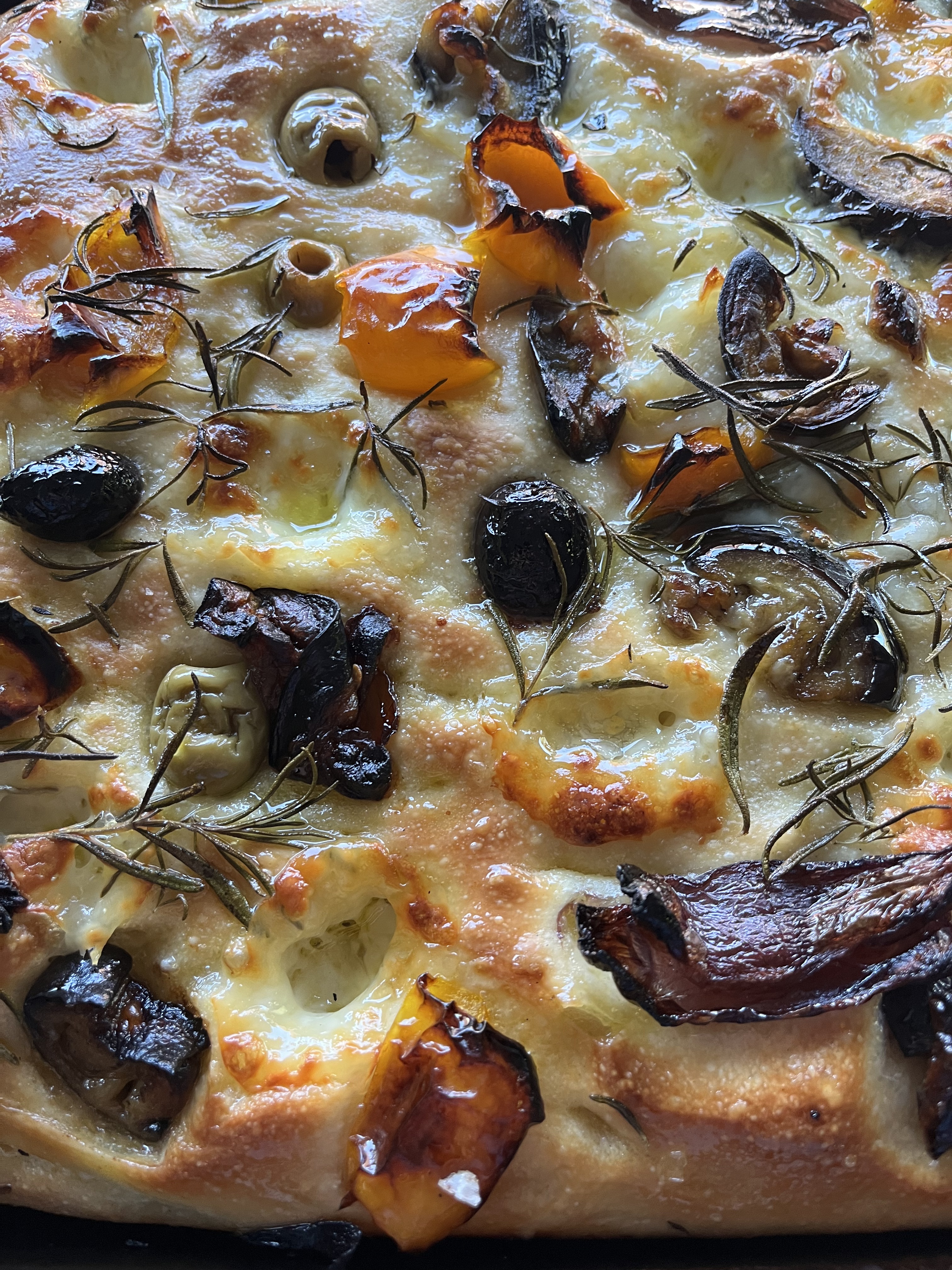
It makes a great centre piece for informal dinners/lunches with cheese and cold cuts and if you add chargrilled veg – and I thoroughly recommend you do (chargrill first) it’s a meal in itself with some crispy green salad.

Here’s a pic of it with some toppings, it makes for a really gorgeous meal about 20 mins out of the oven.


I can tell you how good this was: really bloody good.

Quick spelt pizza

This is a Donna Hay recipe which makes a really quick, light, and slightly flakey pizza. It’s not pizza as you may know it and I find it best if you fold over the finished product and eat it like that. But it is delicious. And fast. I’ve reproduced the recipe more or less as she originally gave it but you can customise it with any topping you like. This makes two pizzas which we divided up to have half each and I found that was plenty for dinner with a green salad.

The base

1-2 fennel bulbs thinly sliced

Four tablespoons of olive oil

260g white spelt flour plus a little extra

Half a teaspoon of sea salt

250g Greek yoghurt

The Topping

300g soft mozzarella (ie not the block kind, Hay calls for burata but i didn’t use it)

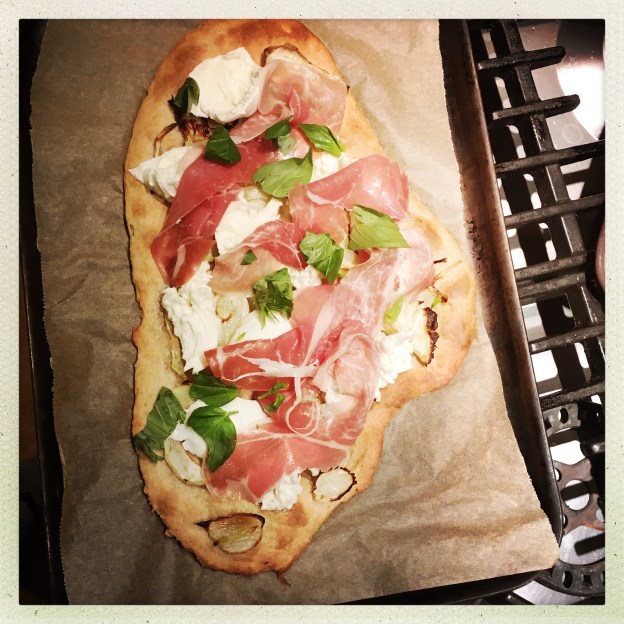
6-8 slices of Parma ham or equivalent

Some fresh basil to scatter atop

Method

Oven to 200C, I put mine a smidge lower and on fan so that I can do both at the same time. Put two large baking trays in the oven to heat up.

Toss the fennel slices in two tablespoons of the olive oil and set aside. To make the pizza dough put the flour and salt in a bowl, stir, make a well in the middle and into that put the yoghurt and the remaining two tablespoons of olive oil and use a fork to mix it all together. Tip onto a lightly oiled board or work surface and gently knead until a smooth dough forms – this doesn’t take long. Now divide into two.

Roll out each piece between two pieces of baking parchment. This always seems wasteful to me but it’s needed and you’ll use two of them for final baking. (I use three piece in total, as I move the top sheet from one piece of dough to the other.) Roll out until, Hay says, they are about 35 x 25 x 0.5 cm. I just did mine until they seemed right (and they were!).

Keeping the dough on the bottom sheet of the baking parchment (you’ll transfer the whole thing onto the baking tray), remove the top piece and arrange the fennel slices on the top. If you’re using something else that needs to be baked – pepper slices, tomato sauce, you’d add that here too. Don’t over do it though, think of this pizza as something you do partly in the oven, partly you top outside of it. But the beauty is that you can also experiment.

When you’ve done that, take the baking trays out of the oven, slide the topped pizza on top, repeat with the other one and then bake for 15-18 minutes until the base is crisp and golden.

Remove from the oven and top with the slices of mozzarella and Parma ham or other toppings you’ve chosen that don’t need cooking. And scatter over Basil leaves if you have them.

Bay-crushed roast potatoes

This is such an easy, but delicious, way to do roast potatoes if, like me, roast potatoes slightly daunt you (so many people have a theory on which way is best!). They’re also quite forgiving and if you can’t decide between roast/baked/mash, this is a bit of all of those.

Because, unlike with roasties, you don’t have to worry about breaching the crispiness, these lend themselves particularly well to meals where there’s juice or gravy to mop up. That said, the smashing does give these potatoes bits to delightfully crisp up. I originally got this from Delicious magazine.

For about four people you need:

1 kilo of small-ish waxy potatoes – I use Charlottes

Four tablespoons of olive oil (I use extra virgin but you don’t have to)

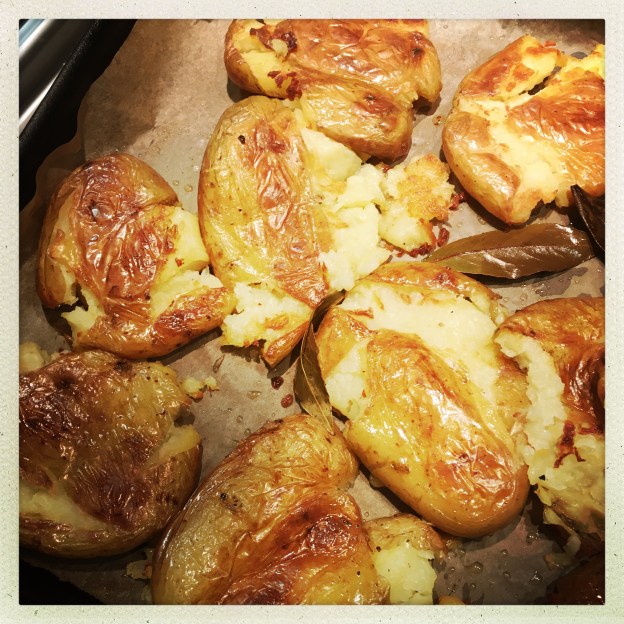
6-8 fresh bay leaves, ripped if you like

Method:

Oven to 200C. Get a roasting dish and line it with baking parchment – this really makes a difference. Wash but don’t peel the potatoes, put them in the tin with one tablespoon of the oil, mix well and roast for 30-40 minutes.

Now take the dish out of the oven and with a potato masher or a fork press down on the potatoes to gently smash them, you’re going for a genteel muddlement not Trump-style devastation. You want them flattened and a bit broken up to give you nice peaks. Now add the bay leaves and drizzle on the rest of the oil, add salt and pepper and mix together gently.

Put back in the oven for another 20 minutes, remove, toss them one more time and return them to the oven for another 10 minutes. If they’re not crispy around the edge and you’d like them to be you can turn the oven up to 220c for the last five minutes.

Ratatouille and halloumi tray bake

This recipe came from an excellent and surprising source. My friend Lynda recommended it and it’s The Fast 800 Recipe book. But don’t let it put you off, honestly it’s become one of my most used and loved books for its simple, healthy, quick recipes which you can augment or add to if you’re not fasting. Which I so rarely can…This serves four which you can eat with lovely crusty bread if you’re not carb-avoidant. And who is these days? It’s surprisingly delicious. TBH I’m not a huge fan of ratatouille, or beans and yet this is…yum.

Ingredients

2  peppers – not green sorry, de-seeded and cut into chunks

1 medium aubergine or two courgettes

1 onion cut into chunks

3 tablespoons of olive oil

2 garlic cloves, peeled and crushed

Basil leaves, a small handful sliced into shreds (don’t cry if you don’t have)

1 x 400g can of chopped tomatoes

1 teaspoon of oregano (or use a tin of tomatoes with herbs)

225g block halloumi cheese – slice into eight

A tin of 400g of drained and rinsed cannellini beans

Method

Oven to 220C. Place the peppers and aubergine/courgette and onions onto a tray, drizzle on the olive oil, season with salt and pepper (but not too much salt as the halloumi is quite salty). Mix everything around and roast for 30-35 minutes, turning half way through if you can be bothered.

After this time, take out, stir in the garlic and basil, tomatoes + oregano and beans. Arrange the slices of halloumi on top and back in the oven for about 15 mins. I tend to give it a ‘top oven’ blast for a few minutes at the end. The halloumi should be lightly browned.

Scatter over more fresh basil if you remember and serve with a crisp green salad.

Pasta with roasted red pepper and walnut sauce

This is a super simple, super tasty little dish which you can prep beforehand and then, after cooking the pasta, assemble at the last minute.

Ingredients

3 red peppers (you can also use an orange or yellow one but the red adds a good colour; don’t use green peppers)

75g walnuts, lighted toasted

1 garlic clove mashed

1 tablespoon of pomegranate molasses (nice but not essential, I’ve made it without)

zest of one lemon

20g parmesan

pinch chilli flakes

25g chopped flat leaf parsley

four tablespoons of extra virgin olive oil

300g pasta – linguini or tagliatelle are a good shape here


Method

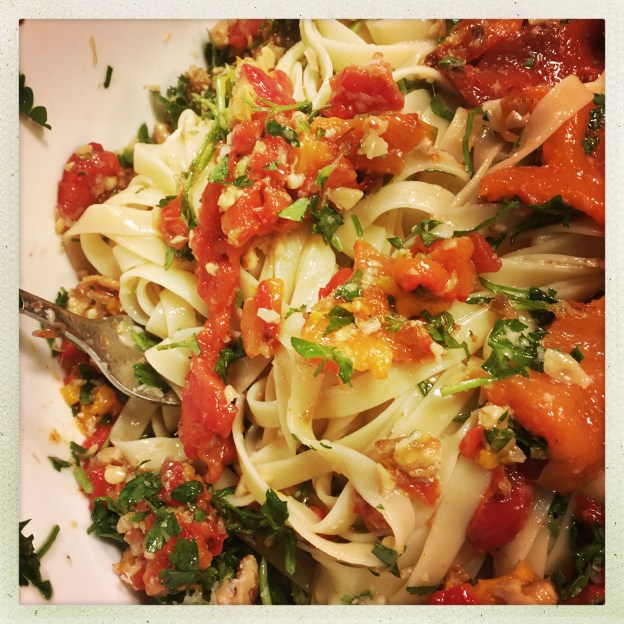
You need to roast the peppers for 30 minutes at 220C, and you can do this bit the day before or earlier in the day. Once roasted and cool, skin, de-seed and finely chop the peppers. As you can probably see from my pic, I chop mine very inaccurately and have tiny pieces and sometimes the odd larger piece. It is better if you take the time to really chop the pepper quite finely – so don’t be like me.

I’ve often thought about keeping the juice the peppers exude and mixing it into the pasta later, lessening the amount of oil, but confess I’ve yet to do it because I forget.

If you haven’t already, lightly toast the walnuts for five minutes but watch carefully because we know how readily nuts burn. Finely chop these too.

Once the peppers are all cooled and de-seeded and chopped, you can add in the rest of the sauce ingredients – which is basically all of the rest of the ingredients above save for the pasta. What I tend to do is do the peppers and walnuts and assemble the rest just before dinner time.

But whichever you do, at some point, you need to mix together the other ingredients to make the sauce and then season it. I forget to season something and it’s also okay. The chilli flakes lift it but I add those over the plate as my children don’t like them.

Cook the pasta, or have it cooking whilst you mix together the sauce. Then when the pasta is ready, drain, plonk into a big serving bowl and put the pepper sauce on top. Serve with extra parmesan/chilli flakes if you like. Voila.

Bad mood pasta

This is actually a John Whaite recipe that was published in BBC Good Food October and we adapted it for the four of us (and also changed some of the ingredients and cooking times). It’s from Whaite’s new book A Flash in the Pan.

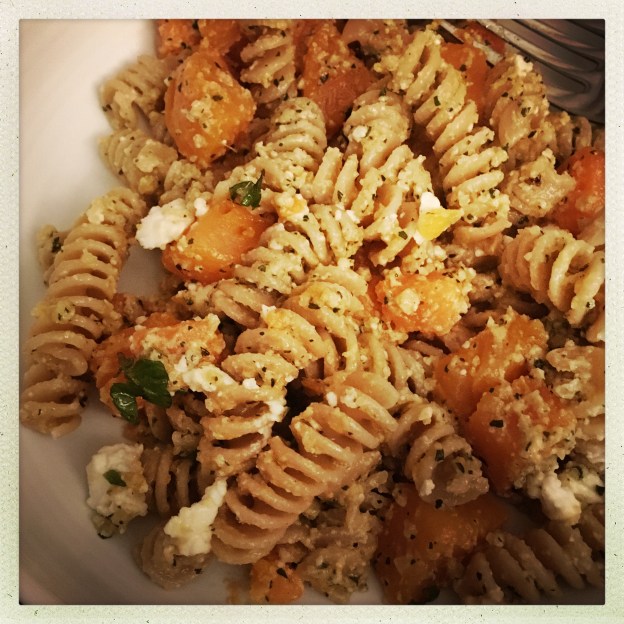
It’s proper title – its kennel name – is walnut, feta and mint pesto with sweet potato and wholemeal pasta. But I was in the worse mood (for no discernible reason) when I selected this for dinner and in the end was in too much of a funk to make it, so my partner very kindly stepped in.

I had reservations…because…potato and pasta is not a combo I’d usually go for. And the calories per serving, which I’m not a slave to but do glance at, look like a typo (I dare not repeat them here but it’s a hefty amount). But what can I tell you. This dish has instantly gone into my top ten pasta dishes and that’s not easy to do.

Don’t be scared by the wholemeal pasta. I used Rummo Organic Wholemeal Fusilli which I get from the excellent Sous Chef and it was delicious and just added something to it without it being obvious. I think the use of wholemeal pasta elevates this dish to something else.

Anyway, here is the recipe for four:

For the pasta:

400g dried fusilli

Two sweet potatoes, peeled and cut into little dice

For the pesto

120g walnuts

Two handfuls of mint leaves

100g feta, plus a bit extra if you want to crumble on top

200-300ml of extra virgin olive oil

First make the pesto, heat a heavy frying pan and when hot add the walnuts and stir around for about 3-5 minutes. Don’t burn them.

Fill a pan with boiling water (or boil in the pan..), and then when boiling drop in the sweet potato and cook until tender (8-10 mins), fish out and reserve, covered, to keep them warm.

Then add the pasta (in the same water if possible, add more water if you need to but make sure it’s on a rolling boil before you add the pasta), bit of salt and cook for the time on the packet (which always lies but it’s a good starting point). Ours was eight and a half minutes.

Meanwhile put the toasted walnuts, the mint, the feta and the oil in a food processor and some black pepper (Whaite says to add salt here – a teaspoon for the recipe above – but personally we found that too salty so would leave it out). Pulse until coarse.

When pasta is cooked, drain but reserve the cooking water – about a cup full, add that slowly to the pesto until you have a looser mixture – you may need less. Reintroduce the pasta to the pan (off the heat), stir through the pesto, scatter atop the sweet potato and serve in a big dish with scattered, crumbled, feta.

Sit in front of the TV or the fire, kick your shoes off and try not to eat five portions all to yourself.


Olive oil flatbreads

These are so useful to make in a batch and then freeze. To defrost simply leave at room temperature for a bit or microwave for 10 seconds and eat immediately.

I love the meditative nature of making these. I make them on a large, flat skillet pan, prepping the ones still to cook by first rolling them into balls, then squashing into discs and finally rolling them out. I do this in stages – a mini production line – so the gluten has time to relax in between. I can’t get these super thin, but then I don’t really want to. They are really soft and tasty.

I keep them warm in my warming drawer whilst making the whole batch, but a very low oven serves exactly the same purpose.

I make eight out of this recipe, you could make more if you made them smaller as individual (as opposed to ‘tearing’) dipping breads.


7g of dried (fast action) yeast

600g strong white bread flour

100ml of extra virgin olive oil (doesn’t have to be super expensive)

350ml of water

half a teaspoon to half a tablespoon of sea salt

(depending on taste. If you’re going to serve these with super-salted food then you don’t have to put too much salt in. The first time make them with the lower amount and see how you go.)

These couldn’t be easier. You mix the 7g of yeast with the 600g strong white bread flour, and mix in the 100ml of olive oil and 350ml of water and, finally, the salt.  Mix to a rough dough just using a fork, and then rest in the bowl for ten minutes whilst you wash your hands and put everything away.

When the ten minutes is up, turn the dough out onto an oiled surface and give it gentle knead for ten seconds, then cover it with a bowl and rest again for ten minutes. Repeat twice more. By this stage you should have a smooth dough, with no bits.

If you plan to make these the same day, oil a bowl, place the dough in it, cover and leave until doubled in size. How long this will take depends on your kitchen. I tend to use a bowl that the original, unproved, dough comes up half way on, that way, I know that when it’s at the surface it’s doubled in size. If you plan to make these later put in a cold place in the fridge (by that I mean, as close to the bottom as possible) for the final prove, you could leave it overnight but I wouldn’t leave it for more than about 12 hours.

When ready to go, take the dough out, lightly knead and divide into eight/how ever many pieces you want to make. Roll into a ball by placing the dough on the flat palm of one hand and cupping the other hand over the top and making circular movements, or whatever works for you.

Then flatten each ball into a disc. Put a dry, large frying pan on a high heat and when you are ready to go roll out as best you can to about 18-20cm – if you’ve divided the dough into eight, obviously smaller if you’re making more than that.

As I said in the intro, you can get into a production line with them, prepping each before it goes on. I get it so that as I put one on to cook, I roll the other one out in preparation so it has time to relax a bit. If you can get them perfectly circular great – I never can.

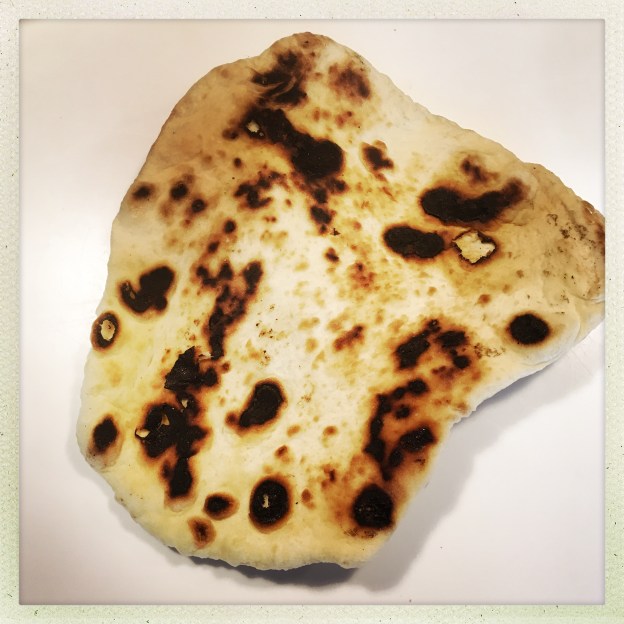
When ready to cook you slap them into the pan and cook for about 5 mins – if you’re like me you’ll turn them often as I’m a bit of a flipper. You can see they’re done as they brown and go ‘dry’ – no more moist bits. If you need to turn the heat down for the second side do so, but turn up again for the new flat bread going on as it’s the dough hitting the hot skillet heat which causes the bubbles to form, which then blister and blacken.