Tag Archives: bread

Sourdough bagels

I’ve long made bagels and they are a thing of beauty and deliciousness. I have made sourdough ones but not with any regularity. But recently I started making them again. They take a bit more time, in that they need to be left to rise in their own sweet time, far more than yeasted bagels. I rushed them last week and they were dense – still delicious but not so airy and light.

I tend to shape these into little round rolls first and then puncture a hole with a wood spoon handle. I tend to make these with a smaller hole than my yeasted bagels. Who knows why.

Unlike yeasted bagels these can also be left to prove for 48 hours in the fridge (maybe even longer but I’ve never left them that long), so if there aren’t that many of us, I tend to cook a batch up in two lots so we have fresh bagels for two days running. I can’t do that with yeasted bagels as they really have to be cooked the day after making (after an overnight prove in the fridge, ie they don’t ‘last’ that long in the proving stage).

If you want to make them totally vegan then don’t egg wash them.

You can of course use 500g of just white flour, or mix in a bit of wholemeal. I’m always looking for a more gut-friendly diversity so I add Vanessa Kimbell’s Diversity XXX flour. TBH these days I add 10-15% of it into almost all my bakes but here I use 20% (100g of 500g is 20% isn’t it? I failed maths..)

I think this recipe is, at least in part, from Edd Kimber but I adapted it a while ago. (I love Edd.)

What you need:

185g active sourdough starter
250g warm water
1 tbsp of sugar or barley malt syrup
1 tsp of fine sea salt
400g strong white bread flour
100g Diversity XXX flour

I mix everything together in my Kenwood Chef food mixer with the dough hook. I leave it on low for ten minutes. Then I turn the dough out onto an oiled surface, cover it with a bowl and leave it for an hour. After an hour I give it a gentle knead for ten seconds, leave it for an hour and then knead it again for ten seconds. If your house is very cold you might want to do this one more time. I kinda go on dough-feel (and no I’m not very good at it either).

When you’re ready to shape the bagels, when the dough feels lighter and a little more yielding, then cut it into 6/8/10 depending on how many you want to make (this makes eight regular sized bagels for me). I roll into little balls using my hands, then make a hole with the handle of a wooden spoon, stretching the hole out a little.

Place on a parchment lined tray.

I now leave this out, covered with a tea towel, for about another hour before putting them in the fridge overnight. I also think they benefit from coming up to room temperature after taking them out of the fridge but I never have time to do this so I put them straight away into the boil process.

Boiling and baking

Bring a pan of water to the boil. Some people put things in the water to make them more of a bagel (I don’t know what but stuff that makes it apparently taste more bagel-y) I can never be bothered. When the water is boiling I plop two in there – if you can get more in without them hurtling into each other than do. I give them a minute or two until they float and puff up a little, and turn them with a slotted spoon, another minute or two, then take them out and rest them on a tea towel. When all are done put them back on the parchment lined tray, brush with beaten egg if you want and scatter with seeds if you want and cook at 220C for 14/15 minutes. Check after 12.

These are really very good.
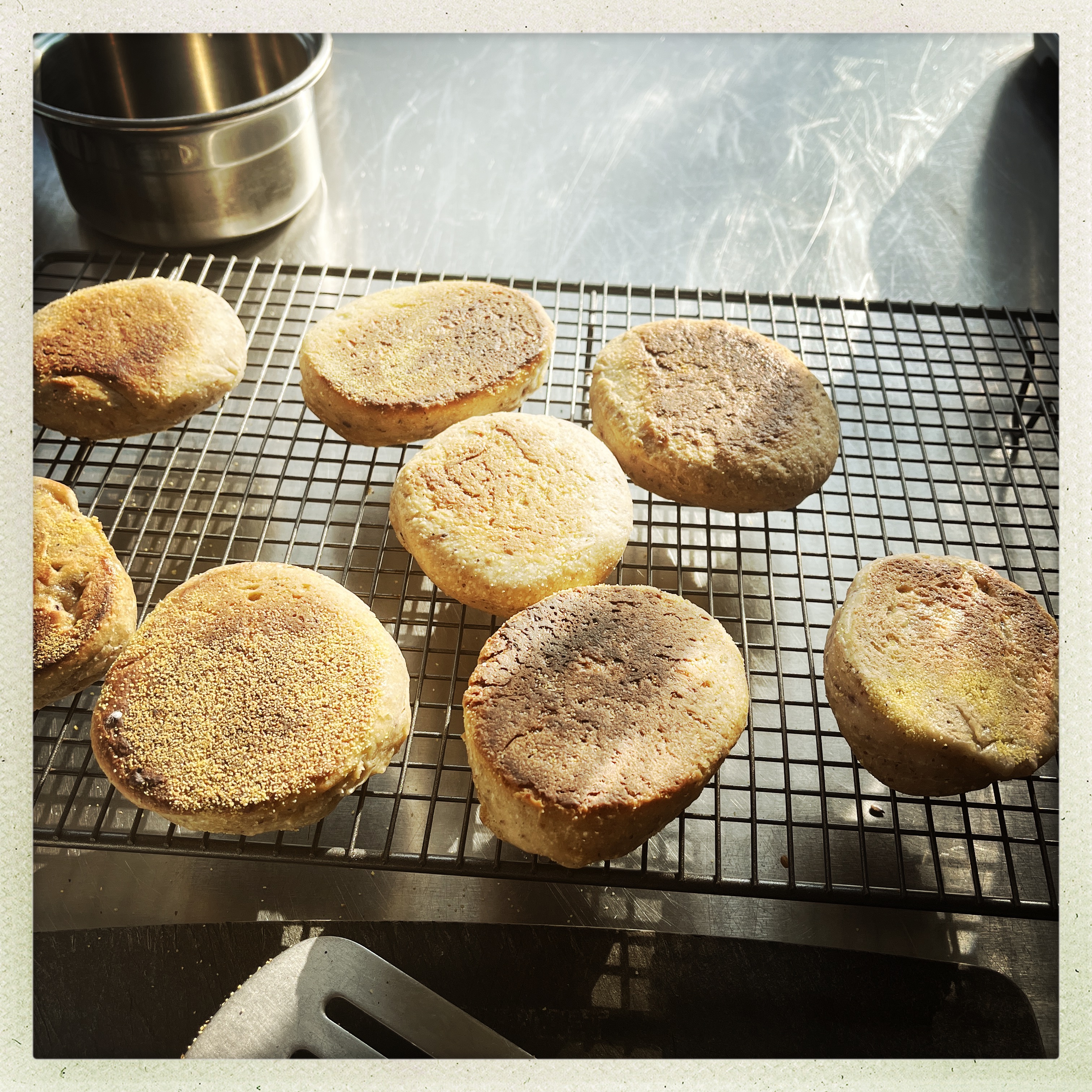
Sourdough (English) muffins


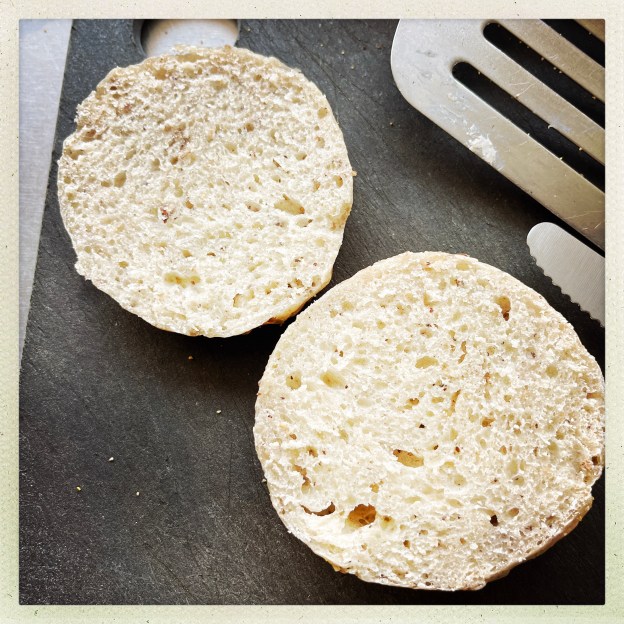
I’ll get straight to the point. These take time to make but most of that time is resting the dough in some shape or form. You have to cook them slow and low. But they are delicious and they freeze really well. I got the recipe from Facebook, from one of the many sites I follow about sourdough. The original says to use active starter, mine was a few days (in the fridge) old and it did it no harm. But I’ve adapted it slightly. You’ll need to start these the day before you want them. The bulk ferment (the bit where it stays out at room temperature for 10-12 hrs or as long as as possible) takes a long time so best to start these in the morning of the day before you want to eat them. Note you cook these on the hob, not the oven.

Ingredients


250g whole milk
115g water
55g butter (unsalted)
20g honey (or sugar, if using sugar add it with the flour)

75g starter
500g bread flour (I used 50g of Hodmedod’s Sourdough School’s Diversity XXX blend and the rest white but you can also use half wholemeal and half white depends how wholesome you want them to be)
A gently heaped teaspoon of fine grain sea salt

Method

Put the milk, water, butter and honey together in a sauce pan and gently heat til all melted then let it cool for ten minutes. If you’re using sugar then add it to the flour mixture next.

In a large bowl – for this is what you’ll eventually mix everything in, add the starter (sugar if you are using) and then add the milk/honey/water/buttery mixture and mix everything together, now add in the flour and salt. You’ll get a rough dough. Cover it and leave it to rest for 30 mins.

Now over two hours, every thirty minutes, you give it a gentle knead/fold and stretch. When this is done put in a clean bowl (oil with some olive oil) and cover it with a tea towel or a plate if you have one big enough. You leave it out for a looong time for the bulk ferment, or as long as you can. The original recipe says 10-12 hours. But if your kitchen is raging hot then probably half this. I think I left mine out for about 7 hours. Then transfer to the fridge for a day or two. I left mine in for two days.

When you’re ready to make them turn out the dough on a clean surface/board that’s been oiled or lightly floured and roll out to about 1.5cm thick. You don’t want it too thick. Get a biscuit cutter that’s the size you want the muffins to be – mine was about 6-7cm – and cut out as many as you can, transferring them to a baking tray which has either been lined with baking parchment or dusted with polenta. Re shape the dough and roll out again until you’ve used it all up. You’ll have one left that you’ll probably shape by hand. This will be the sacrificial muffin.


Leave out like this, covered with a tea towel, for about an hour. Heat up a cast iron frying pan – big as you got – but make sure you have a lid for it. You can also use a Le Creuset but make sure the heat is low. You can’t rush these babies.

When the pan has warmed up put in the sacrificial one to try out the heat of the pan and how long they take. It’s really worth doing this. Of course I thought I knew best so I ruined four finding out the hard way that my heat was too high.

Eventually I worked out mine took about eight minutes each side, on the lowest gas setting. You want them to be gently brown, when done turn over and do the other side for eight minutes. Keep an eye on them, it’s easy for them to burn but be raw in th middle (this is also why you don’t want them to be too thick to start with). Note they do puff up a bit when cooking.

Cook in batches, put on a cooling rack and then eat. With bacon and egg, sausage, cheese and chilli jam, hummus and carrot, whatever you like. They are SO tasty and freeze beautifully. Of course you can also toast them but I had mine fresh.

Sourdough sandwich loaf

I’ve been making sourdough for fifteen years, either in a boule shape or a baguette shape or, sometimes, as little rolls. But the thing I really wanted at times was a soft sandwich loaf, but made with a sourdough starter.

There are lots of recipes for such going round the internet and this is one and it’s lovely. I sometimes add a bit of wholemeal flour, or some seeds, but there’s no doubt this should be predominantly white flour for that full soft sandwich experience. The one pictured here used a wholemeal starter but otherwise 100% white bread flour.

It makes for a very soft loaf that produces great sandwiches and is nothing like its crusty trad-sourdough boule cousin, lovely though that also is. Also fantastic toast. Some recipes I’ve seen use butter, in the dough and to brush the top with, but I don’t eat butter so I use olive oil. This makes two small loaves or one big one. I make mine in my Pullman bread tin which is 33cm x 10cm. I’ve yet to leave the lid on all the way through cooking to make a perfectly square loaf. What I do is leave it on for the first 20 or so mins then take it off for the last 10/15 mins.

Anyway this is what you do:

600g bread flour, white or a mix (see intro)
300g tepid water
150g sourdough starter
30g honey
30g extra virgin olive oil
10g fine sea salt

This is way easier and less hands on than traditional sourdough and you rest it in the tin you will cook it in, so no banneton needed. What I do is put everything in a stand mixer and mix it up with a dough hook for ten minutes. Then I rest it for an hour and give it a gentle knead and fold after one hour, then rest it for another hour, then give it another gentle knead. Then I place it in the tin it will be cooked in (I sort of roll it up like a giant swiss roll but you can also shape it into two boules and place them end to end) and let it rise at room temperature for as long as I have but until it kinda doubles in size.

Then I put the lid on (but if you don’t have just cover it with a tea towel) and put it in the fridge overnight.

In the morning I take it out and leave it at room temperature just for as long as the oven needs to come up to temperature: 250C.

Then I put it in the oven (if you have a Pullman, with the lid on if not do I need to point out you don’t put the tea towel in the oven?) for 15 or so minutes then take the lid off and let it cook for another 15/20 mins at 220C. As soon as it comes out coat the top of it with more olive oil (or melted butter).

It keeps really well for several days and like I said makes great toast.

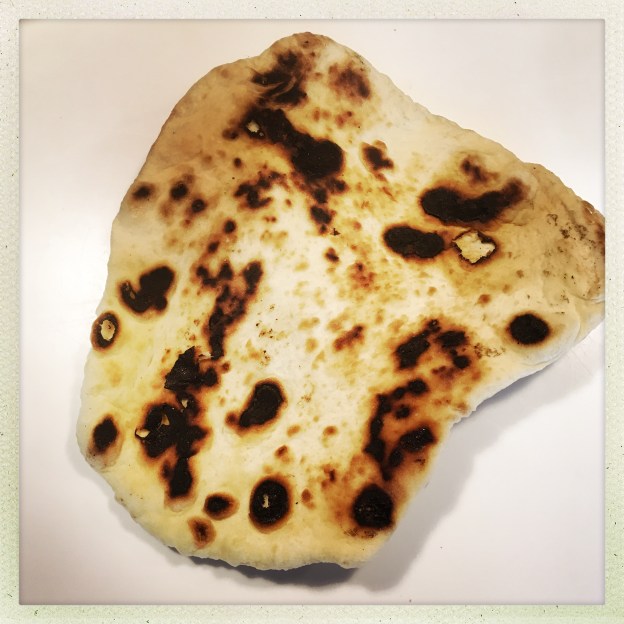
Lavosh

Lavosh are a bit like Italian Linguette – flat breads that you use with dips. They are so easy to make, the dough can be kept, balled up into individual portions for extra convenience, in the fridge for a day or two, ready to be rolled out and baked and you can have fresh lavosh on the table in under 20 mins.

You need, for eight lavosh

1 teaspoon of dried yeast
125ml of lukewarm water
1 teaspoon of caster sugar


300g of 00 flour (or just plain if you don’t have 00)

60ml of extra virgin olive oil

1 teaspoon of sea salt plus extra for sprinkling

1 egg white

Some herbs for atop, I’ve used basil here but you can use anything you like, fresh rosemary would be nice, as would dried oregano.

Mix together the 1 teaspoon of yeast, 125ml of lukewarm water and the teaspoon of caster sugar in a small bowl and give it 10-15 minutes until the top is frothy.

Whilst you are waiting for this mix together the 300g of flour and one teaspoon of salt in a bowl, make a little well and pour in the 60ml of extra virgin olive oil.. When the yeast/water/sugar mixture is frothy, pout this into the flour mixture too, and mix together until you have a rough dough. Knead this gently for a few minutes (if you need to you can do this on a lightly oiled chopping board or surface) leave for five minutes, go back and knead it again for a a minute or so (nothing strenuous is needed) leave it for another five minutes and by this time it should be smooth. Now leave it covered with a tea towel in a bowl in a warm place until it’s risen slightly. You could also put it in the fridge at this stage and carry on the next day with the cutting up into portions and rolling it out.

When it’s risen slightly cut into eight portions. I then roll them up into balls and with a rolling pin roll them out until they are long and thin. You can then cook, as below.

But if you haven’t previously kept the whole dough overnight you can cook some now and some – balled up in portions or as one big lump of dough – tomorrow as long as you leave the dough in the fridge at about 4C.

Basically when you are ready to bake them, preheat oven to 200C.

You can then either place baking parchment on a baking sheet and put the rolled out lavosh onto it, brush with the egg white, press in the basil leaves or whatever herbs you are using and sprinkle some salt. Then cook for about 12 mins until golden brown.

Or what I do is I preheat the baking sheet with the oven and when the oven is up to temperature the baking sheet is hot. I have separately prepared the lavosh onto the baking parchment (I have a re-usable silicon one). I take out the hot baking sheet and gently slide the lavosh on the baking parchment onto the tray. This way the lavosh puff up more but it’s really not necessary. Then bake as before

They are ready to eat pretty much straight away and are absolutely delicious with dips.

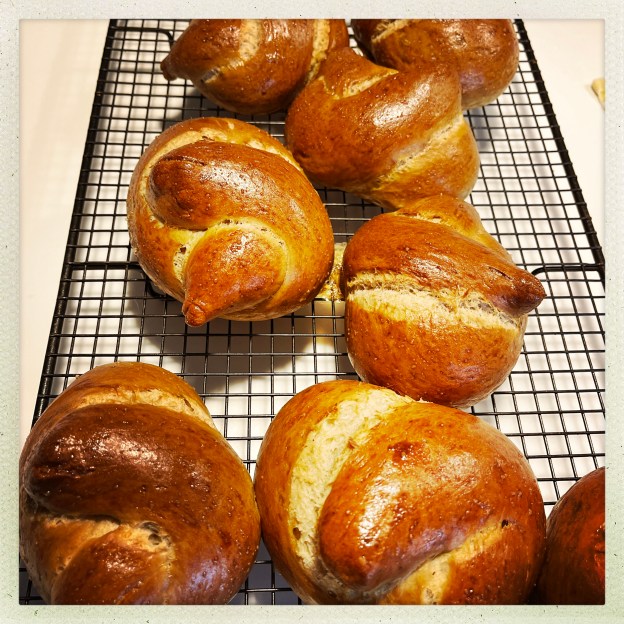
Pretzel Rolls

The food writer Nicola Miller introduced me to what I think is the best bacon roll, from 5 Angel Hill in Bury St Edmunds. Their soft pretzel rolls, filled with salty bacon slices can see me going pretty much all day. Few breakfasts do this.

So when I saw this recipe for soft pretzel rolls in BBC Good Food magazine a while ago, by Edd Kimber (who I think is a genius and the only person I pay for on Substack) I had to make them.

I gave up hope of making them so they looked like pretzels, mine just look like in the picture. They make great rolls for sandwiches, sweet – but not too sweet – and soft. And of course with bacon for breakfast, and maybe an egg. I also really like them on their own.

The baked bicarb bit is a pain but you only need to do it once to yield a jar of baked bicarb which lasts for a good few batches, and it is worth it (I’ve done it without and they are fine but the baked bicarb does add something). I’ve reproduced the recipe here, eversoslightly tweaked, largely to help me as the way it’s laid on in BBC Good Food I always found confusing.

For the pretzel rolls (makes eight)

500g strong white bread flour

7g dried yeast (I use Dove’s Farm)

25g dark brown muscovado sugar

300ml of luke warm water

50g unsalted butter
(I sometimes put 50g of fridge-cold butter into a jug of 300ml of just boiled water and wait til the butter melts, thus cooling the water, and then wait until the water is at the sort of temperature that when you dip your finger in it feels neither hot or cold)

1 teaspoon of salt

For when ready to bake

2tbsp baked bicarb (see later)

An egg for egg wash

Sea salt for sprinkling if you want.

I put all the ingredients for the pretzel rolls (not the ‘for when ready to bake’ bits) into a food mixer with dough attachment and mix for ten minutes. Then I take out the dough hook and leave at room temperature for an hour (less if it’s really hot).

When ready, take the dough out and divide into eight. You roll each piece out into a long sausage and then shape into a U then cross the ends up and over. If you get stuck just YouTube How to shape a pretzel but don’t get fixated on making large holes or gaps. You can also just shape these into little normal buns. Place on parchment covered tray.

Then you can either set these aside for – as the original says – 20 mins (covered with a cloth) or do as I do which is put them in a fridge which is at 4C (on a parchment covered tray, covered with a tea towel). I bake them the next day. Note these won’t keep for ever in the fridge so if you want them the next day, make them late afternoon/evening.

When you are ready to cook, preheat the oven to 200C and bring a large pan of water to the boil put in the two tablespoons of baked bicarb (I will tell you how to do this at the end). Take your tray of pretzel rolls out of the fridge. Depending on how big your saucepan is you put in, say, two pretzel rolls and a time and boil for 20 seconds each side (flip over using the slotted spoon). Take out the pretzel rolls with a slotted spoon and place back on the parchment covered baking tray.

When all are done like this you brush the rolls with beaten egg, sprinkle with sea salt if you so desire and bake them at the 200C for 20 mins. They will be a rich golden brown. As soon as you are able to place them on a cooling rack, off the parchment (otherwise they can go soggy). Wait as long as you can to start enjoying them.

Once cooled these also freeze beautifully, I defrost them in the microwave on the defrost function for about 2 minutes.

Baked bicarbonate

Preheat oven to 120C. Foil line a baking tray and pour a whole tub of bicarbonate of soda (the sort of size you get in the supermarket) . Spread out so it’s all even and bake for one hour. When cool put in a specially marked container so you have it for next time.

Really good focaccia

Beautiful focaccia

I am not short of focaccia recipes. I have ones that use a sponge starter, a sourdough starter, fresh yeast, dried yeast…but this one that I happened upon in Delicious magazine is my favourite to date. it is absolutely…delicious. And fairly quick and easy.

The dough is – be warned – incredibly frisky and difficult to handle, almost impossible to handle at the beginning. But don’t panic and use plenty of oil for your hands (and oil the surface you’re using). You’ll find you have to wash your hands a lot.

I used to do this in a mixer with a dough hook but a note here that the dough is easier to handle if you do the whole thing by hand.

The baking tray I use is approx 37cm by 28cm. It yields a focaccia which is a perfect depth for me.

Ingredients:

500g strong white flour

One and a half teaspoons of fine sea salt

3g/one teaspoon of dried yeast

400g water (make sure it’s not cold, I leave mine out for about 20 mins)

80g of extra virgin olive oil (note: you’ll use this during the stretching process but you’ll have quite a bit left which is okay, you use it just before baking)

toppings: salt/rosemary/chargrilled veg/olives/mozzarella (I use Mozzarella Cucina as it’s a lower hydration cheese but regular mozzarella is fine, just make sure it’s well drained)

Method

Put everything EXCEPT the oil in a bowl, mix up with a fork until it’s all come together, then add a handful of oil from the measured out oil and amalgamate as best you can, then leave it for about 20 mins.

After this, oil a surface/chopping board, again using a bit of the measured out oil to lubricate the surface you’re using (and also your hands) – or you can even use a large shallow tray. Turn the dough out, and gently stretch it out and fold it over on itself a few times. Leave for 30 mins and do the same thing again – stretch, fold. It’s nothing dramatic but you’re trying to get some air bubbles into the dough. Do this once or twice more (leave for 30 mins, stretch and fold) depending on the temperature of the room. You want it a bit bubbly and excited looking.

The recipe says to now put the dough in the fridge for 10 mins. I don’t really do this. After the final rest I pop it in the tray I’ll be using to cook it (I line mine with baking parchment but you don’t have to). Put the dough in, stretch it, fold it, stretch it fold it and then I leave it for about 20 mins to relax. I then stretch it to reach into all four corners of the tin, massaging in all of the left over oil and stick my fingers in to dimple it. At this stage I cover it with oiled clingfilm/more baking parchment (tea-towels tend to stick) and put it in the fridge overnight (I make it in the afternoon if I want it the next day) and cook it in the morning.

If you want to cook it straight away then give it about 30 mins to an hour at room temperature to rest.

I add my toppings before I bake it, top it with salt and bake it in a preheated 220C oven for about 20 minutes. The recipe says to put an oven-proof bowl of water with about 150ml of water in the oven too. Sometimes I do, sometimes I forget. It’s fine.

You want it golden on the top. When it comes out of the oven, brush it with more oil – this is important.

It’s really delicious. Makes excellent sandwiches but isn’t that great the next day (sure you can griddle it to make toasted sandwiches, but…nothing beats what it’s like on the day) – so don’t feel guilty if you eat it all.

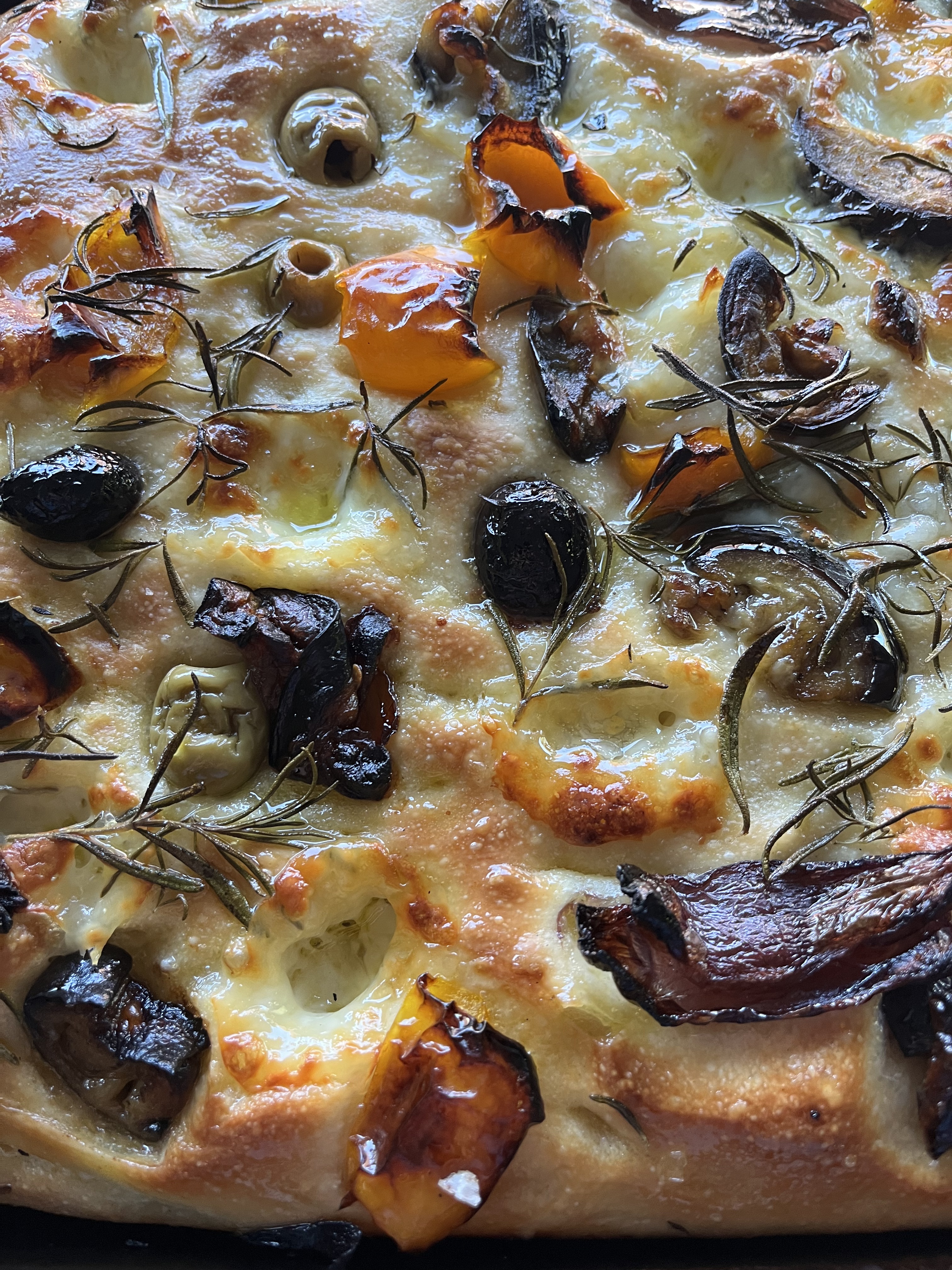
It makes a great centre piece for informal dinners/lunches with cheese and cold cuts and if you add chargrilled veg – and I thoroughly recommend you do (chargrill first) it’s a meal in itself with some crispy green salad.

Here’s a pic of it with some toppings, it makes for a really gorgeous meal about 20 mins out of the oven.


I can tell you how good this was: really bloody good.

Hot oven? Cold oven?

Most mornings I preheat my oven to put the day’s bread in. My oven has a handy timer which means I can come down, the oven is up to temperature (I put the baking tray in the night before) and then I can bake the bread. That’s the usual advice isn’t it? Bread goes into a hot oven.

But one day I hadn’t pre-heated the oven and I only had a certain amount of time to put the bread in so I just put the bread onto a cold baking tray, dusted with polenta, into a cold oven, with my regulation one ice cube on a tray underneath. Then I put the oven on to 250C fan and cooked it for 40 mins (as that’s all the time I had available).

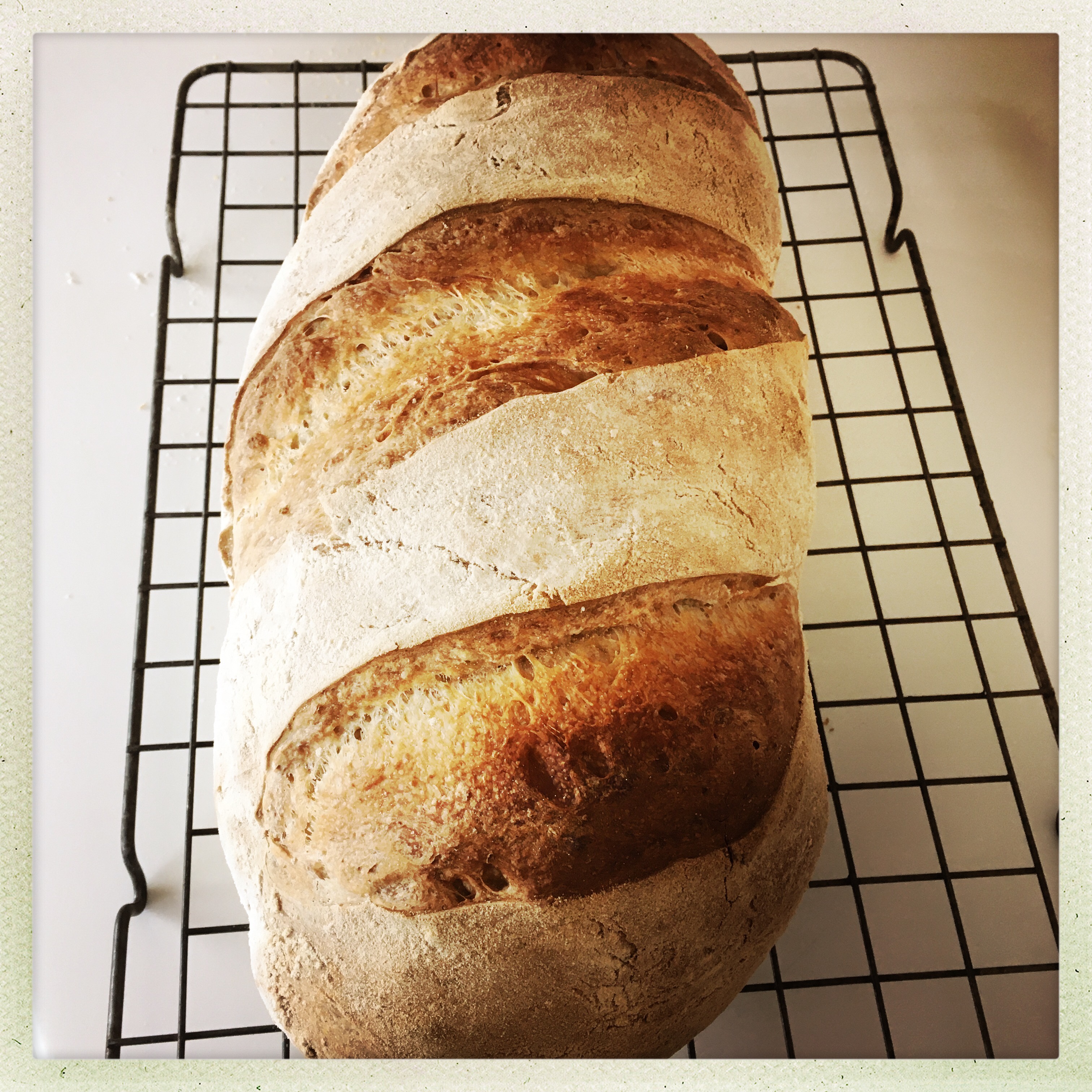
The bread needs a bit longer cooking time – probably 50 mins for a decent crust. But guess what? Absolutely no difference. Here’s the loaf I made today which went into a totally cold oven..


hipstamaticphoto-608024196.859590

Back to retarded proving with sourdough

Like so much of my sourdough bread making, this reminder of how delicious a long prove can be, came about by accident. I’d started that day’s bread and had to go out for the day so I had to stick it in the fridge and pick up where I’d left off the day after.

Although the resulting bread was over-proved (see pic) the taste was sensational. You can tell when the bread is over proved because it has that ‘false ceiling’ look (I don’t know if that’s an accurate description but it is what I call it..), where the bread has risen up and can’t sustain its own, early, promise.

HipstamaticPhoto-603450013.505641

Super delicious but over proved sourdough

I’ve been baking sourdough for over a decade now and, as Dan Lepard so brilliantly put to me one day, sometimes we let success hinder progress. I know my shaping could do with (more) work, but I’ve grown lazy. And because I can make bread, now, I haven’t experimented much. And whilst my sourdough tastes good, a longer prove really improves the flavour.

I don’t do it very scientifically. Sometimes I start the bread with starter/water/flour/salt and leave it, unmixed, for a few hours. Sometimes I’ll take it to the first one hour rise phase and then put it in the fridge overnight and carry on the next day. Sometimes I start it, mix it up roughly and leave it til the next morning (in the fridge) – but if you rest if for a long time and the dough isn’t totally smooth, make sure it’s well covered, otherwise, as per point 2 below, you can get hard bits.

There are no hard and fast rules, but a few things to remember:

  1. You need a good starter to do prolonged proving, so one that’s been refreshed in the last twelve hours.
  2. Don’t leave it at the first (unmixed) stage for too long as hard lumps will form that will be hard to eliminate. Ask me how I know.

But other than that, just experiment. What can go wrong? Put it in and out of the fridge over a couple of days, see what happens. When I’ve finally shaped it, I leave it at room temperature for a few hours before putting it (back) in the fridge for its final rest. I tend to try to always cook it from fridge cold as it’s easier to handle and slash.

The mixture I’ve used recently has been 425g white bread flour with 75g rye. I had previously shied away from prolonged proving with white flour but it seems to be okay. If you need more information about sourdough do a search for sourdough in the search bar or select it in the drop down category menu on the right hand side of this page. If you’re new to it here is a step by step guide I did some years ago.

And if you’re totally new to it and fancy a try, do what I did many years ago: buy Dan Lepard’s excellent The Handmade Loaf. In terms of bread-making it changed my life.

Olive oil flatbreads

These are so useful to make in a batch and then freeze. To defrost simply leave at room temperature for a bit or microwave for 10 seconds and eat immediately.

I love the meditative nature of making these. I make them on a large, flat skillet pan, prepping the ones still to cook by first rolling them into balls, then squashing into discs and finally rolling them out. I do this in stages – a mini production line – so the gluten has time to relax in between. I can’t get these super thin, but then I don’t really want to. They are really soft and tasty.

I keep them warm in my warming drawer whilst making the whole batch, but a very low oven serves exactly the same purpose.

I make eight out of this recipe, you could make more if you made them smaller as individual (as opposed to ‘tearing’) dipping breads.


7g of dried (fast action) yeast

600g strong white bread flour

100ml of extra virgin olive oil (doesn’t have to be super expensive)

350ml of water

half a teaspoon to half a tablespoon of sea salt

(depending on taste. If you’re going to serve these with super-salted food then you don’t have to put too much salt in. The first time make them with the lower amount and see how you go.)

These couldn’t be easier. You mix the 7g of yeast with the 600g strong white bread flour, and mix in the 100ml of olive oil and 350ml of water and, finally, the salt.  Mix to a rough dough just using a fork, and then rest in the bowl for ten minutes whilst you wash your hands and put everything away.

When the ten minutes is up, turn the dough out onto an oiled surface and give it gentle knead for ten seconds, then cover it with a bowl and rest again for ten minutes. Repeat twice more. By this stage you should have a smooth dough, with no bits.

If you plan to make these the same day, oil a bowl, place the dough in it, cover and leave until doubled in size. How long this will take depends on your kitchen. I tend to use a bowl that the original, unproved, dough comes up half way on, that way, I know that when it’s at the surface it’s doubled in size. If you plan to make these later put in a cold place in the fridge (by that I mean, as close to the bottom as possible) for the final prove, you could leave it overnight but I wouldn’t leave it for more than about 12 hours.

When ready to go, take the dough out, lightly knead and divide into eight/how ever many pieces you want to make. Roll into a ball by placing the dough on the flat palm of one hand and cupping the other hand over the top and making circular movements, or whatever works for you.

Then flatten each ball into a disc. Put a dry, large frying pan on a high heat and when you are ready to go roll out as best you can to about 18-20cm – if you’ve divided the dough into eight, obviously smaller if you’re making more than that.

As I said in the intro, you can get into a production line with them, prepping each before it goes on. I get it so that as I put one on to cook, I roll the other one out in preparation so it has time to relax a bit. If you can get them perfectly circular great – I never can.

When ready to cook you slap them into the pan and cook for about 5 mins – if you’re like me you’ll turn them often as I’m a bit of a flipper. You can see they’re done as they brown and go ‘dry’ – no more moist bits. If you need to turn the heat down for the second side do so, but turn up again for the new flat bread going on as it’s the dough hitting the hot skillet heat which causes the bubbles to form, which then blister and blacken.


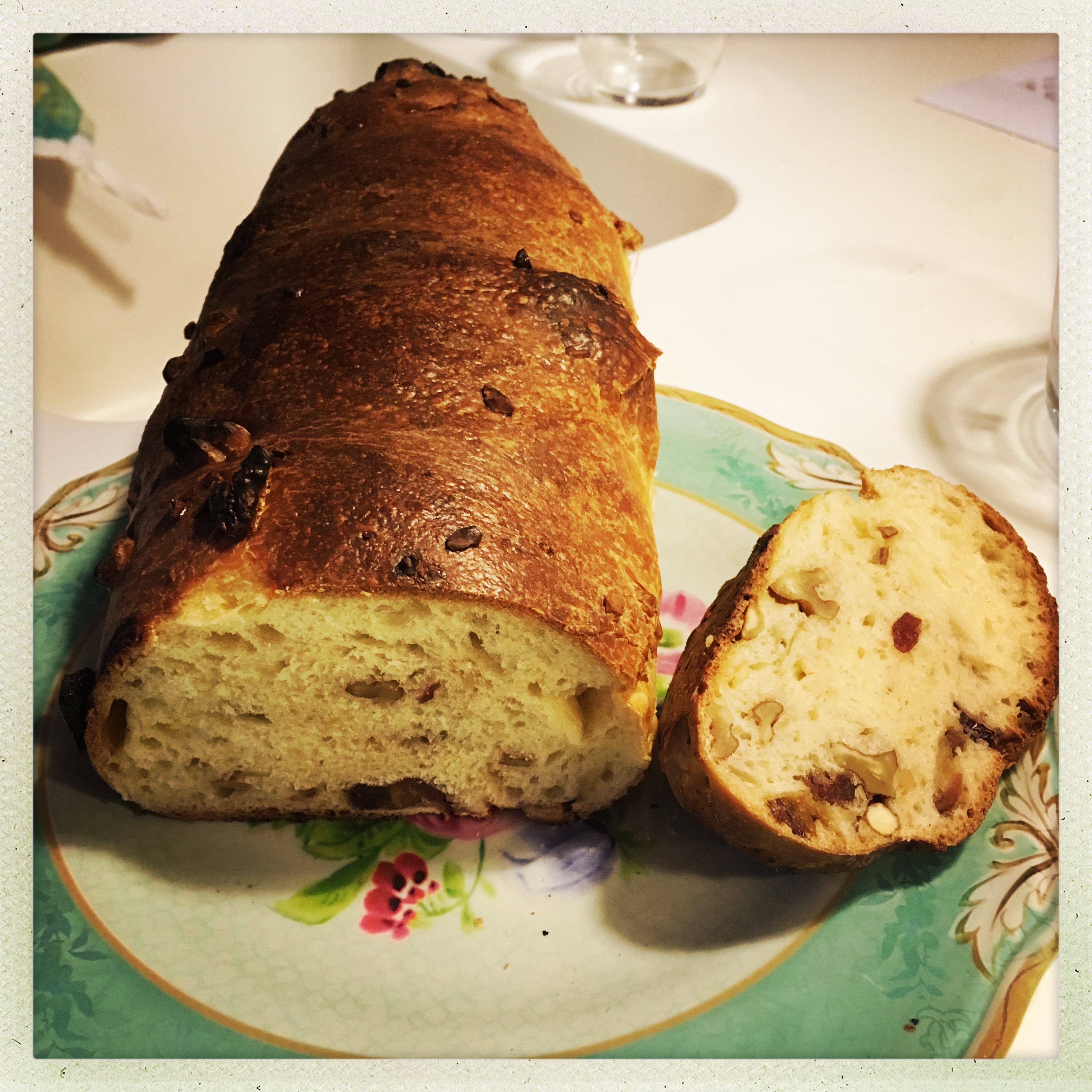
Enriched bread dough with nuts and dried fruit (bread machine)

After I made enriched dough chocolate chip rolls, I thought I’d try making something similar, but stuffed with nuts and dried fruit instead. My mum especially, likes bread like this. She gets something from M&S that is stuffed with nuts and fruit.

I doubled the recipe used before and added 160g of mixed dried fruits and nuts of your choice. The bread was lovely, really soft, tasty and would be lovely with cheese or just eaten with a thick spread of butter. I made two loaves this morning and one is almost already all gone (the other, on its way to my Mamma).

Without adding any bits, these make a fantastic burger/hot dog bun and are now what I use for burger buns. You can also make, bake and then freeze for future use.

This is what I did:

One teaspoon of dried yeast (I use Dove’s Farm)

500g strong white bread flour (you could make this a teeny bit more healthy by using 400g strong white/100g of strong wholemeal, but I never do)

Two teaspoons of caster sugar

50g butter, chopped and added in

Two tablespoons of milk

One teaspoon of salt

Two eggs

175ml water

for later: 160g of ‘stuff’ if you are adding bits: dried fruit, nuts, chocolate chips or a mixture. My every day is chocolate chips and flaked almonds. I’ve now found a great source of very good quality chocolate chips which I can buy in bulk, as it was costing me a fortune. I like the 55% cocoa ones, as they are a good half way house, but you can go higher or lower.

Put everything, bar the fruit and nuts, into the bread machine and set to a dough cycle (mine lasts 2hrs 20mins). You can also easily make this by hand by mixing everything together, leaving for 15 mins, kneading lightly, leaving for 15 mins etc: repeat about four times until dough is really smooth and soft.

When done, take out and put in a bowl and mix in the fruit and nuts. Leave for ten minutes.

On an oiled surface, tip out and knead lightly to make sure everything is incorporated. Leave for ten minutes. Then cut in half and shape: either into a baton shape, a round or buns. I get eight good sized buns out of this but you can of course make them slightly smaller and get more. Place both on a baking parchment lined tray and prove overnight in the fridge (cover with a clean dishcloth).

In the morning bake for approx 12 mins at 220C.

Delicious!

(Apologies if I’ve made any mistakes, I’m typing this whilst also answering 101 questions about Our Generation dolls, posed by my youngest…)

HipstamaticPhoto-533895246.730634