Tag Archives: recipes

Sourdough bagels

I’ve long made bagels and they are a thing of beauty and deliciousness. I have made sourdough ones but not with any regularity. But recently I started making them again. They take a bit more time, in that they need to be left to rise in their own sweet time, far more than yeasted bagels. I rushed them last week and they were dense – still delicious but not so airy and light.

I tend to shape these into little round rolls first and then puncture a hole with a wood spoon handle. I tend to make these with a smaller hole than my yeasted bagels. Who knows why.

Unlike yeasted bagels these can also be left to prove for 48 hours in the fridge (maybe even longer but I’ve never left them that long), so if there aren’t that many of us, I tend to cook a batch up in two lots so we have fresh bagels for two days running. I can’t do that with yeasted bagels as they really have to be cooked the day after making (after an overnight prove in the fridge, ie they don’t ‘last’ that long in the proving stage).

If you want to make them totally vegan then don’t egg wash them.

You can of course use 500g of just white flour, or mix in a bit of wholemeal. I’m always looking for a more gut-friendly diversity so I add Vanessa Kimbell’s Diversity XXX flour. TBH these days I add 10-15% of it into almost all my bakes but here I use 20% (100g of 500g is 20% isn’t it? I failed maths..)

I think this recipe is, at least in part, from Edd Kimber but I adapted it a while ago. (I love Edd.)

What you need:

185g active sourdough starter
250g warm water
1 tbsp of sugar or barley malt syrup
1 tsp of fine sea salt
400g strong white bread flour
100g Diversity XXX flour

I mix everything together in my Kenwood Chef food mixer with the dough hook. I leave it on low for ten minutes. Then I turn the dough out onto an oiled surface, cover it with a bowl and leave it for an hour. After an hour I give it a gentle knead for ten seconds, leave it for an hour and then knead it again for ten seconds. If your house is very cold you might want to do this one more time. I kinda go on dough-feel (and no I’m not very good at it either).

When you’re ready to shape the bagels, when the dough feels lighter and a little more yielding, then cut it into 6/8/10 depending on how many you want to make (this makes eight regular sized bagels for me). I roll into little balls using my hands, then make a hole with the handle of a wooden spoon, stretching the hole out a little.

Place on a parchment lined tray.

I now leave this out, covered with a tea towel, for about another hour before putting them in the fridge overnight. I also think they benefit from coming up to room temperature after taking them out of the fridge but I never have time to do this so I put them straight away into the boil process.

Boiling and baking

Bring a pan of water to the boil. Some people put things in the water to make them more of a bagel (I don’t know what but stuff that makes it apparently taste more bagel-y) I can never be bothered. When the water is boiling I plop two in there – if you can get more in without them hurtling into each other than do. I give them a minute or two until they float and puff up a little, and turn them with a slotted spoon, another minute or two, then take them out and rest them on a tea towel. When all are done put them back on the parchment lined tray, brush with beaten egg if you want and scatter with seeds if you want and cook at 220C for 14/15 minutes. Check after 12.

These are really very good.

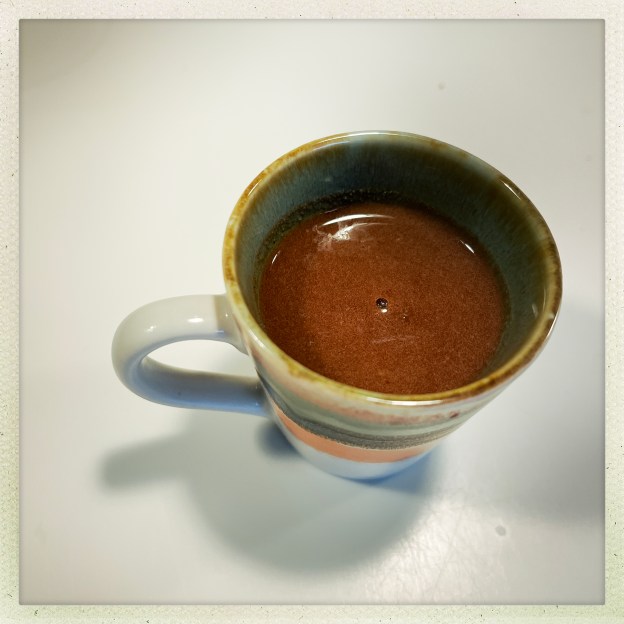
No/low alcoholic chocolate mulled wine (a thing of beauty)

Some years ago I posted about a recipe I’d found for chocolate mulled wine, and indeed I made this for some years. But I stopped drinking about five years ago and life changed and I’d not made it since.

But last week, in preparation for some friends coming round to make wreaths, I decided I’d try to make it again but this time as a no-alcohol version, this was the original plan. This was in part inspired by another girlie-get together a couple of months previously, around the fire pit, where my friend Tracy had brought round some Captain Morgan no-alcohol rum which proved a big hit. I still had some left so I decided to use that as the basis for this no/low alcohol version.

I’m very much not a throw things in a pot kinda girl. I like a recipe and instructions. Sure I sometimes – often – then vary a recipe but I always like a framework to work to. So I was super pleased with how this worked out. I realised, as I started to make it, that I didn’t have the 750ml of liquid the original recipe called for. So I started to panic a bit, looked in the fridge, found some ginger beer, realised that still wasn’t enough to get it to 750ml, panicked some more and added some red wine (hence the low-alcohol title of this post). However you could easily just make this with all no-alcohol rum, or half that and half ginger beer, or what I did. What I did is reproduced below but bear in mind you can, as I did, vary what you use. Add a bit of booze if you like or not.

Chocolate in mulled wine? Don’t knock it til you try it. Don’t be tempted to use anything other than 100% cocoa here. I used Firetree which is the best 100% but you could also use any 100%, most of it is awful on its own but here it could shine. The Fiori di Sicilia essences were, if I say so myself, inspired in this as it adds a wonderfully citrusy note to everything.

Bottled up wouldn’t this make a fabulous present for someone? Shake it up and heat it up before serving. My husband said it was one of the most delicious things he’d ever tasted.

Feeling REALLY pleased with myself over this.

Ingredients:

750ml some sort of liquid, see above. I used 500ml of no-alcohol rum, 150ml of red wine and 100ml of ginger beer. I used this Captain Morgan rum and this gingerbeer.
1 cinnamon stick
1 teaspoon of chilli flakes
1tsp ground mixed spice
5 whole cloves
100g dark muscovado sugar
(you can also use just normal caster/granulated)
80g 100% cocoa chocolate of your choice (I used Firetree), broken into pieces.
A good few drops of Fiori di Sicilia. Of course you can make this without this ingredient but I use it a lot in my cooking and I really think it’s worth buying, you can use it in so many things and it lasts for ages.

Put everything together in a sauce pan and heat through gently until the chocolate has melted. Then either serve immediately or cool, put in the fridge and heat up as required. This will happily see you through Christmas!

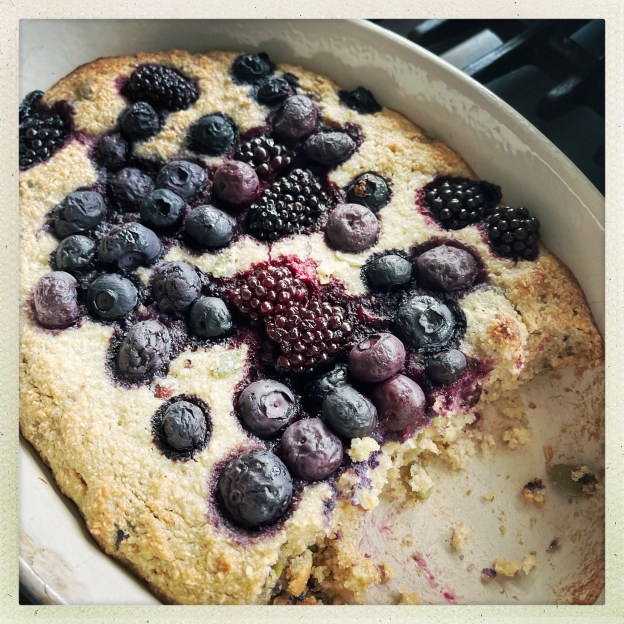
A super healthy clafoutis

So, first up this is from Tim Spector’s excellent The Food for Life Cookbook which you should buy.

I have a very restrictive and healthy diet (no dairy or soya, minimal animal products, nightshades and sugar). Regular cakes, biscuits n ting are a thing of the past. I do taste chocolate as that’s my job, but in tiny amounts. So Tim’s book (as well as some of the Deliciously Ella books: the first one was awful but they’ve got really good since) is a Godsend for me. I still make yummy things for my family and friends but I rarely have anything for me to eat that’s desserty. Don’t feel sorry for me! I look great, have lost a ton of weight, feel pretty good most of the time and can, and still do, eat pasta and bread because my nutritionist – Pr Valter Longo – is Italian!

I didn’t have much hope for this but I made it for some girlfriends and I really loved it and my friend Katie went mad for it, but I thought I could improve it (sorry Tim) and so this is my adapted version.

55g light brown sugar
3 tablespoons of extra virgin olive oil
1 egg
200g kefir (I use coconut kefir)
100g oat bran
100g ground almonds
35g toasted hazelnuts (or nuts of your choice, or more seeds), chopped
35g pumpkin seeds
half a teaspoon of baking powder
Pinch of salt
160g frozen berries or fresh ones (I particularly like cherries when they are in season)
Zest of one lemon

Oven to 200C, oil an oval baking dish (the sort you might make a crumble in, Tims says 23cm round one).

Basically put everything together, mix well, spoon into the dish, whack in the oven for 25 mins. Best eaten warm, it also makes a rather nice breakfast. Serve with whatever you want/can eat. I have mine with coconut yoghurt.

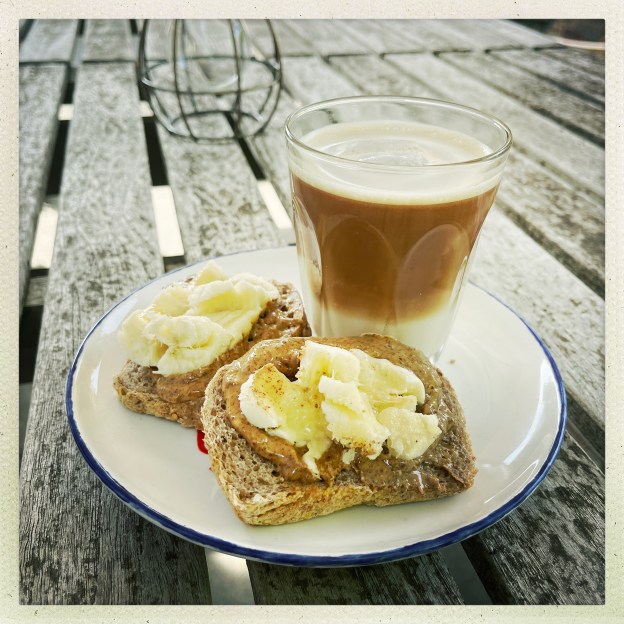
Oat Milk Iced Coffee


I’m always a little embarrassed to post a ‘recipe’ that’s basically just an idea. But tbh I’ve had some of my best tips from people posting mere ideas…

Since I stopped eating sugar and dairy (and soya, nightshades, meat and probably something else I’ve forgotten) to help with my health I’ve felt so much better. But it’d be a lie to say it hasn’t had its challenges. We are a family who loves our coffee and especially in the hot months, our iced coffees.

I don’t know why I didn’t think about it before but actually half a glass of oat milk (or plant milk of your choice), half a glass of ice, and an espresso or two makes an excellent cold drink that’s my new favourite way to drink coffee atm.

However, it seems to challenge baristas when I go out.

“Do you have oat milk?” I ask. “Yes they say”.
“Do you have ice?” I ask. “Yes,” they say.”

“Then could I have half a glass of oatmilk, some ice and an espresso?”

You’d be amazed how often the answer to this is ‘no’. (And listen, my parents ran a cafe for years and I worked there so I know what it’s like to work as a barista.)

Pret can’t seem to handle it and insist on giving me an Americano instead (which alters all the proportions). The coffee bar at my otherwise amazing military club can’t get their heads around it, although just a few feet away the staff at the lounge bar can mak a beautiful drink for me. The waiter at Ottolenghi got it and made it for me himself.

But most of the time I just make it for myself at home, thus saving myself £££.

If you like sweet drinks this isn’t for you. But if you like all the component ingredients you’ll love this. And if you’ve been doing this yourself for years then: good for you. Why didn’t you tell me?

Sourdough (English) muffins


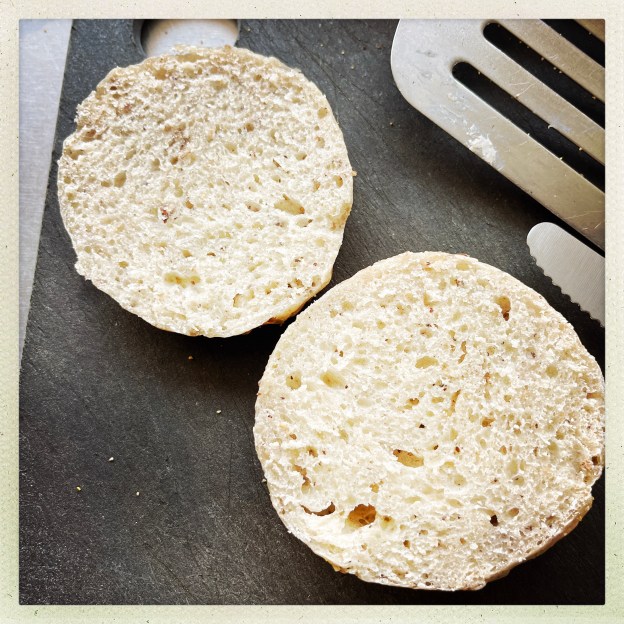
I’ll get straight to the point. These take time to make but most of that time is resting the dough in some shape or form. You have to cook them slow and low. But they are delicious and they freeze really well. I got the recipe from Facebook, from one of the many sites I follow about sourdough. The original says to use active starter, mine was a few days (in the fridge) old and it did it no harm. But I’ve adapted it slightly. You’ll need to start these the day before you want them. The bulk ferment (the bit where it stays out at room temperature for 10-12 hrs or as long as as possible) takes a long time so best to start these in the morning of the day before you want to eat them. Note you cook these on the hob, not the oven.

Ingredients


250g whole milk
115g water
55g butter (unsalted)
20g honey (or sugar, if using sugar add it with the flour)

75g starter
500g bread flour (I used 50g of Hodmedod’s Sourdough School’s Diversity XXX blend and the rest white but you can also use half wholemeal and half white depends how wholesome you want them to be)
A gently heaped teaspoon of fine grain sea salt

Method

Put the milk, water, butter and honey together in a sauce pan and gently heat til all melted then let it cool for ten minutes. If you’re using sugar then add it to the flour mixture next.

In a large bowl – for this is what you’ll eventually mix everything in, add the starter (sugar if you are using) and then add the milk/honey/water/buttery mixture and mix everything together, now add in the flour and salt. You’ll get a rough dough. Cover it and leave it to rest for 30 mins.

Now over two hours, every thirty minutes, you give it a gentle knead/fold and stretch. When this is done put in a clean bowl (oil with some olive oil) and cover it with a tea towel or a plate if you have one big enough. You leave it out for a looong time for the bulk ferment, or as long as you can. The original recipe says 10-12 hours. But if your kitchen is raging hot then probably half this. I think I left mine out for about 7 hours. Then transfer to the fridge for a day or two. I left mine in for two days.

When you’re ready to make them turn out the dough on a clean surface/board that’s been oiled or lightly floured and roll out to about 1.5cm thick. You don’t want it too thick. Get a biscuit cutter that’s the size you want the muffins to be – mine was about 6-7cm – and cut out as many as you can, transferring them to a baking tray which has either been lined with baking parchment or dusted with polenta. Re shape the dough and roll out again until you’ve used it all up. You’ll have one left that you’ll probably shape by hand. This will be the sacrificial muffin.


Leave out like this, covered with a tea towel, for about an hour. Heat up a cast iron frying pan – big as you got – but make sure you have a lid for it. You can also use a Le Creuset but make sure the heat is low. You can’t rush these babies.

When the pan has warmed up put in the sacrificial one to try out the heat of the pan and how long they take. It’s really worth doing this. Of course I thought I knew best so I ruined four finding out the hard way that my heat was too high.

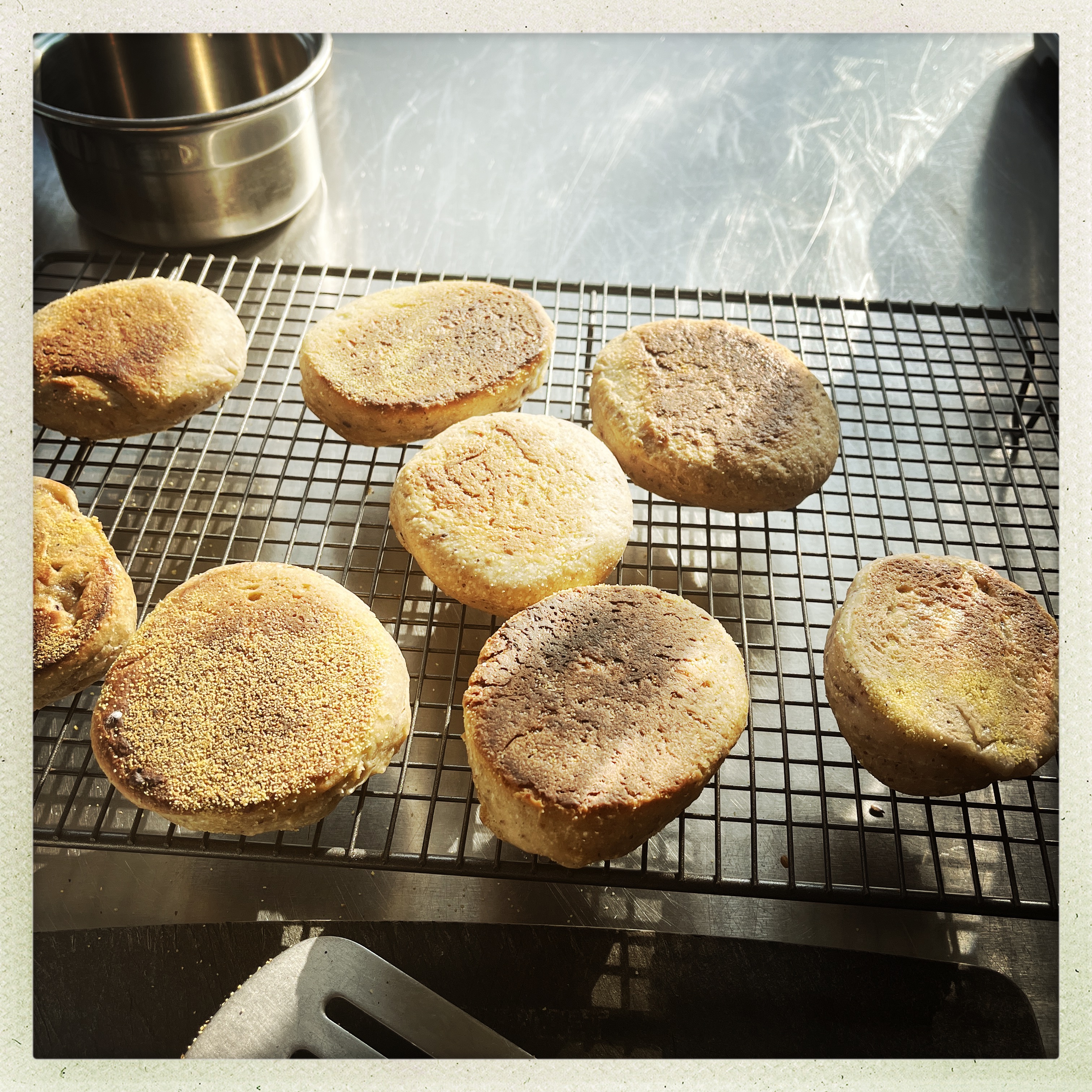
Eventually I worked out mine took about eight minutes each side, on the lowest gas setting. You want them to be gently brown, when done turn over and do the other side for eight minutes. Keep an eye on them, it’s easy for them to burn but be raw in th middle (this is also why you don’t want them to be too thick to start with). Note they do puff up a bit when cooking.

Cook in batches, put on a cooling rack and then eat. With bacon and egg, sausage, cheese and chilli jam, hummus and carrot, whatever you like. They are SO tasty and freeze beautifully. Of course you can also toast them but I had mine fresh.

Carrot and Cardamom cupcakes

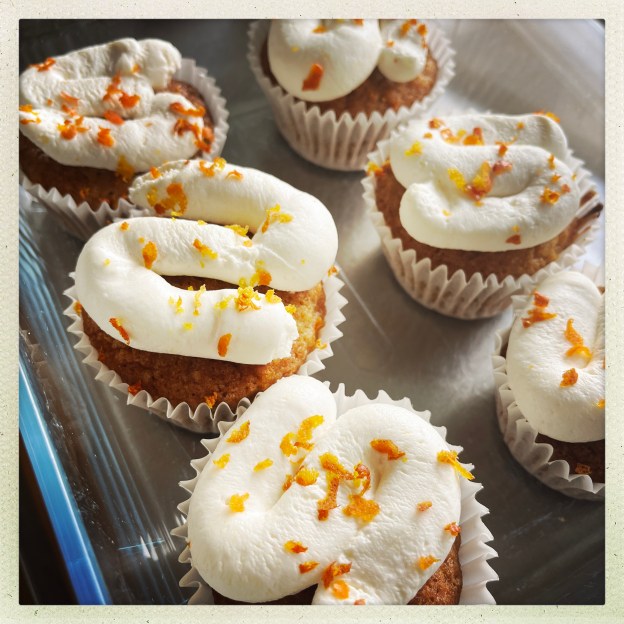
These are delicious, fresh and light and adapted from a Waitrose recipe which you can find here.

I changed the frosting as I can’t bear an overly sweet one and the addition of the Fiori di Sicilia is, if I say so myself, inspired…

Unfortunately they don’t travel well and need to be kept in the fridge – if you can let them chambré at room temperature for a bit before eating. I guess you could make this into one giant cake but not sure why you’d want to…

Ingredients for the cakes

12 cardamom pods
175g light brown sugar
200g self raising flour
Half a teaspoon of baking powder
Quarter a teaspoon of fine sea salt
2 eggs
150ml of olive oil
200g of carrots, coarsely grated (I hate grating things)
Two oranges, preferably organic as you are using the zest. You’ll only need the zest of one for the actual cakes. So if you’re short you really don’t need two but the zest, grated, as a decoration – see later – does look nice.

Ingredients for the icing/frosting

250g mascarpone
85g Greek yoghurt
55g icing sugar
Optional but wonderful: a good few drops of Fiori di Sicilia essence. You can also add this into the cake mixture if you prefer.

Oven to 180C.

You’ll need a 12-hole muffin tin lined with muffin papers. Open the cardamom seeds, discard the shells and grind up the little seeds as best you can. It’s good if you’re in a bad mood here as you can really bash away with a pestle and mortar.

Whisk together the sugar, flour, baking powder, salt and the ground up cardamom when ready.

In a separate, larger bowl whisk together the eggs and olive oil then pour over the dry ingredients with the grated carrot and zest of one orange. Gently mix until combined well and then pour equally into the muffin cases.

Bake for about 20 mins until a skewer comes out clean and they bounce back when gently pressed (careful not to burn a finger). When done take out and let cool completely (I take them out of the tin, still in their cases of course, about ten minutes out of the oven).

You can make the frosting whilst they are cooking and put it in the fridge for later. Here you just mix the mascarpone, icing sugar and yoghurt together with a few drops of the Fiori di Sicilia. You should have a fairly thick mixture. If it’s not thick enough for you (and sometimes it isn’t due to the water content of the dairy) then add a bit more icing sugar.

When the cakes are cooled you can ice the frosting on – it looks really good if you can be bothered to do this but I admit sometimes I just can’t be so I just spoon/spatula it on thicky and then, if you had another spare orange, grate zest on top. Voilà.

Sourdough sandwich loaf

I’ve been making sourdough for fifteen years, either in a boule shape or a baguette shape or, sometimes, as little rolls. But the thing I really wanted at times was a soft sandwich loaf, but made with a sourdough starter.

There are lots of recipes for such going round the internet and this is one and it’s lovely. I sometimes add a bit of wholemeal flour, or some seeds, but there’s no doubt this should be predominantly white flour for that full soft sandwich experience. The one pictured here used a wholemeal starter but otherwise 100% white bread flour.

It makes for a very soft loaf that produces great sandwiches and is nothing like its crusty trad-sourdough boule cousin, lovely though that also is. Also fantastic toast. Some recipes I’ve seen use butter, in the dough and to brush the top with, but I don’t eat butter so I use olive oil. This makes two small loaves or one big one. I make mine in my Pullman bread tin which is 33cm x 10cm. I’ve yet to leave the lid on all the way through cooking to make a perfectly square loaf. What I do is leave it on for the first 20 or so mins then take it off for the last 10/15 mins.

Anyway this is what you do:

600g bread flour, white or a mix (see intro)
300g tepid water
150g sourdough starter
30g honey
30g extra virgin olive oil
10g fine sea salt

This is way easier and less hands on than traditional sourdough and you rest it in the tin you will cook it in, so no banneton needed. What I do is put everything in a stand mixer and mix it up with a dough hook for ten minutes. Then I rest it for an hour and give it a gentle knead and fold after one hour, then rest it for another hour, then give it another gentle knead. Then I place it in the tin it will be cooked in (I sort of roll it up like a giant swiss roll but you can also shape it into two boules and place them end to end) and let it rise at room temperature for as long as I have but until it kinda doubles in size.

Then I put the lid on (but if you don’t have just cover it with a tea towel) and put it in the fridge overnight.

In the morning I take it out and leave it at room temperature just for as long as the oven needs to come up to temperature: 250C.

Then I put it in the oven (if you have a Pullman, with the lid on if not do I need to point out you don’t put the tea towel in the oven?) for 15 or so minutes then take the lid off and let it cook for another 15/20 mins at 220C. As soon as it comes out coat the top of it with more olive oil (or melted butter).

It keeps really well for several days and like I said makes great toast.

Chocolate Chestnut Rum Roulade

I’ve made this every Christmas for over twenty years. Last year, I went to look up the recipe on line (it was a Waitrose recipe from Iceland) and it had gone. It was a ‘404’. I panicked. Despite an extensive internet search nothing came up for it.

More panic. This is my pièce de resistance every Christmas, and my children love it so much they have, on occasion, requested it for birthdays.

But luckily – amazingly – I had made a note of it in my Travelling Cookbook which I started up years and years ago to commit my favourite recipes to paper. But if that goes…so finally I’m going to commit it to technology for me, and all, to enjoy.

I won’t say this is difficult. It’s not. But it’s not always perfect and it is a roulade and involves rolling, like a Swiss roll. It’s not super easy but just go with it and don’t worry. It’s delicious and look, no flour.

Ingredients

For the roulade

170g 70% chocolate, broken into pieces
170g caster sugar
Five eggs separated
1 teaspoon of vanilla extract
Three tablespoons of hot water (see note later)
Icing sugar for dusting

For the filling

Three tablespoons of icing sugar
115g unsweetened chestnut purée
Four tablespoons of sour cream
100g cooked, peeled chestnuts chopped
Two tablespoons of rum (or liqueur of choice but then it’s not rum roulade!)
285ml of double cream

Method

Now, those are the ingredients above. I admit what I now do is buy some vacuum packed chestnuts, whizz some up and use the rest chopped. Because otherwise I tended to get left with lots of left over chestnut purée. But you do what works.

Preheat oven to 180C. Lightly oil a shallow baking tray of approx 34cm by 24cm and then line with baking paper and very lightly, again, oil. TBH you’re probably fine with just the baking parchment/paper but this recipe is from like 25 years ago so just reproducing what they said at the time..

Now melt the chocolate in a bowl, on top of some simmering water and as ever, do not let the bowl touch the surface of the water.

In a separate, large bowl, beat the caster sugar with the egg yolks until thick and pale and creamy. Add the vanilla extract to that.

Once the chocolate has melted and cooled a little, stir in the hot water until smooth then gradually add into the egg/caster sugar mix. Now again, I’m not sure what the hot water does. I’m quite skilled and fearless with adding hot water to chocolate but chocolate can and will seize if the water you’re adding is too hot or cold, so you might want to leave it out. Gently stir the chocolate until smooth and then gradually stir this into the egg and sugar mix.

Now again separately, whisk the egg whites until they hold soft peaks. Quickly and gently fold them into the chocolate mixture and pour the whole lot onto the lined tray, spread evening and put in the oven for fifteen minutes.

Remove and immediately cover with a sheet of baking parchment and a clean tea towel and leave until cold. Don’t leave it too long though or it will crack when rolling it.

Whilst that’s happening, mix the icing sugar into the chestnut purée, followed by the sour cream and chopped chestnuts. Pour the rum/liqueur and double cream and whisk until peaks, then partially fold the rum/cream into the chestnut cream so you have a marbled mixture. You could technically do this in advance and keep it in the fridge but it’s a perfectly good thing to do whilst the roulade is cooling.

Now the originally recipe asks for you to spread out a large sheet of baking parchment on a clean work surface, liberally dust with icing sugar and then gently turn out the roulade onto it, peeling off the baking parchment.

I don’t do this. To me this is adding too much faff and precariousness. So what I do is I take the sponge off the baking sheet – already on baking parchment – and I use that as the base. If you want, trim the roulade of any rough edges but I don’t – it’s all good. Spread the marbled cream on the roulade and then carefully roll up the roulade from the long end. It may crack – do not panic. What I do is I then sort of mould it/hold it together with cling film (just on top using your hands to do this you don’t take the roulade off the plate to do it it just helps keep it together if that’s what it needs) and put it in the fridge until it’s time to serve it. Then I peel off the cling film and then I sprinkle with icing sugar and decorate it. I’ve made this so many times and sometimes it cracks, sometimes it doesn’t and there seems to be little rhyme or reason. It’s always delicious and it reminds us that, even cracked, things are still beautiful.


Chocolate chestnut cake (a perfect alternative to Christmas cake)

I discovered this recipe in Delicious magazine (the original is here), a couple of years ago. I’m a total sucker for chocolates and chestnuts which is why I paired with Lumi to make Chocolate Chestnut Truffles. (Please note I don’t make any money from these truffles and never have.)

Anyway I made this and it has become a bit of a classic in our house and I like to make it in the run up to Christmas, when you want to give yourself over to festivities but aren’t ready for the full Christmas pudding/Christmas cake yet. Not that I ever make either – I do like them but in small doses. At Christmas in our house I make Chocolate Chestnut Rum Roulade (which I really need to add to this blog before the recipe slips away).

The original recipe calls for a very small cake tin – 16cm. I toy every time I make this with buying a special tin but feel so reckless doing this as I have so many cake tins already. However, the smallest diameter one I have is 20cm so that’s what I make it in and it’s absolutely fine. But if you want a taller, more towering cake then you may want to invest. The cooking time doesn’t seem to change, for me, in the wider tin.

You need:

60g sultanas, put them to soak in 60ml of port, sweet vermouth or whatever nice liqueur you have. I think Cointreau is nice but this year I soaked mine in Plum Liqueur forgetting, foolishly, that I had some Panettone flavoured spirit which is divine (from Selfridges). Give them a really long soak.
100g butter cut into little pieces, it can be from the fridge
300g vacuum packed chestnuts
130g crème fraîche (original recipe calls for 130ml but I just put in 130g as I measure everything into a bowl, atop the scales)
30g plain flour
half a teaspoon of cinnamon
half a teaspoon of ginger

200g of 70% chocolate, chopped into small pieces
3 eggs, separated yolk and white into separate bowls
60g caster sugar

Later, for the ganache

100g 70% chocolate, again chopped
160ml double cream


A tin of 16-20cm (see intro) lined with baking parchment, at the very least on its base, and oven preheated to 160C.

What to do:

First things first: put the sultanas to soak in the liqueur of your choice. I tend to do this in the morning of the day I want to cook, but you can also do it the night before. When you do use the sultanas you’ll need to drain them of the liqueur and if I time it right, I use the liqueur in the cranberry sauce I make (I just stir it in once the cranberries are done, but you could also do it before they cook). If this doesn’t work for you you could whip some cream up with the left over liqueur, to serve with this cake.

In a food processor, blitz together the crème fraîche and the chestnuts.

In a separate bowl mix together the flour, spices and a pinch of salt.

Now you want to melt the chocolate and butter together over a saucepan of simmering water. Make sure the bowl doesn’t touch the water, and you want to take it off before all the chocolate is melted – just carry on stirring – or the chocolate may seize up. I do this part – the chocolate and butter melting – on a fairly large bain marie and I end up using the top part of the bain marie to mix everything together when the time comes. But otherwise, don’t worry: just get a big bowl and decant your chestnut and crème fraîche from the blender into that and this will be your bowl where everything, eventually, meets.

Once the chocolate has melted, put it aside to cool for a bit – about ten minutes. Then mix it into the chestnut and crème fraîche mixture; one at a time stir the egg yolks into this mixture, until everything is fully mixed and then add the flour/spice/salt mixture.

Whisk together the egg whites until stiff, then take a little of the beaten egg whites and mix it into your cake mixture to loosen it. Then taking a large-ish metal spoon as it makes it easier, gently fold the egg whites into the cake mixture. Don’t forget the sultanas, if you haven’t drained them do so now and add them into the cake mixture. It will be a fairly thick mixture, level it out and bake it for 30-35 mins. I admit mine took a bit longer, more like 40mins but the numbers have worn out on my oven dial so it’s possible it was too low. It’s done when a few crumbs of mixture are still clinging to a testing skewer.

Leave to cool for ten minutes in the tin, then turn out. The bottom of the cake will become the top of the cake. You can easily do this bit the day before but, day before or not make sure the cake is thoroughly cooled before you ice it.

To ice the cake, put the chocolate and cream in a bowl again on top of a pan of simmering water. Again: do not let the bowl touch the water underneath. Stir until the chocolate is nearly all, but not quite, melted then take off the heat and keep stirring.

Let the ganache cool for about ten minutes then slather on the cake using a spatula. You can then adorn it quite opulently if you like or leave it plain. It is quite a plain looking cake but there’s no shame in that. The original suggests things like sugared almonds, marron glacés, sugar sprinkles…you get the idea. In the photo here I used caramelised white chocolate and praline covered pistachios which are beautifully green on the outside. I got them from Melt and I loved the colour contrast (not to mention the festive green). They are insanely expensive so I’m only giving you this as an idea, not suggesting you spend all that money on buying a cake topping decoration.

Store in the fridge but bring out for about half an hour to chambré before serving. Truly delicious. And rich.


The best flapjacks you will ever make (a bold claim)

Many years ago, I co-founded a parenting website called I Want My Mum (so named because I said this a lot when I was pregnant and after I had my first born). It was a small but wonderful little site and many of us are still friends today. Aside from mothering tips we also shared recipes.

From somewhere I got this recipe for flapjacks and they were amazing. I shared it on the board and then lost it and then over the years wondered how I’d ever find it when anyone ever talked about flapjacks…. But a wonderful woman called Sarah Green saved it and started making them.

Recently I asked on Facebook if anyone (I’m friends with lots of ex-IWMMers) just happened to have it. “No,” a few said “but Sarah Green makes the best flapjacks”. Sarah was at choir but when she came back she said “the recipe I use is the one YOU posted all those years ago.” The fact she had kept the recipe (and was so generous, she could so easily have just said it was her recipe, after all it wasn’t actually mine, I got it from somewhere) made me unfeasibly happy.

So to avoid having to hunt for it again, here is the original recipe with Sarah’s additions.

250 unsalted butter
Grated ring of one unwaxed orange
325g golden syrup
325g rolled oats (Sarah sometimes replaces 50g of oats for 50g of oat bran which is a great idea)
75g light muscovado sugar

Preheat oven to 180C/350F/Gas mark 4. You need a tin of about 28cm x 20cm which you line with baking parchment.

Put the butter, orange rind, golden syrup and brown sugar in a pan set over a low heat and stir until the butter has melted and everything is coated. The add the oats to the pan and mix it together. Tip the whole lot into the tin and spread evenly.

Bake for 15-20 mins. Don’t overcook or you’ll lose the lovely chewy texture. You know it’s done when it’s just beginning to go golden brown around the edges but don’t panic cos the mixture will be really soft still.

Leave in the tin to cool completely and it will set. Don’t be tempted to take it out before it’s cool. When it is, take the whole thing out of the tin, holding the edges of the baking parchment and cut into slices as desired.

I will make these again and post a picture but in the meantime enjoy them!