Category Archives: Wheat free

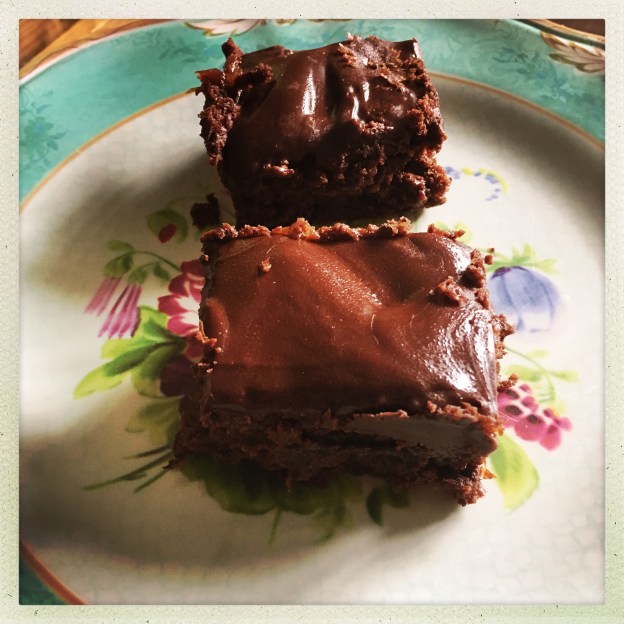
Prune and dark chocolate brownies

I saw this recipe in my Donna Hay Fresh and Light magazine, which costs me a staggering £9.50 from Selfridges but is, to my mind, worth every penny as each edition yields more recipes than many recipe books which cost double that.

But I saw it and shunned it as I’m not overly a fan of brownies – too sweet for me usually. But due to a rather terrifying health scare a few weeks ago (I had tests and everything is not only fine but I am actually in really good health yay!) I’ve overhauled the way I eat which was long overdue because although I have always eaten with health in mind, I’ve I’m also greedy and at times lazy. So I’ve gone back to planning what I eat (this has always worked really well for me) and maximise nutrients. And it not only shows in the way I feel, but I’ve lost weight and body fat, whilst augmenting my muscle mass (I do big weights twice a week).

Anyway I shunned them but then was fancying a weekend chocolatey treat and decided to try them and I was not disappointed. Now I know that this isn’t a recipe which magically transforms broccoli into brownies, and I know that prunes are very high in sugar. I know all this but prunes have more nutrients than mere sugar and here’s the thing. These are delicious in their own right. My eldest doesn’t like them but my youngest adores them and my partner – who hates brownies – had one and declared it “the best chocolate thing I’ve tasted in a long time”.

So these are still an occasional treat (I only eat stuff like this at the weekend now) but they’re delicious and gluten free.

The brownies

255g prunes, take the stones out

50g of dark chocolate, melted (Hay asks for 70% but I use these chocolate chips for nearly all my cooking now and they are delicious)

60 ml of light olive oil

80ml maple syrup

1 teaspoon of vanilla extract

80g ground almonds

25g cocoa powder (I use raw organic, no idea if it’s better but it makes me feel better looking at the packet)

2 eggs

The chocolate ganache

80g dark chocolate

60ml of cream (Hay says to use coconut milk but I used cream as that’s what I had, you could use milk)


Pre heat the oven to 180C. You need a 20cm square baking tin, preferably with a removal bottom, if not make sure the baking paper you line it with comes up the sides so you can carefully lift it out later. If you scrunch up the baking paper first it sits in the tin more easily.

Take 170g of the prunes and put them in a jug, cover with boiling water for about ten minutes. I scissor cut the remaining prunes into small pieces and put in a small bowl for later (don’t forget them!) or you could of course chop them with a knife on a board.

Drain the prunes (discard the water) and place in a bowl with the rest of the ingredients for the brownies and whizz up with a hand held blender (or you could put in a food processor, I did as I was told). When done, scatter in and mix in the prune pieces. Put the mixture in the tin and cook for 25-30 minutes. The middle should be firm when pressed but you do want them a bit squidgy.

They will be very soft, so keep in the tin and when cold gently take out. Make the ganache by very gently heating the chocolate and cream in a small pan (I would never usually melt chocolate like this, I’d use a bain marie set up, but I was hungry and it was fine). Spread over the top. If you can, wait a while before slicing up and eating. Store in the fridge where they do harden up.

IMG_7999

I have no idea how long these last as they were practically all gone in 24 hours.

Note: the main image is the brownies a day later, after being taken out of the fridge, the image in the text is of them first iced and sliced – with some missing for, ahem, testing purposes.

Note to self: Put walnuts in next time.
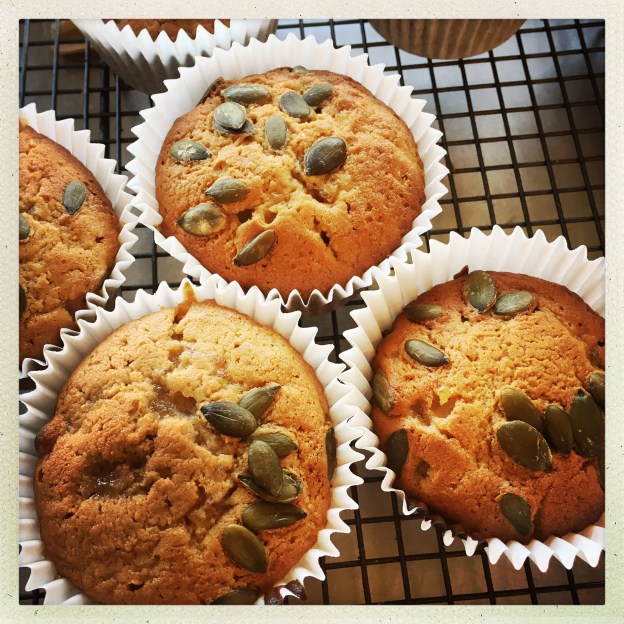


Chestnut marmalade muffins (gluten, wheat, dairy free but don’t let any of that put you off). AKA Marcus’s Muffins.

These are adapted from a Hugh Fearnley-Whittingstall recipe (from his book Light & Easy).

The original calls for 75g coconut oil, which I just find too much, but have since subbed very successfully with extra virgin olive oil and 75g runny honey, which I originally eased back on just ever so slightly but now (as I update this in Feb 2026 and after 18 months of eating very little sugar) make with just 10g of honey. I would start with closer to the original to see how you like them. But just 10g of honey is plenty sweet enough for me.

His recipe also says cook for 25 mins, but mine are plenty done after 20 mins, sometimes sooner.

It calls for chestnut flour – which isn’t cheap, nor madly readily available. But is delicious and so filling. Don’t be tempted to buy it in bulk, it doesn’t keep for very long.

And you really need an electric whisker unless your arms are super strong. If they are, all respect to you.

These are just so delicious though, and gluten-free if that’s important to you. I love anything to do with chestnuts as it reminds me of my Pa.

Note these make ten. I’ve been making these for a few years now and every time, with my 12-bun tray, it catches me out.

I think of my friend Marcus, who died in 2017, when I think of these. I made them for the first time when I visited him in the hospice. I think I was possibly stupid, or in denial, that I didn’t realise he was dying. “La Speranza’, my parents used to say, ‘è l’ultima d’andare’. Hope is the last thing to go.

Anyway he was very jolly that day and these muffins are forever, in my mind, associated with him.

125g chestnut flour

A pinch of salt

2 teaspoons of baking powder

125g marmalade (I use the St Dalfour Thick Orange Spread which has no added sugar just the fruit sugars)

2 large eggs

70g runny honey – I now use 10g.

half a teaspoon of vanilla extract

50g coconut oil, melted and cooled. I use extra virgin olive oil now.

Pumpkin seeds to sprinkle.


Preheat the oven to 170. Line a muffin tin with…muffin cases

Combine the flour, salt and baking powder and set aside.

In a food mixer with whisk attachment, put the eggs, honey and vanilla and whisk for, frankly, ages. But about eight minutes. Until the mixture is like a thick mousse and the beaters leave trails when you lift them out.

Now gently and slowly, with the mixer running, spoon in the flour mixture and when all is incorporated whisk again for a few minutes. The mixture will go down to a batter-type one. When done, trickle in the melted coconut oil/extra virgin olive oil,  with a tablespoon of water, and whisk for half a minute more. Take off from the mixer and just with a spoon fold in the marmalade.

Spoon the batter into the TEN muffin cases (with less honey I actually only get nine out of them). They won’t come up all the way, that’s how it should be, about 2/3 full. Sprinkle on the pumpkin seeds and bake for  about 20 mins – check after 15. They should be golden and bounce back when you touch them. Depends on your oven of course.

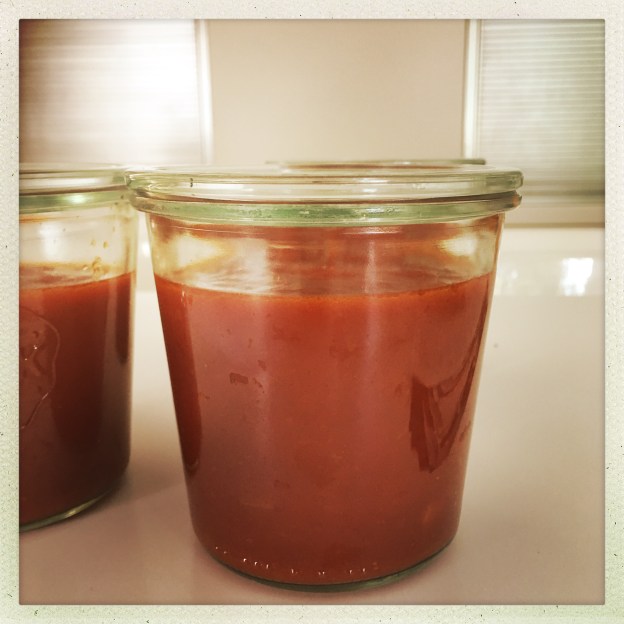
The very best tomato sauce for pasta.

In Italy, August is the month of  ‘i pomodori’. Where they make pasta sauce for the whole coming year. The tomatoes are boiled, ‘passati’ (literally ‘passed’ through a sieve), reboiled and bottled. There is a lovely video here which shows you.

Because it’s quite a job, it tends to be done with everyone pitching in. It’s very low-tech (or used to be). Because the raw materials are the sweetest tomatoes the salsa you get (or passata) is incredible.

I never hoped to reproduce that in the UK, but my mother makes a very keen contender in her kitchen, in central London. She has even made it in my kitchen. I have tried to replicate it, I have watched her do it. I have bought the exact same ingredients as her, but it’s never the same.

If I have frozen salsa, and I serve it up on some pasta at a later date, my children can tell, immediately, if it’s ‘Nonna’s salsa’ or mine. They say her secret ingredient is salt, and love. And it’s true I tend to under salt things. For this I didn’t and went large with the salt.

It was a secret shame of mine, that I couldn’t make salsa as good as hers or any of my Italian relatives. Not because there is any shame in it really, but because, well, I cook a lot and you’d think this simple thing would not be beyond me. I tried cooking with plum peeled tinned tomatoes, chopped tomatoes,  fresh tomatoes, roasted tomatoes (this does work very well but is another layer of work), passata, all of the above and added tomato puree to it…but nothing came close. It all tasted too ‘new’ and didn’t have that complex taste, it always had a ridge of acidity, and none of the thickness of my family’s salsa.

“You needa to cooka it for a long time,” my Ma says – to take the acid out of the tomatoes. But whenever I tried I burnt it.

This year, I decided I really needed to step up. My mum and all the female relatives who hold the secret to good salsa are all…getting on.

So this is what I did. It’s so simple I am embarrassed I never tried it before and you will be disappointed there is no real secret recipe. Well there is. The secret is it’s really simple.

Warning, you really need a slow cooker and I think this goes some way to compensate for the fact that you are not using super red, sweet tomatoes from southern Italy. I have this one and it is a wonderful bit of kit which I use regularly and thoroughly recommend.

You take:

A jar of passata, I use Cirio’s Passata Rustica, 680g

One onion

A big pinch of sea salt

A clove or two of garlic if you like, chopped

Some very good olive oil (the better the better) – don’t skimp, this gives the sauce flavour

That’s it. Don’t add water or anything else. You finely chop the onion and fry it in the olive oil. I do this in my slow cooker as it has a saute function. When soft, you add the garlic if using and cook for a minute or so. It is at this point I add the salt but you can add it at any point, even at the very end, but give it a good stir through.

If you can’t saute in your slow cooker, and have been doing this on the stove top in a pan, you now add the onion, garlic and any remaining oil to your slow cooker. Then the passata.

Put down the lid and you cook it in the slow cooker, on low, for hours. At least six but 12 if you can. Then you take it out, cool it, use it all at once or store it in glass jars in the fridge (it keeps for a good few days) or freezer.

You can easily double/triple etc this recipe so you can make a batch up every few weeks and store it in the freezer so you are always good to go. And you will always have super-wonderful home made salsa for your pasta or pizza or whatever.

You can add herbs later but honestly, you just don’t need to. Yesterday I did as above, but cut up some sausages and stuck them in (lightly sauted first but you don’t need to) – you could also put meatballs in. I cooked it overnight for 12 hours and it was superb on pasta for lunch.


Leek and butter bean soup with crispy kale and bacon.

This is a lovely soup. What I also love about it is that you can leave the bacon off and it instantly becomes veggie/vegan. It’s stuffed full of probiotic-friendly leeks. It’s from the BBC Good Food magazine.

You need

4 tsp olive oil

500g leeks sliced

4 thyme sprigs, leaves picked

2 x 400g cans butter beans

500ml vegetable stock (or chicken if you like)

2 tsp wholegrain mustard

half a small packet of flat leaf parsley

3 rashers of streaky bacon

40g chopped kale, stems removed

25g hazelnuts, roughly chopped

You do

Heat 1 tablespoon of oil in a large saucepan, add the leeks, thyme and seasoning and  cover and cook over a low heat for 15 mins until soft, adding a splash of water if need be – don’t let the leeks stick.

Add the butter beans with the liquid from the cans, the stock and mustard. Bring to the boil and simmer for 3-4 mins until hot. Blend with a stick blender in the pan (or put in a blender). Stir through parsley, check seasoning.

Put bacon in a large frying pan, medium heat. Cook until crispy, set aside to cool. Add the remaining 1 tsp oil to the pan and tip in the kale and hazelnuts. Cook for a few minutes, stirring under the kale is wilted and crisping at the edge and the nuts toasted. Cut the bacon into small pieces and stir into the kale/nuts.

Reheat the soup, adding a bit of water if too thick (or have both operations going on at once) and sprinkle the bacon/nuts/kale on top.

Polenta ‘pizza’ with cherry tomatoes and some sort of cheesy topping.

This is not, of course, pizza. But it is delicious.

Polenta featured large in my father’s home cuisine – northern Italy. But it didn’t feature in my mum’s – southern Italy. And because my mum was the cook when we were growing up, I feel I can safely say we never had polenta. I would hear about it, but I could not get my head around what it was. Sometimes it was a powder, then it was solid, then like mash.

When I got older I tried making polenta and it was a disaster. Since then things have improved and it features in my home cuisine and I always find it comforting.

This recipe is from Delicious magazine. I like that the making of the polenta doesn’t involve loads of butter and parmesan – sometimes you want that, but not all the time. Of course you can vary the topping to have what you want on it. Because my children aren’t so keen on dolcelatte I bought some brie with truffles in it as a treat.

Anyway this is just delicious. It easily fed four of us and I had the left overs for lunch the next day (heat up for a few minutes in a dry frying pan, if you can cover it to catch the steam) and it was wonderful.

2 courgettes, sliced thinly (I used a potato peeler)

200g or so of cherry tomatoes, halve them

Olive oil for drizzling

600ml of milk

400 ml of chicken stock, either your own or made from a cube

250g instant polenta

50g cheddar, grated (or use some other cheese it’s okay)

80ml of passata

80g of dolcelatte or brie, thinly sliced

a handful of basil leaves to scatter

Method

Heat the oven to 200C. Spread the courgettes and tomatoes over a large baking tin, drizzle with the oil, season with salt and peper and roast for 10 minutes. This bit is important as you won’t be cooking the finished pizza for long enough to get the courgettes and tomatoes sufficiently roasted. When done set aside but leave the oven on.

Meanwhile, put the milk and stock in a large sauce pan and bring to the boil. Put the polenta in a jug and when the liquid boils, pour the polenta in a stream and stir continuously with a wooden spoon or large whisk. You want the mixture to thicken and bubble on the surface, like larva. Now turn down the heat and stir in the cheddar and season well.

Pour the polenta mixture onto a baking sheet (I find some baking parchment helps but is not essential), spread out thinly to a circular or rectangular shape. Spread the passata over – it will be very thin. Top with the roasted courgettes/tomatoes and the thin slices of cheese. Bake for 15-20 minutes until golden. Scatter basil leaves atop.

You can serve this with a salad but I like it on its own, with one fork, and my feet up on the sofa.

Besto pesto

Pesto is not something I have ever made particularly successfully. Lord knows why. It is not difficult or complicated. My eldest can make it before she takes her coat off (but has washed her hands) after school. But the pesto I make never makes me shut my eyes, momentarily transported, and go ‘mmm’.

A friend called Vonetta first made me pesto, with farfalle shaped pasta, when I was in my 20s. Incredibly, I had never had it before. It does not feature highly in the cuisine of my father’s province: Parma, nor my mother’s: Avellino.  Italian cuisine is incredibly regional you see – there is very little cross fertilisation; each region fiercely proud of everything they do and determined it can’t be bettered. They rarely invite in new dishes, however old.

I made this pesto in a great rush, after tearing the recipe out of a magazine (the superb Donna Hay’s) as an afterthought. As I orchestrated dinner, and everything came together a bit too fast, a bit too suddenly, I didn’t have time to taste anything until I was sat at the table, and then I was blown away.

This pesto was the basis for another dinner, which I will post another day, which was so successful, that my youngest, who likes almost nothing savoury that I make aside from my sourdough bread, ate four helpings.

For now, here is the pesto recipe, ever so slightly adapted:

Ingredients

80g baby spinach leaves

25g basil leaves

150g roasted cashew nuts – these are absolutely key, and they must be roasted. I gave mine about 4 mins at 190C, watch them carefully.

1 clove of garlic

1 teaspoon of salt (I used pink Himalayan salt just because I had that in)

The juice of half a lemon

The zest of one small lemon

2 tablespoons of olive oil

2 tablespoons of water

Method

(Note: no parmesan, that is correct!)

Put the spinach, basil, cashew nuts, garlic, salt, lemon juice and rind in a food processor until everything is well chopped and blended. While the motor is running slowly add the oil and water. Scrap down the sides of the processor if need be so everything is finely, and uniformly, chopped. That’s it. Use it there and then, keep it for a few days in the fridge or freeze it for another day. It’s superb in pasta, of course, but also spread as an extra layer in sandwiches, in salad dressings or used on cauliflower pizza.

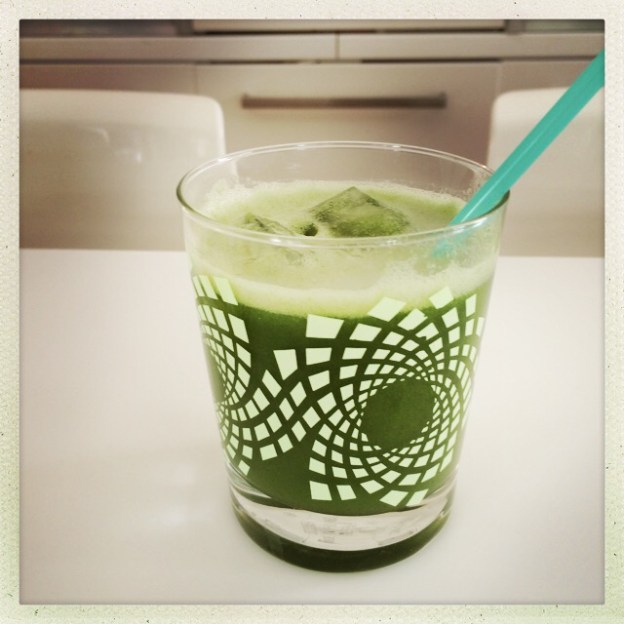
Zingy green smoothie: cucumber, spinach, apple, mint, lime, ginger

I know there are loads of debates about smoothies and how much sugar they contain. I agree that you should consume more vegetables than fruit. But, if you eat the whole fruit – either by actually eating it or blitzing it into a smoothie – then you get lots of fibre (both insoluble and soluble), vitamins, minerals and antioxidants. The rise in diabetes isn’t due to people eating too much fruit in its whole, natural form; it’s eating too much refined sugar in sugary drinks and too many refined carbs that busts your pancreas.

Anyway, this smoothie is really zingy and my partner loved it, but my youngest struggled with it – she prefers something that contains banana/berries at its base.

I always put a cube of frozen spinach into my smoothies. Okay, not always, but mostly.

Anyway, for this one you need, for four small glasses:

About 20g frozen spinach (or fresh of course)

Half a thumb size of ginger – be careful, if it’s fresh and good it’ll be quite powerful. I used half a thumb size and it was a bit too much for the children, adults loved it though

The juice of one lime

Half a bunch of mint, you know those bunches you get in the supermarket that cost about 85p (rip off)

Half a small cucumber, washed, not peeled and cut into chunks

One medjool date to bump up the sweetness and fibre a bit but you can leave this out

Apple juice. I get mine from our local farmer’s market, it’s really good but if you can’t get really good apple juice then blend in an apple (not the pips) and some water

Put all the ingredients in a blender/Nutribullet and taste it: because lime sizes vary and the recipe isn’t precise, you may need to add that date, or a bit more apple juice or water or cucumber. The ginger and mint are strong tastes, the cucumber calms it all down, the apple juice adds liquid and sweetness.

i think this would be really good if you had a cold. I can still feel the zingy effects over an hour later.


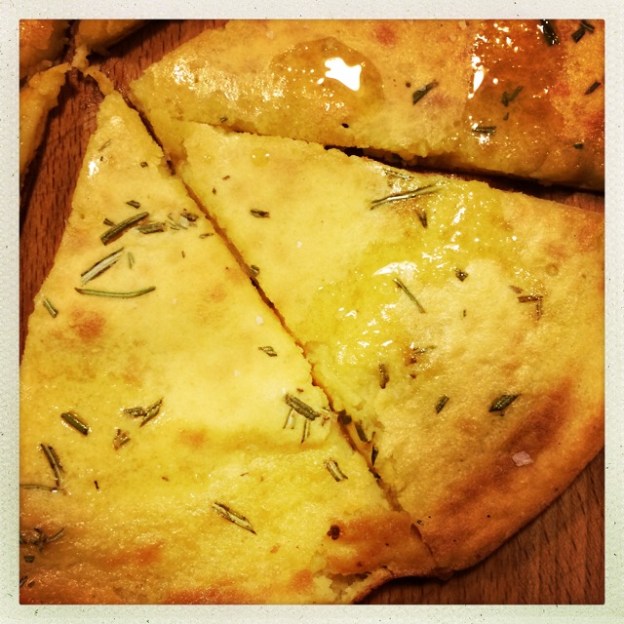
Farinata and Friday night Tray of Treats

We used to do our main shopping on a Saturday as this is how things naturally fell, and it coincides with market day. And I do love a market. This meant that, come Friday, the fridge was a little bare and, often, my partner would be away on Friday. He is really good at conjuring something out of nothing in the kitchen, a skill my mother also has but not one that I’ve inherited.

I’m not bad at cooking but I need to a) be in my own kitchen b) have ingredients c) have a plan. Thus it was that, often, on a Friday, I would want and need to pull together a dinner for me and the children made out of not very much. And this is where I invented the Tray of Treats.

This is basically a fun and slightly misleading name for leftovers and bits dragged out of the depths of the fridge and cupboards. Although, these days, it’s become such an institution that we do tend to shop specially for Tray of Treats, back in the day it was crudites, bits of cheese, ham, bread sticks and whatever else could be cut up and look small and canape sized.

This is where these farinata come in. (Farinata literally means a ‘flouring’.) They are great as last minute bread, easy to make, gluten free and need almost no prepping. The slathering of extra virgin oil and salt makes them, so don’t skimp on this bit, because that would be to miss the point of them.

I use a 26cm skillet and it makes two big ones, which you slice up into wedges. Chickpea, or gram flour, is high in protein so these are gut-bustingly filling. These are also great little snacks to serve with a drink of an early evening.

150g chickpea flour

Two tablespoons of extra virgin olive oil plus extra for drizzling and cooking – use the best you have

half a teaspoon of baking powder

One teaspoon of salt, plus sea salt for sprinkling

Fresh rosemary sprigs, chopped

Pour the flour, the two tablespoons of olive oil, baking powder and salt in a mixing bowl and, using a balloon whisk, whisk through 300ml of cold water. I use filtered water. If you use normal water be aware you might get a bit of scum on top of your batter after resting, if so, just skim it off. I never get it, and you may not.

Whisk this up until you get a batter. Now if you want to make the farinata now, rest the batter for ten minutes and heat up the oven to 240C, if not, put it in the fridge for later and just remember to heat up the oven before you start. The batter keeps for a day or so so you can also make one pancake today and one tomorrow (they are delicious with curries).

When ready to cook, put some extra virgin olive oil – about a tablespoon – in a frying pan that can go in the oven. I know it seems wrong to use extra virgin to fry with, and I don’t normally, but it works here trust me. Spread the olive oil around so it coats all of the pan, let it heat up and then pour half the batter in. When the mixture starts to bubble, scatter over the snipped up rosemary leaves and cook until the sides are golden, then transfer to the oven for ten minutes.

You know it’s ready when it’s crisp at the edge and has a soft centre. Flip it out of the pan (it should come out easily) sprinkle with sea salt and drizzle, generously, with the extra virgin olive oil. And marvel, at how few ingredients can make something so delicious.

My lovely Italian friend Sonia, who is a very talented chef, and from Livorno (where farinata originates, although it’s called torta di ceci there and they sometimes have it in between two slices of bread!), contacted me to tell me that the way I make it isn’t authentic: you shouldn’t use rosemary or extra virgin olive oil as it ‘overpowers the delicate taste of the chick peas’. This is apparently how you do it properly (it’s in Italian, sorry). But I love my way so will continue to do it like that, but, you know, authenticity is important so it’s good to know what one is mucking about with…

Lovely, nutty tasting (but with no nuts) poppy seed oatcakes

These are wonderfully nutty tasting, and you’ll be convinced there are nuts therein. But there are no nuts. They are very frangible, so don’t roll them too thin, and when cooked don’t be too rough with them. Lovely with some cheese, of course, but I also sometimes have them for breakfast with some almond butter and a smidge of apricot jam on top.

Being full of oats ‘n’ seeds, they are particularly good for you, too.

(Note: I’ve put these under gluten free, oats are naturally gluten free but some have gluten in due to the manufacturing process so look at the packet your oats come in.)

These are from Hugh F-W’s Light and Easy book.

150g medium oatmeal

150g porridge oats (not the jumbo variety, if you have those, give them a quick spin in a food processor)

One tablespoon of ground linseeds

One tablespoon of poppy seeds

One tablespoon of sunflower or pumpkin seeds, or half of each

half a teaspoon of salt

75ml of sunflower or other tasteless oil

You will also need 100-150ml of boiled water

Baking parchment


Oven to 180C.

Put all the ingredients, save for the oil and water, into a bowl. Make a well in the middle and now add the oil and mix the ingredients around. Add 100ml of just boiled water and mix to a sticky wet dough, if you need to, add up to 50ml more but try not to if possible. This will seem like an unpromising dough and won’t be like a smooth dough, such as you may be used to.

Now you need two sheets of baking parchment to roll the dough out. Not too thin. Cut into squares – just free form with a knife, you don’t need to be madly exact. Hugh recommends cutting the square in two so you get triangles and I like this shape, too.

Don’t be tempted to use a cookie cutter. But do ball up and re-roll any off cuts. I shaped the last one by hand, in a butter-patting style.

Put on baking parchment lined baking tray and cook for 20-25 mins until just coloured. These give out a lot of steam (cos of the water) so be careful when you open the oven. You don’t want them too cook too much and be too dark, but equally they do need to be cooked so if your oven is temperamental, check after 15 minutes. The surface should be dry – no bubbling bits of steam – but not too coloured. Mine took about 22 minutes in a quite fierce oven. You may need to cook in two batches, I did.

This makes about 20-24, depending, on course, on the size.


Date and ginger biscuits (gluten, refined sugar and dairy free)

I haven’t gone gluten, or dairy free. I am incredibly fortunate that I can, thus far at least, eat what I want. And I do. Last night I stuffed my face with cheesy Wotsits (I love a flourescent food stuff sometimes). Today, for the first time in eight years, I went into a supermarket and bought a loaf of white sliced and we had toasted sandwiches for Sunday lunch.

But generally, I do eat really well and also, I do like to try new things and double-also I like to have a little biscuit or something every day, and it kinda helps, now that I’m no longer 19 years old and seven stones, to think of my health ‘n’ stuff.

(Whilst I’m vaguely on the subject of healthy eating, has anyone else noticed that saying you’re on a ‘whole food plant based’ diet seems to have replaced saying “I’m vegan”? I’m not saying this recipe is vegan btw, because it’s not – it contains eggs – but I’ve noticed this phrase a lot lately..)

So I found these in Hugh F-W’s new book Light and Easy (which thus far I really like although have only tried a few things). They are choc-full of good-for-you ingredients, have no refined sugar, no dairy, no wheat, no gluten and although they absolutely won’t be to everyone’s taste, they are to mine and also my youngest loves them (incredibly). They are not overly spicy or gingery, and make a great little snack when you need a treat. But are also – thanks to the fibre and protein – rather satisfying and sustaining.

You need:

200g pitted dates

15g peeled ginger, roughly chopped

2 eggs

250g ground almonds (this is not a cheap biscuit recipe..)

a quarter of a teaspoon of bicarbonate of soda

One and a half teaspoons of ground Chinese five-spice

Pinch of salt

Flaked almonds for topping if you so wish

What you do:

Oven to 170C. Baking parchment or magic carpet type sheet onto a baking sheet.

Put the dates and ginger into a food processor. Not a blender, but a processor (it’s sticky and if you put this in a blender I wouldn’t want to be you cleaning up afterwards). Whizz up for a couple of minutes until the mixture is really sticky and everything is evenly chopped up. This is also the time you realise you have bought unpitted dates as the processor will start making an awful sound and then start smoking.

When the mixture is all mixy, then you add the eggs and process again until you get a nice sloppy mixture – takes seconds really. Now add all the other ingredients and pulse for a few times until everything is, how can I put this? Mixed. You will have a very sticky dough. Either drop spoonfuls onto the tray or wet your hands slightly, roll into a ball and then flatten – which is what I do. I make mine about 5cm wide. They don’t really spread out so you can pack them fairly tight – but not touching – onto a baking tray. Top with flaked almonds if you so wish (this is my addition).

I bake mine for 15 minutes and this is plenty. Hugh says 20. They should be golden but not too dark and have a ‘slight give’ in the middle. I can lift my straight off the tray, with my hands, onto a wire rack to cool.

That’s it. Eat and feel virtuous.