Perfect trousers, not just for Christmas

It isn’t madly often I can recommend trousers but here is why these are good:

They come in various colours. I like this choice even though, of course, I stick to black and navy. (I may tip toe into taupe in the new year, who knows, I do live in the country now.)

They are slim fit, skinny I guess, without being unflattering. But you can tuck them into boots which I wear every day because, have I mentioned, I live in the country. I got these after seeing a picture of me wearing normal trousers with a wind behind me and realised I didn’t need that much fabric around my legs.

They have a gentle stretch which means you can eat over Christmas, still look good, but without feeling as if your trousers have given you gastric band surgery.

However, they have a proper waistband. This is terrifically important over any holiday season. Never wear elasticated trousers long term. And here‘s why.

They are not fucking hipsters. God I hate hipsters. I hate watching women pulling up their fucking hipster trousers because they are falling down. And that’s just me, watching my own reflection. Yet they are not so high waisted that they make you feel like you are in an ad for  incontinence pads. You know the ones.

They are the perfect waist-band height, I think

Anyway, I think they are optimum trousers for this winter. For Christmas, for beyond Christmas. They are corduroy, which I like, they are also apparently slightly thermal (‘heat tech’). I can’t say I have noticed, but I haven’t been cold. When I bought them they were on offer at half price, but sadly they’ve gone back up to £29.90 now.

White chocolate and berry cheesecake

I’m mindful, at this time of year, of having lots of people to cater for at once, and also the value of being able to Do Things In Advance.

I made this at the weekend, for a lunch party at a friend’s house where I was asked to bring pudding. The value of this is that it feeds lots – easily 12*. It not only can, but has to be made in advance. It looks good, but can also be brought out after a meal, to sit on the table for many hours without spoiling and be picked at (‘I’ll just tidy it up’) as guests get drunker and drunker.

I didn’t have a tin big enough, so I made this in one large rectangular Mermaid tin and a smaller tart tin. But this cheesecake is so good that I think it’s worth buying the right size tin for it as I will be making it again.

A few notes:

I put in 300g of frozen mixed berries as that’s the packet I had, and didn’t see the point of keeping back a handful of berries.

Yes you do put the berries in frozen.

Do build the crust up to a good height at the sides, although this mixture didn’t (for me) rise up, there is a lot of it and if your sides aren’t high enough, you’ll be at a dam-bust situation.

It may be an idea to put the tin on a baking sheet to catch any drips – I didn’t have any but see my point just above.

It definitely took an hour in my oven, maybe a few minutes more.

That’s it. This is a good one to keep up your sleeve for party season and the other great thing about it is that * you can cut the slices as thin or thick as you want, so it could feasibly feed may, many more than the predicted dozen.

Here is the recipe.

Prune and almond loaf

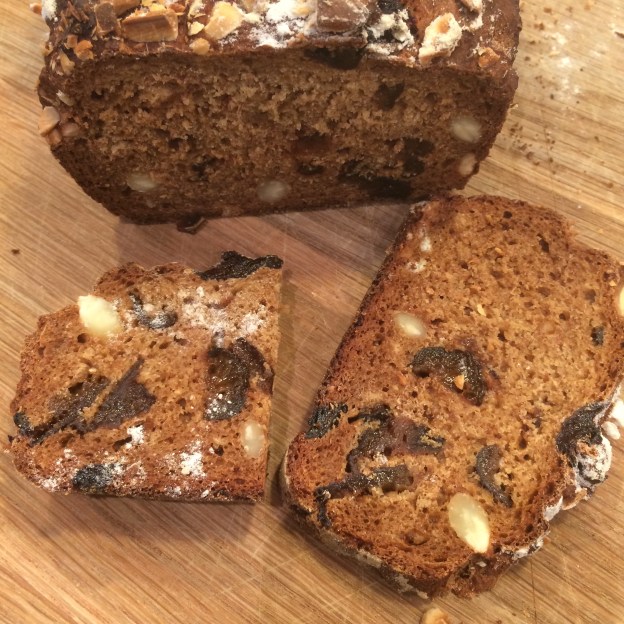
This is a magnificent bread recipe, adapted from the equally magnificent Donna Hay magazine that was out this summer.

It’s fantastic when you need something bready, fast, and it is SO delicious. No yeast or proving is necessary. And come on it’s got nuts and prunes in! Good for you..

I’m not going to pretend some of the ingredients are ‘store cupboard’ but aside from the buttermilk, nothing will go off quickly so if you get them in you’ll have something to rustle up over the Christmas period if you (gasp) run out of food, or even if you need to bring something to someone’s house as a little present.

This loaf, with some nice cheeses and a cheese humidor, would make an excellent gift for a cheese-loving friend. But it’s also good with pate.

Ingredients

125g plain flour (not bread flour)

125g wholemeal plain flour (not bread flour)

1.5 teaspoons of bicarbonate of soda

half a teaspoon of salt

100g whole blanched almonds (not the end of the world if you have them with their skins on) – you could also, if you wanted to, use other nuts such as walnuts or hazelnuts.

85g pitted prunes, chopped up

40g maple syrup – this really adds something to it so try not to substitute it for something else

190g buttermilk (you can use kefir if you make it, instead)

65ml of sweet sherry (one of my readers has said she uses very strong Earl Grey tea for this)

Method

Preheat the oven to 200C. Lightly grease and flour a 2lb loaf tin. (I use this one.) Place the flours, bicarb, salt, almonds* and prunes into a bowl and mix up. Make a well in the middle and add the maple syrup, buttermilk and sherry. You will have a very sticky dough, slop it into the tin, whack it in the oven for about 35-40mins and that’s it. Leave to cool for five mins, turn it out, let it cool and then eat it with joy.

(*The astute amongst you may notice there are nuts on top of my loaf. This is what the original recipe stipulated – that you reserve half the nuts and scatter them atop the dough before it goes into the oven. I’m not sure I would do this again as some of the nuts got a bit too brown, but see how you feel/what sort of effect you want.)


Dense chocolate loaf cake

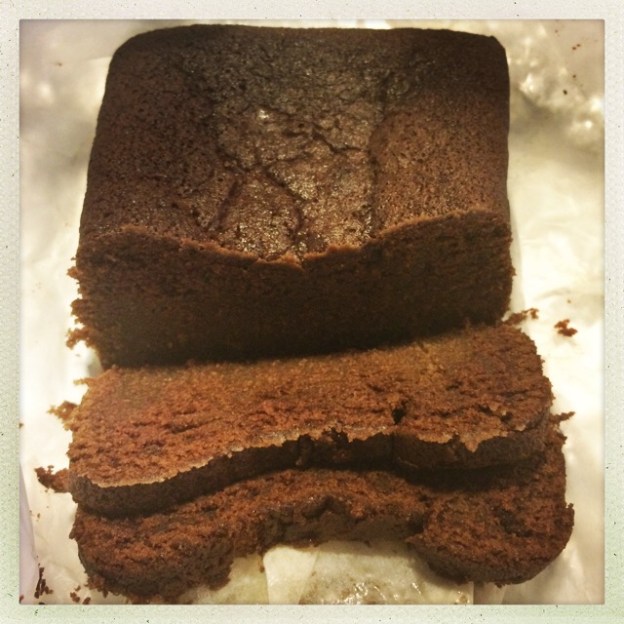
This is a lovely chocolate cake that I’ve been making for years. It’s so simple, yet so good. I’ve put it up here for my friend Kate who has never, to my knowledge, asked me for a recipe. But she did after tasting this on Saturday. It’s a cake that keeps, a bit like gingercake, for a good few days wrapped in parchment and foil. Ideal for taking for weekends away, picnics, lunchboxes

I don’t know a child who doesn’t like this – and it’s rare I can say that; and, slightly warm, and with custard or maybe some cream, makes a nice, simple pudding.

It’s originally from Nigella Lawson’s How to Be a Domestic Goddess, but, like a lot of Nigella’s recipes, God love her, I’ve cut down the sugar dramatically (yes, really and it’s still at 250g!) and changed the flour around a bit.

225g very soft, unsalted butter

250g dark muscovado sugar

2 large eggs

1 teaspoon of vanilla extract

100g dark chocolate (70%), melted

150g plain flour

50g wholemeal plain flour

1 teaspoon of bicarbonate of soda

150ml boiling water

A 2lb loaf tin, about 23x13x7. Mine one is bigger. If you want to use two smaller loaf tins you can, cook for less time: 20min for first part, then 10minutes.

Preheat oven to 190C.

Line the loaf tin – this is really important as this is a very moist cake and it will fall apart if you have to wrestle it out of the tin. If possible leave some baking parchment overlapping so it lifts out easily.

Put the chocolate on to melt – in a bowl above a pan of simmering water, making sure the bowl doesn’t touch the water. When melted, set aside to cool slightly.

Cream the butter and sugar together with a wooden spoon, then add the eggs and vanilla. Now fold in the cooled chocolate. Mix the flours and the bicarb together.

Now you’re going to add the flour mixture and the water, a spoon at a time, stirring well between each. This is important. If you add the flour and water too fast, the boiling water will cook the flour into little balls and you’ll end up with little white flour balls in the cake. I know because I’ve made this many, many times and tried to cheat the system and it doesn’t work.

You’ll end up with a very runny batter. Put – pour- in the cake tin, and if your tin is very up to the brim already, it may be prudent to put a baking tray underneath to catch any spills. (This is why I use an even bigger loaf tin than recommended. I can’t bear to lose any to the oven.)

Cook for 30 mins, then turn down to 170C and cook for a further 15 mins. I do this exactly and end up with a very squidgy, moist cake. If you use two smaller loaf tins, cook for 20mins and then 10 at lower temperature. The top should be set and there shouldn’t be any discernible ‘wobble’ (or not much) but a skewer inserted may still have some crumbs attached due to the moistness of the cake. Don’t overcook.

Let it cool completely before taking out of the tin. It will sink a bit in the middle, don’t worry, it’s meant to. If you don’t eat it all immediately, wrap in parchment and foil and enjoy a slice every day.


Alcohol laced creams. Mmm.

Today I was in Waitrose and I found these flavoured creams. They have a really long sell by date (the ones I picked up today were sell by 10th Jan), I guess because they are pasteurised and have booze in them.

The two I picked up were laced with amaretto and spiced plum and dark rum Channel Island creams. I picked up two because they were on offer: two for £4 instead of £2.65 each, so it seemed mathematically wrong not to have two.

You hear what I’m saying.

There was also a Cointreau one and a Remy Marten one.

Anyway they are pretty fab. You can put a dollop in hot chocolate for adults, or do as I did tonight: spooned some of the amaretto cream onto some crushed amaretti biscuits and ate it like a sort of lazy, boozy, two-ingredient (okay, three if you count the amaretto) pudding, in front of the fire. It reminded me of the sparse, yet oh so delicious assembly job dinners I’d have when I was single. Like mashed potato studded with chopped up bits of salami and mozzarella (truly, delicious).

Note: the next day, I had the Spiced Plum and Dark Rum cream with this toffee apple, apple crumble and it was delicious. And really Christmassy. But don’t tell anyone because it’s still only November.


One giant Twix (tart). Gluten, dairy, sugar and fat full

I like this tart for bringing to people as a present. I’ve yet to meet a grown up, or child, no matter how posh or spoiled and used to presents, who doesn’t love this (unless of course you hate Twixes). But it also makes a good dessert when you really can’t decide what to make to please everyone. And just a small slice is really enough.

I can’t overstate this. It is pancreas-bustingly sweet. A bit too sweet for me if truth be told, it sets my teeth on edge. I want to play around with the recipe next time to try to resolve this. That said, a small slice (or even cube) is a treat. But, like the Wagon Wheels I made last year which set off a sort of crazy reaction, proceed with caution

The caramel making is a faff, I won’t lie. A thermometer is a must (I can hear you sighing). I have very similar to  these, which is brilliant. You can use it to probe meat with, take the temperature of a child, use it to make confectionery – it’s great because you just have a probe sticking into the hot caramel, with the actual body of the thermometer somewhere out of the way. I stick mine above where I’m working, to the extractor fan hood (it has a magnetic back). Obviously you do need to remember to clean the probe between child and caramel.

Anyway, this recipe was from Delicious magazine some time ago. I made a fundamental change to the timing of the caramel/temperature, because the first time I made it, taking it up to 115C meant the bottom of the caramel burned, so you had burnt/darker bits. It didn’t affect the taste, but it was annoying. I now stop the last bit of the caramel making at 111C – precision is all in caramel making – and it’s fine: chewy, golden and just before it starts to burn. I also changed the way you make the chocolate ganache.

This is what you need:

For the base

225g shortcake biscuits

75g unsalted butter, melted

For the caramel

125ml double cream

90ml condensed milk

125ml golden syrup

110g caster sugar

30g unsalted butter, cut into small pieces

For the chocolate topping

200g good quality milk chocolate (I use Green and Black’s Cooking chocolate at 37% cocoa solids)

75ml double cream

Small knob of butter


What you do:

Heat the oven to 170C. Put the biscuits and melted butter in a food processor, then pulse until all amalgamated. Line a loose bottomed tart tin, mine was 35cm x 12cm the biscuit crumbs. You can lightly oil the tin first, if you are of a nervous disposition.

Press the crumbs down and up the sides,  chill for ten minutes then cook it for 15 mins. Let it cool, then put back in the fridge. You’re done with the oven now, so switch it off.

To make the caramel, put the 125ml of double cream in a sauce pan with the condensed milk and heat up very slowly. I do this at the same time I’m making the caramel, cos I’m ‘ard and can multi task. If you do it separately it’s important it’s kept warm-ish as otherwise, if you introduce it to the caramel – such as you will later – cold, it might split.

Now put the golden syrup and caster sugar in a separate pan with 30ml of cold water, trying hard not to think of the glycaemic index of these two ingredients combined. Heat it gently until the sugar melts, stick the thermometer in, bring to the boil and then bring down to a simmer until the thermometer reads 120C. This may take a while (5-10mins). When making caramel, the temperature rises, then seems to stall, then rises again, then leaps. Be careful here, a caramel solution at 120C is very, very hot. Don’t have small children wondering round. Don’t leave it unattended.

When it reaches 120C, take it off the heat and stir in the chopped butter, then add the still warm cream/condensed milk mixture. Stir stir stir, (take out the tart base from the fridge in its tin), and put the caramel mixture back on the heat and bring back to the boil – this will take a while – until the mixture is at 111C. When it reaches this temperature, pour the caramel into the biscuit crumb lined tray and leave to cool completely. When it’s cool, put in the fridge.

Then, make the chocolate ganache: put a bowl atop a saucepan of simmering water. In this bowl put the milk chocolate, the 75ml of double cream and the knob of butter. Stir until everything has melted. This is the chocolate ganache. You now pour this over the caramel filled tart and as it cools, make wavy patterns, just, you know because.

Leave to set. Keep in fridge. Eat slowly and in small portions. No-one wants diabetes for Christmas.

Pumpkin and ginger loaf

I got this recipe from the BBC Good Food magazine. I have adapted it ever so slightly. I would also experiment with dropping the sugar content, but never the first time I make something. It’s great for using up Hallowe’en pumpkin carving scrapings, but I admit I used butternut squash as bit too early, for us, to be carving pumps.

Ingredients

250g pumpkin or butternut squash chunks (note: peeled weight)

50g black treacle

140g golden syrup

140g light brown sugar

100ml milk

100g cold butter, diced

125g self raising flour

100g plain wholemeal flour

1 teaspoon of bicarbonate of soda

half a teaspoon of baking powder

1 tablespoon of ground ginger

2 teaspoons of mixed spice

2 eggs

8-10 pieces of crystallized ginger, thinly sliced

What you do

Oven to 180C. You need a 2lb loaf tin (23cm x 13cm x 7cm) which you have lined in baking parchment.

Put the pumpkin or squash chunks in a bowl with a bit of water, cover with pierced cling film or a suitable microwave cover, and cook on full power in the microwave for about 9-10 minutes. When done, drain any excess water and mash it up.

Whilst that is doing, put the treacle, golden syrup, milk and sugar in a saucepan and bring to a very gentle boil, stirring until the sugar is all dissolved. Take off the heat.

Sift together the dry ingredients: the flours, ginger, mixed spice, bicarb and baking powder, add the diced butter and rub together with finger tips until like fine breadcrumbs. I admit it, I did this in a food processor because I am a lazy bastard. Set aside.

Whisk the egg gently into the pumpkin/squash, just until you have a gooey, orange mass. Now pour this into the treacle/syrup/sugar/milk mixture, or vice versa. Now add to the dry ingredients, mixing carefully and slowly. If the syrupy mixture is too hot and/or you add it too fast, then you will get small clumps of flour that will never disperse.

Or you could be like me and chuck the whole lot into the bowl of a food mixture and whisk it together, because you can never have too much washing up.

Pour the batter into the loaf tin and onto the top, scatter 80% of the sliced up crystallized ginger. Bake in the centre of the oven for  45 minutes. A skewer should come out with some moist crumbs, you don’t want it too dry. Five minutes before, scatter the rest of the sliced ginger on top.

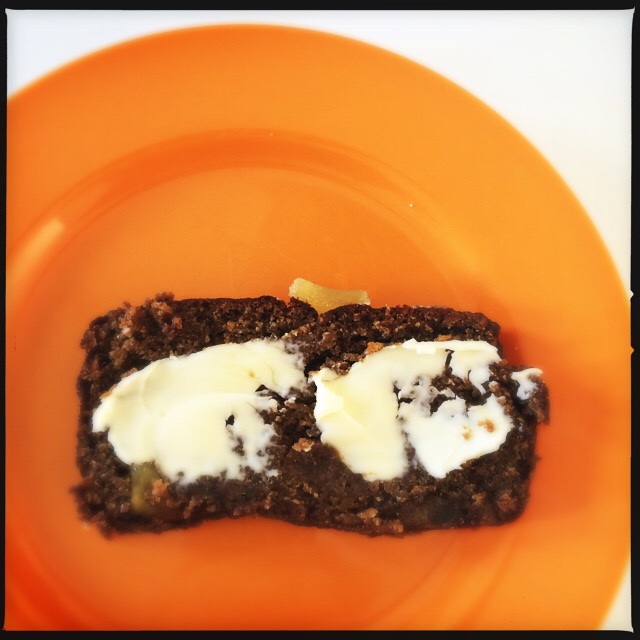
Take out and cool completely. Like all gingerbread, it tastes better after a few days of being wrapped in baking parchment/foil and is delicious sliced and spread with butter and served, in front of a fire, with a cup of tea.  It is full of lovely autumn flavours.

IMG_9616


Raw chocolate and orange tart (gluten free, dairy free)

For a while I’ve been meaning to make a raw chocolate tart. I keep seeing recipes for them and I love a birruva treat every day after my lunch. But. I don’t always want that sugar high/low I get after eating pastry (much as I adore pastry). Anyway. I saw this in Delicious magazine and I’ve adapted it every so slightly. Next time, I think I’d make some changes to the base, too – I would use toasted (sssh, I know that won’t make it raw but it will make it delish) nuts instead of the dessicated coconut.

If you don’t like coconut you won’t like this, but otherwise, this is a really intense chocolate treat. It still feels ‘spoily’ and not too worthy. It lasts a good long while so you can have a slither every day and it tastes even better after a few days. I warn you, the chocolate hit is powerful.

For the base:

110g coconut oil

140g ground almonds

175g dessicated coconut

2 tablespoons of honey

1 tablespoon of raw cocoa (I buy it in 1K bags and it works out at quite good value compared to the Green and Blacks one I used to buy)

For the filling:

75g dates

Zest and juice of one orange

50g coconut oil

175g honey (I used mostly honey and some maple as I ran out)

140g raw cocoa powder

Method

Soak the dates in some boiling water for about half an hour then drain them, and discard the water.

Put the ingredients for the base (not the dates, they aren’t part of it yet) in a food processor until it starts to clump together, then tip into a 23cm loose based tart tin. Don’t wash the food processor up yet!

You don’t need to grease the tin or anything (although be warned, the first slice is hard to cut). Flatten it down and up the sides with your fingers, cover with cling film and put in the fridge.

So much easier than pastry isn’t it?

Now put the drained dates, plus all the other ingredients for the filling, into the food processor and whizz up. I found it made quite a sticky mess that was hard to liberate, fully, from the bowl and blade but do your best. Spoon the filling into the case and put it in the fridge. But, once it’s been in the fridge, I find it tastes nice for being out of the fridge for ten minutes.

You only need a tiny slice.


Cauliflower-crust pizza (gluten free)

I am not a fan of food, which, under the umbrella of ‘being healthy’, pretends to be something else and in so doing, delivers only disappointment. Courgette strips instead of pasta, yoghurt when you really need cream, vegetables in cake (which I admit can sometimes work)..cauliflower instead of pizza…

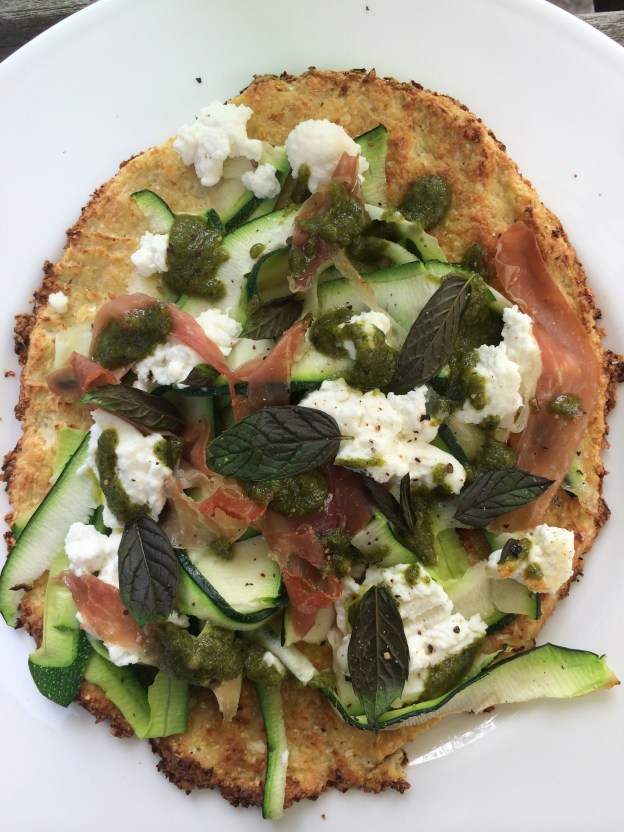
This isn’t anything like a pizza. I warn you now. But if, as I do, you like to have a lunch with a ‘base’ and lots of veg then this is a really good, gluten-free, wheat-free and tasty (yes really) offering. To me, it didn’t taste like cauliflower at all, more like a lovely parmesan crust. My partner was a veggie for 20 years; he views such things with deep suspicion, having been offered beans, made into the shape of a lacklustre burger for many years. But he was impressed and delighted.

I got the recipe from Delicious Magazine (no link because it doesn’t appear to be online), and I’ve halved the ingredients to make it ideal for two, for lunch. I followed the recipe topping but obviously you can add whatever you want. We happened to have some pesto made by my eldest (she makes it better than I do, taking it off me and saying “here Mummy, let me show you”. I love how she is confident like this). You could, feasibly, leave the pesto out and add a drizzle of olive oil or chilli oil, or just, you know, BUY SOME.

225g cauliflower florets
1 medium egg
75g ground almonds
25g grated parmesan
salt and pepper
1 courgette
2 slices of Parma ham
120g ricotta
Pesto and mint to serve

Heat the oven to 200C and put in a large baking sheet. Now, put the florets in a food processor and blitz so it looks like cous cous. Put in a bowl and add the egg (which you have lightly beaten), ground almonds, parmesan and a bit of salt and pepper (not too much salt as the parmesan is also salty). Stir together.

On a piece of baking parchment, spoon out two portions. I sort of shaped it by hand, into two round shapes. It was easy, no rolling and although the mixture is wet and you think it won’t work, it does.

When you’ve done this, take out the baking sheet (which will be hot!) and gently slide the baking parchment onto the baking sheet. Cook for about 20 minutes or until golden and firm to the touch. Check after 15 minutes.

Whilst that’s cooking, slice the courgette into ribbons.

When the bases are cooked, take out and keeping them on the baking sheet, scatter over the ricotta, courgette and ham. Cook for another five minutes and then, spoon a bit of pesto and scatter some mint leaves atop.

2016 update: I just love this dish. What I tend to do is spread a thin layer of chilli jam/caramelised onion/chorizo jam over the base, then layer on the courgette and ricotta but also add (ssssh) some slices of chorizo, which I love. This really is tasty! When it’s cooked I drizzle on some olive oil (extra virgin).


My meatloaf

My mother’s meatloaf is the stuff of legend. In the past, whenever we had meatloaf at my house my children would look up, all eyelashes and downy cheeks and say “is this Nonna’s meatloaf?” and I would have to say that no, no it wasn’t, it was mummy’s. And they would look down and  eat it, making approving, encouraging noises but they would know, and I would know, that it wasn’t comparable. Every meatloaf I’ve tried, until this one, was just not right.

The thing about my mother’s meatloaf is that she minces her own meat, so it’s silky smooth and sublime. I like my meatloaf like I like my sausages: not coarse. I want it to be an easy transaction. And all the meatloaves I’d made before were too coarse, too dry, trying too hard.

Last year I bought Donna Hay’s Simple dinners, from whence this recipe comes.  It’s a great book. Her recipes are genuinely tasty, pretty healthy, made from a clever combination of not too many ingredients and easy to follow. She is, to my mind, just about the best cookery writer of the day (for meals ‘n’ stuff. Dan Lepard is still my man for bread). I’ve adapted it here because I’ve been making this meatloaf for over a year now and I’ve made it my own: I’ve adapted it slightly to suit our needs.

As such, this is now my meatloaf recipe, in that it’s the one I use as my go-to meatloaf recipe. I can’t imagine it will ever be made better by anyone else’s meatloaf recipe. Except, naturally, my mum’s.

(What I also love about it is, if you make this for a Sunday lunch, and it’s very good at Sunday lunch, you can make it in advance or the day before, keep it in the fridge and put it straight in the oven. Just give it 5-10 mins more in the oven at the lower temperature i.e. the first round of cooking.)

This is great served with the usual stuff, but I particularly like it with mash for a real comfort, fork-only meal.

You need:

a packet of thinly sliced pancetta, about 20 slices

110g breadcrumbs

60ml milk

400g rose-veal mince (all veal sold in Europe is non-crated, but I only buy higher welfare British veal, if you are not sure, substitute beef mince)

500g free range pork mince (I never, ever buy any other sort of pork)

1 tablespoon of Dijon mustard

1 large egg

a tablespoon of thyme leaves, stripped from the stem

salt and black pepper

2 tablespoons of maple syrup

What you do:

Oven on to 160C if you intend to cook it straight away. Get a loaf tin which is about 22cm by 8cm and line the bottom with the pancetta (line across the width, not length if you follow). If you imagine that the meatloaf will be turned upside down on serving, this will be the top of it. Don’t sweat it if you don’t have enough pancetta to cover the whole bottom/sides, and ditto if you have a bit too much, I also line the side/sides not just the bottom. If you have very long slices then don’t worry, you can just overlap them when the tin is full of the mince. It doesn’t have to be perfect.

Because I rarely have properly stale bread, and even if I did I hate grating bread (my mum always, always has properly stale bread which she grates), I put some day or so old bread into a food processor and whizz it up. Take it out then pour the milk over it and give it a little stir.

Now, what I do to make it all super smooth is this. I put the milky breadcrumbss back into the food processor with all the mince, the mustard,the thyme leaves and the egg. Add a bit of salt and black pepper. And then I whizz it all in the food processor. It comes out looking like awful meat slurry.

Don’t worry. You know it’s not.

Now, pack this into the loaf tin. It will seem like too much but keep the faith, pack it in, press it down, tuck over any overhanging pancetta slices if you have them. Then, either put in the oven or cover with cling film and put in the fridge for a day or so (obviously not over what the sell-by date of the meat is).

When you are ready to cook it put it in the preheated 160C oven and bake for 30-35 minutes until the meat is just cooked through. (If you’ve had it in the fridge then increase this time to 35-40 minutes maybe a tad longer, use your common sense.)

Now, take it out and onto a baking tray, invert the meatloaf. Obviously the tin will be hot so take care with oven gloves, etc. Onto the inverted meatloaf brush with the maple syrup. Turn oven up to 180C and now bake for 15-20 minutes.

Serve. It’s delicious.